
Hi.
I am a homegrown mechanic Smile
Quick question. I think I have found the answer but would be great if someone professional could confirm it.
I've got a titanium hardtail frame that originally came with SRAM SX Eagle DUB / 170mm / 32 Tooth / BOOST Crankset.
I would like to install instead my old SRAM 2x XX crank, like this (would like to run it in 1x configuration):
https://www.wiggle.co.uk/sram-xx-10-speed-2x10-gxp-chainset
How do I go around converting my old 2x XX crank to 1x that would run with boost frame?
The frame got BSA 73mm BB shell and XX crank is GXP.
Can it be done at all? I have found this webpage with some info about it:
https://int.oneupcomponents.com/pages/understanding-chainline-for-optimal-1x-conversions-boost-and-non-boost
According to it, my old XX crank should perfectly fit the boost frame as a 1x setup. All I have to do is remove the small ring and leave the bigger one as it is. No spacers needed, as the chain line should be just right for 1x boost setup.
Is this correct? If so, do I need a different chainring, or can I still use the original XX one with an 11 and 12-speed setup?
Appreciate any help guys.
So, the thing to understand is that, unlike Shimano and some other brands, SRAM cranks are not different between Boost and non-Boost. However, the chainrings are offset differently, so a Boost chainring will sit 6mm further out from the BB.
What this means is that you can change a Boost to non-Boost (or vice versa) 1x setup by simply changing to a chainring that's appropriate for your frame.
Whether you actually need to or not will depend on your frame / desired chainring size. My personal opinion is that if you can get away with running a non-Boost chainring on your Boost frame (i.e. no clearance issues) then that's the way to go. This gives you a better chainline in the larger sprockets.
I don't actually know how this all relates to 2x setups and spiders, but certainly you can just use a new 1x Boost chainring on your existing cranks.
EDIT: I missed the bit where you were saying you were using an older 2x10 speed XX crank. That doesn't have a detachable spider. So it may or not work - it'll depend if the tabs on the crank and the chainring itself clear the frame. I'd bet they would but you may have to just try it.
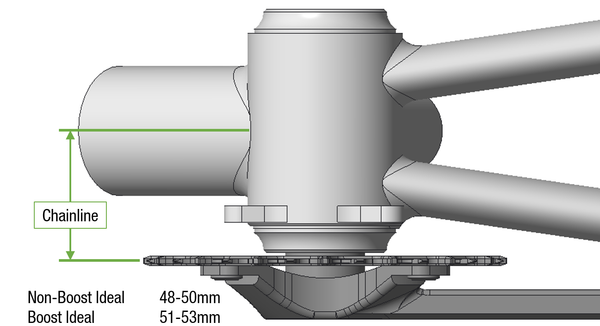
According to it, my old XX crank should perfectly fit the boost frame as a 1x setup. All I have to do is remove the small ring and leave the bigger one as it is. No spacers needed, as the chain line should be just right for 1x boost setup.
Yes, within a mm or two.
Is this correct? If so, do I need a different chainring, or can I still use the original XX one with an 11 and 12-speed setup?
Maybe.
11/12s is obviously narrower than 10s.
Also the big advantage of 1x is the chain doesn't fall off the chainring. At a minimum that means a single speed chainring, or better a narrow/wide one.
Thanks for all the replies guys. Narrow/Wide chainring then. Now, do I need any spacers, or can I just fit it in place of the original bigger ring?
Thanks for all the replies guys. Narrow/Wide chainring then. Now, do I need any spacers, or can I just fit it in place of the original bigger ring?
Should just be in place of the big chainring.
Check the cranks actually fit the frame first, just in case the crank itself fouls the chainstays or the small chainring mounts foul chain guide mounts or anything like that. As Superficial said SRAM cranks are now a fairly universal fit, but obviously that might not have been the case when yours were made.

This (replacing bigger ring with 1x ring) should take 49.5mm original chain line to 52.5mm, which is in boost range.
Thanks for that. Very useful info. I guess it will be best to just try to fit it in and see how it looks then.
Yes you are correct, just fit your choice of chainring in the outer position of an old double and hey presto, boost setup.
You are the best guys!
Pedant alert
The boost chainring sits 3mm further from the BB, not 6mm. The total extra width over non-boost is 6mm, 3mm on each side.
11/12s is obviously narrower than 10s.
It isn't, well the chain is, but the teeth aren't.