UPDATE: Reviews section refreshed, redesigned, searchable: Go take a look
a large number of potential owners are put off by the public charging approaches being poor
At the risk of being an echo chamber - how are these large numbers of potential owners put off? It's not by actual personal experience as they're not owners. It's by the disproportionately large voice (press and ICE enthusiasts of a certain age) that the anti or non-owning brigade have.
I think the lack of sales is more to do with early adopters have all bought, remaining people don't understand how it can work and are put off by all the above noise rather than the reality most owners experience most of the time.
I'm not a fanbois for the sake of it and quite happy to concede that EVs are not a convenient panacea for all (see TJs situation above). But for me and almost every one of my friends who have them, they seem to work really well and should be a large part of the transport mix for this and all countries. Nice to drive, quite non polluting. Don't require the v energy hungry and polluting (at extraction and use) fossil fuels.
Make the range of public chargers (7-150/200 kw) work in the right locations and numbers via simple contactless or one unified app. Simples....or maybe this thread shows it's not!
How are you going to solve that for folk like me?
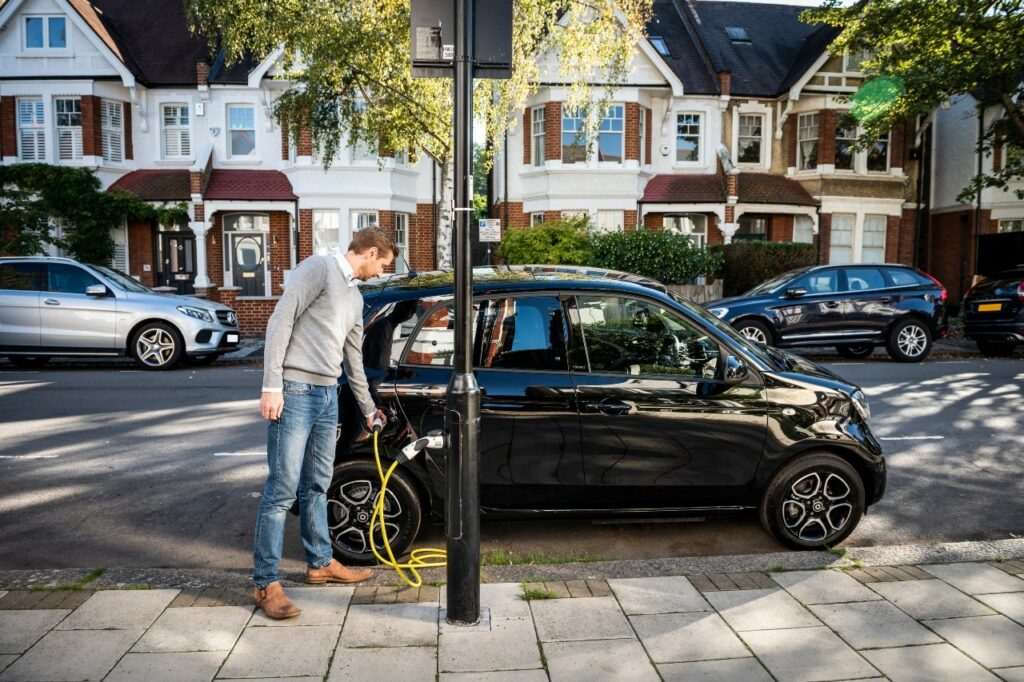
Every on-street parking spot has to have a charge point that pops up out of the ground - or you can plug into a lamppost. There's a lot of development around this, but not a lot of funding for it.
Rubbish.
Do you ever go shopping? Do it then.
Buy a coffee? Sit in and charge it.
Fast food? Pick one with a charger.
I'm pro EV, as you know, but I don't think any of those would work. None of those activities take long enough to provide a meaningful amount of charge unless you are rapid charging, and it's not really practical to install that many rapids. What we need is on-street slow chargers as above. Of course, ideally we'd have better public transport and far fewer cars - just to pre-empt TJ - but that's not what the thread is about.
In fact, TJ you should be in favour of outright banning of ICEs because it would force people who live in city centres to take public transport - isn't that what you want? 🙂
Do you ever go shopping? Do it then.
you'd need a very large bank rapid chargers (so they can do a weeks worth of charging in 30 mins) in urban supermarkets. It could be done, but its a long way from the "4 slow chargers at my local tesco hypermarket" we have today
I assumme you have thought about the funding for this molgrips?tens of millions of chargers
For me ev or ice makes very little difference in cities. Both create pollution and congestion and make life unpleasant for the majority
Point missed
If you have no dedicated parking then you have to find a random spot. If its an EV then you have to find a random unoccupied EV charging point. The number of EV charging points needed would be huge. Far better for locations like mine is the car club model
No. Point not missed at all. In fact I think you've missed my point in pursuit of your "have less car ownership" model. Which is an interesting debate, but not the one that we're having. It belongs in a "less car ownership" thread rather than this one.
Re your "have to find a random spot" point - the point is that - yes - random spots would have chargers too. They would need to be installed just about EVERYEWHERE.
The whole point of "install lots of chargers" is that - yes - there are a very large number of chargers installed. They therefore need to be small, simple, cheap and realistically mass produced. The argument of "but you'll need to install so much infrastructure" was probably made when electricity or mains water systems were first introduced.
Ok - a charger at every kerbside potential parking spot plus all public car parks? tens of millions of them. How is that to be funded? Would need massive amounts of new cabling etc etc
How would you deal with those who installed their own home chargers complaining about how unfair it is they have to pay
Its not insurmountable technically but its ruddy difficult practically and politically
Its not insurmountable technically but its ruddy difficult practically and politically
Yes - that is exactly my point.
How would you deal with those who installed their own home chargers complaining about how unfair it is they have to pay
I'd imagine the easy way is that the flood of public chargers are charged out at a rate which includes some overhead to cover the cost of install in the long run.
normal car drivers are all subsidising EV owners today via the various tax breaks EVs get (company car tax, low\no VED, no fuel tax, no congestion charging, cheaper parking, etc), so I don't think thats any different
Fair enough. I find the dismissal of the huge practical issues irritating. Far too much pie in the sky. I think EVs of the type we have now are going to be a dead end and a short lived one.
I think the car club model is a far better solution
I think I'll sign up for a Tesla subscription for a month. I reckon I'll be able to recoup my £9 subscription fee if I use 100kw from their chargers. I'll to use nearer 200kw anyway.
I think EVs of the type we have now are going to be a dead end and a short lived one.
Really? You're expecting some sort of amazing new technology is going to be easier than putting plugs on lampposts?
Would need massive amounts of new cabling etc etc
Most streets already have electric cables in them that supply the houses and the lamp posts.
I find the dismissal of the solutions to the practical issues irritating.
There is a pretty common theme amongst the anti-EV community. A strong dismissal of the solutions to the problems, combined with a ready acceptance of alternative technologies (Hydrogen or continued use of fossil fuels being the most common ones) which actually have much more fundamental and harder to solve problems.
It's not either/or tj. I agree that for city dwellers without off street parking, owning a vehicle of any description is an expensive hassle. I would like to buy my daughter a car if it was remotely practical, but it isn't. But for us, it works.
Really? You’re expecting some sort of amazing new technology is going to be easier than putting plugs on lampposts?
No - I am expecting private cars to become less and less common. ( hoping? 🙂 )
Most streets already have electric cables in them that supply the houses and the lamp posts.
Which will need upgrading significantly for the extra current required.
I find the dismissal of the solutions to the practical issues irritating.
When the solutions are pie in the sky? 🙂
Two of my colleagues have taken delivery of EV's and do not charge at home. Neither can be bothered to get a point fitted. Both do 20,000+miles and manage with a little bit of change of their routine. Not a revolution, just a tweak. It's not that hard.
I think the car club model is a far better solution
That would be a bigger change for a lot of people, but you would embrace that? Shows you can bend when you want to.
I agree that for city dwellers without off street parking, owning a vehicle of any description is an expensive hassle.
EVs more so
Its one of my issues with this - suburbanites forgetting the difficulties in cities
In cities IMO the car club model is a better one than individual ownership
I am not anti EV in toto. However I do understand they do not solve the problems with private motoring in cities
I have been a car club member but it does not work for me. I do not own a car and never have. I hire one when needed I have friends who are car club members and it works for them ( I tend to use a car for long out of town trips - not for round town)
Edit - my local car club now has EVs thats a fine idea
suburbanites forgetting the difficulties in cities
Cities have rapid chargers, out of town retail places have rapid chargers, it's not that hard.
I do not own a car and never have.
Maybe formulating car infrastructure to suit you is a wasted endevour?
The lampost thing above is the easy way. My car has plug and charge - plug it in and walk away and it works automagically and the cost goes on my card. It's not the most difficult thing to sort out.
Opening peoples minds is harder. Much harder.
Which will need upgrading significantly for the extra current required.
You might be surprised.
There are problems, with solutions that need to be found; but don't forget that ICEs spewing fumes everywhere is one of those problems, not a solution.
How practical do you think that would be? EVs can work if you can charge at home. When you cannot then its impractical
What a massively sweeping statement that unsurprisingly is wrong.
I've driven over 30k miles in the last 18 months and cannot charge at home. There's no denying I've had to change my habits, but they're just different, not worse.
TJ - why do you find it so hard to visualise change on a large scale? This is all far from pie in the sky - it's technologically straightforward and politically is actually happening.
According to zap-map there are 68,273 electric vehicle charging points across the UK, across 35,230 charging locations. This represents a year-on-year increase of 41% in the number of public devices, with 19,823 installed since August 2023. There are several providers not covered by zap-map too such as connected kerb etc so the actual number will be higher.
Re future quantity rise needed to enable on-street parking - just look at the recent / ongoing changes to street lighting for evidence we can make high volume change - there are circa 6-7 million lamp posts in the UK, and 55% are already converted from older tech to LED. That's a similar order of magnitude to the number of chargers needed, and a similar level / cost of change to add a simple AC charge outlet to swapping the whole light head over. Very rough figures from some quick googling but from an order of magnitude perspective that's good enough.
Re peak power capacity - Lamp Posts I believe are usually powered via the DNO cable - i.e. the 3 phase cable in the street that is capable of supplying power to every house in that particular street / zone etc. So no issues with peak power capacity if the wiring from lamp post to DNO is upgraded. A commercial supplier ( https://ubitricity.com/en/charging-solutions/ac-lamppost/) is quoting 5.5kW max - I assume that's using the existing cabling so maybe not even any need to do that.
Re overall power capacity - bear in mind the earlier calc that for 12K miles a year you would need to charge for <1.5 hrs a day at 7kW, so actually the street furniture chargers don't need to be 7kW - half that would easily do. And most cars would not need to plug in every day - once a week overnight would be plenty for the majority it people.
Re power GRID capacity - the UK grid has plentiful capacity at off-peak times - either at night when baseload generation outstrips demand or during the day when solar etc is generating. EV charging is typically targeted for those times, so there would be little additional peak demand on the grid.
Not much pie in the sky going on here.
TJ – why do you find it so hard to visualise change on a large scale?
I think he just likes to point out problems - which isn't a bad thing in itself. On one thread it's 'cars are bad', on another it's 'EVs are rubbish because people in cities can't use them'. Surely if people can't use cars then that's a good thing by your own logic? Or he's assuming that anyone in favour of a particular thing is touting it as the solution to everything. He's very black and white that chap 🙂
Re the charging solutions, what @whatgoesup says is promising, but this really does need some government action to push it all through or at least unblock it.
this really does need some government action to push it all through
Yes - it really does. Left to the private sector this will just “rip off” those who can’t install their own chargers - see connected kerb right now. 50p/kw.hr for a 7kW charger really isn’t an economical way to charge. These kerbside chargers need to be much closer to the prices you can get on domestic tarrifs to not be pretty unfair to those without their own chargers
Also, I think a massive untapped source of chargers is those people who DO have a drive and a charger...
I think with a bit of planning and a financial incentive, using private chargers could work.
I see no reason why someone couldn't use my charger 3 nights a week, or in the day, if the system was set up so
a - i receive payment
and
b - people don't leave their car on my drive for a week..
A good feedback system would help with that i.e if you're a "bad user of my charger" I can ban you from the whole network etc etc..
DrP
@drp - that already exists. There are a few services allowing this that you can sign up to as a provider or user.
that'll learn me for thinking of a new idea eh!!!
DrP
At the risk of being an echo chamber – how are these large numbers of potential owners put off?
I've been meaning to respond to this for a while. Strap in, it could be a long one 🙂 I've been doing a bit of EV research recently. Basically questioning everything, as is my wont and I've come to a few conclusions.
First, it is quite hard for any normal person to get an accurate picture of EVs. Basically everyone seems to have an agenda and the algorithms on places like YouTube favour those who shout the loudest. There are some thoughtful discussions of the issues, but they tend to get buried in all the noise.
I think ICE cars may end up being a bit like smoking. Bear with me here. When I was growing up in the 80s, in a family of five, by the time we all reached 16 it was only me and the dog that didn't smoke and I wasn't too sure about the dog. To be honest, the only reason I didn't smoke was because I'd been asthmatic as a kid and my lungs objected every time I tried to look cool. Basically almost everyone smoked, just like almost everyone drives an ICE car. There is/was a well funded oil/tobacco lobby trying to keep things that way. there are/were a few environmental or heath nuts bucking the trend, but they are/were a small minority and easy to ignore. But they are/were growing and government agencies have good reason to encourage that growth. At some point a tipping point is reached. I expect that in the end the minority of ICE drivers will also be portrayed as selfish people polluting the air of others. I'm just not sure when that will be.
But back to now and what is putting off potential buyers. It's important to recognise that there are various different types of car buyer and not all are put off.
Those getting company cars or buying through a salary sacrifice are being given some big tax incentives to buy an EV, which is basically what is keeping the prices of new EVs up and funding the transition.
Those who lease cars for a couple of years may be happy enough to give one a go as they know they will hand it back soon.
The tougher nut to crack is those who tend to buy cars outright (new or second hand) and keep them until they need replacing. Some of those will be convinced by the environmental arguments and will be happy to buy and just accept the costs, but most want to know what the true "costs" (in the broadest sense) will be and that's where it can be hard to get an accurate picture with all the noise.
Some common concerns that stop these people going electric are:
Long journeys will be a pain: This is becoming less of an issue all the time as range creeps up and more chargers are installed. But it's still the case that a long journey will probably take longer overall in an EV and may involve more hassle at busy times. There is also the fear that a car bought now will look pretty outdated in a few years when a 500 mile range may be normal. Personally I'm not sure that will be the case and I expect that we're more likely to see cheaper 300 mile range cars than 500 mile ones, but it's a common fear that puts people off buying an EV.
The car will be scrap in five years: Almost certainly rubbish, but a common claim. A car with, say, a 60 kwh battery is still going to have a battery around 50 kwh in probably ten let alone five years. Battery prices will come down but that's still going to have value. Electric motors also last ages. So, I expect that a ten year old EV will actually be worth more than a ten year old ICE car in 2034.
They are more expensive: True for brand new cars but we've almost reached price parity (like for like) on 1-2 year old cars of the same type.
Very expensive to insure. That can be an issue if you are not careful. A Model 3 long range (for example) is insurance group 50. With insurance prices increasing the way they are, you could easily see the extra insurance costs wiping out any savings you make in fuel costs if you don't do big miles. But a Model 3 LR is a two-ton car that does 0-62 in 4.4s. Of course it is going to be expensive to insure. The problem is that it's easy to give an EV more power and power sells, particularly to the type of people who are buying new EVs (company car drivers). Even a middle of the road EV has hot-hatch acceleration these days and that is going to make insurance more expensive.
Random thought, given the torque/acceleration on EV's... why can they not simply electronically limit it, so instead of having a car that does 0-60 in 4 seconds, set it to ten seconds or whatever?
Surely that has to be better for the battery charge and battery lifespan, better for tyre wear, better for insurance, etc, etc, ?
Because it shows they are 'better' than ICE.
Teslas are a crap example of EV. They are difficult to repair because Tesla won't release parts to non-franchise repairers. Used for catapult launches by show offs. And driven fast when the handling is awful, which can get you into trouble if not ready for it.
The market is being exposed to lots of ex company EV's and prices are being driven down as supply exceeds demand. It'll level off at some point.
The tougher nut to crack is those who tend to buy cars outright (new or second hand) and keep them until they need replacing.
That's me. 3 years ago I bought a VW eUp!, as our 'local' car. My wife and I tend to go to places independently so we have two cars, the other is ICE (Focus), for longer trips or to carry loads. My calculation at the time was that the car cost £6-7k more than the ICE version and the reduction in running cost would mean break even in about 6 years. Electricity prices have risen since then so it will take longer, but probably half our charging is from PV which would otherwise go back to the grid and not earn much, so I still think it will be worthwhile. So far, I've seen no drop in battery capacity. If it does need expensive work later in it's life, it's probably a smaller risk than the Focus (on its 3rd clutch and with the Ecoboost wet belt and cooling issues).
The tougher nut to crack is those who tend to buy cars outright (new or second hand) and keep them until they need replacing.
Why? EVs are likely to last much longer and with far less maintenance than ICEs. The cars that are available now have such good battery management that they will last a really long time. The limiting factor will be interior parts like the seats, infotainment and the tech that is fitted. The electronics under the bonnet will have a far easier time as it's heat and vibration that kill electronics; which aren't present anywhere near as much in an EV. You may get a duff cell or two but they are replaceable, you don't need an entire pack.
They are more expensive: True for brand new cars
I think that even now that's artificial. They are charging more because the demand is there fuelled by company car tax breaks. The next lot of cheap EVs released in the next couple of years will be cheaper than equivalent ICEs, and it really won't be long before they are cheaper across the board.
A car with, say, a 60 kwh battery is still going to have a battery around 50 kwh in probably ten
Not even that. The car with a 60kWh battery pack will only let you use 55kWh from new. In ten years it might be at 54kWh, so basically the same as new. And after the first few years the degradation stabilises anyway. I've got nearly 80k on mine, the range is the same as new. I might've lost a few miles since the tyres I have might be better than the OEM ones, I don't know.
But it’s still the case that a long journey will probably take longer overall in an EV
I disagree. The shortest possible journey time will be in an ICE i.e. if you don't stop at all; but most people (which covers the 'probably' clause) stop to eat, piss, by coffee etc. As I've said, in my short range slow car on the way to Scotland I only spent about half an hour actually waiting for it to charge. All the other stops I was looking after myself and I would probably have made them anyway. If I were in a modern car, I would certainly have spent more time stationary than was needed for charging.
Very expensive to insure
I'll give you that; but it's going to have to change due to market forces. Repairers will have to get better rather than just avoid EVs like many do now.
Random thought, given the torque/acceleration on EV’s… why can they not simply electronically limit it
There isn't really any need. The battery engineers, being skilled and experienced know what their batteries can do. As for tyre wear - drive like a ****er, wear your tyres out - this has always been the case.
300bhp is about 220kW. That means it's very roughly 3C discharge rate i.e. triple the 1hr rating of a 70-80kWh battery, or enough to drain it in 20 minutes. That's nothing for a lithium ion battery, especially one that's carefully managed. And by definition you're only using that power for a very short time unless you're on a track.
Someone from Volvo was asked why they made the EX-30 so fast (3s 0-60) and they said that they already had these motors being supplied for their fancy cars and they just stuck two in the small one rather than design something new - and that's how fast it goes. So rather than artificially limit it for no reason, they left it like that. I wouldn't use it often but it might be handy overtaking.
The market is being exposed to lots of ex company EV’s and prices are being driven down as supply exceeds demand. It’ll level off at some point.
The price of used Ioniqs is plummeting - they're cheaper than the exact same cars in petrol/diesel hybrid now. But whilst on paper their stats aren't good they are still fantastic cars. However I've been keeping an eye on Ioniq 5 prices and they dropped but have now stabilised for the last 6-9 months or so.
My Ioniq is charging at 31kw/h at a Tesla fast charger! Luckily we aren't in a rush.
Took a while for the app to start up as well. I think that had more to do with my network producer than Tesla though.
Charging has sped up to 47kw/h. All is forgiven.
Cheap with the subscription. So that's a bonus.
I just topped up in Aberystwyth on Tesla at 205kw! I think that's all the car can take.
Smelt a bit, well, BBQ - but much miles in 20 mins
@retrorick what percentage did you start at?
Rapid charging up to I think 60% is up to about 48kW, depending on the battery temperature - and it doesn't heat it up whilst chariging as far as I know. So you're limited to the heat you get from your driving and the charging process itself. I've seen as you describe in cooler weather, but when on a motorway trip in warmer weather I generally get 45+ within 30s or so of plugging in.
4 stops in total to get to Inverness. 375miles, 84kw from Tesla chargers. Had a reasonable battery level at the start of charging sessions. Car performed well. Camping on a site with astroturf pitches. 
Nice!
Quick question about home charger installation ... our fuse box is in the middle of the house so we'll have to have Ohme's non-standard installation which is fine, but what are the internal cables like? it'll need to go a short distance around some of the dining room before making its way down the inside of the garage before popping out the wall into the back of the charger.
Are we talking cabling the size of your finger like we put in out to the shed or the stuff that the cooker's wired up to? they also mention trunking which I presume is going to be the box stuff?
Someone should have paid for a service diversion when that extension was built.
What's the construction method of the floor in there? But yes, if you want to pass a lot of current it will be a bigger cable.
7kW charger will pull around 32A. That will be a 6mm² conductor which makes for a cable about 12mm (½") in diameter
The extension was already done when we got here, judging by everything else we've done after the last 8 years it was done on the cheap (the floor's 10mm higher than the kitchen FFS!), I'd have done it differently if it were me, but unfortunately it wasn't - floor itself is a poured concrete slab with wooden flooring over the top.
There's an old style fuse box in the garage but it's not on it's own spur so no self-respecting sparky's going to touch that to wire in an EV point, hence it'll be going back to the new consumer unit (well about 6 years old). In an ideal world you'd go under the floor but it's only 2m around a corner of the dining room that no-one will notice and that'll be a far cheaper option. Could I whip the skirting off and get them to run it behind that?
If they're talking trunking is that just beautification for inside the house? or are they going to want to run it all the way through the garage etc too?
At least the house is already on a 100amp fuse.
You normally connect the EV charger to the incoming power at the meter box, not through the consumer unit. Mine has its own mini weatherproof consumer unit sitting next to the meter box because the installer couldn't fit all the gubbins in the box, ymmv, the cable to the EV charger goes outside the house.
I have been charging slowly but successfully along the nc500 using CPS chargers and podpoint at Tesco.
Used the CPS RFID card to initiate all the charges. Successful on the 2nd attempt if not the first. I think the fast DC chargers prefer the car to be switched off and locked to start the charging?
@Rio unfortunately the meter's next to our consumer unit, in the under-stairs cupboard which is accessed via the kitchen. It used to be on the outside wall until the extension went up sometime in the 90's but the cable route is the same whether it goes straight into the meter or via the consumer unit.
I've an idea on the route they'll take but we'll see what happens when the installation quote comes through (just waiting on the link to kick all that off).
>You normally connect the EV charger to the incoming power at the meter box, not through the consumer unit.
Totally wrong I'm afraid , that's just lazy installers not wanting to go into the main consumer unit, or finding it full.
In fact it breaks DNO and government rules to fit none supply equipment in the meter box, the official line is:
"If a DNO or MOP attends the premises to carry out work on their equipment and insufficient space is available within the meter enclosure, work will not be able to proceed. The customer will need to organise (at their expense) the removal of unrelated equipment to create the space needed for the work to be carried out.
NICEIC strongly recommends that electrical contractors do not install any other equipment within meter enclosures."

