
MegaSack DRAW - This year's winner is user - rgwb
We will be in touch
Yes this is a bike forum - but I know some here will have dabbled..
Runners and non-running gear stalkers - good or bad for you?
I'm interested only in your personal experience (please!)
The concept of it - great! I have embraced fore and midfoot striking, and any heel striking feels horrible now. Slowly eased into it - like just doing 10 mins every 2-3 days to begin with. I've not overly embraced super minimal shoes, but rather I use light weight race shoes for training, which have a little more cushioning than barefoot shoes, but still have minimal drop from heel to toe.
I highly recommend reading 'natural running'.
Like other leisure pursuits ease into it being very gentle at first then gradually build up length and intensity.
Regular runner, developed ankle tendon injury that had built up due inefficient running style (heel striking) that had me unable to run for months.
Eventually referred to a specialist physio who gave me the option of expensive custom insoles or starting from scratch on principles of barefoot running. Chose the barefoot running option, spent a few months with the physio on specific muscle strengthening exercises (e.g. squats for my gluts which were pathetically weak apparently) 🙂
Eventually got to start running using the forefoot/midfoot plant (yet still letting the heel touch down) at a quicker cadence, distance only half a km to begin with.
Built up slowly, and am enjoying regular 6-10 mile runs (mixture of offroad and onroad) in my Merrell Trail Gloves.
It's not for everyone, but for me personally it sorted me out and it's a great feeling running in minimal footwear. I had the benefit of a superb physio (Bristol based Keith Graham) overseeing everything, but the main thing is if you're gonna switch, build it up gently.
ooo, Jolsa - I'm tempted by trail gloves. tried a pair on the other day, felt rather nice. Are you happy with them? Do you feel much through the sole when running off road? Some of my runs will be in the peak district on rocky ground, and I'm a bit concerned I'm going to feel every rock/stone edge, like on my silly light inov8 fell shoes.
cp - Very happy with the Trail Gloves. Sole felt a bit hard to begin with onroad (I was running in [url= http://www.amazon.co.uk/Gwangung-Black-Feiyue-shoes/dp/B001GO96V8 ]these[/url] before I bought the Trail Gloves) but with a few miles done they feel great.
Offroad they're superb. There's a particular offroad stony/rocky descent that was always a bit problematic with the Feiyues (visualise running on hot coals) but with the Trail Gloves the protection is excellent.
There' a lot of good articles about barefoot pros, cons and implications on [url= http://www.sportsscientists.com/search?q=barefoot+running ]Science of Sport[/url]
[img] 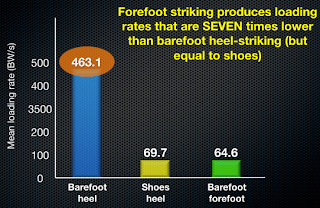 [/img]
good or bad for you?
my doctor told me i'd never be able to run again without having my sesamoid bones removed.
the least bad local running shop told me my toes were too high, and i needed to spend many hundreds on custom fitted orthotics.
i wear these now, with no problems at all.
[img] 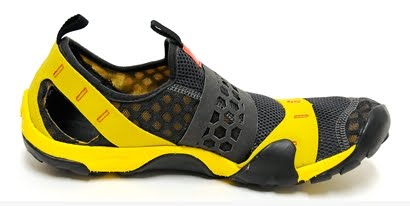 [/img]
(half marathons on tarmac, 10k fell races, the lot)
yes, i'm aware of the irony in wearing shoes for 'barefoot' running, but they do little more than stop the pointy stones from hurting too much, and provide a bit of grip in the mud.
If you think its going to work for you, and you have the patience to go slowly and build up some new muscles, and you think that you're doing serious damage to yourself by not running like this, then it's worth thinking about.
If you do it becuase you've read an article in runners world, or a book, then your going to hurt yourself.
I tend to use flat shoes (innov8 f195 in my case) if I'm doing sprints and short runs and even then if I push it I can feel my tendons the next day, and I've been doing it now for at least 6 months
Now that I'm doing longer runs (want to do ultras and marathons next year), i've gone back to mostly cushioned shoes.
I'm 45kg 160cm, run on my toes naturally (when I'm concentrating LOL)
Is it the case, that even with this style of running, the heel should still contact the ground with every pace, just at the end of the landing rather than the beginning?
I do about 1/3 of my running on the forefoot, but cant seem to find a technique that allows time for the heel to fall all the way to the ground. Just wondering if its OK to just run on the balls of my feet with no heel contact.
I started to develop problem after problem when running. First it was 'runners knee' then a hip niggle/problem and finally a calf problem that I just could not shake, despite three different pairs of shoes.
I took the plunge and went barefoot/minimal from that day onwards.I used Barefoot Ken-Bob's book to change my running style. Now I run 2 out of 3 runs a week completely barefoot and the other in five fingers. I took it steadily and I have had no 'top of foot pain' or achilles and only 'growing' pains in my calves, which now, three months on, are barely noticeable.
Personally I think it is the style change, that barefoot forces on you, which is the greatest difference. To me it's all about being 'lighter', shorter strides, quicker cadence, absorbing the landing. I am not 'light' by the way 16st +.
In short works for me.
Edit for Urban Hiker: The majority of barefoot texts and 'experts' do not reccommend significant distance without touching down the heel. I found I had to change one part of my style at a time and think about that one part exclusively until it was second nature, then add another. I think it is a long slow process for some, but it does mean that you don't go too far too soon and injure yourself. Keep pluggin away.
Matt
Personally I think it is the style change, that barefoot forces on you, which is the greatest difference. To me it's all about being 'lighter', shorter strides, quicker cadence, absorbing the landing. I am not 'light' by the way 16st +.
+1. It feels far less destructive to me although I'm slower. The calf ache was an eye opener for the first few weeks, but it goes soon enough.
I've always been heavy footed and this has helped me along with skipping. I'm now running purely forefoot and my boxing has improved quite a lot!
UrbanHiker - MemberIs it the case, that even with this style of running, the heel should still contact the ground with every pace, just at the end of the landing rather than the beginning?
i'm no expert, but my calves don't hurt afterwards if i remember to let my heels down.
I do about 1/3 of my running on the forefoot, but cant seem to find a technique that allows time for the heel to fall all the way to the ground. Just wondering if its OK to just run on the balls of my feet with no heel contact.
don't know, but you'll be working your calf muscles very hard, i suspect they'll start to grumble sooner or later.
don't rush it, learning takes time. try running slowly so you can practise?
Is it the case, that even with this style of running, the heel should still contact the ground with every pace, just at the end of the landing rather than the beginning?
That's how they describe it in Natural Running. I found that I could achieve this better by landing on the ball of the foot rather than more towards the toes, which is actually how that book describes it working.
As others have mentioned, it's a much smoother style of running.
[i]It feels far less destructive to me although I'm slower[/i]
this is what put me off, if I do a 10k in my flats, Im constantly thinking about my feet and I run slow times, I'm interested in going fast, and 'for me' that only really happens when I'm in normal trainers.
I think weight/height/history of running injuries, plays a massive part in all of this.
I think weight/height/history of running injuries, plays a massive part in all of this.
Quite right emsz, I'm 35, 6ft and the best part of 15st. My knees are creaking after spending many years running in boots normally with extra weight. I'd not be running at all if I weren't doing it this way.
Learning to run is a lot like making love to a beautiful woman...
Swiss Tony - Member...ease into it being very gentle at first then gradually build up length and intensity.
I discovered on a treadmill once that landing toe first was about a zillion times easier than my previous heel first. Having read and then thought about it a fair bit I realised that my heel slamming into the ground ahead of me was braking me every stride, which is why I found running such damn hard work.
I changed style then I got some flat thin shoes, never had any issues related to the change, but I was only ever doing short distances anyway rather than knocking out 10 milers. No sore calves or bad achilles. Result is that whilst I'm still slow, I can actually run properly, whereas before I was a shuffling ogre. MUCH quicker now too - easily worth a minute per mile over what I was doing before. I went from 9m to 8m instantly.
Cannot imagine heel striking now. So wrong.
if I do a 10k in my flats, Im constantly thinking about my feet and I run slow times
I do think about my gait a lot, but I have to otherwise I'll put in far slower times. Some folk are natural runners, I suspect these people are doing it right naturally. I wasn't, probably because I'd got some heavily padded shoes. You can't heel strike in bare feet or really thin shoes, it'll hurt like hell - so the shoes force you to do it properly.
Is it the case, that even with this style of running, the heel should still contact the ground with every pace, just at the end of the landing rather than the beginning?
This is what I do when I am going slower or am tired. If not I stay on my toes all the time. Another important thing for me is to not push UP when I push off, but concentrate on pushing forwards (or pushing the ground backwards behind me). I need to lean forward a bit more to make it happen, and it seems to result in a big speed boost but is hard to get right. It also needs flexible hip flexors so you can 'lead with the hip' like XC skiiers do.. seems to make me quick but it's hard to keep going.
Stretching hip flexors really helped me a lot though in general:
[img] 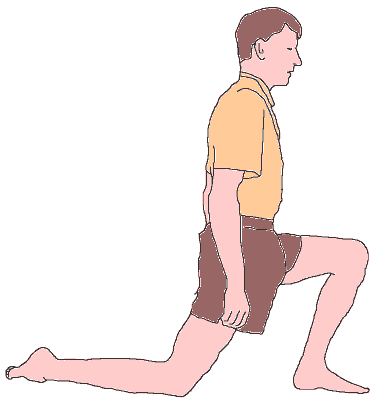 [/img]
Daily 10km road run in New Balance MT10's here. Had to build up slowly but works a treat for me...
It's been working for me. I used to run a lot as a youngster (20 years ago or so) but haven't enjoyed it for years. I bought some Merrell trail gloves back in February and got on with them straight away. I naturally run more forefoot/mid-sole so the adaption seemed easy enough. I'm now running three or four times a week (between 3 and 8 miles) and vary between road and trail. Had no problems (although didn't in normal trainers, for balance). I can't explain why but I am enjoying my running more and look forward to getting out.
I'm 6'4''and 15.5 stone if it makes any difference (I've lost a stone this year since I've started running again which is another bonus). At my size, striking heel first just doesn't make sense to me. I doubt it is for everyone so I don't like to wax lyrical about it, unless I'm specifically asked.
If you do it becuase you've read an article in runners world, or a book, then your going to hurt yourself.
Good point, and one that doesn't get made often enough, IMHO.
I'm a heavy runner - I'm 'only' 12st, but land heavily on my heels - and have thought about exploring the non-heel strike method. But it does strike me that you need phenomenally strong calf muscles not to cramp up after about 10k, no?
And Phil.w: is your point with that graph that if you're running barefoot you should never land heel first??
I've never been a runner, I'm just too large and lumbering. I used to run 100m as fast as the fastest in my school/college but switching to longer distances 400/800 I found I angered my knees and back fairly regularly. Thinking back I ran the 100m almost entirely on the front of my foot and never suffered at all. I also found that offroad I could run for ages but I also ran that mostly forefoot first. Just never twigged.
One thing to note is that the Achilles is designed as both a shock absorber and an energy store device, it's designed to act as a spring - almost every animal with that arrangement of tendon uses it for long distance running to store some of the energy and return it on the next stride.
From an engineering/biomechanics point of view it's really quite interesting. I'm not sure I could do it just now as I'm overweight enough for me to fairly rapidly injure my tendons I feel, but running a mile "normally" ends in days of aching knees so maybe it's not much different!
And Phil.w: is your point with that graph that if you're running barefoot you should never land heel first??
I find when I'm tired, my form goes and I start to drop my heels harder. Not a pleasant sensation but it's another good mechanism for preventing you from going too mad to soon.
If you try a genuine heel strike without shoes you'll soon find out that it's a bad idea. One or two strides would be enough to convince you.
Matt
But it does strike me that you need phenomenally strong calf muscles not to cramp up after about 10k, no?
I never had this, although 10k is about my limit for other reasons. As above you can land on your heel a bit after the forefoot strike, it's still not heel striking. I think heel striking is far harder to deal with than tired calves tbh.
Coffeeking - I was a fast sprinter and a lumbering oaf, and came at it from an engineering perspective. It did not knacker my calves or anything - you should go for it. Just don't make your first outing a half marathon. My achilles never complained once and I never did anything to strengthen it before hand. Just run a mile and see if you enjoy it rather than hating it 🙂
EDIT I should add that I rarely run more than 5k anyway - going for speed not distance.
I should add that I rarely run more than 5k anyway
not without a portion of cheesecake anyway. 😉
Thanks all for sharing your own stories - quite inspired to develop some new fluency in my strides now(fnaar)
I'm going to try a two step I think:
Shed my shoes for building a few intervals up on grass during runs and try and develop some 'feel'.
Then go shopping 🙂
Had anticipated more encountering problems to be honest, or mixing it up as training tool to go better when wearing trainers (as some indeed appear to) - will report progress at end of the summer!
[i]Cannot imagine heel striking now. So wrong.[/i]
For you.
Nothing wrong with it as long as your not injuring yourself
I am a fan in principle of remembering how we were designed run but sceptical about the hype associated with barefoot running and product placement such as VFFs etc. go back and read Gordon Pirie for all you need to know and the "evils" (?) of modern running shoes.
Then buy a basic pair of flats - no need to spend outrageous amounts of money. Or do it in phases eg asics DS trainer for a while and then the DS racer. Or go to the dreaded sports direct and buy a pair of retro running shoes like the Adidas marathon. £40-45 rather than £90-120 on marketing hype.
I am not a lightweight in physique (sadly) but perfectly happy running maras plus in lightweight shoes.
But it does strike me that you need phenomenally strong calf muscles not to cramp up after about 10k, no?
you do when you're learning, and getting it a bit wrong.
but when you get the hang of it, you'll find that you can relax your calf muscles a bit - this allows your heels to touch down gently, further reducing the load on your calves.
I've found a 4mm drop to be my sweet spot.
I love my zero drop bare grips for grassy/muddy fell runs but on anything rocky or hard packed and over 20 miles it's the 4mm X-talons, or 4mm Newbalance MT110's I'd plumb for.
Tried the Merrel Trail gloves but couldn't get on with the positioning of the cleats under my toes.
Road running is 4mm too; using Nike free 3.0's and Saucony Kinvaras. The Kinvaras are worth about 15 seconds a mile over the Nikes though......but they don't last long.
Oh; 81kg, 5'11", 40+ miles a week (usually up big hills).
Took me the best part of a year to ease into it.
go back and read Gordon Pirie for all you need to know and the "evils" (?) of modern running shoes.
“…no material comfort can equal the luxury of a well fitting, broad-toed, flexible, heelless shoe. Of course, the secret is that a good barefoot shoe enables us to walk naturally and to find in simple natural exercises not only health, but sanity and happiness as well. If I were a fairy and asked to bestow one gift on the man and woman of the twentieth century I would give them each a pair of model shoes.”
Bliss Carman, 1908
😀
I get on pretty well with barefoot, but live/run in the Peak and find the lack of any sort of underfoot, instep protection problematic when trying to descend on really rocky stuff - you just have to screw up one foot placement and land badly on a sharply angled bit of rock to bruise your foot quite painfully. Not such an issue heading up or along, but iffy for me heading down. Then again, I probably just need to develop better footwork.
Interestingly, the Merrell Trailglove, which I mostly like, has 4mm of EVA, but they have a new sort of semi-barefoot thing called the Bare Access which has 8mm of padding and still zero drop, which seems to make quite a big difference in feel, particularly on harder surfaces.
I'm not sure there's a 'truth' to it all, I suspect it depends on you, your personal preferences, terrain, weight, running style etc. I tend to wear conventional running shoes on the road and something lighter on trail/moorland stuff, but then that's just what works for me and I've not had particular injury issues with either.
Decent runners don't worry about all this shite... they just go out and run.
Decent runners don't worry about all this shite... they just go out and run.
+1 at least it keeps the roads/hills/paths clear to train on.
go back and read Gordon Pirie for all you need to know and the "evils" (?) of modern running shoes.
Gordon "puff puff" Pirie was a superb runner however he had some strange ideas about training so may not be the best person to quote.
Cheers Ian - that's made me feel young again!! I like the quote.
When I was little, I had two friends run B'ham marathon in dunlop green flash and runners still (just about) had plimsoles (not sure of spelling).
But shoes are such a personal thing. As much as I like flats etc, I just do not get on with innov-8s. Got PF running ultras with them 2x and yet many of high ranked Lakeland 100 runners wore them with great success. Horses for courses.
p.s. surfer, true but he saw the BS in heel striking!!
p.s. surfer, true but he saw the BS in heel striking!!
The faster you are the less likely you are to heel strike.
If your slow and fat... run... and run some more... one day you'll probably stop heel striking.
In case you missed it... Run.
Edit: I know eff all about running, but if you're going to get good at something you have to do it a lot.
The faster you are the less likely you are to heel strike.If your slow and fat... run... and run some more... one day you'll probably stop heel striking.
That's not true.
Which bit?
Heel striking appears unnatural to me. I run in neutral well cushioned shoes and tend to like Nike more and more as they have good cushioning under the mid/forefoot.
As a junior and younger runner I did a great deal of my training on the track where its natural to run on the ball/front of your foot and to be running quickly. 30 yrs later I couldnt run on my heels if I tried.
Never gave it any thought which means it must be natural, especially as all my mates who run (and this is a large proportion of my friends) also run on their forefoot/midfoot.
The faster you are the less likely you are to heel strike.
generally because faster runners have good technique anyway. This 'barefoot' thing isn't anything new in concept - good runners have been using the forefoot/midfoot strike for a loooong time.
If your slow and fat... run... and run some more... one day you'll probably stop heel striking.In case you missed it... Run.
No, you'll just get faster whilst still heel striking. Unless by fast you mean sprinting, in which case most people get onto their forefoot anyway.
I wouldnt have put it as bluntly as TSY but I largely agree with the sentiment 🙂
No, you'll just get faster whilst still heel striking. Unless by fast you mean sprinting, in which case most people get onto their forefoot anyway.
Thats a contradiction, take out the word sprinting. Running speed is a continuum. I tend not to run slower than 7:15 pace all of the time. If I do run a bit slower my foot strike doesnt change, its not natural to heel strike at reduced speeds then forefoor strike as you go quicker. 7:15 pace is not sprinting in fact 5:00 is not sprinting (albeit very difficult at my age!)
Surfer - it's my new tough love approach to training*
*All credit to Dave Scott.
My running ability has changed a lot in the last 10 years. At some points I was quite good and at some points I was crap. Same part of my foot always hit the ground first.
A fundamental change in form like forefoot strike takes a quite a lot of effort, I don't believe it'll just happen naturally as you get quicker (it didn't for me).
A fundamental change in form like forefoot strike takes a quite a lot of effort, I don't believe it'll just happen naturally as you get quicker (it didn't for me).
Thats my point, I would argue forefoot (by this I mean anything from approximately midfoot forward) is natural and heel striking has to be learned.
Thats my point, I would argue forefoot (by this I mean anything from approximately midfoot forward) is natural and heel striking has to be learned.
I think I'd find forefoot strike very difficult in a pair of my old ultra cushioned asics just as heel striking in my trailgloves would feel very wrong. Perhaps things were a little different for me having done a lot of my early running in boots.
I don't believe it'll just happen naturally as you get quicker (it didn't for me).
I think Yeti's comment was suggesting it happens when running fast enough. Without meaning to sound rude, maybe you haven't reached this point yet?
It is a great way to run, however you must break in easily as I didn't and was in agony after a 10 miler 🙄 I now have a pair of Suacony triumph 9's which offer a gradual heel drop from a normal 12mm to 8mm. I will use these until I feel ready to move down to a more minimal shoe.
Good luck and have fun 😀
I think Yeti's comment was suggesting it happens when running fast enough. Without meaning to sound rude, maybe you haven't reached this point yet?
I know what his point was, it's just not true. Short of sprinting (as stated earlier by at least two posters), this will not just "happen".
Short of sprinting
What is this "sprinting" of which you speak?
I believe it will.
Epecially if you train with others and compete.
You'll be forced to learn efficiency.
How fast are you running BTW?
I know I'm rubbish at running, and I'm going to get better by running more.
I believe it will.
I know I'm rubbish at running,
So you've not started forefoot striking yet? At what point do you expect it to "kick in"?
How fast are you running BTW?
Similar to surfer by the sounds of it, although I couldn't maintain that pace in minimalist shoes for long if at all yet. I was a lot faster when I was younger and lighter, I'm on the down slope now though as my knees have seen better days.
Epecially if you train with others and compete.
You'll be forced to learn efficiency.
I find myself agreeing with you again TSY. Changes in style happen naturally for the most part. If you find yourself forcing to change your style then you are probably not training enough, I do think a lot of this is just marketing bollocks.
When I was a lad (!!!) we simply ran till our eyeballs popped! not scientif or even advisable but we spent more time running (and as a result running fastish!) and less time agonising over the latest fad!
Bear in mind the majority of runners just want comfortable and supportive footwear. The over cushined shoes are really just a straw man. The "barefoot" shoes are now becoming more complex and built up so in reality they match the ones most runners use anyway.
A fool and his money!
I can't run slower than 8 min miles... maybe it's something to do with how I already land my feet...
But I'm not yet doing sub 40m 10k's. So I'll keep running.
Frankly if you focus on cadence (in my exprience and Pirie's) then foot striking has a funny habit of taking care of itself!! Funny that!
We learned heel striking from footware, it is not a natural method!
And another thing!
Whats a "minimalist" shoe? is it the equivalent to "wild" swimming and "free" running?
or is it just what we used to call "running" shoes until a magazine/manufacturer re branded it?
It's a racing flat aimed at someone who [s]isn't quick[/s] doesn't race. 😉Whats a "minimalist" shoe?
Whats a "minimalist" shoe?
FFS look it up. What did you used to call free running BTW?
. I tend not to run slower than 7:15 pace all of the time. If I do run a bit slower my foot strike doesnt change, its not natural to heel strike at reduced speeds then forefoor strike as you go quicker. 7:15 pace is not sprinting in fact 5:00 is not sprinting (albeit very difficult at my age!)
Why have you changes your tune?
[i]This 'barefoot' thing isn't anything new in concept - good runners have been using the forefoot/midfoot strike for a loooong time.[/i]
Amusingly I was overtaken by the fastest guy I know training. He's trained with the Kenyans and just about skimming 4' mile pace.
So anyway, I'm pushing myself on a good effort session, he floats by taking it easy... I couldn't help notice that the heels of his fairly well-built trainers never went near the ground. I've never asked him, but I suspect he's doesn't spend a lot of time worrying about form. He just is.
TO those that think only the fast guys forefoot strike- Try running on the spot as slowly as you can, heel strike only. Now forefoot strike only. Which feels best? Now jog very slowly forwards so your just moving. Which feels best now?
I wear racing flats for everything i do now after changing from heel to forefoot striker around 5 years ago. I dont use barefoot shoes although the nearest fad shoe i bought was the newtons which helped the transition to forefoot running.
FFS look it up. What did you used to call free running BTW?
Tell me what mag you bought and I will. "running" BTW
Why have you changes your tune?
Where was that then?
It's a racing flat aimed at someone who isn't quick
You really think that's going to get someone to bite? I run to keep the fat off, I'm not quick, don't race and don't particularly enjoy it. I do enjoy boxing (std and thai), circuits, and MTBing.
You accusing me of not being quick is like me saying you've got a crap teep!
Tell me what mag you bought and I will. "running" BTW
Never bought a running mag in my life.
You did this and called it "running"? Talk about understatement
Why have you changes your tune?Where was that then?
????
Never bought a running mag in my life.
Didnt say you did. These fads are ususally in "life style" mags or "supplements"
I tend not to run slower than 7:15 pace all of the time
That's a 3.10 marathon pace at a cruise. What's your PB HM, FM? Must be way below 3 hours!
Changes in style happen naturally for the most part.
its not natural to heel strike at reduced speeds then forefoor strike as you go quicker.
Which is it?
Didnt say you did. These fads are ususally in "life style" mags or "supplements"
No and no. I have subs for Dirt and ST. I've "bought into" MTB far more than I have anything else.
72 HM and well below 3 for a FM but not worth quoting 😳
It probably is; if only to qualify your comments. It's hard enough as it is to trawl through the sh@ without someone who actually knows what their talking about withholding their credentials.
Changes in style happen naturally for the most part.its not natural to heel strike at reduced speeds then forefoor strike as you go quicker.
Which is it?
They are not mutually exclusive although in my haste I may not have explained it well.
Point 1 is true IMO in point 2 I was trying to say that if you forefoot strike when you are running fast then you will tend towards forefoot striking when you run slower.
You really think that's going to get someone to bite?... You accusing me of not being quick
It wasn't aimed at you, or accusing you of anything. Merely stating it how it is - a 'minimalist shoe' is essentially a racing flat re-branded, it's re-branded as calling a shoe 'racing' puts a lot of people* off.
*these are the people who I was referring to by don't race / don't run quick enough. The speed has nothing to do with the suitability of the shoe, more so their perception of a [i]racing[/i] flat.
withholding their credentials
Its not important I was a mediocre club runner and just an interested party. I have no qualifications (in running, I do have a CSE in needlework however!)
For you. Nothing wrong with it as long as your not injuring yourself
Not convinced there. I can't figure out from a physics point of view how sticking your leg out in front and slamming your heel into the ground isn't going to slow you down.
Decent runners don't worry about all this shite... they just go out and run
I suspect that the reason they are decent is that they don't have to worry about it - they just have it sorted instinctively. What should we do if we're not decent?
If your slow and fat... run... and run some more... one day you'll probably stop heel striking.
Disagree - if you're fat and slow you'll probably stay fat and slow unless you work out how to run properly. It DOES NOT come naturally to everyone, especially if you are relying on shoe technology to try and overcome poor gait.
You'll be forced to learn efficiency.
It won't just happen magically overnight. You may have to think about what you are doing (although that seems terribly unfashionable on here sometimes).
Changes in style happen naturally for the most part.
It didn't for me. Running was sheer torture until I thought about it, now I like it much more. I could've wasted years getting frustrated and disillusioned waiting for something to happen on its own, or I could've put in some thought and sorted it straight away.
Whats a "minimalist" shoe?
One with not much heel or padding. I had no idea what they were called or if they existed before I went looking, before you start insinuating I'm a marketing led fool....
Mol - you quoted me well enough already to answer what you should do if you're not decent....
If your slow and fat... run... and run some more
Less worrying, less fretting, more running.
I really beleive it's this simple. Don't be a running geek... be a runner.
in point 2 I was trying to say that if you forefoot strike when you are running fast then you will tend towards forefoot striking when you run slower.
Which I wholly agree with.
if you heel strike when you are running slow then you will tend towards heel striking when you run fast.
Same thing, see? See cp's post near the top^
This has descended a bit now, apologies. Try it, dont try it. Its a fad, its not a fad. You might be faster or slower. At worst, you'll end up with some very comfy shoes.
I suspect that the reason they are decent is that they don't have to worry about it - they just have it sorted instinctively. What should we do if we're not decent?
I know a lot of runners of all "abilities" and the one factor that strikes me almost without fail is that you "get out what you put in" there are exceptions but for the most part if you train sensibly but hard there is an overwhelming relationship between performance and training.
I think we may have disagreed in the past on this subject "learning to run" (paraphrasing a bit)
I dont agree I think "style" comes though specific training and in your endavour to get faster you will naturally become more stylish.
Coe/Ovett didnt become fast runners because they were "stylish" but became sytlish because over years they trained over long distances incredibly quickly. Repeat over and over again twice daily for 15 yrs!
Less worrying, less fretting, more running.
I can't see why you equate 'worrying and fretting' which are negative things with 'working out how to do it properly' which is a positive thing.
I've told you this many times before: I used to hate it and be really bad, then I thought about it, now I am much better and enjoy it a lot more.
I can't see where I went wrong, or how I would have benefited from not having thought about it. Can you please help me see why I should stop thinking?
if you train sensibly but hard there is an overwhelming relationship between performance and training.
So how did I gain a minute per mile between one run and the next, then?
TSY - have you applied the same logic to swimming? 😉
So how did I gain a minute per mile between one run and the next, then?
Is that a serious question?
I'm applying it to everything from now on.
Technique probably has a bigger part to play in swimming though IMO. Having said that my swimming has improved dramatically the last month by going to the lake as often as possible. More than it did doing drills in the pool.
Molly - I'm in danger of being offensive if I discuss things further. So I'll bow out now. As long as you're having fun, that's all that matters.
Can you please help me see why I should stop thinking?
This is a serious question. Do you think about your style when you are running? Do you literally think about your foot strike etc mid stride?
For me i never give it a second thought even over very difficult terrain.
As almost an inverse of Yeti's idea that you naturally move to mid/fore foot strike above a certain speed, I would say that below a certain speed it's more natural to heel strike.So how did I gain a minute per mile between one run and the next, then?
From my own experiences, even as a natural mid foot striker, if I drop below a certain speed (particularly when tired) I will have some heel strike.
Based on this, but without knowing what speeds you are running, I would guess that you [i]had[/i] to run faster in order to forefoot strike successfully. As opposed to being able to run faster because you were forefoot striking. (I appreciate this is a bit chicken and egg)