It’s that time of year when we look into the mists of time, peer into the future, and see what lies ahead. Maybe.
A year ago, we had a few solid hits with our annual predictions, but how will we do for the year ahead?
Chipps’ predictions for 2026
More of the same?
The mood at the 2025 Eurobike show was more cheerful than it’s been for a couple of years, but there was still a lot of caution about the future. I think that many companies still have too many unsold bikes in the warehouses, so they’re keen to sell those first. This will probably limit the amount of innovation and new models that they’ll pump out in the next year. And, in addition, I think a lot of companies will be watching how the e-bike market expands. Don’t expect massive innovations in analogue trail bikes from the bike companies. Plus all that tariffs uncertainty has put a hold on many companies committing to massive new orders from foreign factories. This does, however, leave room for those fast ‘n’ agile companies, perhaps ones who make their own stuff, have minimum stock levels and a desire to succeed, to move and fill those gaps. Or perhaps there aren’t any gaps to fill?
Old New Media
A new media order: With some traditional media companies going away completely and others being hoovered up by Big Media Publishers, will 2026 become the year that more readers flock to smaller, independent print magazines for their reading pleasure? Will we try to put away our phones and concentrate – hard! – on a print magazine for a few minutes a day as a detox? I certainly hope so.
The return of style
I don’t mean skinny downhiller jeans for everyone, but for those riders who feel their riding has plateaued – you can ride everything you’re prepared to ride, you’re not after taking new risks to learn new skills – where do you go from there? You concentrate on how you ride. Bikes are so capable that they can get you down just about anything, but there are ways of doing it. I think that those riders who’ve stopped pursuing bigger jumps and drops will start to look at HOW they ride. Can they get free speed from working dips and corners better? Can they catch their riding pals even while pedalling less, but using the flow of the trail, pumping features and braking later? The flow is going to start to rival the sheer speeds. And smoother riders always look better.

13 speeds, really?
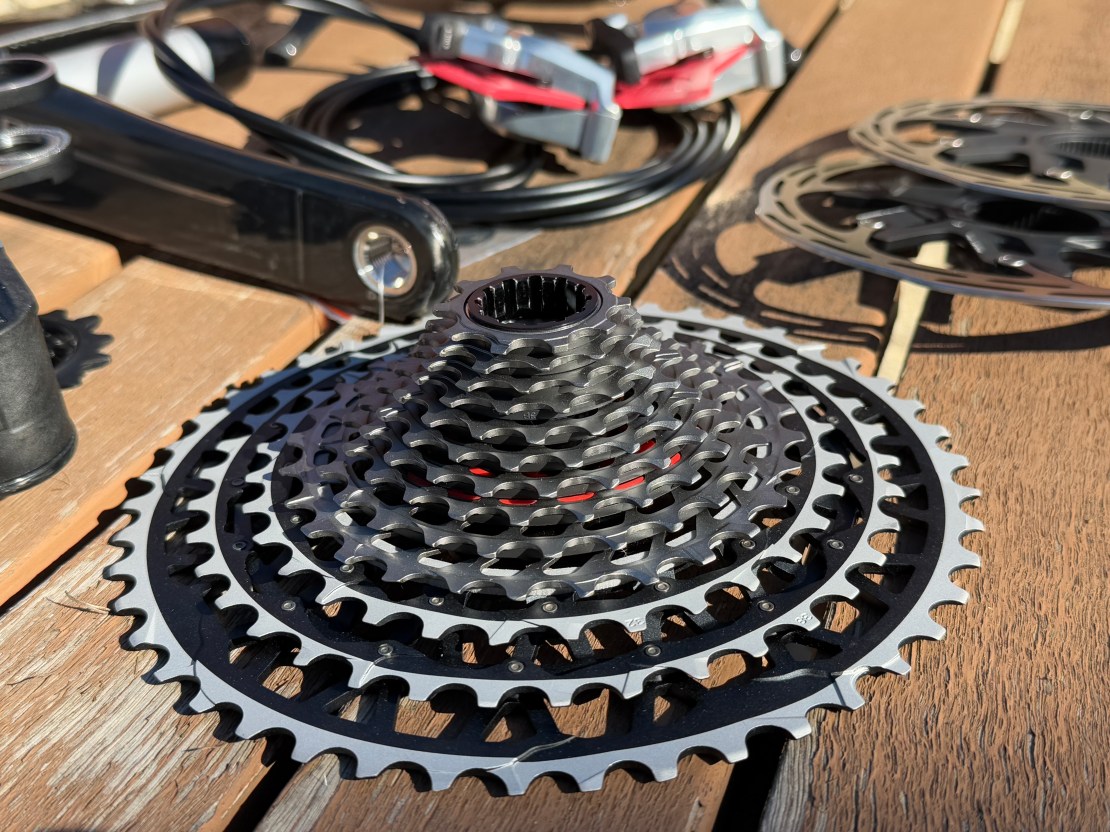
It’s going to have to happen, isn’t it? We’ve seen 13 speed transitions from Campag and SRAM on the gravel side, but what about for mountain biking? Of course it’s not needed, but it’s one bigger, so someone is bound to do it. You won’t see anything new from Shimano for at least four years, so that leaves SRAM (I’m giving a 50% chance) or a smaller, hungrier company like MicroShift or TRP. I’ve already heard stories of racers keen to bodge SRAM’s gravel 13 speed Red setups onto their mountain bikes, for speed of shifting and smaller gaps between gears, so perhaps…
Trail Shuttering
So far, so predictable, so my attempt at a bonkers wildcard is that there’ll be some kind of attempt at a widespread mountain bike ban somewhere in the UK. We’ve, perhaps surprisingly, seen large chunks of Morzine’s off-piste riding taken away – and it can always happen here in some form. Perhaps it’ll be the Forestry Commission banning bikes without third party insurance, or some new tree or bovine disease making the countryside off-limits, or proposed legislation to make riding bridleways after dark illegal. I think this is just my way of saying ‘Hey, don’t take things for granted. If you’re involved in your local access forum, great. If not, why not?’

A decent Easter
I’ve always maintained that the UK bike scene is more reliant on good weather over Easter than gears and widgets. If the Easter holidays are glorious and sunny, then even lapsed riders will get the bikes out of the shed and get out on the trails (or off to the bike shop for a new bike or a refresh of the old). If it’s a week of rain, they won’t and then there won’t be a sustained period of time off to lure them back until the summer holidays, by which time, they’ll feel that they’re too behind their now-fit friends to join in. Let’s hope for a decent streak of weather in April!

Mark’s predictions for 2026
End-of-tunnel glimmer?
2025 was shockingly bad for the bike industry. Last year I predicted that by the end of the year the bike industry would have recovered a bit. It kind of has… a bit. But not really enough to significantly move the needle. There was more ‘consolidation’ in the media world as everyone involved battles to adjust and regroup. We finished on a bit of a high though, with a successful CrowdCube campaign that saw us recruit over 200 shareholders – that’s what’s leading me into 2026 with more optimism than I had this time last year.
AI Slop continues
In the world of media AI is only going to get worse/better. Better in a technical sense as it becomes harder and harder to detect what is real and what is generated. Both images, video AND words. Media brands will start really broadcasting their human generated content via badges and disclaimers. Also AI will get worse in 2026 for exactly the same reasons.
For some, it won’t matter. Content is content and who cares who or what makes it? For others it will matter a great deal and for those of us who like the human touch, a new niche of no AI content will be in demand. So there’s opportunities there. But there are also risks. AI is here now and it isn’t going away and it will only get better and more advanced. There’s a place for it but the boundaries are yet to be set.
Print is back but different
Print has never actually gone away although the landscape of print has shrunk dramatically. 2026 will see the end of the bottoming out of print and a cautious resurgence on a limited scale. Print has been likened to Vinyl in it’s demise and then bounce but I don’t agree. Vinyl is objectively poor at what it is designed to do. It is the worst of all audio formats in both quality and practicality. CDs are much better and streaming now delivers better quality audio in a incredibly convenient package.
Print is different. Print delivers content in a way that cannot be reproduced digitally. It delivers without screens and in a tangible medium that just looks and feels great. Print never went away, but it is actually now better than it has ever been. Magazines are more akin to books now and they can deliver content and especially design in a way that is still almost impossible to replicate on a screen of any size. Singletrack will remain in print and our readership numbers will increase throughout 2026.
Big reach numbers are history
AI is killing traffic to websites and this will get worse in 2026. But the traffic that is no longer coming was never really valuable to begin with. What is more important is the traffic that remains. Smaller in number but very high in value. Regular visitors to media websites are where the quality audience lies and marketers continually chasing massive reach will only continue to see their ROI get smaller and smaller. Solid, loyal audiences is where the real value sits. Singletrack has that in spades.
James’ predictions for 2026
Asa Vermette will be the DH World Cup overall winner.
Loic Bruni will finish second, and Jackson Goldstone will be third. It will be the most exciting downhill season since 2025.
Hattie Harnden will win the Gates Belted Purse.
Maybe. That might be wishful thinking, but either way, there’s more chance of a woman winning the Gated Purse.
The rise of the 32in wheel
They’re coming, whether you like it or not. And not just for XC. Resistance is futile.
More brands will continue to feel the squeeze. I don’t know which ones, but as more of the market becomes electrified, it’ll be harder for the small to mid sized brands to keep up because…
The Chinese will continue to dominate the ebike market
More and more far eastern brands loaded with the Avinox motor are hitting these shores. Consumers will have less allegiance with traditional bike brands, as new motor and battery tech develops at pace and draws new riders with no history or brand preconception into the sport.

Benji’s predictions for 2026
Fcuk knows.
Gravel migration
In an echo of ye olde distante past – where people in the 80s/90s who were already riding offroad on unsuitable bikes (BMXs, road bikes, Raleigh Choppers, Grifters etc – I expect we’ll see a lot of gravel riders getting a Mountain Bike and realising they’re just better. And we’ll be here for them.
Goodbye USA, hello UK
Partly fuelled by the Americans’ seemingly unending e-bike-phobia, but also for reasons of access (ie. not really having any rights-of-way), and a highly car-centric resort-based sports-focus in the US, I think we may well see British bikers ceasing to look west for their inspiration.
Cross country not-racing
For me, this may be a big focus for 2026. Very much related both of my predictions above. The riding and the experience and the attitude that I think we all have as mountain bikers is almost wholly absent from ‘MTB Media’. There is way more to mountain biking than berms, hucks, danger, overbuilt bikeparks and energy drinks. Where are all the representations of MTBers having a nice time in nice places with nice people?
Eeb laws decided in EU
And DJI won’t be pleased. I predict the ‘amount of assist’ ratio (ie. how many watts a motor can give out in relation to the amount of watts going into the cranks from the rider) is going to become A Law. And while this makes a lot of sense – they are pedal assist bikes after all – it probably won’t be an entirely unbiased project. Some brands are going to put the ki-Bosch on DJI’s potential dominance.
32in is coming
For the non-eeb market at least. Although some media bods are predicting that 32in wheel bikes are going to be aimed at tall riders, I think we all know that the real market who will ‘go for 32’ are XC racers. Of all heights. I don’t think we’ll see 32in trail bikes (well, apart from some from smaller brands). As ever, big wheels will sate big lung bikers.
The continued meh of trail bikes
Non-electric full suspension bikes with more than 130mm of travel are a thing of the past. Well, genuinely new ones are anyway. They’ll still be made of course (because they are one of the best things humans have ever invented) but they won’t be any different from the ones that came out in 2022. Like all the ones currently gathering cobwebs in your LBS. Maybe, just maybe – it’s only a maybe – maybe some brave bike designer may finally design a bike with genuinely worthwhile proportional geometry? Even then, there’s a whole load of marketing myths, journo cliches and incorrect received wisdom to combat. Regardless, all of this is great news for smaller brands who actually care. Which is nice.

At the last Taiwan industry show they were being hyped for gravel too. 686mm / 32″ rims, ~45mm tyres. 650B can make a great smaller framed gravel bike (and works perfectly for my all-road / gravel tastes and I’m 6ft) yet as 650B options slowly fades from tyre catalogues, they’re tooling up for 686mm. I can’t help but make some conclusions from that.. Anyway sorry, this thread is about the MTB world.
I think you’re right, other than a few early adopters and those riding sponsor bikes I expect that the response of most people to 32″ is a cynical one. The primary advantages seem to be touted as speed and stability, but a decent amount of people outside of flat-out racers are already going ‘back’ to Mullet setups or even 27.5″ on trail bikes having not really gelled with 29ers for that exact reason; to bring back manoeuvrability/fun.
I expect to see it more in the niche ‘Bespoked Show’ type circles where boutique hardtails with big tyres and rigid/short travel forks are already a thing for big days out in the countryside, and another way to be unique/contrary is embraced (I don’t mean that as a criticism btw).
As for my prediction, I think “simple" electronic suspension with manual control (equivalent of replacing a dropper lever/cable with AXS dropper, but for lockouts) is on the cards. Less cables to faff around with and route internally but a useful function of a 2/3 position lockout from a bar lever rather than an automated infinitely adjusting range of settings.
Something I expect to see continue is the double-edged sword of MTB brands ditching internal routing (Yay) in favour of wireless-only drivetrain options (Boo)
I’ve been thinking a bit about standards lately. For many, a standard crank length is 165mm to 175 mm. I’m keen to try some 150mm cranks but I find I’m reduced to ordering some kids cranks off aliexpress and hoping that the q-factor isn’t going to be an issue.
I’m definitely not the only one who is short crank curious but Sram and Shimano don’t seem to be falling over themselves to furnish us with lots of options for cranks lengths.
I think there is definitely a difference in changes to what has been done before where you can swap out an existing component on your current bike vs changes that require buying an entirely new bike. It feels like the latter gets all the attention and the push, not just in terms of advertising but also in terms of how its fawned over by magazines.
Just take a look at 29 inch wheels compared to tyre inserts. To me, tyre inserts are way more of a game changer than a relatively small change in wheel radius (and to be perfectly clear, I’m not talking about the geometry changes that accompanied the introduction of 29″ wheels, just the change in radius in isolation). And I can feel people already typing out just how wrong and stupid I am.
Changes that can be swapped onto your existing bike are generally given a quick, ‘I guess you can try it, maybe you’ll like it or maybe you won’t. It’s just one part of the bike, after all.’
A focus on swappable parts (tyres, inserts, pedals, grips, bars, dropper posts etc) has always been there for riders and the media. Perhaps this will increase this year.
Oh, plenty of 155mm “adult” chainsets out there. Why the 150mm requirement?
Plenty?It could just be the online shops I’ve been looking at but so far I’ve found a single 155mm crankset from Sram while Hope offer some of their cranks in 155mm. I generally don’t buy Hope stuff if I want to try something out given the cost so that leaves the Sram offering which only seems to come as a complete crankset. So then I’m also buying a new chainring because the Sram offering comes with a 32 tooth chainring. If you wan to go down in crank length then you probably also want to go down in chainring size so then your left trying to find a chainring as well.
As far as I can see there is only one reasonably priced option available and even then it comes with the same size chairing as the rest of the lengths they offer.
Unless you are talking about e-bike cranks which seem to make up the vast majority of short crank offerings but they don’t really do me much good as I don’t have an ebike (if there is a way of bodgeing a chairing onto a set of ebike cranks I’d be very interested in hearing more as that would make life a lot easier).
The general arc of products is toward a closed single system, proprietary parts and less user-serviceability, like electronics and cars. Bikes are the same but as I got into a bit earlier, I’m not sure that it’s working for the industry and that Q is coming up more often with more people. I’d say it depends on what part of the industry / what rider we’re talking about and I think one problem the industry has is not being able to address both equally well. A transport/commuter will buy a closed system and needs a reliable, serviceable bike, they might fit a new saddle, grips or accessories and that’s about it. An enthusiast often wants to express that enthusiasm via customisation and fine-tune the performance with upgrades. Buy an everyday runner C-Max of customise a Focus ST?What I think the industry got wrong is not knowing whether e-MTBers were in one camp or the other (might be 50/50 in reality), perhaps failing to meet the expectations of either.
If the bike brands learned one thing in the last few years you’d hope it was about the need for selling power rather than buying power. Buying power gets new stuff done, for sure. You can buy as much as you like…
Over stuff that doesn’t really make much difference or is only a potential PITA (eg front axle spec) I’d agree, things can be forced through. But supply and demand means true demand for a materially different alternative will usually be met.