“Our demon product test section features a long term test on a Rohloff Speedhub and a first look at new XTR.”
Magura Wotan
- Price: £599
- Time Tested: Three months

Appearing quite a while back in a ‘Beta’ form as the Thor, the greatly redeveloped Wotan (Yes, they are still doing the Norse Gods thing) has been a long time coming. But the time has not been wasted. Out of the box I was impressed at how smooth they felt, previous generations of Maguras had very tight seals, which gave them great reliability but also a bedding in period close to the lifetime of a Blue Peter tortoise. The smooth feeling continued throughout the test, and my initial fear that prudent British weather-proof sealing had been sacrificed for out of the box performance proved unfounded.
Performance downhill is superbly fluid, the fork really coming to life when you up the speed and hit anything in sight as quickly as possible. There is impressively little in the way of high speed compression damping spiking either which is often a problem when you really push long travel forks. At slow speeds they can wallow a little, but by upping the compression damping on the Albert Select platform damping things become more manageable. Heading back up the hills, by pushing down on the Flightcontrol remote bar mounted lever and compressing the forks, travel drops to a climbing friendly 120mm. This works very well saving dialling, er, dials in and out to adjust travel. Going from 120mm back up to 160mm requires pressing the lever and pulling a mini wheelie, which isn’t ideal, it would be better to press the lever and the let the fork rise to full travel itself.
Looking at the Wotans you know they are going to track well, the double arch design looks and feels rigid and that is indeed the case when throwing the bike through rough stuff. It takes a particularly large obstacle to defl ect you from your chosen line. As if the performance wasn’t enough they are easily the meanest looking single crown fork on the market, and that counts for something in my book. These forks will sell on looks alone.
Latest Singletrack Merch




Buying and wearing our sustainable merch is another great way to support Singletrack
Full marks have to be given to Magura for licensing RockShox’s Maxle bolt-thru. It’s the best system out there and rather than try to come up with their own system they’ve plumped for someone else’s. If only they had used RockShox Poploc lever too. The provided lever uses some incredibly tiny and easily round-able Allen bolts and is tricky to adjust once on the bars. It also seems fragile and prone to dirt ingress, which is a shame as the fork itself is quite the opposite. Magura has gone to (8in only) post-mount brake mounting too, in line with the general movement. Overall: With every fork manufacturer having an ‘ All Mountain’ model in their line up this year competition is going to be fi erce, but with its build quality, meaty looks and reasonable price the Magura will be one of the front runners in the long travel arms race. – Sim Mainey
Maverick Speedball Seatpost
- Price: £159.99, with remote £179.99
- Tested: Five months

Perhaps it’s my old school XC racer roots, but I never drop my seat post on a ride. I don’t usually have a seat QR, the Allen keys are too hard to get at and by the time I’d lowered it, I could have minced down the descent anyway.
The Maverick Speedball post is aimed at reluctant freeriders like myself and at habitual saddle droppers too. Proudly using ‘offi ce chair technology’ it offers an infi nitely adjustable saddle drop of up to 3in. What it isn’t, is a suspension seatpost though; you move it and it stays still, it doesn’t bounce.
There’s a slim lever under the saddle – obviously on my Maverick, the extreme seat tube angle puts it in just the right place. On other bikes, it’ll be a little more proud. It only comes in 31.6 and 30.9 diameters too.
If you can work a pneumatic offi ce chair, you can work a Speedball. Approaching the Descent of Doom, you make a Michael Jackson style ‘crotch grab’ action, pull the lever upwards toward the seat and let your weight lower the post. Let go of the lever and the Speedball will keep the saddle at its new height. When you’re past the scary descent, pull the lever again and allow the (factory-set) air pressure to return the seat to normal height.
I found myself using the post way more than I thought I was going to, and really got to like it. I used it to drop the saddle out of the way for big descents, but also found myself fi ne-tuning my ride height, dropping the saddle an inch or so for sweeping singletrack and all points in between. It’s not shown any sign of losing pressure and it didn’t creep up when set in the down position.
I did fi nd that when I really needed to lower my saddle in a hurry, it was too late to take my hands off the bars and ‘do the Michael Jackson.’ The bar mounted remote lever will solve that, though it costs more and you’ll have another cable to ziptie to your top tube.
Overall: If you have the right sized seat tube, and either lower your saddle a lot OR never lower your saddle, then you need to test drive the Speedball. – Chipps
Rohloff Disc Speedhub 500/14
- Price: £725.00
- Tested: Nine months, 1000 miles
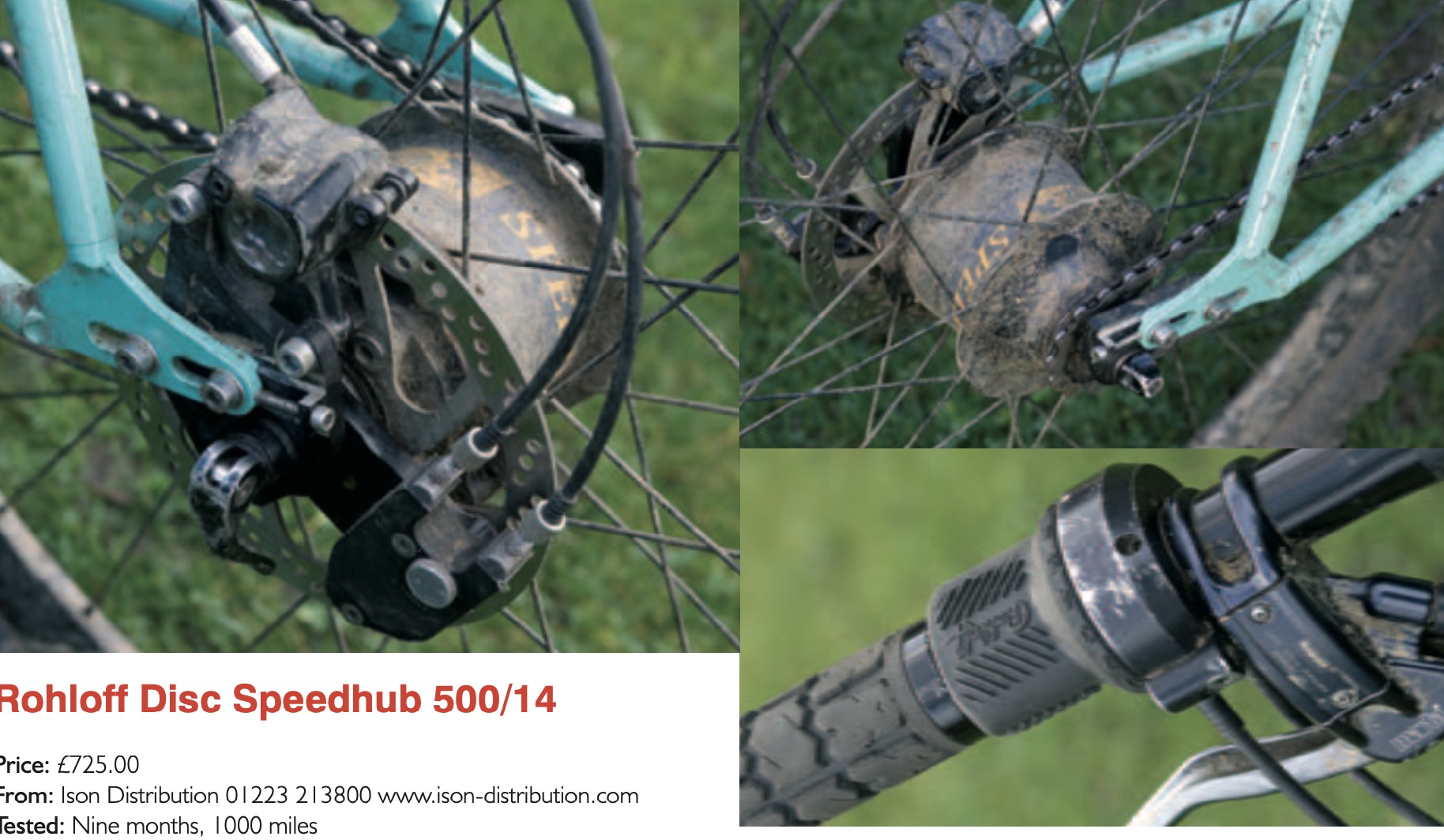
As a serial rear mech destroyer I was volunteered to be the tester of this internal gear hub from Rohloff. The Speedhub has 14 gears in total covering roughly the same spread of gearing as a normal derailleur-based 27 speed setup. Shifting is performed by a single twist-style shifter which goes on the right hand side of your handlebars. The frames I tested it on had Speedhub-friendly horizontal dropouts (over 6mm thick with at least 40mm slot length) but most frames will require the use of a £30 ‘Speedbone’ support arm and very probably a £49.99 tensioner.
Like most people, I was at first primarily interested to find out how it felt to ride with a lot more weight at the back of my bike (the hub weighs around 1700g). It is noticeable but not nearly as much as you’d think – and there are benefits as well as disadvantages to this. Unweighting the rear wheel over obstacles did take more effort but it was perfectly viable. It may be more of an issue for riders who like to leave the ground more than I do though. The back of the bike did have an occasional tendency to skip about or full-on fishtail if I was braking hard down steep slopes.
I did find the extra rear-end weight useful when climbing where it seemed to aid with traction and allowed me to concentrate on controlling the front end of the bike (kind of similar to climbing on a full suspension bike). Surprisingly I also found it helped when riding off-camber where it would refuse to misfire even over rooty stuff. So yes, the extra weight at the back does make a difference but it’s not all detrimental – far from it really.
The Speedhub’s unique ability to change gear while not pedalling is a fantastic. It’s the main thing I miss whenever I’ve gone back to riding derailleur systems. On unfamiliar terrain I was never caught out desperately trying to change down to granny ring as an unexpected steep climb appeared out of nowhere. Just twist the shifter and off I went. And on technical, lumpy trails, where it wouldn’t be possible to change gear on a derailleur setup due to pedal striking, I was laughing (quite literally). Having said that, it’s perhaps just as well you can change gear while not pedalling because trying to shift while pedalling can be extremely frustrating. Shifting under pedalling load was met with resistance. I found that I had to back off on the pedals so much and for so long that by the time the gear was engaged I would have lost a significant amount of momentum – and it would be time to change gear again! If I kept the pressure on during climbing (so as not to lose any momentum) the hub wouldn’t ‘let go’ of the current gear until I really yanked on the shifter at which point it would abruptly break free and I would shift through more gears than intended.
I also found the ratio jump from gear to gear to be too large. Changing gear results in such a dramatic change in cadence that it quite often put me off my stroke (so to speak) and was especially disrupting on climbs. I’m probably the least frequent shifter of anyone I know – I would imagine more ‘shift happy’ riders would find this even more of an issue.
I didn’t really get on with the ‘twist grip’ style shifter either. It felt a bit vaguely indexed (the result of having all the indexing done at the hub on the end of two full lengths of outer cable) and having a black-on-black number display that’s illegible is stupid. I’m also wholly unconvinced that ‘twist grip’ shifting is safer on rough descents (because you don’t have to remove a finger/thumb from your grasp to chan e gear with). In practice after you’ve changed a gear or two your hand/wrist/arm is now bent out of position (reducing control) so you have to loosen your entire grip slightly and reposition everything. Give me trigger shifters every time.
On the positive side the fact that there is no rear mech dangling off the back of my bike means I can thrash down stuff as carelessly as I wish with no fear of cutting yet another ride short and walking back to the car. The zero-dish, short-spoke wheel build of a Speedhub makes it incredibly strong which further encourages reckless riding. The lack of chain slap made for quiet riding and the virtually zero chance of unshipping the chain over rough terrain was most reassuring too.
The system’s performance in mud was also a great thing. During long muddy rides where other riders’ chains were skipping everywhere and their gears were either seized or badly mis-shifting I was fine and dandy. And I didn’t have to bother cleaning the bike when I got home either, just chucked it in the garage and forgot about it (maybe oiling the chain before the next ride if I was feeling energetic). The whole fit-and-forget lack of maintenance with the Speedhub is very impressive.
Overall: In my opinion the Rohloff Speedhub is some way off being The Holy Grail of bike gearing. Changing gear while not pedalling is extremely useful, and its indifference to mud and neglectful ownership is ace. But it needs to be lose weight (I reckon it to be about 700g heavier than a Shimano XT derailleur system), change gear a lot better during pedalling, ditch the ‘twist grip’ shifter and come down in price. You can buy an awful lot of rear mechs for £725 (and keep a spare one in your Camelbak). – Craig Woodhouse
Shimano XTR Mk4
- Price: Groupset around £1000 (w/disc brakes, excluding hubs), wheels £500 a pair, pedals £79
- Tested: Currently a few hundred miles, many more to come…

XTR is Shimano’s top flight, no expense spared, cross country racing groupset. The fact that its components are also used by all-day riders, downhillers and poseurs also says something about its durability and desirability. We have a full groupset of XTR Mk4 with Dual Control levers on test and intend to give it a very hard time of it this winter and spring. First though, are our thoughts after a few hundred miles of use.
Aesthetically, new XTR is more industrial looking and ‘deconstructed’ than previous high-polish editions. Much of it has a matt grey finish, like XTR Mk2, but with exposed faces of cranks, mechs and brake levers, polished to survive scuffing a little more. Just as we’ve got used to the ‘pod’ shaped shifters perched on Shimano brake levers, they’ve redesigned the shifter so it’s more compact (dense even) though at the expense of a little swoopiness. There are two shifting options and two rear mechs – Rapidfire Plus, or Dual Control, plus Low-Normal and High-Normal mechs. Both shifters allow you to shift up to two gears at a time in one direction and three in the other. We have a Low-Normal rear mech and (£220 a pair) Dual Control shifters.
The (£299) chainset and BB set up is an evolution on those currently found on XT and LX – there’s no longer a pinch bolt on the non-drive crank, but there’s a large bolt to secure the non-drive crank to the oversize through-axle BB spindle. The play in the system is then taken up with a threaded collar twixt crank and BB shell that expands to take up the slack and then bolts in place. It’s a little more complicated initially than the current Hollowtech II system, but seems to work fine. The middle chainring is a very swish, carbon-reinforced titanium job. The other rings have also been hard anodised for what Shimano reckons is a ‘conservative 100% increase in durability over previous XTR rings’. The front mech (£65) is a wide pivot model, but still barbarically hits the chain from the side until it changes rings. Brutal, but still an effective way of changing rings. The rear mech (£85) features the ‘X’ theme and drilled jockey wheels. It comes in medium and long cages. It plays over the most outrageously expensive bit of the grouppo – the £110 cassette with its titanium sprockets and alloy carriers.
The calipers (£99 a wheel inc rotors) are small and matte and neat and radiate power like military components. They’re a single forging and are one of the least understated bits of the group. The Centrelock rotors, meanwhile use chunky ally carriers with the rotor riveted on. Brake pads come in sintered and organic and are titanium backed to resist heat better. Up at the brake lever (of either style) the reservoir is cunningly hidden below the lever. The new hubs have much quicker engagement than before and come as ‘normal’ hubs, or in the wheels, with straight spokes (threaded at both ends). Considering they’re ‘normal’ steel spokes and the rim is tubeless compatible, the lack of weight of the wheels is impressive. In fact, the groupset and wheels are nearly a pound lighter than the previous XTR.
So that’s what it all is. How does it ride?
So far, everyone’s been very impressed with the ride of new XTR. The main focus has been on the Dual Control levers. Some think they’re clunky and others like the stark functionality, but everyone’s been impressed by the function. There’s been no accidental shifting while braking (or braking while shifting either) in use. The braking action is much lighter feeling than a current XT unit and the lever is a great shape. Shifting on all Shimano stuff is always great when new. We’re more interested in seeing how it does a few months down the line – but at £110 a cassette, we don’t want to go through many of them. The ability to shift multiple times in both directions is a great feature and the shifts are pretty instant, if a bit sensitive for clumsy riders. Braking is predictable and strong and rotors go from 140mm (rear) up to 203mm – more than enough for everyone.
The cranks are stomptastically stiff. There’s no noise, no creaking and it all feels like a solid unit. Despite the silver face to them, they started looking tatty VERY quickly. The logos say ‘…TR’ now. It’s not what you want from a £300 chainset. OK, so it’s winter and gritty and we’ve been riding in boots, but even racers wear chunky boots in the winter Overall: Initial thoughts are a big thumbs up for all the clever designing. It goes together well and works fantastically and intuitively. While we believe the claims of increased durability of chainrings, cassette and brake pads, it still doesn’t stop it looking scruffy pretty quickly. – Chipps

Ah – the good old days when a £110 cassette was expensive…
And droppers were still a relatively new thing, with several having a lever under the saddle. I still have those XTR derailleurs on my commuter – amazingly robust bits of kit.
I had that rear mech on my gravel bike for 13 years, it never missed a beat. Brilliant bit of kit.
Those years were exciting times… lots of innovations and development of the bikes and kit. I tried Rohloff hubs on a couple of builds… never got on with them but always hoped it would improve over time. It didn’t!
Those cranks are still some of the best looking, even now.
Wow! Thanks for finding this in the archives, Benji! What a blast. And that XTR group was on a Turner Flux – peak mid-noughties there.
Still got a set of those cranks somewhere in a spares box.
I still have a set of those cranks on one of my bikes! Only took the other set off because 104 is so limiting on chainring size. I think the M970 had a bit of a random renaissance when 1x started, because it removed any issues with the damn-fool nonstandard inner chainring offset and meant no need to fanny around with spacers for normal rings.(I got called a degenerate on here once for putting deore steel rings on the XTRs)Just excellent kit though, I’ve had heavier carbon cranks. But at the other end I ran a set of these on my dh bike.
Wow, if ever theres a comment that dates something, its that!
I wonder what the future equivilents will be?
“Perhaps it’s my acoustic bike roots, but I actually quite enjoy pedalling"
“Perhaps it’s my gravel racing roots, but I never liked loose fitting clothing"
Those dual control levers were wild