MegaSack DRAW - 6pm Christmas Eve - LIVE on our YouTube Channel
Being on the heftier side I'm wondering whether a trailer may be a more sensible option for a wee tour I'm planning.
I've done some thinking about it, but what do you lot reckon?
The main negatives for me at the moment is the transport / transfer to from where I want to ride.
Trailer on a train?
It really depends on how much you're planning to take. I did a tour to Budapest in the summer, camping, with just rear panniers. I only took 1 pair of shorts and flipflops for off the bike, jacket was for on and off the bike, no real creature comforts. It was summer and I took a gamble on the weather being good, which is mainly was. Where are you going and for how long? Camping, cooking, or hoteling?
Practicalities aside, can I just say that trailers are FUN.
Unfortunately I can't offer you any more useful advice as I've never used panniers, but would seize any opportunity to stick a trailer back on the bike.
Camping, Atlantic coast of Spain & France, probably for about a month.
Why not spend more on a trailer so you have extra weight to lug about? Some people might think it looks cool.
Panniers, and if you're really worried about the weight just get yourself some heavy duty wheels. Really can't see any advantages to a trailer for on-road touring.
I've toured on and off road with both. Trailers are great for off road touring. I feel panniers are better for the road. The trailer is a bit of a faff for parking. There are pros and cons to having everything in one big bag. For my Trans Am next year, I'll be using panniers.
Mme Moonteresse on the way to the San Juan's
[img] 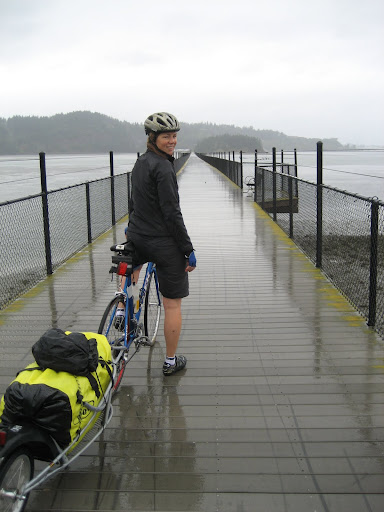 [/img]
If you are thinking about a trailer, I think the Extrawheel would certainly be the best choice for road stuff. Its lighter than a BoB, smaller (easier for trains etc.) and you can run a road wheel in it, reducing rolling resistance and a handy source of spares.
Any more for any more?
credit card/back pocket/1 pair of clean freckers/no more luggage 😉
Really can't see any advantages to a trailer for on-road touring.
Depends how much you're carrying!
We did 12 days round Devon and Cornwall in September. Clothes in panniers, tent, mats, bags, cooking gear in the trailer which I towed most of the time. Vert easy to pack and waterproof too.
One tip - If your route is hilly, make sure you have disc brakes! it got downright scary in the rain with only vees, a 50kg outfit and me to stop!
If you need more than would fit in panniers, I think you'd be better off carrying less stuff rather than buying a trailer.
Joe
I'd go for panniers but haven't ever tried a trailer. Whatever your weight, it really depends on how much you want to carry. Cost of a trailer might buy a lighter tent & sleeping bag.
My preference for road & easy tracks is heavy stuff in front lowriders - front wheel is stronger than rear - and bulky lighter stuff on the rear. Often just front lowriders and a saddlebag. You can carry a hell of a lot like this. I use handbuilt 36 hole wheels, DT/Shimano/Mavic.
But if you really want to take 'the kitchen sink' (nothing wrong with that!) a trailer is probably a good option.
And a month on the Atlantic coast of France and Spain sounds fantastic.
I have just done 1900 miles with a trailer and apart from the first day had no problems, advantages are you can drop it and have a normal bike to scoot about on. I am a big biffa so it made sense not to load the rear wheel to much. Mine is a BOB and it tracked just fine no problems. You can jack knife it to stand up. I carried about 40 pounds and it was a lot cheaper than panniers, 150 quid off e bay.
Trailers are great when you are riding along but a nightmare if you have to get on/off trains.
I did a tour with the extra wheel trailer - for all the reasons I written down previously it was a shit solution to the trailer problem - proof would be they no longer make the original style
My panniers have just arrived today 🙂
I have used panniers a lot - never used a trailer
If you go for panniers get decent racks - tubus are best. I would not use anything else having broken loads of ordinary racks over the years.
As others have said tho - beware taking too much - the lighter you are the better
Really can't see any advantages to a trailer for on-road touring.
on-road is whole advantage. Trick is to get the trailer right. One wheel trailers are better suited for off-road, two wheel trailers are better for on-road.
The key to trailers is they separate the influence of the load from the bike - you put more energy than you'd imagine into balancing the loaded bike, not just propelling the load along. One wheel trailers still need to be balanced by the rider, so they're not really that much more efficient than panniers, but two wheel trailers don't. Two wheel trailers (so long as they're hitched at the dropout and not somewhere higher up like the seatpost) don't influence the bike at all. Its the removal of that balancing effort that makes the difference - you'll either travel measureably further for the effort, or move much more weight for the same effort with a 2 wheel trailer compared to panniers, by quite a large margin. Furthermore you can load them as clumsily as you like, you don't need to spread or balance the load. Other than up hill you forget its there, your bike feels like your bike, it doesn't feel heavy or loaded (until you go through a narrow gap).
The downside as you suspect is that its an extra item to deal with getting yourself on/off of public transport. French trains are ace for cyclists once you're on them, but getting around the station and on and off the train can be a bit of a hassle, less so in some stations, but Nice for instance is like the bloody royal tornament, I can't image there are any wheelchair users in french stations, or anyone elderly getting on and off the trains - in some stations you climb up into them through narrow doors.
While a trailers is extra encumberance in this situation again 2 wheel ones are better, they unhitch easier and good ones balance well in the hand so you can wheel the bike with one hand, and trolly the trailer along with the other. With a one-wheel trailer you've not really got an easy way of dealing with it once its loaded, but off the bike.
We did the Devon Coast-to-coast with the three kids so I had a big load and the dog in the trailer sometimes.
I was really impressed how much more comfortable a trailer(2 wheels Cargo2) was over paniers.
There was no heavy feel to the bike and side to side instabillity just resistance going foreward.
Light touring I would still go for paniers but the trailer for more gear was brilliant.
I found I struggled climbing with road gearing on my road bike towing a trailer. Towing a similar weight with mtb with lower gearing was much much easier. the added weight on the rear wheel improved traction. Be aware that the additional weight on the rear tyre increases tread wear.
[img] 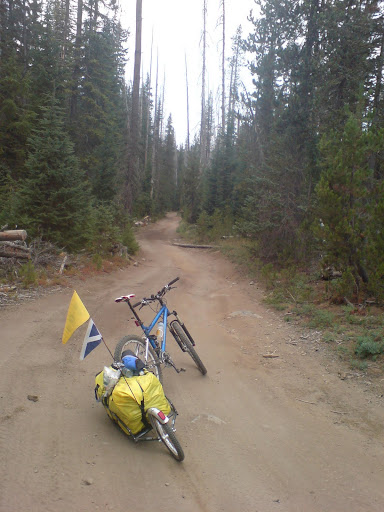 [/img]
[img] 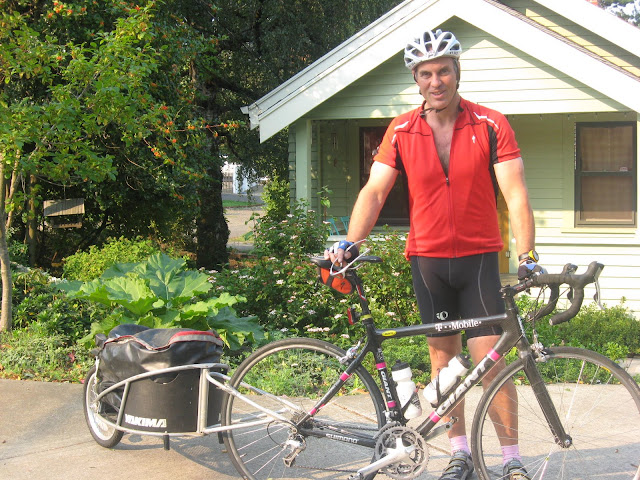 [/img]
I love my extrawheel trailer. Definitely seemed to have less effect on the bike than panniers to me.
I think the main advantage it had over panniers was there was a lot more space, so packing a lot easier. It does mean you have to resist the temptation to overpack, but it meant that I could carry the bulky but light things really easily, like sleeping bags and camping mats.
Easy to unhitch for a quick trip to the shops after a days riding too.
Met a fella this year coming back from the tour de france who'd taken his race bike to do the etape and whacked a trailer on the back. It enabled him to live like a king (stayed in hotels) 2 pairs of jeans, that kind of thing. His problem was descending. Once you get to about 30mph the trailer started bouncing around and made it unsafe which is a shame if your going to do any big climbs/descents.
I'm a big fan of Epic Design/Relavate
Panniers, I've ridden arround with soem seriously heavy stuff in my rear panniers (I moved house 1 bike trip at a time!). While they feel heavy at a junction (had an SPD style moment on flats!) once your going they just make the bike feel realy stable, bit like riding a motorbike, you do a lot more with the steering and a lot less with bodyweight.
Get some lowriders through for the front, otherwise it can feel like your about to weelie out up hills!
The key to trailers is they separate the influence of the load from the bike - you put more energy than you'd imagine into balancing the loaded bike, not just propelling the load along. One wheel trailers still need to be balanced by the rider, so they're not really that much more efficient than panniers, but two wheel trailers don't. Two wheel trailers (so long as they're hitched at the dropout and not somewhere higher up like the seatpost) don't influence the bike at all. Its the removal of that balancing effort that makes the difference - you'll either travel measureably further for the effort, or move much more weight for the same effort with a 2 wheel trailer compared to panniers, by quite a large margin. Furthermore you can load them as clumsily as you like, you don't need to spread or balance the load. Other than up hill you forget its there, your bike feels like your bike, it doesn't feel heavy or loaded (until you go through a narrow gap).
Back in the day I road alot with panniers and this doen't reflect my experience at all. The panniers just became part of the bike.
I've not used a trailer but I'm sure that they are fine
My only reservation on road would be that you loose the chance to draft each other. A day into a head wind with no drafting would be horrible. But if your on your own your on your own
Depends how much you're carrying!
As Joe says, not really - carrying so much that you need a trailer is a disadvantage of itself. Having done 10 day tours on a tandem with just rear panniers (OK, staying in hotels, but just think how little one pannier each is compare to how much you can carry in panniers on a bike), and gone bike camping with mini-aracer in a kiddy seat and just rear panniers, I'm quite certain there's no need for more than you can put in panniers.
The key to trailers is they separate the influence of the load from the bike - you put more energy than you'd imagine into balancing the loaded bike, not just propelling the load along. One wheel trailers still need to be balanced by the rider, so they're not really that much more efficient than panniers, but two wheel trailers don't. Two wheel trailers (so long as they're hitched at the dropout and not somewhere higher up like the seatpost) don't influence the bike at all. Its the removal of that balancing effort that makes the difference - you'll either travel measureably further for the effort, or move much more weight for the same effort with a 2 wheel trailer compared to panniers, by quite a large margin.
Utter rubbish. As mentioned above I've toured with my son in a kiddy seat and panniers. I've also toured with him in a (2 wheel) bike trailer and the kit in/on the trailer when he was a bit younger. Bearing in mind that the total load was higher with the kiddy seat/panniers version, we went a lot faster that way. It really doesn't actually take that much energy to balance - if you think it does then you either don't know how to ride a bike properly or you don't understand how it is you balance a bike. Of course it feels different with all that load on, and you ride a bit differently, but feels different != uses more energy. Meanwhile the trailer creates a lot more wind drag and does slow you down - I suspect I've done the comparison between the same load (one child) in a trailer and on the back of the bike than most on here, and the difference is significant, but not in the direction you're suggesting.
Furthermore you can load them as clumsily as you like, you don't need to spread or balance the load.
Maybe that's your real issue - that you have to pack a bit more carefully with panniers.
Two wheel trailers...don't influence the bike at all.
How can the additional weight of a trailer frame, two wheels and a large bag not influence the bike?! There must be a significant weight penalty to pay for that lot compared to racks and panniers, and you are going to notice that on a loaded touring bike when you start going uphill.
A properly loaded touring bike will handle fine with panniers (having taken one down a few Alpine passes at reasonable speed). I also agree that packing light makes touring a lot more fun. With the advent of trailers, some people seem to pack astonishing amounts of gear these days, and it looks like hard work lugging it all about.
I'm not the most efficient, and I easily managed to carry everything for several months of touring in four panniers (including cooking and camping gear). One of my mates was really organised, however, and could pack a primus, tent and all his other gear in a Carradice long flap saddle bag!
Utter rubbish
I used the word 'measurably' - as in weighed loads over timed set routes/distances with heart rate monitors. Subjectively carry a load any way you like; on a fixie with a shopping basket on the front, in a brick hod on a unicycle, on a pogostick with you're trangia swinging from your pierced nipples. Objectively the best way to move a weight around (that doesn't have legs) on a bicycle is to have that load rotationally de-coupled from the bike, and that decoupling benefit outweights any weight, wind or rolling resistance penalities, so long as the weight is significant.
But touring is about being happy, so do whatever makes you happy, if panniers feel better to you then do it. If your looking for reasons not to use a trailer, there aren't many objective reasons not to, but if you don't want to then fine. Fun isn't always about doing things in the most efficient way.
How can the additional weight of a trailer frame, two wheels and a large bag not influence the bike?!
They don't influence the [u]balance [/u]of the bike - obviously you are pulling the load along and that takes effort, but you're not balancing it. If you put half a tonne on the trailer you wouldn't have to put any effort into keeping the bike upright - if you stepped off the bike the bike would fall over and the trailer and its weight would stay put. If you strap that weight on the bike you have to work to balance that weight, and it takes more effort that you might be aware of.
I still don't believe you understand how you balance a bike - or maybe you can't actually ride one properly. When you're riding along the road in a straight line (which is what you spend most of your time doing when touring IME), you're simply not expending any significant effort on balancing the bike, load or no load. Or at least I'm not.
Objectively the best way to move a weight around (that doesn't have legs) on a bicycle is to have that load rotationally de-coupled from the bike
Well it might do if you were rolling your bike along sideways - personally I prefer to ride mine in a straight line, with the panniers happily following the same straight line as the rest of the bike, in which case the effect they have on the rotational inertia of the bike is pretty irrelevant.
that decoupling benefit outweights any weight, wind or rolling resistance penalities
So an effect which has no obvious basis in physics completely outweighs several others for which the physics is well defined and tested? 🙄
I used the word 'measurably' - as in weighed loads over timed set routes/distances with heart rate monitors.
So you've done lots of riding with panniers to compare against, despite your quite clear belief that it's a far worse way to carry a load? Why?
I've looked up the only data easily to hand online - the results of our cycling club come and try it time trial this year and 2 years ago. 2 years ago I pulled my son around in a trailer, this year he was in a bike seat on the back of a bike - clearly this weight is far higher up than with panniers so must have a far bigger effect on balance than any normal pannier load. Unfortunately despite the same course (5.5 miles) and very similar weather, not all conditions were the same - 2 years ago I pulled the trailer on my super-aero TT bike in a full-on aero TT tuck, this year I was on my winter training bike. This year I was reasonably fit at the time, though not in race winning form, 2 years ago the TT was 4 days before a big national race which I won. My son weighed a lot more this year. The times? 2 year ago with the trailer, 17:12. This year with the bike seat, 15:54.
Let's see your data.
panniers and disks = perfect
Trailers are better for carring odd shaped loads and heavy loads if you are in stop start traffic/roads as that is where they are easier to control. You can not ride out of the saddle with a trailer attached at the axel unless you keep the bike still as you get feed back form the trailer. I use my trailer to take my daughter to nursary and find that the trailer is better for her on those trips as she can see better and has room to take soem of her things with her. Panniers are much better if you are riding with normal loads and dont really effect the bike in any kind of wind unlike the trailer its also easier to stop with panniers than the trailer.
I am with aracer here. Having carried panniers a lot I have never noticed wasting energy to keep balanced and can see no mechanism why it should. It required no energy to balance the bike at speed. Gyroscopic precession and the castoring of the front wheel does it for you.
YOu do get an increased wind resistance with panniers ( compared to an unladen bike) - but you will with most trailers. Which is greater I don't know
i have got both and used both quite extensivly ....
in the uk in winter going bothying where i need to carry a fair few warm clothes trailer
in nz camping for 4 months - rear panniers only.
weather is the deciding factor - where your going id be a panniers only kinda guy !
as above - if you "need" a trailer to go touring there - your taking too much - hell if i dropped some serious wedge on my winter gear id get away with panniers for that too .....
[s]panniers or trailer[/s] Saddlebags.
3 months spain/france. Camping.
[img]  [/img]
[img]  [/img]
[img]  [/img]
panniers or trailer Saddlebags.
3 months spain/france. Camping.
How can I take your recommendation seriously when you went SS. 😯
I think they rode fixed 😆
I'm gonna throw frame bags into the mix now 😆
Mrs Stoner in "flat-back roadie" shocker!
I'm disappointed, Stoner - you didn't tell us lot using panniers that we're carrying too much 😉
I thought that was inferred.
Mrs Stoner in "flat-back roadie" shocker!
I have no idea what that means but it sounds dirty. Thank you. 😈
I'm totally aware of how bikes are balanced when you ride them, but its naive to imagine they are balanced without any input from the rider, I'm not saying its enormous, but when the load is heavy its enough for there to be a benefit detaching that load from the bike. The tests I'm referring to relate to a 16kg load on the bike and comparing to a 16kg load on the trailer and then a 32kg load on the trailer. In a work fleet context so some stop/start and lower speed manouvering in the mix.
Most of your effort, once you get going from stationary is still pushing your bike through the air, and on a hill dragging it against gravity. And the load, even heavily loaded for touring, is still small compared to the rider, so its only that small portion of the effort that we're talking about.
If your load is quite light though, such as in stoner's example (or even Ton's) the efficiency benefit deminishes, but even in that context I still prefer the feel of the bike with a trailer over panniers.
I'm totally aware of how bikes are balanced when you ride them, but its naive to imagine they are balanced without any input from the rider, I'm not saying its enormous, but when the load is heavy its enough for there to be a benefit detaching that load from the bike.
But a bike (loaded or not) will quite happily balance all on its own when going at speed. How much effort do you really think it takes?
The tests I'm referring to relate to a 16kg load on the bike and comparing to a 16kg load on the trailer and then a 32kg load on the trailer.
So not actually at all comparable to having panniers and no trailer - you have the disadvantage of a trailer in both cases, so your figures are meaningless in the context of this discussion - it would seem mine above are the only useful ones.
In a work fleet context so some stop/start and lower speed manouvering in the mix.
So not really comparable to touring either, where you're mostly tootling along a road. I'm happy to accept in that context a trailer might feel better, but that's not what we're discussing.
Most of your effort, once you get going from stationary is still pushing your bike through the air, and on a hill dragging it against gravity.
Indeed, so adding the extra weight and wind drag of a trailer isn't likely to help is it?
you have the disadvantage of a trailer in both cases
no - carry a load on a bike only, then carrying the same load on a trailer instead - no load on the bike, then carrying double the load on a trailer with no load on the bike.
In that context you could carry 16kg on the bike or 32kg on the trailer for approx the same effort
the trailer weight isn't all that significant in the scheme of things, and its tucked right in behind you with less frontal area than two panniers
I'm with aracer.
No way does balancing loaded touring bike require physical effort, just mental, which you get accustomed to.
skidartist - Member
less frontal area than two panniers
Surely the panniers are, to a large extent, behind your legs - in which case they have little aerodynamic effect.
In the context of a thought experiment or in the context of making measurements of effort? At what point do we introduce a theoretical conveyor belt?
That said, do whatever you feel is best, if we were sensible you'd get the bus instead
You haven't seen my skinny legs druidh 🙂
😆
but I've got huge feet infront on the trailer bag
I look like spike milligan drew me
I'm inclined to agree with skidartist on this one.
Anyway, what about the price and usefulness of each option? If you intend to do a fair bit or touring investing in racks and pannier might be worth it. Most folk might need to get stronger wheels for the extra weight of those panniers at least, especially if you have a more modern road bike with lightweight wheels. This could get expensive. Then there's the faff of fitting panniers to get heel clearance and bolting the racks in the right place. Touring bikes are longer in the chainstay for better stability and heel clearance.
However a trailer, while a decent cost on it's own, might be much cheaper. Your bike won't need stronger wheels as the trailer wheels take a lot or all of the weight. This means you can use a normal road bike ( as one of the posted pictures show). It's a more simple set up. You don't have to pack as carefully as the bag is bigger (less carefully doesn't necessarily mean more weight) and you don't have to spread the load evenly. You can also bolt the trailer to other bikes you have, and getting a single wheel one like a Bob means you could off road touring as well.
So even if the bikes do handle the same, the trailer may be a cheaper, simpler and more versatile option. Obviously depends on your circumstances but itd be my first option to try.
Don't forget a bar bag though. Best thing in the world for touring!!
Some useful thoughts on decoupling a load here:
[url= http://www.carryfreedom.com/downloads/Trailer%20Science.pdf ]Trailer Science[/url]
I own a Carry Freedom City trailer. I use it for heavy loads like shopping and in my experience it's easier to handle than a similar load in panniers.
Now, when touring you shouldn't really have such a heavy load! Light is good. I have used dry bags on bars / top-of-rack and a frame-fit bag when touring and found that a great solution. I found it a very aerodynamic and light way to carry gear on a bike.
Hope that helps!
Another practical advantage of panniers for me is that I can easily have all my kit to hand inside the tent (one man Terra Nova - rear panniers and one front inside the fly space and one front with valuables inside the inner). I think that would be difficult with one big trailer bag. Separate panniers also make it easier to strip the bike down if you want to carry it into the woods to find a quiet wild camping spot.
I've never used a trailer, but I have always assumed that the handling must be a bit more stately - surely you can't flick the bike in and out of corners so smartly when you are pulling all that extra wheelbase behind you?
I did think one trailer solution I saw an American couple using was quite smart. They were touring with folders, and the hard shell flight cases for the bikes converted into wee trailers that they towed behind the bikes.
IME panniers especially front ones do add significantly to the wind resistance. Even just rear ones does. However I don't know how thios would compare to a trailer.
As for cost - I don't know there is a huge amount in it if you get quality racks and panniers The setup on the tandem was a couple of hundred pounds - tubus racks front and rear and carradry bags front and rear.
However I am convinced there is no extra effort involved in balancing the mass once above walking pace. Our set up (tandem) touring is well over 200kg all up weight.
The ideal with a trailer is you shouldn't need to change anything about you're bike, lower gearing is nice, but thats about it. You don't need to have a dedicated touring frame, or stronger wheels.
A trailer pack isn't more cash than a pair of panniers, a trailer is more than a rack, but its cheaper than buying an extra bike. It was mentioned above that you could save the money for a trailer and buy a lighter tent, but a hundred and odd quid is only going to shave grams off a tent. If you're already invested in panniers - you've got a bike with braze ons, low bb, strong wheels, racks and panniers and you're accustomed to riding it then is a bit of a step to switch to a trailer as you make all that other stuff redundant. But from scratch a trailer is the cheaper way to go.
Bar bags give me the boak, if you've got panniers on you might as well use one too, but on their own - no chance. But theres a tiny wee pack that topeak make that sits behind the stem and means you're camera is always to hand, they're ace.
I recently bought my wife a Topeak bar bag, under £30 and it looks quite small. However its just the right size for keys wallet phone etc, well padded and converts to a good bum bag thing when you take it off. Also the bracket for it has a removable mount to put computer or lights on so it gives you back the bar space the bag mount uses. Really excellent - more and more impressed with the Topeak one.
Mind you it doesn't have a map case like mine does which is invaluable. Not having to stop to figure out directions is fantastic.
That trailer science link was great almost totaly data free
I'm sure trailers are fun but I'm really not buying the balance effort thing at all.
It is fun reading made up physics though 😉
The only bit that sounded true was the the thing that Skidartist said about stop start utility biking. If I was riding around town with a big load getting on and off then I think a trailer would save time and effort as you do have to hold the bike up as you get on. But my touring experience has been that you don't do that very often.
There might also be a load where the benefits of a trailer kick in and it may be around 36Kg. The only time I ever felt I was fighting the bike was riding into Auckland from the airport. I had say 16kg of touring gear in panniers and about 20kg of climbing gear in an 80 litre rucsac strapped onto the rack. That was hard work and balance felt odd. But you'd need to be carrying a months food to reach that kind of load
it's an attractive idea that aerodynamics suffer with panniers but I doubt any of us can really state that authoritatively, or that it's significant. There are too many other factors.
Anyone remember the front panniers from the early 80s with the curved leading edge profile that actually claimed to improve aerodyamics...!
Trailer Science
That wouldn't be at all biased would it?
http://www.carryfreedom.com/
Complete junk science too - they mention that it costs more energy to lean a bike with panniers on, but then go on to suggest that you lean your bike all the time because of "every time they turn their pedals they and their bike wiggles, slightly to the left then slightly to the right. That’s a slight wiggle every turn of the pedals, 60 times a minute, 3600 times and hour." I don't suppose they'd stopped to consider that you might just put the same amount of energy into this wiggling but wiggle the bike a bit less. Also "as cyclists turn corners, again the bike will lean left or right" - which uses how much energy (I suspect they don't understand how a bike balances either)?
It is good that link - full of assertions with no explanation.
However if the panniers moving side to side wastes energy ( and i believe it will) this is only at very low speeds - at higher speeds gyroscope precession and self castoring hold it vertical
The same movement however would yaw the trailer (move side to side this wasting the same energy)
My[i] [b]guess[/b] [/i]would be that on the flat a trailer is marginally more efficient mainly from aerodynamics but once you do a lot of stop and start or hills the panniers would be as there is less total weight to be lifted or accelerated.
Very marginal tho.
cynic-al - Memberit's an attractive idea that aerodynamics suffer with panniers but I doubt any of us can really state that authoritatively, or that it's significant. There are too many other factors.
True but I do have anecdotal evidence - a wide set of front panniers ( big rears as well)on the tandem our top speed down glencoe was 35 mph. On similar roads without panniers we reach 45+easily mph.
Lots of factors for sure but certainly the frontal area was greater and it appeared to me that the aero drag built more quickly that without the panniers
I'd say the same as TJ regarding the panniers aero drag - have no hard data, but I've ridden the same bike on the flat with and without and there's certainly a slight speed decrease with.
Not that I'm convinced there's actually less drag with a trailer because it's sitting in your draft - so are my panniers.
interesting TJ but that is a huge difference in speeds to be accounted for by the panniers. Doesn't wind resistance increase exponentially with speed?
Some friends of mine are much slower downhill on their tandem when they are towing a trailer. I can actually freewheel beside them. I don't think panniers would be any worse.
I've never used a trailer, but I do like the idea on being able to ride a road bike and just unhitch the trailer for day if I want a nice light bike for a circular ride.
al - wind resistance does increase exponentially with speed. Thats why you reach a terminal velocity. with the panniers the terminal velocity was a lot lower.
Anecdote tho - and it was a big wide pannier setup
'I'm totally aware of how bikes are balanced when you ride them, but its naive to imagine they are balanced without any input from the rider, I'm not saying its enormous, but when the load is heavy its enough for there to be a benefit detaching that load from the bike.'
vs
'But a bike (loaded or not) will quite happily balance all on its own when going at speed. How much effort do you really think it takes?'
it takes a lot less energy than pedalling, but since we constantly steer / lean a bike to keep it upright and that takes input, it does use energy - concentration as well as a small amount of muscle power.
bikes are balanced at all speeds not by centrifugal force, but by the rider steering into the sideways fall, thus keeping the c of g hovering around the centreline / balance point between the wheels at all times. how our c of g is balanced and how it interacts with teh steering geometry and moves around this centre line is what determines bike handling.
centrifugal force adds stability but is not what keeps the bike upright in the first place. if it did, you could 'ghost' a bike down a long straight hill for miles. in reality it veers to one side and falls. at low speeds this shuffling of your c of g over the centre line, back and forth, requires steering input. so when touring, more energy is expended by steering / balancing a bike with heavy panniers on than when towing a trailer. your steering input has to move bags on teh fork as well as teh frame in most cases. since touring involves (ime) a lot of time going slowly uphill and steering input per mile is greatest when climbing, there's a sound reason to say that less energy is used in controlling a bike (not just pedalling it) when the painners are lighter, or better still, the load is supported independantly on a trailer.
a similar example - i've found more stable road bieks to also be better over long distances, not because less twitchy steering means i move less ansd save energy that makes the difference, but because i need less concentration when tired to keep it on line. it's subtle but it's noticable that i feel better on the more stable bike teh more tired and slower-reacting i get.
James - yuo forget gyroscopic precession and castoring - those are two effects that hold the bike upright.
yes TJ...but a 30% increase in speed means an even greater reduction in wind resistance - panniers alone could not account for that and so something else must have been at play.
Al - think about he nature of it. Yes other factore could be in play but 30% increase in frontal area? Two big fat panniers on a wide mounting at the front of the bike?
It may not be the only answer but on that tour I really felt the two big wide front panniers increased wind resistance significantly.
Only anecdote tho
TJ, castor helps you steer by adding stability at speed, gyroscopic affect also adds stability but the principle of your c of g moving around the centreline is what actually keeps you balanced over the 2 wheel's axles. castor and gyro are only a part of it by aiding stability as speed increases. think of how you balance when ttrackstanding )
a bike can be steered without any castor at all, and super-light wheels that have little gyroscopic effect against a 100kg rider, because of the principle above. it wouldn't handle well, but you could ride it )
you're right on the wind resistance thing TJ, it makes a huge difference. cervelo focus on drag more than weight as once you're over around 12-15mph the ratio of weight of a rider vs bike is less significant compared to the frontal area of rider vs bike.
James - gyroscopic precession is a self stereing mechanism as is castor.
At high speed they provide the stability
think about rolling a wheel down a hill - no bike. At high speed it goes straight - its only as it slows that it falls over - oir think about the gyroscope balancing.
you're right, they add stability. but the wheel will tilt and fall at any speed, it cannot carry on indefinately.
this is a real QI question for cyclists, you may be suprised by how many designers and even non-cycling physics types say castor and gyro or one of the two, but those two only aid balance at speed. 'steering into a fall' is what makes it possible to ride a bike at very slow speeds or trackstand to stay upright. and we all do it all the time without thinking about it - it's the 'eureka moment' when you learn to ride a bike - how much steering corrects the fall and how much is too much.
another example, think of how a slack angled dh bike can be carved from one extreme lean to another more easily than a road bike. the castor and gyro effect aid stability, the castor (long trail) is really just adding to the ability to swing your c of g from side to side with control, ie to pull it back from a fall / extreme lean angle without crashing.
ps edit to say that wheel example, it only goes straight if you set it off straight..
also, think about how you initiate a turn. you steer momentarily against the direction you want to go to initiate a lean/fall to the side you want to turn to. you then steer in that direction of the turn to balance your c of g on the centre line of the wheels for that given radius of turn (or close of the centreline, as centrifugal force balanced against your weight will also come into this, but then it's getting more complex to discuss and i'm not into the maths there!)
heavier wheels and longer trail / castor effect make it a bit harder to steer / be bounced off-line / initiate a turn due to the stabilising effect you point out, and therefore they feel more stable. it's because they both work against you steering into the fall initilly, but alone are not enough to stop you steering - or to keep the mass of ther rider upright above the axles. that would require some weird gravity )
apologies for the hijack there OP )
frame bags are a good compromise - it's what i'd use next time alongside a rack-pack and a small rucksack for light bulky items though the rucksack did limit my speed to about 50mph in the Alps last time i did a light-road tour there. caught the wind quite noticably, maybe 5mph slower than the same road w/o a bag?
side-winds may be an issue with a frame bag but that may be a blessing on some days..
TJ its not just about frontal area.
and as its exponential (square IIRC) its not 30% but more like 70%.
Al- have a think aboiut it. You have got your exponential s muddled
Wind reistance is proportianal to frontal area. Its exponential to speed.
So at a steady speed double the frontal area double the #wind resistance. As speed increases wind resistance increases exponentially.
so 30% more frontal area = 30% more drag.
As I said tho it will be multifatorial but it felt to me like that set up of very fat wide front panniers increased wind resistance singnificantly
James - have a read up on gyroscopic precession. Its really weif#rd but it does hold the bike in a straight line - as I say think about rolling a wheel down a hill. its gyroscopic precession that holds it straight and upright.
Cornereing ( at speed) You want to turn right. You steer left. Gyroscopic precession topples the bike to the right and moving the contact patch to the left topples the bike to the right - this initiates the turn. as the bike leans gyroscpic precession returns the bars to the midline. Cornering force is not generated by steering angle - it is generated by camber thrust from the wheels. You remain in a steady state of cornering with the bars in the midline unltil you initiate a corrective steering movement.
However wobbling is different. Riding along in a straight line and start to topple to the right - gyroscopic precession turns the bars to teh right which then steers the bike to teh right bringing the contacvt patch back under the cog. self correcting.
Frames bags, better load distribution and less wind drag than paniers.
TJ, you seem to be assuming that gyroscopic precession / effect is more influential than your own steering input or placement of your c of g in relation to the axles, but it isn't. the gyro effect of a 1500g wheelset rotating at whatever rpm it does at 10-40mph is a small force compared to the pull of gravity on you. i can hold a spinning wheel at the axle and move it about at arm's length, but i'll bet i can't move you about at arm's length. also, your wheel example, it will fall pretty quickly. gravity will take care of that and it's tilting around its base, not pivoting at the axle. it doesn't pull itself upright as it rolls faster, which would be in support of the gyro argument if it happened. (edited, not 100% on this bit tbh - but it will fall based on its c of g and base stability right?)
I understand the basics of gyro precession - don't ask me about the maths or physics in detail ) but i know what you mean. we've all played with a spinning wheel and many of us of a certain age or older had gyroscopes as toys when we were young, but it's not true that the gyro influence of the wheel is what makes a bike 'work'. it helps at high speed, that's all.
"Cornereing ( at speed) You want to turn right. You steer left. Gyroscopic precession topples the bike to the right "
in fact, you steer left, your centre of gravity moving onto the right side of the line between the tyre contact patches makes you fall toward the left, not the precession. you then steer into this fall and carve a line to the right. precession will influence and aid this by being a force to react against that will help to lean the bike but it's not the significant force at work here. it's proportionally greater as speed increases, it does aid stability and yes, in turn steering, but it's not why a bike is steer-able in the first place. for precession to aid stability or steering we have to get up to a speed where the gyro effect is significant, and that involves steering using your centre of gravity. precession can't be a factor on a slower, technical trail either as the speeds are lower, more variable and the wheel is moving around too much to build any satbility. here it's 99% c of g steering.
bikes are brilliant really, always falling to some extent but always upright while the rider has influence and control over their c of g.
if gyro precession was the main reason a bike worked, i'd be spending less time looking at bike fit, rider positioning and front end trail etc, and more time working on wheel size and weight (que a pro-29er argument, or a 'so that's why your bikes suck' comment from someone!)
James of corse both factors are at work but You underestimate the effect of gyroscopic precession at speed. it is what keeps you upright
How would a wheel roll down a hill without toppling without this effect