UPDATE: Reviews section refreshed, redesigned, searchable: Go take a look
The colour of the party doesn't matter. They'll continue to privatise by stealth for as long as there's a revolving door where government ministers walk straight into highly paid boardroom roles with the private companies who have been the beneficieries of their policies
This is very true. However the electorate do have one trick up their sleeve. The one thing elected politicians worry about, truly worry about, is the thought that things might go tits up on election day and that they might not get elected. And believe me if the threat is big enough they start to seriously worry.
So staying at home watching telly on election day instead of voting doesn't, despite the obvious appeal, "teach politicians a lesson". Getting out and voting for their opponents however does.
It's with this simple truth in mind that some in the healthcare professions formed the National Health Action Party to target key coalition seats.
So rather than not voting "because they are all the same" a far more sensible response, if the NHS matters to you, would be to be proactive and get out and vote. Or even, god forbid, do a bit of canvassing/election work.
http://www.nationalhealthaction.org.uk/
I know it's the model we know and have grown up with, but who says it's the best one for the UK given our current and future health needs and financial situation?
Why shouldn't it be changed?
Interesting this. Mrs Daz works in the NHS and doesn't have much good to say about her experiences of private sector provision of services. I guess the question is, do you trust a private company to deliver the same level of care (or better), for less money, so that they can take a slice in profit to pay their shareholders?
The free market mantra that profit driven private companies will deliver greater efficiencies and hence better services is all very well in theory, but as has been shown in other privatised industries, a free market is not what will happen. Instead the market will be carved up between a few big providers who will run it as a virtual monopoly with profiteering, price fixing and all the other dubious practices such as offshore accounting, tax avoidance etc. And yet we're told they will provide better services, for less money. Yeah right.
All people who think the NHS is not the best option have to do is come up with a viable alternative...
I wonder how many Brits ask themselves why no other country in the world has an NHS model. Anything to do with the fact it's very, very expensive?
Healthcare is very expensive, but the NHS is way more efficient that the USA model which always shows up as the least cost effective system whenever they compare different models.
However, if you're a Tory minister looking for a nice well paying NED when you next lose the election, having a load of private companies creaming off 100s of £m from the NHS budget starts to look like a very good model (for retirement funding).
I know it's the model we know and have grown up with, but who says it's the best one for the UK given our current and future health needs and financial situation?
Who says it isn’t? Those with commercial interest in the alternative seem to be enjoying the biggest audience at the moment. Not much counter argument is getting made.
There are two sides to every story, and anyone you care to ask currently seems so far to have only heard one side.
One problem is that there are few people alive who remember what it was like before we had an NHS. My parents do and they think that, even in its run down state, it's the best thing about this country. My experience of public and private healthcare leaves me in no doubt that I would like to see no private healthcare at all, all surface gloss and crap patient care (proper patient care not nice meals and fancy rooms).
Interesting this. Mrs Daz works in the NHS and doesn't have much good to say about her experiences of private sector provision of services.
Likewise. I have encountered a few charity/third sector providers of health/social care that were previously NHS, and a couple have done well for their patients and their balance sheets, and and a couple have not. Of course these are without sharholders and invest any surplus back into sefvice provision. Serco, Virgin and ISS who all have big contracts near here are not doing terribly well and generating a good deal of ill-feeling and dissatisfaction from their patients, whilst somewhat amusingly, the three NHS trusts from which they picked off profitable services are really doing rather well considering... However I am yet to hear of any provider failing in the delivery services on behalf of the NHS blaming the financial mess left by their predecessors. 😆
I guess the question is, do you trust a private company to deliver the same level of care (or better), for less money, so that they can take a slice in profit to pay their shareholders?
In my professional experience, no. Don't forget also that the cut in staffing costs trickle down to a reduction in income tax and NI paid into the treasury from the employees providing the same service, (either by using fewer employees, or similar numbers on non-agenda for change payscales or 'rebanded' to lower pay grades) whilst the profits made from delivering that service at same or reduced cost to what was spent doing it via NHS will be subject to some extremely clever tax-accounting before any of it comes back into the treasury as tax. 😈
However, if you're a Tory minister looking for a nice well paying NED when you next lose the election, having a load of private companies creaming off 100s of £m from the NHS budget starts to look like a very good model (for retirement funding).
Nail on the head there. I find it hilarious that the old unionised industries were shut down for being 'inefficient' and requiring too many state subsidies, yet the exact same thing is happening now but instead of it being called a subsidised industry, it's called 'outsourcing'. The main difference of course is that instead of the subsidies going into state owned institutions (some might call this 'investment'), it's going straight into the pockets of private shareholders.
I wonder how many Brits ask themselves why no other country in the world has an NHS model. Anything to do with the fact it's very, very expensive?
Would you like to post up some facts to show that ah sod it I will show that to be BS myself
for example UK is 9.6 % of GDP and the USA is 17.9 % and they dont even cover everyone.
Ok europe
Germany 11.6
France 11.9
Greece 10.2
Portugal 11%
Shall I go on or will that do?
http://data.worldbank.org/indicator/SH.XPD.TOTL.ZS
Perhaps a picture
[img] 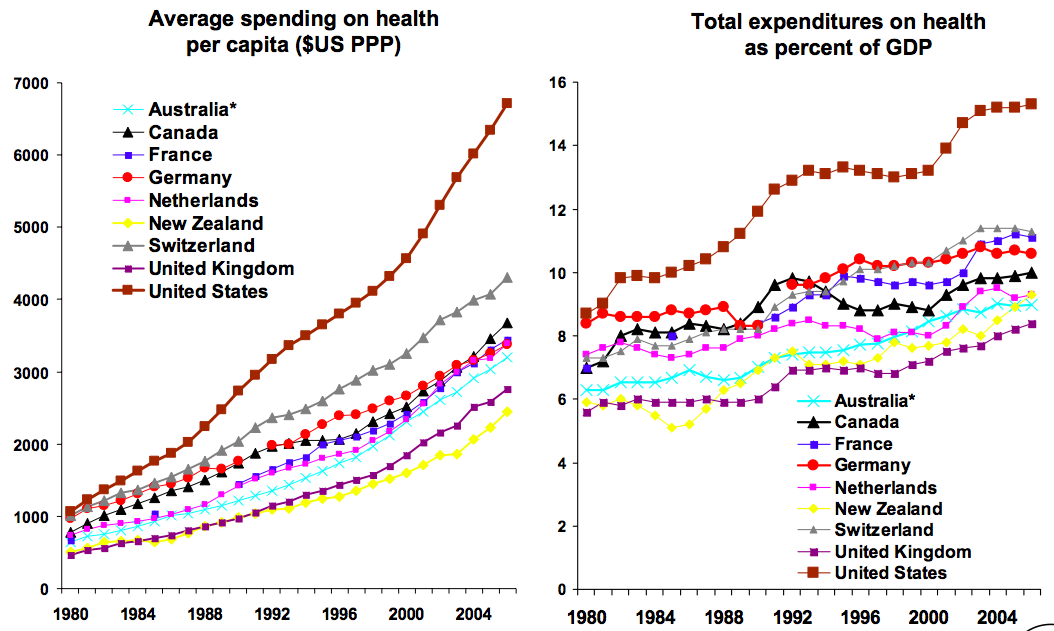 ?w=500&h=299[/img]
There is a ten minute edit if it helps.
Ok that I will watch
I know it's the model we know and have grown up with, but who says it's the best one for the UK given our current and future health needs and financial situation?
Why shouldn't it be changed?
Can you put forward an actual reason why it should be changed ?
Crosses fingers it works better than your it is expensive argument
While the previous Governments inflicted PFI arrangements on the NHS which some trusts re having to spend over 25% of their budgets to service, I have to say that this current shower of way-anchors are sending this country further into the neo-liberal pit of despair.
I guess the question is, do you trust a private company to deliver the same level of care (or better), for less money, so that they can take a slice in profit to pay their shareholders?
You only need to look at private enterprise and note that if they get hold of critical public services there will be less money for services because of profit, and when they fail, we the tax payer pick up the tab. You only need to look at G4S and the olympic security debacle to see that it was public servants, the army how came to the rescue.
Unfortunately, because of the lack of profit to be made elsewhere, these corporations have been targeting the cash cow that is tax payer funded public services.
Wait until you see what they have lined up for the justice system.
This is a government that doesn't like government.I said on this forum before that this is a government of political suicide, but by the time they leave office the damage would have been done.
I don't expect any of the main parties to set it right. Corporatism is now the adversary of democracy.
Ok, I'll wade in.
I run 3 acute care dentist surgeries, 12 dentists, 40 staff. They open 8-8 every day and operate that service 365 days a year. They were run previously by salaried staff (within the NHS). When I joined (just after the takeover) we were seeing about 4-5 acute patients a day. With a bit of reorganising we're now seeing 15-20 acute patients a day. We offer the same level of care to the rest of our patients, as we still operate the same hours, and have the same time limits, we just have better organisation and structure to the day, something that the salaried staff had no reason to bother with...(and still complain loudly about). Loads of my patients are exempt, they get the same level of care and attention that every-one else gets. When you go to your NHS dentist, ask them which company they work for...
Some parts of the NHS need a dose of reality. I can send my NHS patients to a private clinic operating wholly within the NHS for M.O.S* and they get seen next day, or I can send them across the road to the same service run by the NHS were they will wait a month. As they are referrals within the NHS both patients pay the same. £49...which would you rather go to?
I love the NHS as much as the next wailing leftie, but I've seen the consumables they got through, the waste of money on computer systems and OPT installations and on and on and on...
*Minor Oral Surgery...we love our TLAs like a fat kid loves cake....
Might [i]Minor Oral Surgery[/i] be the kind of service cherry picked by the private providers? Does that compound the problem? Private providers can no doubt turn a profit on those straightforward jobs, and I guess it works great. When complications arise and things get unprofitable, what happens? Those private providers have a legal duty to act in the best interests of their stake holders, no?
An aunt of mine quite quickly found the private practise surgeon that left her in a state was suddenly very hard to get in contact with when she started asking for his mistakes to be corrected. It got sorted by the NHS when she finally showed up at the local A&E in a state.
So the private providers fall over themselves to get hold of the profitable, straightforward cases and will succeed in winning those bids, able as they are to outbid the social remit competition by having access to far greater funds (I imagine credit cards and mobile phone tariffs must be a good earner, though I’m not so sure about planes, railway franchises, beauty products, space travel and record breaking balloon trips) and what’s left of the NHS ends up dealing with all the complicated, expensive things.
I was given remedial keyhole surgery on my leg last year. Cleaning up the cartilage, quick job. My consultant at the NHS hospital referred me immediately to his own private practise. I was given my own room in a private hospital with fresh towels and soap in the hotel style bathroom, a copy of the Mail on the table, Sky on the telly and a view over a manicured garden out of the window. I was in and out within 5 hours, sent away with six weeks of physio scheduled in my posh appointment card.
When I did the original injury, had to have my leg realigned on the hill to maintain blood flow, was brought in with a shattered mess where my ankle used to be, requiring five hours of emergency surgery, a raft of x–rays and scans, casts, follow up surgery to remove screws, more casts, crutches and three months of intensive physio followed by a long period of trial and error orthotic treatment at a podiatry clinic to get me back on my feet, I wonder how quick that same Consultant would have been to get that little lot on his private books.
[b]El-bent[/b]
Wait until you see what they have lined up for the justice system.
Start a thread. This stuff needs talking about.
The legal aid changes are another very telling factor in this debate.
http://beforeitsnews.com/economy/2013/03/60-of-us-bankruptcies-due-to-medical-bills-while-78-of-those-bankruptcies-have-insurance-coverage-2500492.html
Have you seen the links on the right hand side?
Everything from conspiracy theories to insane ramblings!
Having experienced both private and public healthcare susyems, the NHS is a beautiful thing that constanlty needs to reform but is worth holding on to.
To all the naysayers and privatisation experts out there- tell me you will be happy with 60 quid visits to the GP and several thousand pound bills when you fall off your Carbon 29er in some man made trail centre
(lol- the last bit is a joke but a poke at some individuals who can afford private healthcare at a drop of a hat)
Here you are thisisnotaspoon, perhaps CNN is a more acceptable news provider for you :
[url= http://edition.cnn.com/2009/HEALTH/06/05/bankruptcy.medical.bills/ ]Medical bills prompt more than 60 percent of U.S. bankruptcies[/url]
They're quoting The American Journal of Medicine btw, I'm assuming this particular journal isn't part of the conspiracy theorist movement ?
[i]Private providers can no doubt turn a profit on those straightforward jobs,[/i]
You got it about face, patients go to MOS when they are complex, when our general dentists don't think they can do it. So actually it's not a cherry pick, quite the reverse in fact. the private clinic do it as it gives them access to complex cases, as it makes them better dentists.
[i]Those private providers have a legal duty to act in the best interests of their stake holders, no?[/i]
No, our dentists are essentially contract workers to avoid exactly this sort of conflict of interest.
Thing is, there are surgeons in the NHS who take pride in the fact that they don't know the cost of things...which is fine, if you've got a bottomless pit of cash, but when you've got a patient list of 6000, and you've spent your budget by patient 4500, that's bad.
If you want a snappy one liner, the NHS is utterly brilliant at patient (singular) care, it's utterly failing at patient (plural) management.
My cousin's husband and daughter need regular meds, one for high BP and the other for asthma, they live in sunny california and it consumes 25% (yep that one full quarter) of each of their salaries just for the drugs and bi-monthly check ups. Their medical insurance premiums are sky high, they leaped up several fold as soon as each of them was diagnosed with an ongoing health problem.
Gail had her gall bladder removed (same op as MrsCat) we got it nice and free, it cost Gail $7000 as her excess for the insurance.
Competition does not enter into it, there is nowhere else to go, you have to use the services there in front of you, the prices of alternative treatment centres are within a few dollars, to quote Gail "You just gotta suck it up!" (yes she has developed a hideous Californian accent).
D'ya think Virgin will run maternity wards?
No - that'll be taken up by Easy.
Appreciate the feedback, nickc.
thisisnotaspoon - Member
http://beforeitsnews.com/economy/2013/03/60-of-us-bankruptcies-due-to-medical-bills-while-78-of-those-bankruptcies-have-insurance-coverage-2500492.html
Have you seen the links on the right hand side?Everything from conspiracy theories to insane ramblings!
As soon as I saw the beforeitsnews.com in the URL alarm bells rang; that's the same site that had the conspiracy video about the Woolwich murder, so they're about as trustworthy as The Sun or The National Enquirer, as far as I can see.
Shall I go on or will that do?
http://data.worldbank.org/indicator/SH.XPD.TOTL.ZS
I might be being thick but I can't find any definition on the World Bank site of what this covers? What like for like comparison is it making?
I'm not pro-privatisation particularly, just not convinced NHS is going to be the best way forward, especially is the UK population at large is making a heroic effort to stuff it's face full of crap and make itself ill, without thinking about what this is going to cost the taxpayer...
+ we're all going to be around for close to a century and I can't imagine looking after all those doddery oldies being too cheap...
Would I be right in thinking in the US your likely to have healthcare insurance denied if you make more than 3 claims?
This is not a statement, it's a question.
ernie_lynch - Member
I suppose you haven't heard of the BMA, the royal colleges, and all the other healthcare professional organisations, who are opposing the privatization of the NHS ?
Its funny when the same people who were opposed to the establishment of the NHS in the first place (that is until they were bribed with a new pension among other things) are now perceived to be its saviours. What a funny old world!
Not really that funny. The BMA [i]were[/i] opposed to the creation of the NHS, what would be peculiar would be that if after decades of proving what a success the NHS has been, and the stunning benefits it has provided to the British people, the BMA was still opposed to it. That would be very peculiar indeed.
Its funny when the same people who were opposed to the establishment of the NHS in the first place (that is until they were bribed with a new pension among other things) are now perceived to be its saviours. What a funny old world!
Not funny at all,but never trust the establishment.
Funny = ironic, not ha,ha
Consultants know exactly which side of the bread is buttered. Why change a winning situation for them?
Consultants know exactly which side of the bread is buttered.
So you think patient care doesn't come into it then ?
That is a remarkably low opinion that you have of senior healthcare professionals teamhurtmore.
Sadly at the moment it comes from painful personal experience Ernie. Plus listening to the now departed Sir ? Nicholson being interviewed recently about his priorities. In order - his systems, then his staff oh and then the sick people. From the horses mouth......
I thought David Nicholson was a civil servant, not a consultant or member of the BMA ?
He certainly knew "which side of the bread is buttered", that's for sure - I'll give you that.
And he was certainly handsomely rewarded for failure, as is now the custom in the upper echelons of British management.
But what a pisspoor piece of evidence to back up your claim that "Consultants know exactly which side of the bread is buttered" 😕
Its funny when the same people who were opposed to the establishment of the NHS in the first place (that is until they were bribed with a new pension among other things) are now perceived to be its saviours.
the BMA never actually opposed the nhs as such they merely disagreed about how it should operate and they supported the principle but discussed the how.
none of their requests included pensions that I am aware of.
The majority of doctors were opposed to the introduction of the NHS as they believed that they would lose money as a result of it.
Source http://www.historylearningsite.co.uk/national_health_service.htm
we could do a uni essay on this and some short soundbites late at night wont cover it.
They never opposed universal health care just how it was implemented
I kinda like the late night soundbites.....
“I should have thought and we all hoped that the possibilities contained in the Act would have excited the medical profession, that they would have recognised that we were setting their feet on a new path entirely, that they ought to take pride in the fact that, despite our financial and economic anxieties, [b]we are still able to do the most civilised thing in the world – put the welfare of the sick in front of every other consideration. I therefore deplore the fact that the best elements of the profession have been thrust to one side by medical politicians who are not really concerned with the welfare of the people or the people of their own profession,[/b] but are seeking to fish in these troubled waters. I hope the House will not hesitate to tell the BMA that we look forward to this Act starting on July 5, and we expect the medical profession to take their proper part in it because we are satisfied that there is nothing in it that any doctor should be otherwise than proud to acknowledge.”
Aneurin Bevan 9 Feb 1948, House of Commons
And how did he change their minds?
By, "stuffing their mouths with gold." Bevan again.
Perhaps we can agree to disagree on the position and motives of the BMA!! But hopefully In those days, Bevan was engaging in more than soundbites?
My understanding has always been that the BMA were opposed to the creation of the NHS but this had little if anything to do with money. At the heart of their objection was status, they did not as government employees want to be merely "civil servants", which they considered to be an unfitting social status for doctors. That is why concessions were made and GPs were allowed to be self-employed practitioners and work under contract.
The other main basis of opposition would have been political. The creation of the NHS was very much seen as a socialist policy, which of course it was. As most medical students were invariably recruited from the ranks of the bourgeoisie doctors had a natural tendency to oppose what they saw as socialism. And to be fair a universal nationalised healthcare service was an untried experiment outside the Soviet Union.
I don't know if they "stuffing their mouths with gold" was what eased their pain, I guess it's plausible. But I do know that after seeing how successful the NHS was/has been, and the enormous benefits it brought ordinary people, the BMA changed their minds. Which as I said, is hardly peculiar.
decades of proving what a success the NHS has been, and the stunning benefits it has provided to the British people,
Any data to back up that assertion, rather than anecdote?
Here's some evidence that we may not actually be very healthy at all...
[url= http://www.bbc.co.uk/news/health-21654536 ]UK 12th place out of 19 in Lancet Study[/url]
And from: [url= https://www.gov.uk/government/policies/reducing-obesity-and-improving-diet ]In England, most people are overweight or obese[/url]
In England, most people are overweight or obese. This includes 61.3% of adults and 30% of children aged between 2 and 15. People who are overweight have a higher risk of getting type 2 diabetes, heart disease and certain cancers. Excess weight can also make it more difficult for people to find and keep work, and it can affect self-esteem and mental health.
Health problems associated with being overweight or obese cost the NHS more than £5 billion every year.
Surely we need a kick up our ever-increasing backsides rather than "do what you like to yourself and we'll patch you up for free" approach currently offered... removing sentiment about private vs state provision I really can't see how the current setup is providing better health outcomes if year on year, the data shows our health getting worse...
Here's some evidence that we may not actually be very healthy at all...
🙂 Who said anything about the British people being "very healthy" ?
I said that the NHS has been a success and provided stunning benefits to the British people. Few people would disagree with that, although some, such as Dan Hannan, and presumably you, will.
Here's an opposing point of view for you :
If we're 12th out of 19 rich Western countries in health outcomes (years of healthy life), and more people are overweight and obese than of healthy weight, what are the 'stunning benefits'?
I don't care what 'people' would agree or disagree with, I'm interested in the metrics and scientific evidence that demonstrates the 'success' of the NHS.
IMO the NHS debate is riven with propaganda and sentiment, which isn't actually terribly helpful when we're talking about life and death... Without an evidence-based debate we're massively at risk of making the wrong decision about necessary reform...
what are the 'stunning benefits'?
Most people would agree that universal healthcare for everyone free at the point of delivery has provided stunning benefits for the British people, when compared to when Britain didn't have universal healthcare for everyone which was free at the point of delivery.
On that basis they would consider it a success - not a failure.
You don't agree, obviously. Well there you go.
Perhaps distinguishing between the delivery of heathcare at the point of need, and the society that engenders obesity and practices that promote poor health (readily available junk food & booze combined with a more sedentary lifestyle) should not be laid at the feet of the NHS. It is the NHS that picks up the pieces of this problem, and does so remarkably well.
I can't really see the NHS causing Obesity either.
I can see a clear argument for making sure alcohol and fatty foods are taxed sufficiently that the health consequences are paid for by the products causing them though.
I'm not saying the NHS 'caused' obesity! That would be insane!
I'm saying that it's hard to claim the NHS has brought great benefits when the data demonstrates the UK is in a very poor state of health on 2 key measures: years of healthy life and BMI...
And that this worsening of health, along with an ageing population is going to overload the NHS, and therefore reform is surely necessary.
The only place you could suggest any causality IMO, is that care provided free at the point of need removes any incentive for people to look after themselves as they don't directly connect their self-abuse with the financial costs of treating it...

