Forum menu
I'm in the process of buying a new-build house that comes with a 10kw (peak) array. It's not been finished yet so I can't tell you the real-world output but hoping it will be enough to run the house including air source heat pump and some underfloor heating plus enough to charge the house battery (10kwh). Haven't got an EV yet, but it will definitely be on the agenda once we get settled.
One issue with the bigger capacity seems to be that it's not straightforward to arrange supply to the grid for any excess we might have, hence the house battery.
if that’s what you’re banking on, I have some bad news I’m afraid
When I said 'the ocean absorbs CO2' you read 'everything will be fine because the ocean absorbs all the CO2'...
I was simply countering that anything over zero CO2 is a problem. It's anything over NET zero that is the problem. We're producing it faster than it can be sequestered. What we need to do is produce it slower than the rate at which it can be sequestered.
I get two or three environmental news stories in my feed every day at least, so yes I knew about the reduction in CO2 sink capabilities of warmer oceans.
Interesting thread.
I'be got an existing ICE car that does around 40-45mpg with 70k miles on the clock which I am thinking of trading in for something larger as kids are growing bigger. What would be the best action to take from an environmental POV -
1.Stick with the current car for as long as possible
2.Change it for another used ICE car with a more modern engine with better mpg values (50-55mpg?)
3.Change it for a new EV car
Second hand EV's tend to be a bit thin on the ground currently, especially in a bigger car format.
I’m in the process of buying a new-build house that comes with a 10kw (peak) array.
That's a hell of an array (30 panels). I'm currently looking into installing a 5 kW array. I think you need DNO permission to feed anything over 3.8kW back into the grid unless you have a three phase supply. In summer its only going to take an hour to fully charge you battery so what are you going to do with the rest?
did I? 🤔 I think you've become confused... I was saying I would be more than happy to charge up an EV from home solar. You told me it's not feasible, which is of course nonsense, because like most people I'm not going to be driving 200+ miles [I]every day[/I].Again, you assumed it was 20% renewables, when its actually 40+%, didn’t know about thermal efficiency differences, etc.
yes. "Net CO2" is obviously what I meant. (In order for the human race to [I]actually[/I] produce zero CO2 we'd have to blink out of existence, in an instant, probably not a bad thing for the planet though!) And as it stands, buying an EV and driving the same as we always do, will not achieve it.I was simply countering that anything over zero CO2 is a problem. It’s anything over NET zero that is the problem.
Hi everyone, please can you give me the benefit of STW’s advice on what EV to get to replace Mrs J-R’s Fiesta.
She is looking for something for local journeys only, so I guess a real world winter range of about 100 miles is fine. And we want to spend in the region of £7k-£10k.
I was thinking of something like a Zoe - I realise there is the issue of battery lease to consider.
Is that a good option and what are the similar alternatives?
1.Stick with the current car for as long as possible
2.Change it for another used ICE car with a more modern engine with better mpg values (50-55mpg?)
3.Change it for a new EV car
its a quandry I am pondering myself, only with slightly different reasons and figures.
and its not an easy descision, because you need to consider not only *your* impact, but everyones. If you chop in your car, presumably someone else will buy it and use it (at 70k, its not even half done yet).
Someone should be running current cars to their practical deaths, doesn't mean it has to be you. Likewise, affordable second hand EVs are only going to become a thing if someone buys (or leases) them new.
what are you going to do with the rest?
Well, the developer is in talks with the power company. I don't know how likely it is they'll get it sorted between them. They reckon there is no technical reason not to allow feed-in, it's just a question of approval but I don't know the details.
The Octopus tariffs allow you to feed back stored power from car batteries at peak times too if you've got spare. Good way to outsource power storage, although I guess you'd have to consider the effect on battery life over time.
We will need power for all heating, cooking and hot water plus two of us WFH, plus car eventually.
How many miles per year do you do?
1.Stick with the current car for as long as possible
2.Change it for another used ICE car with a more modern engine with better mpg values (50-55mpg?)
3.Change it for a new EV car
Sort of a similar quandary to us.
We have a late 2019 car which is worth more than the PCP due to stupid 2nd hand prices. Its a 2.0 TSI medium SUV and does between 35 to 40mpg.
I have no real reason to change other than I can move to Electric now rather than in a few years time, later on in its PCP cycle as its financially viable. I'd happily stick with the car we have and change in 2yrs time.
But is it better to move to leccy now 🤔
If you chop in your car, presumably someone else will buy it and use it
True but if you buy a used EV that means someone else who wants one will have to buy new which contribute to the development of the tech and the electrification of the fleet.
BUT if you sell your car it will mean that at the bottom of the chain someone's car is going to be scrapped when it could be repaired.
Just a question regarding the 40% renewables, are you factoring nuclear into the mix and the fact that from November we'll be losing ~2GW over roughly a year IIRC then another 2GW in 2 years and another 2.5GW probably 2 years after that?
43% renewables, 59% rewables + nuclear
Hinkly Point brings the nuclear proportion back up again in 2026, maybe.
In summer its only going to take an hour to fully charge you battery so what are you going to do with the rest?
At 10Kwh it’s going to take a lot longer than an hour.
Hi everyone, please can you give me the benefit of STW’s advice on what EV to get to replace Mrs J-R’s Fiesta.
She is looking for something for local journeys only, so I guess a real world winter range of about 100 miles is fine. And we want to spend in the region of £7k-£10k.
I was thinking of something like a Zoe – I realise there is the issue of battery lease to consider.
Is that a good option and what are the similar alternatives?
Morning bump
Hinkly Point brings the nuclear proportion back up again in 2026, maybe.
Not even close, Hinkley Point C is due to generate 3.2GW, by 2026 we'll have lost at least 4GW from planned closures at Hunterston B, Hinkley Point B, Hartlepool and Heysham 1 (I'm not even counting Dungeness B since it never generated since 2018 anyway but that's another lost GW). Another 2.4GW will be lost with the closure of Torness and Heysham 2 after that.
Sizewell C is still at Coming Soon [TM] status and nothing else has even gone through consultation never mind having anyone to build them.
At 10Kwh it’s going to take a lot longer than an hour.
@Drac I meant his house battery which is 10kWh not his car battery
1.Stick with the current car for as long as possible
2.Change it for another used ICE car with a more modern engine with better mpg values (50-55mpg?)
3.Change it for a new EV car
I recently listened to a podcast quoting a European report which concluded that even on the US grid an EV overcomes it's larger embodied footprint to net produce less CO2 than a conventional car very, very quickly. Something like 3 years IIRC. So answer is probably that if you can find an EV then that is the better choice. I'll try dig out the report later.
Does anyone think that the Government may announce something further on electric cars in the run up to COP 26 in terms of extended grants etc?
They are going to need some sort of policy announcements over the summer as COP26 will keep environment in the headlines. Encouraging electric car use with positive incentives is likely to be easier sell than eg re-introducing the fuel tax escalator
Double post
Does anyone think that the Government may announce something further on electric cars in the run up to COP 26 in terms of extended grants etc?
I'm generally against subsidies like this because it just encourages manufacturers to increase their prices by the amount of the subsidy and trouser the extra profit. It was amazing how some manufacturers could instantly decrease the price of their EVs when the government recently reduced the price cap on the EV allowance.
Dropping the VAT on public charging from 20% to the 5% charged on domestic electricity would be a better idea.
We'll see if those nuclear plant closures happen on time.
I meant his house battery which is 10kWh not his car battery
Ohhhh!
We’ll see if those nuclear plant closures happen on time.
They will, they're already ahead of schedule for political/technical reasons. Based on what I've heard about the second tranche AGRs I've no reason to doubt they'll be following the first lot.
I’m generally against subsidies like this because it just encourages manufacturers to increase their prices by the amount of the subsidy and trouser the extra profit.
In general yes but there might be a role for subsidy in cases like these. Of course there's Catch 22 situation here - economies of scale are required to make EVs cheaper, but that won't happen until lots of people buy them, and one of the biggest blockers is cost, so people are waiting for prices to come down which requires economies of scale...
Not many OEMs are making money on EVs yet. It's definitely not a case of just trousering more profit, unless you consider it that the grant is helping them to pull their fleet average down and therefore keep selling at the more polluting end of their range.
Anecdotally I've not heard anyone complain about the concept of EVs, only express concerns about charging infrastructure.
All my neighbours were very interested in the Ioniq when it turned up, but all were positive. Most people seem to accept that they "are the future" so I think the PR battle has mostly been won.
This means that the manufacturers will capitalise on this and the government action will be seen as positive. If you want to see EVs adopted then I think you have a lot to be pleased about.
And we want to spend in the region of £7k-£10k.
I was thinking of something like a Zoe – I realise there is the issue of battery lease to consider.
Is that a good option and what are the similar alternatives?
There are three different ages of Zoe now; the oldest 22kwh ones with a range of about 80-100 miles, the slightly newer ZE40 40kwh ones with a range of 150-180 miles, and the newest ZE50 50something kwh with a range of 240 ish miles. Your budget would easily get you one of the old ones, should get you a ZE40 but the only used ZE50s will be too new for your budget.
We loved our ZE40; it was a nice little car. The boot is bigger than normal for the size of car. It was pretty basic for gadgets and whatnot but did us fine.
The main complication is that only the ZE50 can charge from DC chargers; the older ones are AC only. There are quite a few chargers being installed these days that only do DC, so doing longer journeys might be more faff than in a DC charging car like a Leaf or most other things.
You can buy out the battery lease these days; I get the impression that dealers sometimes do this as it makes it easier to sell on a used car without the complication of the lease.
There's a Type 2 socket on every Zoé made. It's by far the most common standard. The EU will only have two obligatory standards for charge points from 2024, Type 2 and Combo.
Could you point me at a recent charge point anywhere in any country that doesn't do Type 2 Phil. The Uk isn't in the EU anymore but not having Type 2 is turning away most of your potential business.
I've a Zoe with Type 2 and Combo and have never seen a recent charger without Type 2.
Type 2 doesn't define a charger as AC or DC though
Could you point me at a recent charge point anywhere in any country that doesn’t do Type 2
Well all the ABB rapid chargers Gridserve are installing in the UK Electric Highway network to replace the old Ecotricity units are CCS and Chademo only. The Zoe drivers are going mental. Gridserve have explained they will be installing separate Type 2 AC only chargers shortly (good idea as it keeps old Zoes off rapid chargers) but still they complain.
Could you point me at a recent charge point anywhere in any country that doesn’t do Type 2 Phil. The Uk isn’t in the EU anymore but not having Type 2 is turning away most of your potential business.
Instavolt are DC only, and are in second place (behind BP Pulse) for number of open-to-all rapid charging points in the UK now, at nearly 600. https://www.zap-map.com/statistics/ They guessed (correctly) that DC would dominate, it makes their chargepoints neater and easier to use, one less connector to maintain, and keeps most PHEVs away.
Even with BP Pulse a lot of their new installs with 100+kW DC units don't have AC on them, only the older 50kW triple-head ones.
And Ionity of course are CCS only. They may be required to install units with other connectors at sites in France and elsewhere but not here.
I think it's fair to say 43kW AC is doomed now. Only about a third of UK Zoes can charge at that, it was just the early ones and those who paid several hundred points for the option later on. As the old rapids get unreliable and get replaced there'll be fewer and fewer 43kW AC ones.
Quite a few new rapids (Osprey, Geniepoint, etc) have a 22kW AC socket which isn't a bad idea, and you can often use that even when the DC is in use. And there seems to be more and more 22kW destination charging which is really useful for Zoes.
As for the ZE40 Zoe, I don't think it's a bad car within it's capability - you just need to allow for long trips needing an hour-long charge to get another 90-odd miles in. Even the battery lease isn't too bad - don't think of it as a replacement for fuel cost, more like a shared ownership house. You own most, you rent a bit which you can buy out later. It makes the base car cheaper and you get an ongoing battery warranty and breakdown cover for your money. The buy-out price goes down over time too.
Chademo
I thought Chademo was all but dead and gone with most manufacturers adopting CCS?
I thought Chademo was all but dead and gone with most manufacturers adopting CCS?
There are a lot of Nissan Leafs out there using Chademo. Gridserve's usage stats have shown that they need a ratio of 1 Chademo for every 3 CCS connectors to keep Leaf drivers happy.
A remarkable difference between, countries then, thanks for that Plil and Simon. Chademos are rare here, Auchan did a deal with Nissan but all the other supermarkets are type 2 AC. Travelling around Spain, Germany, and France Type 2 22kW AC are by far the most common. Poland is a bit thin on chargers but the ones we used were Type 2 and Combo.
I prefered the drive of the Zoé 40. Mechanical handbrake, no touch screen which I find a distraction, I'm happier with a normal radio with aux/usb and the phone out of sight where I have to stop to use it. I prefered the gear change which would accept being put in drive whilst still going backwards and visa versa. I find three point turns on a hill with parked cars irritating in the Zoé 50, and uphill starts on snow lack finesse. Having the A/C on the key was great.
But the 50 is quicker (of no use), goes another 80km (very useful) and charges in half the time if there's a Combo - getting increasingly useful, though on a 440km journey yesterday it was easier to have lunch on a Lidl charger (Type 2 only) than go out of our way to a Combo. It used 11.7kWh/100km with the A/C on, the same journey last week without A/C was 0.8 less.
The advantage of 7-22kW AC is the ease of installing a charger almost anywhere. Around here they use street light infrastructure so they've popped up in every big village and on enough supermarket car parks to not need to go hunting for a petrol station. 22kW gets a Zoé underway again in the time to each lunch and do a quick shop, but an e-Tron owner would risk getting fat on that basis. 😉
There are three different ages of Zoe now; the oldest 22kwh ones with a range of about 80-100 miles, the slightly newer ZE40 40kwh ones with a range of 150-180 miles, and the newest ZE50 50something kwh with a range of 240 ish miles. Your budget would easily get you one of the old ones, should get you a ZE40 but the only used ZE50s will be too new for your budget.
We loved our ZE40; it was a nice little car. The boot is bigger than normal for the size of car. It was pretty basic for gadgets and whatnot but did us fine.
The main complication is that only the ZE50 can charge from DC chargers; the older ones are AC only. There are quite a few chargers being installed these days that only do DC, so doing longer journeys might be more faff than in a DC charging car like a Leaf or most other things.
You can buy out the battery lease these days; I get the impression that dealers sometimes do this as it makes it easier to sell on a used car without the complication of the lease
Thanks @phiiiiil
Anybody else got a suggestion?
You could do what I did and go on Autotrader, select 'leasing' and have a look at prices. We would never consider leasing normally but the prices on Leafs/Ioniqs/Zoes etc are really very cheap considering the new price. Of course there are downsides, in that you don't get to own the cars - but the used EVs you can buy for cheap are old enough to have their share of downsides too - small battery backs for example, (in the case of Leafs) poor heat management when charging on older models, or the battery lease issue on Zoes etc.
One of the key factors in us getting a 180 mile car on lease instead of a 60-80 mile car used is that we could use it much more instead of the diesel, which itself saves a ton of money. The Ioniq can do all our errands, day trips and visits to my parents, so the diesel (whatever that ends up being!) only needs to come out for work (non-existent currently) or holidays.
Given the issues with older used cars, the cost of servicing the loan we'd have needed, and the comparable cost and better capability of the new lease option, we went with that.
Type 2 doesn’t define a charger as AC or DC though
In terms of European obligations it pretty much defines it as AC two or three phase. AFAIK only Tesla use the DC option and that's a modified Type 2. On chargemap you can't even select Type 2 DC.
From 2024 the European 'must provide' on a public charger standard is Type 2 AC and Combo (CSS). Looking at the map if there's a new DC only charger (see Phil and Simon's contributions) there's invariably a Type 2 AC next to it which is why my app always shows both of them at charge points. The Type 2 has to be there but not in the same box.
Does anyone know what functionality the recent Hyundai Ioniq infotainment has with route planning to show up to date charging points of different specs? A La Tesla? Availability? Not clear from what I've been able to find on the web.
Or is it a case of using apple car play and zappmap?
Fahsand!
Further to that silliness just had word my Enyaq has been delayed from early September to November sometime. Dunno that I'll see it this year. Would have liked a period getting used to it in earlier weather really.
Guy on a FB group has just posted a review after a cross Europe trip. Car sounds great but infotainment is woeful. I wonder how many of the issues VAG can be arsed to resolve with OTA updates. Be a massive missed opportunity if they don't but I'm not all that hopeful
Does anyone know what functionality the recent Hyundai Ioniq infotainment has with route planning to show up to date charging points of different specs? A La Tesla? Availability? Not clear from what I’ve been able to find on the web.
I know nothing of the Ioniq 5 but some reports say it's similar to other Hyundais. In my bog standard Ioniq (zero?) it's somewhat less than useful but that's to be expected in some ways, given how it has to work.
It will show you the nearest chargers and I think it can pick chargers en-route, but it doesn't have any idea how useful or accessible they are. The two long trips I've taken I did my own research first - in both cases I only needed one charger so it was pretty easy - so I haven't got much experience of relying on it. Whilst the 'nearest charger' feature seems to point me at the most suitable one near me, when we're at home, when I'm driving along it points at things I'm not sure I'd want to try driving off my route to find some of these places.
But I stress I haven't properly tested it out. I may try it tonight and cross-reference it with ZapMap to see what it does.
Looks like the EV charging cartel is coming along nicely. Tesla now 37p/kWh at motorway superchargers.
Does anyone know what functionality the recent Hyundai Ioniq infotainment has with route planning to show up to date charging points of different specs?
If its standard Hyundai/Kia infotainment like on my e-Niro its useless. Its going to be years before non-Tesla EVs get the kind of route planning and real time charger availability info Tesla owners have now. Until then use something like zap-map to plan your charging stops and always have a plan B and C.
Ok so I've been round a few garages looking at EVs. Requirement is small/medium, got to be able to 150mile round trip on motorway in winter, not mega bucks - so want to check list that meets those criteria:
Kia - Niro (bigger battery versions) and Soul
Hyundai - Kona and Ioniq - bigger battery versions
Nissan Leaf - e+ versions
Renault - Zoe
VW - ID3
Is that it - have I missed anything obvious? In terms of first impression Zoe (too small) and ID3 (too plastic) are out.
The Leaf options can ge got relatively cheaply but reviews are not brilliant.
I quite liked the Soul - but not heard much about them
Our requirements were the same. I think you e covered them all tbh. Leaf was my fave car but gave up 30 miles of range to the Ioniq. Anecdotally Kia/Hyundai are a bit closer to their claimed range figures than other makes.
We have a Soul and love it to bits, amazing car. Range forcast very accurate, 210 odd in real winter and about 280 now. Essentially a Kona in a different shell, but because it looks a bit different they have chucked all the bells and whistles at it. I would have quite happily gone for the Kona too, but the soul worked out cheaper and better spec. Plus Kia let us have a 48hr test drive in a Niro which was really useful. That was great too, but felt a bit long and low we are used to Doblo/Panda/Vans. And was a bit scared of the RWD in the snow/ice.
Question for the floor that an admittedly quick search has failed to answer. Can you plus a type 2 cable into a ccs connector and charge? I know the ccs is an extended type 2 with DC charging but am unclear if your typical ccs equipped service station charger can be used to AC charge a type 2 connecter car.
I think that a CCS connector is a type 2 with two extra pins, My car has CCS but I use a type 2 at home like everyone else does. Only when I plug in at a service station do I remove the cover for the extra pins because the rapid charger has them.
The rapid chargers at service stations generally have a cable har wired into them. Some might also have type 2 sockets so can plug your own cable and charge but I've never looked as I can't imagine why on Earth you'd want to do that.
Just discovered that the home charger I got installed when I had a hybrid a good few years ago is 3kw not 7kw. I had planned to simply get the tethered cable swapped to type 2 and use if for the bug 73kwh battery on the new car I hope to get but will this be a problem in terms of forever finding the car isn't charged up enough for the journey I want to make?
will this be a problem in terms of forever finding the car isn’t charged up enough for the journey I want to make?
That depends entirely on your usage! We drive about 10 miles a day in ours which is easily put back. Bear in mind even if you do a long trip you don't need it 100% again the following morning unless you are going to do another long trip. Even if you are, there are fast chargers for that.
And was a bit scared of the RWD in the snow/ice.
allegedly this has been a problem in probably every car you have owned to date as it has a big heavy engine sat over the front wheels, and not a lot over the back. EVs are a lot closer to a 50-50 distribution.
Can anyone on here provide a real world experience from last winter?
I took delivery of an ID3 (RWD) in May this year so I've not had a chance to use it in the Highland snow and ice yet.
It can't be any worse than the front wheel drive Seat Leon FR that it replaced which was diabolical.
Can anyone on here provide a real world experience from last winter?
E Tron was fine in the snow but then again it has Quattro so it’s to be expected.
Question for the floor that an admittedly quick search has failed to answer. Can you plus a type 2 cable into a ccs connector and charge? I know the ccs is an extended type 2 with DC charging but am unclear if your typical ccs equipped service station charger can be used to AC charge a type 2 connecter car.
Nope, on a CCS connector you just have pilot/control pins and earth in the top bit, no AC.
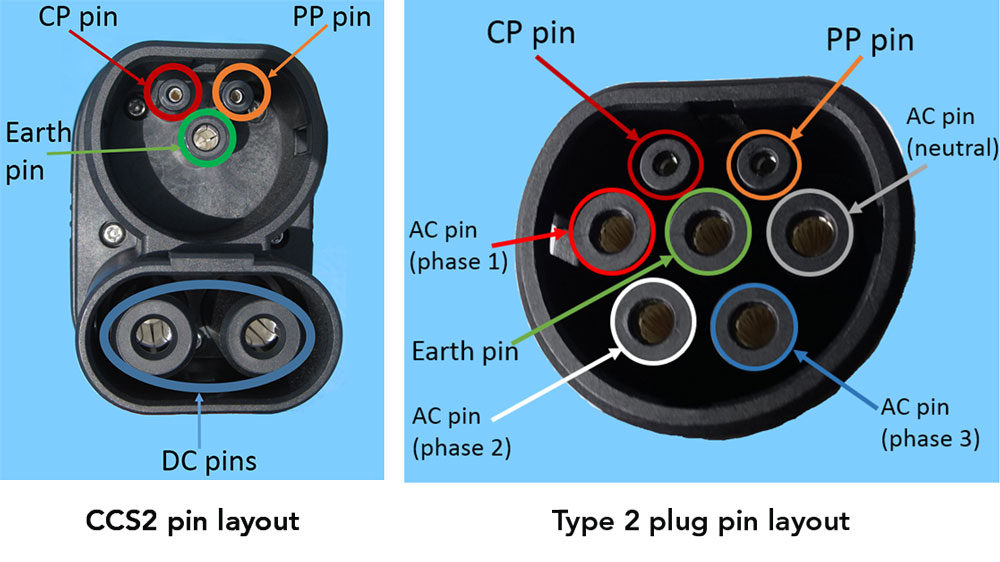
You also can't normally extend a type 2 using another cable anyway - the control pins are deliberately shorter than on a type 2 socket to prevent you doing that.
Just schlepped up to the North York Moors from the South Coast in a Tesla Model 3 SR+
such an easy journey, car chose it's recharging spots and pretty much did all the driving for me.
Less good is the charging network up here. Only vaguely fast charger for miles around is a 50kw in the Lidl car park.
The national parks really need to get a shift on with charger strategy.
Some might also have type 2 sockets so can plug your own cable and charge but I’ve never looked as I can’t imagine why on Earth you’d want to do that.
Car only has type 2 so no choice. This was Winchester services southbound. Appears to be no way of type 2 charging. Zap map also only show chemdemo and ccs.
Thanks simon_g 👍.
Just discovered that the home charger I got installed when I had a hybrid a good few years ago is 3kw not 7kw.
The charger I got installed at home is a 7kw charger but because of the shit electrics in the flats I only get about 3.5kw. This is okay for me as I charge mine at work and only have ever charged it at home twice in 10 months. But if I had to rely on the home charger I wouldn't have gone for a full EV.
Zap map also only show chemdemo and ccs.
Surely it can be filtered for type 2?
Car only has type 2 so no choice. This was Winchester services southbound. Appears to be no way of type 2 charging. Zap map also only show chemdemo and ccs.
Type 2 is coming, but Gridserve were limited on the units they could get their hands on. Some sites have had posts and conduit installed for separate 22kW units, and the first rapid with an AC socket appeared at Ferrybridge services yesterday. They've said all will get one or the other once they can.
That's good to know. Thanks
Yes it can molgrips I meant it only shows those two types at that site.
beamers
Full Member
I took delivery of an ID3 (RWD) in May this year
What's your opinion please (or anyone else that has one) my Model3 goes back on 8 Nov and I want to replace with a hatchback. By the sounds of thing with new cars I need to pull my finger out sharpish. have a test drive booked on Monday, so any advice on stuff to look at that I might love/hate. I really like the look of them altho I hear the interior trim isn't great
Drove a Skoda Enyaq last week. Really nice and big inside.
Off to try an Ioniq 5 tomorrow.
I’m a month into owning an ID3. Absolutely no regrets at all and we’re unable to charge at home so only using public chargers…which is a slight faff but not too bad.
There a few issues with the car that, in an ideal world, would be sorted but nothing major.
It drives beautifully and is, in my eyes, just so goddamn cool and modern.
I can’t see me ever owning another petrol car…not sure how the T5 replacement is coming on yet but I’m waiting and excited for it!
Ive had my model 3 for about 18 months and my wife has had an ID3 for about a month. The ID3 is a great little car and I agree with lister that it’s a really cool motor - I like the side profile the best. Few things that jump out at me when I jump from the Tesla the V Dub:
> One pedal driving is not possible. Tesla have done such a great job of integrating throttle and regen, it feels like a step back. Even in the higher regen ‘B’ mode I still have to use the brake pedal at most junctions.
> The interior is not as ‘premium’ a place to be with cheaper materials used throughout, but that’s expected given the price difference and not really an issue.
> Seating position is a bit high for me. Feels like I’m sat on the car rather than in it if that makes sense.
> Steering wheel only adjusts for rake and not reach which was disappointing.
Oh and lock to lock on the steering feels like miles! But the steering wheel itself is lovely. Nice compact size and not too chunky like a lot of modern cars.
Getting a drive in one is the only way to know if it’s for you.
Our iD3 has steering wheel reach adjustment.
Otherwise, after 1500 miles all is good so far. Comfy, super easy to drive, modern safety tech seems useful.
Interior is fine but not luxurious. Very roomy for the exterior size. Nippy enough.
And 3.9 mi/kWh so far.
@tlr what mix of driving is that?
Re one-pedal driving, I'm still not sure how good it is. I drive mine in the middle setting and it's good for adjusting speed in driving but you still need to swap pedals, and this means that when you do lift your foot off to go to the brakes it gives you a bit of a jerky slowdown. Or indeed if you just disengage cruise.
But maybe I need to go all in on max regen and see if I don't even need the brake pedal.
Ioniq 5 - Swiss Toni salesman, really quiet to drive, infotainment system not very good, boot is small. Looks stunning though.
The regen breaking on my E Tron is very impressive chucks a lot of charge in. But it doesn’t work as well for breaking as the adaptive cruise control on my Golf GTE, it’s not meant to though. However, on the auto regen setting it detects roundabouts, junctions and such so begins to slow. It also slows a little in traffic but again not as effective as adaptive.
Cheers Nick
I had heard that you can't turn off creep in the ID.3 and certainly the one pedal driving in the M3 is great, I've had it set that way from the start (I might turn creep back on to prepare myself for the ID.3 test drive. don't want an accident in a demo car). I've heard the turning circle is good and that people seem to be now questioning whether the heat pump option is worth the cost as apparently it's not that efficient in the ID.3. I'm probably only leaning towards the ID.3 for the exterior looks and could probably have a fully loaded Nissan Leaf for the same cost or a longer range eNiro for similar cost and spec
Ioniq 5 – Swiss Toni salesman, really quiet to drive, infotainment system not very good, boot is small. Looks stunning though.
Oh. Disappointing that the boot is small. I had high hopes for it being a reasonable size.
Just to point out that increasing regen doesn't get you any more energy. Lifting off the throttle activates regen braking according to your settings, but pressing the brake pedal does the same thing. Actual friction brakes are only brought in under heavy braking. At least in my car and my previous hybrid is was like that, I'd be amazed if it weren't true for all EVs. The motoring press seem oblivious of this.
I’d be amazed if it weren’t true for all EVs
Prepare to be amazed. Audi have different regen rates, you can use the paddles to change it or let the car decide.
I went to look at ioniq 5 yesterday. Really like the looks in the flesh. Interior quality v good apart from the centre bin area which was a bit scratchy. Buttons abs materials far nicer generally than my dads mk8 golf.
@murray surprised what you say about infotainment as all reviews I’ve read say it’s sharp and fast to use? Also can use apple car play for zapmap charger planning Which is the one area where Tesla has it but I don’t believe vw is any better than Hyundai.
Agree coming from golf estate boot looked small. But remove the top cover for a bit more depth abs the rear seats a bit forward it was adequate for the 1:100 trip when fully loading up.
About 50% town, 50% 60mph dual carriageway. Basically my wife’s 15 mile commute. It’s not been on a motorway yet, so that probably helps.
Certainly in my case and I suspect in others, not having to use the brake pedal just makes day to day driving simpler, nicer and more convenient, simple as that. I don't think I've ever given the slightest thought as to what energy I might or might not be recouping. Altho I suppose it might depend on type of car, what sort of range you get and type of journey (shopping trip or long distance). I have heard some people turn everything off on long journeys in the belief that lots of coasting will give them more miles, I've no idea.
Audi have different regen rates, you can use the paddles to change it or let the car decide.
Yes, but if you set 50% regen and then touch the brake pedal, it activates the other 50% rather than apply friction braking. If that's not how it works then Audi have made a massive cock up.
Audi electric vehicles feature two types of recuperation via coasting or braking which can be activated by:
1. Deceleration (“One-Pedal”) Recuperation - Once you release the accelerator pedal, the electric motors act as a generator converting a large proportion of the car’s kinetic energy into electrical energy which is stored in the high voltage battery and increases the battery’s range.
2. Brake recuperation - This happens automatically when you press the brakes. The kinetic energy that was propelling the car forward escapes. But instead of being wasted as heat, kinetic energy is recovered from the wheel axles and is turned into an electric charge. In turn, this energy recharges the car’s electric battery and increases range. When you need to come to a stop quickly, the car will switch from recuperating using the electric motor to using the brake discs to slow you down, the transition between the two is seamless.
You can select the intensity of recuperation either automatically or manually. In automatic mode, the car decides when and how to recuperate by analysing the driving situation.
In manual mode, you can select three recuperation levels via a paddle on the steering wheel (standard on e-tron and e-tron Sportback – please check model specific information for other models). Selecting a stronger level will increase the recuperation intensity, harvesting more energy, and therefore maximising your range.
Like I say it uses different regen rates. They’re very effective, coming up 11k miles on the car and barely any wear or the brake pads.