UPDATE: Reviews section refreshed, redesigned, searchable: Go take a look
I don't think it's the initial acceleration and any loss of traction causing the issue - mine and I think most can meet out the full beans as it regulates any slip through management of the motors. I think the issue is as mentioned, the combination of ending up at high speeds very quickly, the weight, and lack of correspondingly powerful brakes. Tesla plaids got roasted in reviews about this last point. My Ioniq 5 AWD is great and planted at quick but still relatively sensible country road speeds. But go a bit beyond and the brakes and dampers start to really lose a sense of control that could very easily result in a problem - so I don't.
One of the things that used to go round was when the Honda Civic VTEC came out, loads got trashed as they were a bit mental, despite the factory upgrades
Some fine fine memes came out of the "when the vtec hits" era
My son does have a sticker saying "My VTEC goes bwaaaaaah". But he won't put it on the car...
Any joke about VTEC engines must be firmly in dad joke territory by now, the sticker wasn't a gift was it?
Maybe. 🙃

But go a bit beyond and the brakes and dampers start to really lose a sense of control that could very easily result in a problem - so I don't.
My polestar 2 has fantastic braking and handles well.
It however is closer in weight to a Cybertruck than a Suzuki Swift, and physics simply refuses to play nicely with such changes in direction with all that mass...
There is a strong correlation across motoring that higher performance vehicles are involved in more fatal crashes per mile driven than normal cars.
I'm sure there are a lot of interesting details in the data. For example:
Higher speed drastically increases the severity of accidents. Having the same accident rate, but crashing at higher speed will give more fatal crashes. Even if performance vehicles have a lower accident rate, they could still have a higher fatality rate.
It's possible that performance vehicles do much lower mileages than regular vehicles, but are driven much more aggressively when they are driven. If this is the case, it's possible they don't cause a lot of total fatalities, but relatively large number per mile.
It's possible that performance vehicles are bought by selfish dicks who don't give a damn about other people and drive accordingly. Even if you banned performance vehicles, these people might still contribute disproportionately to fatal crashes because they drive like dicks no matter what.
Is that true though?
It comes up in a lot of insurance industry surveys. I don't think they could all be wrong.
There used to be a Europe wide stats organisation that collated and published vehicles NCAP ratings alongside real-world outcomes back in the 90s/early 00s but I don't know if they disappeared or just don't publish the info so publicly now. Part of what it was reporting was the rate at which each model of vehicle got involved in accidents and the types of accident rather than just their performance in an accident. Porsches for instance could have fab NCAP ratings but it's not going to a surprise that they get into more and bigger accidents per vehicle mile than a Honda Jazz. Part of it was comparing how vehicles actually performed in real crashes over the very choreographed nature of the tests. (NCAP at the time used to test vehicles like against like so it wasn't really an indication of how a collusion between a rangerover and micra might pan out). It also demonstrated how the crash performance of some cars tailed off over time - with a bit of fatigue and corrosion impacting on how well safety cages performed after a few years.
What was emerging at the time was that some safety measures brought their own risks - there was a bit of an NCAP arms race between manufacturers - with marketing highlighting safety over economy or performance - thicker door pillars, more raked A pillars, and generally bringing the line of the bodywork up around the driver was resulting in reduced visibility. The driver was also being moved backwards in the car to get their legs inside the safety shell and putting the B pillar next beside the driver's head- so cars either had longer bonnets or a huge dashboard with the A pillar both thick and raking quite far forward. There was also a lot of thickening of the structure at the rear of cars with quite chunky C and D pillars and quite high boot edges/small rear windows. So some models of car were revealed to be getting involved in more side-on collisions at T junctions when pulling out (big Volvos in particular IIRC) or were responsible for squashing more pedestrians in car parks etc
The disconnect between the actual speed and feeling of speed is a real thing and does affect your driving unless you are aware of it. It happened to me when I got my first 'proper posh' car which had a powerful but near silent V12, extensive sound proofing and was double glazed. I was driving on holiday through France on the near empty motoway and glanced down to realise I was doing almost 130mph when I assumed it was 70-80mph.
I recently switched to an EV and left the usually annoying speed warning bleeps switched on as it is a useful reminder when you are used to engine noise feedback. But generally I do find it remarkably easy not to smash the accelerator into the floor and drive like a dick.
But generally I do find it remarkably easy not to smash the accelerator into the floor and drive like a dick.
It's a fair point and well made.
Regarding the weight thing, tesla model 3 (most popular in uk I think) is 1600 - 1800kg. Thats very much in normal car weight these days.
Quashqai weight is 1300 - 1700kg
BMW 3 series 1400 - 2000kg
Who here has actually seen or sat in a Cybertruck?
I was driving on holiday through France on the near empty motoway and glanced down to realise I was doing almost 130mph when I assumed it was 70-80mph.
I am sorry. But you knew OR you were choosing to ignore it.
It might be smooth and silent but street furniture and trees etc whizzing by at 130 is massively different.
Regarding the weight thing, tesla model 3 (most popular in uk I think) is 1600 - 1800kg. Thats very much in normal car weight these days.
Battery packs are typically about 300kg (obviously it increases or decreases a bit based on range) but an electric drivetrain is a lot lighter than an ICE one (particularly diesel) so you end up with about a 100-150kg difference
Regarding the weight thing, tesla model 3 (most popular in uk I think) is 1600 - 1800kg. Thats very much in normal car weight these days.
Battery packs are typically about 300kg (obviously it increases or decreases a bit based on range) but an electric drivetrain is a lot lighter than an ICE one (particularly diesel) so you end up with about a 100-150kg difference
Yep bit different to my old Evo IV 1,260 to 1,350 kg 🙂
Regarding the weight thing, tesla model 3 (most popular in uk I think) is 1600 - 1800kg. Thats very much in normal car weight these days.
Battery packs are typically about 300kg (obviously it increases or decreases a bit based on range) but an electric drivetrain is a lot lighter than an ICE one (particularly diesel) so you end up with about a 100-150kg difference
Yep bit different to my old Evo IV 1,260 to 1,350 kg 🙂
And an even bigger difference to my 42 yr old MK2 Golf GTI 16v at 960kg (200bhp) (no longer owned), I know what one I'd rather have on a Scottish B-road
But I doubt a fat yank would fit into a old golf
I am sorry. But you knew OR you were choosing to ignore it.
It might be smooth and silent but street furniture and trees etc whizzing by at 130 is massively different.
on an A or B road, definitely, but on a big autoroute with just grass banks and little else to see, it's far less obvious.
According to MS Copilot:
First‑Generation Morris Mini (1959–1967)
Kerb weight: 585–686 kg
The 1959 Mark I Mini weighed 585 kg.
Broader Mini range kerb weights fall between 580–686 kg depending on variant.
So, a typical early Morris Mini weighed around 600 kg.
🚙 First‑Generation Honda Civic (1972–1979)
Kerb weight: 600–790 kg for hatchback/sedan models
Wagon version: 810 kg.
So, the first‑gen Civic was slightly heavier than the Mini, typically 650–750 kg depending on configuration.
First‑Generation Honda Accord (1976–1981)
Kerb weight: 905–925 kg
This range comes from official specifications listing curb weights between 1995 lbs (905 kg) and 2039 lbs (925 kg).
Additional corroboration: A period description of the Accord notes a typical weight of 898–945 kg, consistent with the above range.
🚗 First‑Generation Toyota Camry (V10, 1982–1986)
Kerb weight: 1014–1108 kg
Verified curb weights for the Camry I range from 2235 lbs (1014 kg) to 2443 lbs (1108 kg).
🚙 First‑Generation Ford Mondeo (Mk I, 1993–1996)
The first‑generation Mondeo had a curb weight between 1260 and 1370 kg, depending on body style and engine.
This range applies to the hatchback, but sedan and estate variants fall in the same general bracket.
🚗 First‑Generation Vauxhall Vectra (Vectra A, 1988–1995)
The first‑generation Vectra (sold as Vauxhall Vectra in the UK from 1995 onward) had a curb weight between 997 and 1199 kg for the 4‑cylinder petrol models.
A specific example:
Vectra B 1.6i (1995) curb weight: 1170 kg.
But generally I do find it remarkably easy not to smash the accelerator into the floor and drive like a dick.
I know this comment is a couple of weeks old but it never ceases to amaze me quite how hard a lot of people find this quite simple task.
I suspect a mixture of attitude and (lack of) competence are at play there.
I am sorry. But you knew OR you were choosing to ignore it.
It might be smooth and silent but street furniture and trees etc whizzing by at 130 is massively different.
on an A or B road, definitely, but on a big autoroute with just grass banks and little else to see, it's far less obvious.
I can assure you that the bends on a UK motorway get a bit tight 😎
Regarding the weight thing, tesla model 3 (most popular in uk I think) is 1600 - 1800kg. Thats very much in normal car weight these days.
Battery packs are typically about 300kg (obviously it increases or decreases a bit based on range) but an electric drivetrain is a lot lighter than an ICE one (particularly diesel) so you end up with about a 100-150kg difference
Yep bit different to my old Evo IV 1,260 to 1,350 kg 🙂
And an even bigger difference to my 42 yr old MK2 Golf GTI 16v at 960kg (200bhp) (no longer owned), I know what one I'd rather have on a Scottish B-road
But I doubt a fat yank would fit into a old golf
You’re right, I had a mk1 GTI 1600 4speed ,they reckon that’s even lighter 810kg !!
They had the Rabbit thou which I always thought was weird.
As weight increases...  casualty numbers fall...
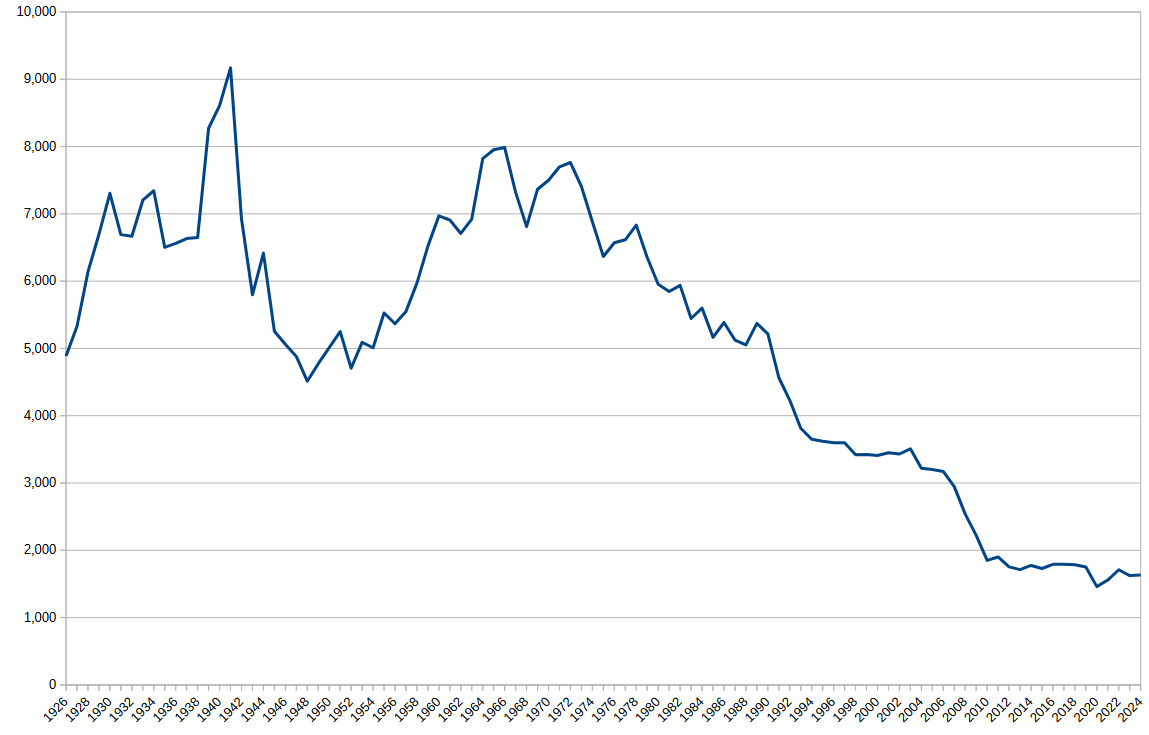
Personally I can't wait until a 5 tonne yank tank is parked on every pavement. /S
Typical ICE weight is around 90-110kg for the block (below 1.5l), about 40-80kg for the ancillaries (Turbo, alternator, exhaust, etc), and then around 60-80kg for the fuel, tank, pumps, etc. So all-up is around 190-270kg
Below 1.0l these can drop to as little as 140kg. A 1.0l ecoboost, fully dressed is only 95kg. Exhaust, tank, fuel and pumps will push that to 140kg.
A BMW I3 120AH, 42kWH battery and motor will weigh 325kg...
A Tesla Model 3 LR battery weight is rumored to be over 450kg with the motors adding another 80kg. So 530kg.
I've not included cooling here as both types of cars need it. HV cabling will also add weight to the EV.
Comparing an i3 to a Fiesta Eco Boost 170- the drivetrain weight of the EV is around a 200kg penalty, but car weight difference is actually closer to 100kg due to the way the i3 was designed.
Comparing a Tesla Model 3 LR single motor to a Focus 1.5 Eco boost 180 - The Tesla is almost 450kg heavier, but comparing it to the ST 2.3 ecoboost, that weight difference drops to <200kg (probably 150kg with fuel). The latter is a better comparison as the power output is more equivalent.
I've done some testing (as a research subject) on this. And yes, the longer, straighter and less features you have on a road, the harder it is to judge speed. Added to lower noise in vehicle (and more isolation) the worse the problem gets.on an A or B road, definitely, but on a big autoroute with just grass banks and little else to see, it's far less obvious.
Eventually, something like a fully electric rolls royce on the autobahn, you've got no chance...
(130 in a 80 does smack of being a shit driver and monumentally unobservant.)
You'd be amazed at the number of drivers out there who use both accelerator and brake pedals as switches in 99% of their driving.But generally I do find it remarkably easy not to smash the accelerator into the floor and drive like a dick.
I know this comment is a couple of weeks old but it never ceases to amaze me quite how hard a lot of people find this quite simple task.
I suspect a mixture of attitude and (lack of) competence are at play there.
I am sorry. But you knew OR you were choosing to ignore it.
It might be smooth and silent but street furniture and trees etc whizzing by at 130 is massively different.
on an A or B road, definitely, but on a big autoroute with just grass banks and little else to see, it's far less obvious.
Little else to see... Like the speedo?
Currently on holiday in Canada and we’ve seen a fair few cyber trucks (I say a fair few, probably half a dozen).
they are quite the sight!
anywho… carry on!
Seems a bit unfair to me. In BSM there's a ****ing huge US personal import ICE Ford pick up with most of the front body work removed and replaced with bull bars. Owned by a Brit I think. In terms of threat to pedestrians, cyclists and other vehicles it's objectively worlds more dangerous than the cyber truck. As above probably the degree of fly by wire but why that leads to exclusion whilst other more obvious dangerous features on other imported vehicles are tolerated I don't understand.

