UPDATE: Reviews section refreshed, redesigned, searchable: Go take a look
Some of whom are striking their heels way out in front of them.
And your point is what?
Have you ever seen an able bodied kid who thought they had a rubbish running style that they had to work on?
Some of whom are striking their heels way out in front of them
You cant tell from the picture if the heel will land first though.
Have you ever seen an able bodied kid who thought they had a rubbish running style that they had to work on?
NO but I've seen load and loads of kids who are crap at distance running! Honestly you must be on a wind up.
You're saying that I should do what comes naturally, aren't you?
I've told you many many times - I started off doing that, I did it between the ages of 10 and 34. And then I thought about it a bit, and got much better. I really don't understand why you don't believe me on this.
I was reading some articles on a running site that said very few distance runners, or triathletes (even those sponsored by Newton) finish the race running on their forefoot.
What they can do though is maintain a good cadence and land with their foot close to their body and with their knees in front of the ankles.
You're saying that I should do what comes naturally, aren't you?I've told you many many times - I started off doing that, I did it between the ages of 10 and 34. And then I thought about it a bit, and got much better. I really don't understand why you don't believe me on this.
I'm saying that you should do what comes naturally yes. A zombie shuffle isn't natural at 10 years old...
Baby - my running style doesn't change with distance. I always land mid foot first, then heel lands shortly afterwards.
Let me explain again.
I started off doing what came naturally, and it was awful, and I hated running. I thought about technique, made some improvements, and my running got much better.
Are you disagreeing with that chain of events?
my running style doesn't change with distance
Or so you think...
What they can do though is maintain a good cadence and land with their foot close to their body and with their knees in front of the ankles.
That's the general conclusion we've come to on STW I think. Foot placement is important, heel/mid/toe less so.
The bit I'm not convinced about is that what you were doing was what came naturally. You may have made some changes which took you back to the "normal" running style that you had as a young child.
Or so you think...
It doesn't - certainly not up to marathon distance.
Ok fair enough.
So why would I have changed my style, and at what age?
And how young are we talking about? Are you saying that ALL young kids have good technique?
And I never ran distances as a child either, so it's a bit hard to make a comparison. All I did was sprint and muck about.
So you're cadence is consistent from mile one though to 26?
You're obviously a very good runner. With excellent technique and ancillary strength.
good technique
I dont know what this means
So you're cadence is consistent from mile one though to 26?
Cadence isnt the same as foot strike. My footstrike stays the same even when I am exhausted and my "form" has started to get ragged. I still land on my forefoot.
Ok, so I think good technique means
a) you're comfortable over several miles
b) you can keep form over several miles
c) if you're generally fit, and you are working hard, you're doing more than say 9.30
So why would I have changed my style, and at what age?
No idea.
And how young are we talking about? Are you saying that ALL young kids have good technique?
Given that you adopted the zombie shuffle at 10yrs old I'd say 9 and below. I'd also say that all able bodied kids without impairments have good running style.
So you're cadence is consistent from mile one though to 26?
Pretty much. Stride length gets longer in the 2nd half of a run as I like to do negative splits.
You're obviously a very good runner. With excellent technique and ancillary strength.
I was surrounded by top quality runners, including olympic gold medalists, as a kid. It's like riding a bike - it never leaves you. 😀
Obviously Surfer. But as a runner tires and their cadence slows to maintain the same pace then the stride must lengthen?
Which may, or may not, result in a change in which part of the foot contacts the ground first.
Worth mentioning that some runners forefoot strike and overstride.
The part of the foot that hits the ground first is not what makes someone efficient.
I was surrounded by top quality runners, including olympic gold medalists, as a kid. It's like riding a bike - it never leaves you.
Did you got to school with a guy called Matt who was into surfing?
I'd also say that all able bodied kids without impairments have good running style.
Based on what?
By the way, I never 'adopted' the zombie shuffle. I was heel striking out in front of me, which is very knackering, and results in significant fatigue. This in turn induces zombie characteristics.
I remember even at the age of about 6 or 7 noting that I had to run differnently in bare feet because my heels were hitting the floor too hard.
Ok, so I think good technique meansa) you're comfortable over several miles
b) you can keep form over several miles
c) if you're generally fit, and you are working hard, you're doing more than say 9.30
Whereas I think good technique is:
You're not landing heavily with limbs going everywhere,
You're not spending all your energy going up and down,
You're enjoying it and you're relaxed.
I think your points overlap with mine, especially the last one.
you're comfortable over several miles
b) you can keep form over several miles
c) if you're generally fit, and you are working hard, you're doing more than say 9.30
But this is a definition of fitness and comes with training.
But as a runner tires and their cadence slows to maintain the same pace then the stride must lengthen?
When I tire by definition my stride length would not lengthen to compensate. If I had the strength/energy to lengthen my stride I wouldnt be slowing. All of those things happen around the same time.
Which may, or may not, result in a change in which part of the foot contacts the ground first.
No necessarily. My forefoot strike comes naturally there is no effort involved and it would take a conscious effort to change it. Its developed that way through no decision on my part. I suspect it is faster and more efficient but is just a by product of a mis spent youth! If you run fast (using the term loosley in my case!) then you lean forward and have to push hard from the front of the foot using them as levers.
It seems counter intuitive that the next part of the cycle involves your heel.
Did you got to school with a guy called Matt who was into surfing?
No, but the guy on the right of this picture was our school running club's coach.
[img]  [/img]
He is even more awesome than Surf Matt. Saw him once at the national relays in Birmingham. What a Physical presence 😳
Glupton more Awesome than SurfMatt? Never!
Here's a picture of Newton (forefoot wonder shoe) athlete Crowie using the patented forefoot lugs to devastating effect in Kona.
[img] 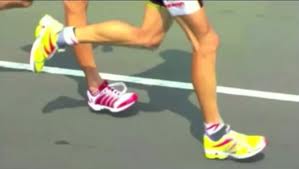 [/img]
And here's some words; http://www.kinetic-revolution.com/forefoot-running-for-ironman-athletes/
But this is a definition of fitness and comes with training.
So you think
1) Technique isn't important
2) Technique comes automatically with fitness or
3) If you're fit then you'll always be fast regardless of technique?
But your definition is so vague to me I cant really answer.
To 1: I would have said of course it is important but you get it through the things I identified above, namely consistent training. Now I am not sure what you mean by "technique" funnily enough from what I think you mean now, I still think the answer is "training" or specifically running, your technique is unique to you. Running is not really a "technical" sport (hurdling, steeple chase yes but running no) I think your technique develops around you in the same way John Treacy appeared inefficient and ungainly but he won a world cross country championship and an Olympic Silver. Ovett on the other hand was poetry in motion. Different techniques but both effective.
2: Yes
3: See 2
So how do you explain my story then? I improved significantly by considering my technique.
Don't you believe me?
Of course I believe you I just dont know what you mean.
Like I said.. you must never have experienced running as badly as I was running. You must have been doing it approximately right automatically.
I'll have to think of a way of videoing myself.
I think that in my 20s when I started trying to do distance running, I thought that you were supposed to land on your heel and roll onto your forefoot like you do when walking. I've even read somewhere that that used to be taught at one point.
Some people might be able to do this well, but with my 85kg or so at the time and lack of running fitness, it was painful, uncomfortable and thoroughly grim. As a fit cyclist and general partaker in sports, I saw no reason why I should not be able to run 8-8.30 after a few months of training and adjusting, but over two miles I was really struggling to beat 10m, and hurting like hell.
Some may be content plodding along at 11m but I was not. So I gave up for a long time.
I'll have to think of a way of videoing myself.
Its really not necessary
I can't get my point acros it seems.
I dont know what this means
Good technique is the smooth seem less transition of the horizontal lower arm raised up to 45 degrees with an comitted accurate movement resulting in superior rehydration.
Anyone read up about Hoka shoes, some ultra runners swear by them apparently
Look absurd to me!
[img]  [/img]
Mixed reviews on the Hokas.
Some have hated them some have loved them, was chatting with a runner from the Anster Haddies the other day and he described them as a "game changer"
Bit of a gamble at those prices. Never seen any with serious enough tread patterns to tempt me.
Am I right in thinking that at least some of those Hokas are zero drop?
I would be more than slightly worried about turning an ankle descending any type of fell terrain!
Yeah, I think they are really low drop but just dead thick
Just grandering, most seem 5mm.
I would love to give the Hokas a try, but I am really tight, so it ain't never going to happen.
I've got a pair of Hokas (fool and money etc). Bit of a love/hate affair with the things - mostly run in inov8 f-lite 195's or similar
Not nearly as clumpy as they look. The actual heel is way lower than you'd think from picture and you sort of sit in the sole rather than on it. Pretty close to zero drop, and the foam is really soft so you can plough through stoney paths without really noticing them or having you ankle twisted around as it conforms quite a bit to the surface. Bit like full-suss bike feeling. Also seems to leave my legs feeling less tired the day after.
Downsides - pretty joyless to run in.
If Elton John ever needed running shoes.
Molgrips - do you ever race?
Interesting video.
My experiences:
I started running to supplement rugby training as a teenager (heel striking in Nike Air)
As a uni student increased my mileage (and hills and fells) and could manage half-marathon in 1.5hr, which I was reasonably happy with, as I'm not really built for distance running.
Began suffering knee pain and numbness.
Told I had flat feet (they are very flat) and advised to use orthotics. moved onto New Balance and then Saucony shoes (which seemed to get gradually more cushioned)
Tore ligaments in ankle (requiring reconstructive surgery)
Suffered various leg injuries over the years, but managed to once train for a 10K and managed just over 40minutes. Then suffered more injuries over in the following years, with no continuity in running or other activities (other than mountain biking)
Earlier this year I decided to get myself sorted.
Physio for ailments, lighter, lower shoes without 'pronation-control', read about the ideas for Chi running, pose, barefoot etc.
After 16 years I've stopped using orthotics.
It's taken a while to get the hang of it (and for my calves to stop suffering), but I've now settled into a shorter stride, faster cadence, bent knee, fore-foot/mid-foot strike, relaxed ankles, 'lighter on my feet' style
It feels great and it seems that I'm becoming more efficient.
I can now run in fairly thin-soled, low drop shoes (that didn't cost me much) without jarring my legs and, building-up distances fairly steadily and doing harder intervals and hills(clutching wood, lucky heather, horse-shoes etc.) , I don't appear to be suffering with the sort of niggles that I used to.
Higher heel drop shoes feel unusual now as the heels seem to catch the floor before I want them to.
Pre-exercise stretching has always seemed a bit odd to me.
I do stretch post-exercise as a part of my cool-down.
ps. I intend to do some 10K, trail and eventually half-marathon races when I feel I'm suitably conditioned -aiming to surpass my former standards.

