If the Lefty came out in 2000, a patent lasts 20 years from when its filed, and they presumably had to spend some time developing the fork after they filed the patent then it can't be that much longer.
From what I understand Leftys are lighter and stiffer than conventional forks and the only reason no one else has done them (except USE) is that the patent covers most feasible designs.
Could we see an explosion of single leg forks in the next few years?
If it doesn't look 'moto' enough, regardless of how well it performs, no.
Leftys are lighter and stiffer than conventional forks
Really? I need evidence as that seems unlikely 😆
Thankyouplease 😆
I really can't see others rushing to replicate lefty forks . I'm not sure about lighter but stiffer and better than regular forks would be pretty difficult to quantify . Modern telescopic forks work so well that any gains are likely to be minuscule or non existent . Changing stems isn't straightforward , you need a specific front hub , they cost a bomb and from what I have seen of them they are certainly not trouble free .
Really? I need evidence as that seems unlikely
Double crown to avoid flex at the crown. Fat tube at the top not the bottom to avoid flex. Square tube in square tube to avoid twist.
It's all difficult to quantify, especially stiffness, but a quick google suggests 250-300g weight saving which is less than I initially thought. Saying that, almost all of that weight saving is going to be unsprung mass so it's not insignificant.
Also, Cannondale have had the whole thing to themselves. If competitors got involved I'd imagine that would lead to improved designs.
Competitors have been involved in building leftys for years .
I'm sure there's a load of detailed knowledge that a new manufacturer would have to learn before they could get to where Cannondale are now. I'm not sure it would be worth it.
No. They look stupid plus I dont like the political connotations of the name.
I don't imagine anyone is counting down the days until they can copy the lefty concept, particularly as alternatives like the USE fork exist, but I could be wrong.
I do like the concept, the execution might be tricky - I'd be interested to see if competitors made something that avoided the roller bearings which are the source of the real maintenance difficulties. The only solution I can think of is a keyway similar to dropper posts (but perhaps beefier) but to get it play free would be quite tricky, and any significant play would make the fork feel horrid.
250-300g isn't to be sniffed at either - it's not huge but it all adds up.
[i] I dont like the political connotations of the name.[/i]
Pretty sure other companies wouldn't use the same name.
[i]you need a specific front hub[/i]
That's why it won't happen.
With their experience of building lefty forks Cannondale would be well placed to make a dropper post with no play .
Ramsey Neil - Member
With their experience of building lefty forks Cannondale would be well placed to make a dropper post with no play
Been expecting to see this for ages, can only assume there are packaging issues to fit a standard 30.9. Surprised they at least haven’t done some kind of proprietary post for their own bikes
As for the Lefty (political connotations of a bike part? Get a grip) stiffness, it is pretty remarkable
Competitors have been involved in building leftys for years .
Yeah, but they've not had competing products on the market which is what forces companies to up their game.
I'm sure there's a load of detailed knowledge that a new manufacturer would have to learn before they could get to where Cannondale are now. I'm not sure it would be worth it.
As Ramsey said above, competitors have been providing the dampers for them for a long time. I know Fox do so I don't think lack of knowledge will be a problem.
you need a specific front hubThat's why it won't happen.
😆
Competitors might enter the market due to the high cost of a lefty and lack of discounting, but that’s offset by the fact that the market is quite small compared to normal forks.
Having just dropped £250 on a lefty fork service including a ton of parts, I’d seriously consider replacing it with a normal fork if it failed again.
From what I understand Leftys are lighter and stiffer than conventional forks and the only reason no one else has done them (except USE) is that the [s]patent covers most feasible designs[/s] public don't understand them and so refuse to buy bikes they are fitted too.
Cannondale themselves have had to spec conventional forks on a lot of bikes to make them sell.
"It's all difficult to quantify, especially stiffness"
Not really, it's a pretty well defined engineering term. Stiffness can be defined, measured, designed, modelled etc. They are a lot stiffer though (lefty's). The double crown plus the square sanction and needle roller bearings. They perform better too due to lack of stiction due to roller bearings rather than bushes and it is noticeable, both in terms of stiffness and more active suspension under braking. My Pikes feel well noodley compared to my old Lefty.
They do present problems though and are more costly than other forks so not sure many other manufacturers will be queuing up to make them. Shame though because after being a Cannondale only piece of kit for all these years with no competition the R&D has been very slow and stilted. If other manufactures were to make Lefty's then they've get a lot better very quickly.
I'd have another Lefty in a heart beat but seems like C'dale are no longer offering them in anything but their short travel and more XC orientated bikes.
Lefty, Dyad pull shock and Project 321 hub here. What arê these 'Standards' folk keep going on about? 😀
3 Leftys now plus a rigid version. I love them all. Only bike I owned with a conventional fork was a Fatty with a Bluto so no point of comparison for me.
Having just dropped £250 on a lefty fork service including a ton of parts, I’d seriously consider replacing it with a normal fork if it failed again.
If it’s bust (therefore not a normal service) you could easily spend that fixing any normal fork
No. They look stupid plus I dont like the political connotations of the name.
This isn't as stupid as it sounds. Little known fact, Cannondale made the righty first but there were issues when a group of riders tried to annex Poland. The lefty isn't without its problems. Wildcat strikes are a particular issue.
(political connotations of a bike part? Get a grip)
There was a chap on here who wouldn’t buy an XTR crank (M985 I think) because he thought the spider resembled a swastika...
http://singletrackworld.com/forum/topic/alternative-to-xtr-chain-set
Giant used to sell a 20" wheel folder with a lefty-type fork. The Half-Way, I think. I liked mine more than any other folder I've used. So the patents are either available to licence, or can be worked around
Lighter, stiffer...
...still 'wrong'
If it’s bust (therefore not a normal service) you could easily spend that fixing any normal fork
Fair point, but I could get a new fox for that based on recent sales, whereas a new lefty would cost me a grand.
Now it’s had the two spring upgrade it’s a much better fork, but I’m not convinced any other suppliers are going to move into the market
I imagine the patents cover the mechanism to stop the slidey bits rotating relative to each other rather than the concept of a one-sided fork per se, which must have been done before in rigid form. The USE linkage-based one-sided fork probably didn't infringe.
Surely you can't take out a patent on not making something round .
As far as I can tell this is the patent:
https://www.google.com/patents/US6145862
It seems to cover pretty much any non-round tube sliding inside another.
The USE one didn't look like it had much of an advantage over normal forks but it didn't infringe on the patent at all.
Looks like it was filed on 30th September 1998.
The Giant Half-way is still available. Designed by Mike Boroughs, who was using single sided hub mounting long before Cannondale. The IP on the lefty will be elsewhere than stub axles
That patent would cover a fork with perfectly round tubes. Obviously, such a fork would need a cunning system of magnets or what-not to keep the wheel straight, but the patent would cover it...
Where are you seeing that in the patent description? They seem to be pretty specific about the flat surfaces and needle bearings but I'm not used to reading patents so I could be missing something.
Where are you seeing that in the patent description?
It's the claims that are important in a patent, not the description or the diagrams, and the claims can be inter-related, depending on the wording. The first claim just mentions tubes, nothing about the shape.
Writing the claims is why patent lawyers earn so much money. You need to cover what you've invented, and anything else that someone may try to use to get around your invention.
The use of the word 'comprising' is important.
a righty,
[url= https://bmxunion.com/blog/evolutions-of-the-bmx-fork/ ]Kastan Uniblade[/url]
Interesting, I assumed the USE fork got around the patent because it used round tubes. Maybe it was the linkage that differentiated it?
I demo'd a top end 'dale with a lefty. The guide told me to go steady as bikes with lefty forks were unbalanced! She was serious too! It was brilliant, but then a £6k bike should be.
having a Lefty hub is great, it just bolts on. Not fiddly like on a Fox fork
I've always thought there was more room in the market for leading link style forks with rear shocks allowing you to swap and change suspension but the complexity, cost and people's inability to see past a design 20 years old seems to be a stumbling block.
BruceWee>>>
Interesting, I assumed the USE fork got around the patent because it used round tubes. Maybe it was the linkage that differentiated it?
It is the absence of telescoping in the main tube that means it doesn't contain all the elements of the claims. The linkage is then one way of avoiding the thing being a rigid one-sided fork (which would also not infringe, but also not be a suspension fork).
thepodge>>>
I've always thought there was more room in the market for leading link style forks with rear shocks allowing you to swap and change suspension but the complexity, cost and people's inability to see past a design 20 years old seems to be a stumbling block.
I am also fascinated by linkage forks. I think weight may also be an issue - when you look at what goes into a telescopic fork, or rather what doesn't - just some ridiculously thin-walled aluminium or magnesium alloy tubes etc., making something out of links and bearings could easily get quite porky.
Mountain bikes is a fashion industry. You can tell this, as it has "model years" and is driven by lifestyle images, marketing, and advertising.
Lefty forks aren't fashionable right now. When they are fashionable, they will be on bikes.
Hmmm, belay that, I have just remembered how the things worked and looked up a picture. What makes the USE fork not infringe is the linkage like you said Bruce. The claim element missing is the attachment of the wheel to the lower telescoping part. In the USE it isn't, it is connected to it via a pivoting link.
You wait, come 2025, we'll all be rocking lefty derived needle bearing dual leg single crown USD forks with oleo strut damping.
I'm not a lawyer, but the patent does seem to be quite specific about flat surfaces with roller bearings between them.
Of particular importance are axially extending longitudinal flat sections or "flats" which are provided on opposing surfaces between the two tubes, along with a plurality of free floating needle bearings disposed on these flat sections to all but eliminate stiction
Linkage forks have been tried on motorbikes too. Like every solution in engineering there are pro's and con's and I think the cons of linkage systems simply mean the overall net benefit is not there, apart from weight, cost and complexity, a downside to linkage setups are poor feedback, which is quite important on a mountain bike to give the rider confidence.
My experience on the Lefty was that the fork was noticeably stiffer and the performance/activity of the suspension under braking - which I'd never really felt before as stiction increases with conventional bushed forks so they don't work as well under braking. This gave me a lot more confidence under braking on choppy surfaces. Something I miss with my current Pikes.
However the Lefty did suffer a lot more braking dive than a conventional fork because of the lack of binding up of the fork action. OK you can easily compensate once you're used to it by moving your weight rearwards when braking to use weight to counteract it, but then you're unweighting your front end at a time you want to weight it up.
So on balance there were overall benefits to the lefty, but they do have their disadvantages too.
However the Lefty did suffer a lot more braking dive than a conventional fork because of the lack of binding up of the fork action
But that should be addressed through damping and spring rate/progression.
nickc - Member
Mountain bikes is a fashion industry. You can tell this, as it has "model years" and is driven by lifestyle images, marketing, and advertising.Lefty forks aren't fashionable right now. When they are fashionable, they will be on bikes.
Woohoo maybe I'll be fashionable one day!.
Boing Boing
[IMG]  [/IMG]
But that should be addressed through damping and spring rate/progression.
True, but the damper on my lefty wasn't that clever. It was a PBR damper so couldn't independently set up low speed and high speed compression damping. It basically had lockout and a single knob for setting rebound damping. And in anywise how would you set up your low speed compression to address brake dive? You'd want to set it high, but then that would compromise the normal suspension performance where you would want it set lower. Brake dive is too slow for high speed compression damping.
I liked the lockout though. It would automatically disengage if you forgot to unlock at the top of the trail when as soon as you got a couple of biggish hits in. Not sure why all shocks don't have this feature. It worked well on the lefty and I really don't use shock lockouts now because I invariably forget to unlock at the top of the climb.
I've always wanted a lefty
Or an AMP Research fork
I like weird designs 🙂
Been following this thread as I too have long hankered for a Lefty fork, especially for my sexy skinny Salsa A La Carte 8)
ChunkyMTB - MemberWoohoo maybe I'll be fashionable one day!.
Boing Boing
Peng
What about the VN Revelstoke? I know its not suspension but still using the Lefty design.
[img] 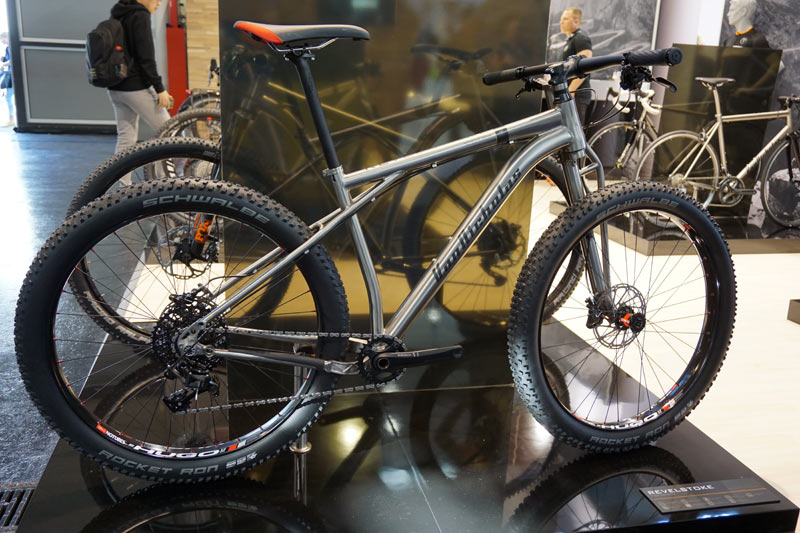 [/img]
I've got a lefty and view it as a conversation starter rather than a performance enhancer.
The suspension action is great but I find it a bit flexy when the going gets rooty and rocky.
I think the needle roller bearings are the crux of this design. Wouldn't be surprised if they came up with that first, then found it really heavy, then realised they could do away with one leg.
I've not ridden one, only squished, but they are extremely sensitive to small forces.
When will we get leftys for the rear wheel?
molgrips - MemberI think the needle roller bearings are the crux of this design. Wouldn't be surprised if they came up with that first, then found it really heavy, then realised they could do away with one leg.
[img] 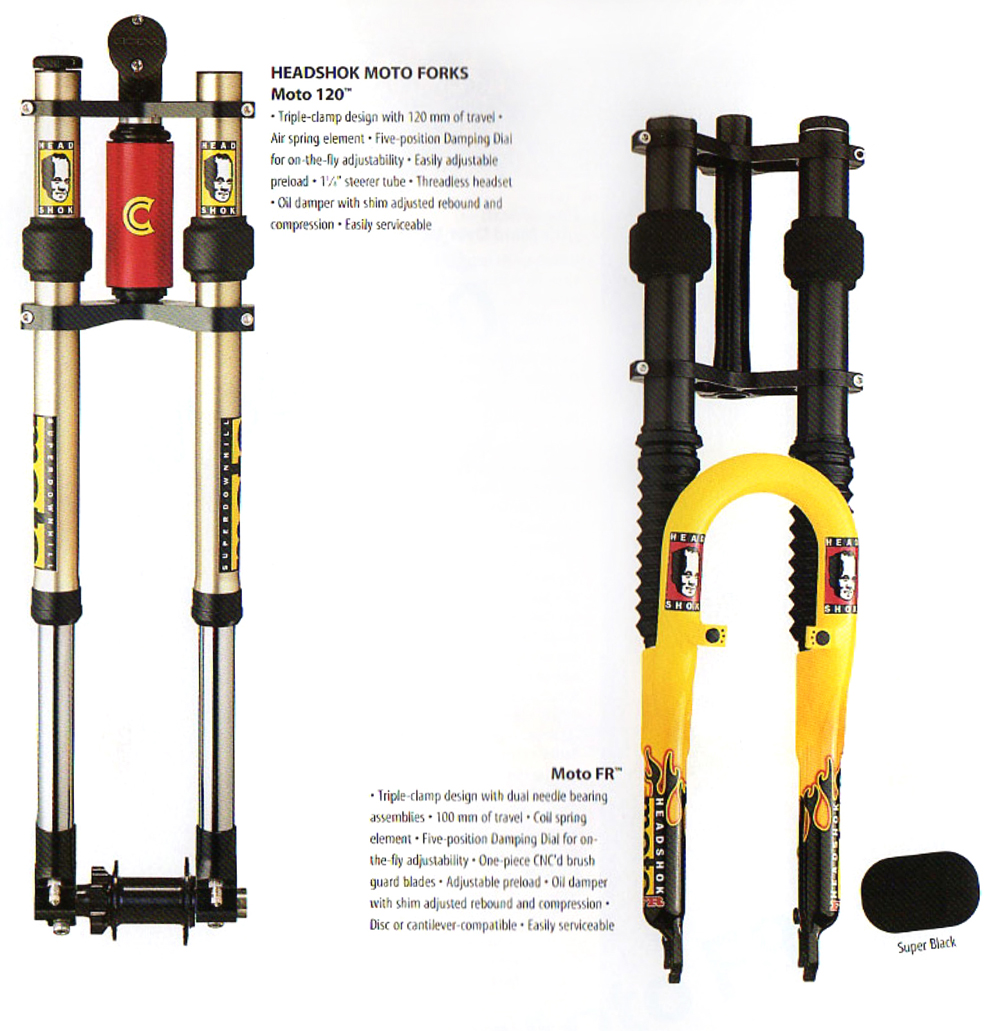 [/img]
You wait, come 2025, we'll all be rocking [s]lefty derived[/s] needle bearing dual leg single crown USD forks with oleo strut damping.
Boosh, back of the net!!
The headshock suspension systems used the 'roller bearings on flat surfaces' prior to the lefty. I think the headshock design was constrained to limited travel, which is why lefty was developed.
Both headshok and lefty are stiff than a conventional fork.
And don't forget that the USE linkage design USP was antidive.
Also, I had the idea for needle roller bearings with square tubes in the early 90s. Didn't do anything with it though 🙂
I've always thought there was more room in the market for leading link style forks with rear shocks allowing you to swap and change suspension but the complexity, cost and people's inability to see past a design 20 years old seems to be a stumbling block.
It's a few decades more than that. They've tried all sorts with motorbikes. The solution that works best is what we've got. Anything else is just a novelty (and worse).