
Subscribe now and choose from over 30 free gifts worth up to £49 - Plus get £25 to spend in our shop
After another near one this morning with a motorist who couldn't wait literally 10 seconds before cutting me up on the inside as I was waiting to turn right I've found this Faceboook lobby group to join, I know it's not doing that much but every little helps
[url=
cyclists space[/url]
I used to think it was 1.5m clearance, although there was a great police video out there showing a police driver giving 'ample' room. Wasn't so long ago they were talking about increasing clearance distance, but that never happened?
Or better yet, give us decent, separated infrastructure so we don't have to worry about idiots and spottily enforced traffic laws. ❓
[img]  [/img]
I think it is pretty clear, pity the courts and police don't enforce the highway code guidance*.
*the Highway code isn't law(mostly) but if your actions fail to meet the standard and you have an accident i always, in my niave youth, thought it would be used against you.
Or better yet, give us decent, separated infrastructure so we don't have to worry about idiots and spottily enforced traffic laws
I'd disagree - [url= http://www.stewartpratt.com/?p=551 ]Bez puts it better than I could though[/url]
Or better yet, give us decent, separated infrastructure so we don't have to worry about idiots and spottily enforced traffic laws
I'd disagree - Bez puts it better than I could though
What 'Bez' is talking about, and a truly segrgated infrastructure (like our cycling friends over the water have), are two completely different things.
There's a fundamental problem in mixing bikes with traffic, whether it be by the side of the road, or in the middle of it. The vehicles are just too different. Hence segregation.
give it 25 years and everyone will be in flying cars so we'll have the roads to ourselves.
By "decent" and "separated" I mean something more than just a line painted on a road.
Have a look at some examples from the Netherlands, they've reconfigured a lot of their roads so that they effectively have an extra carriageway devoted to bicycles.
[img] 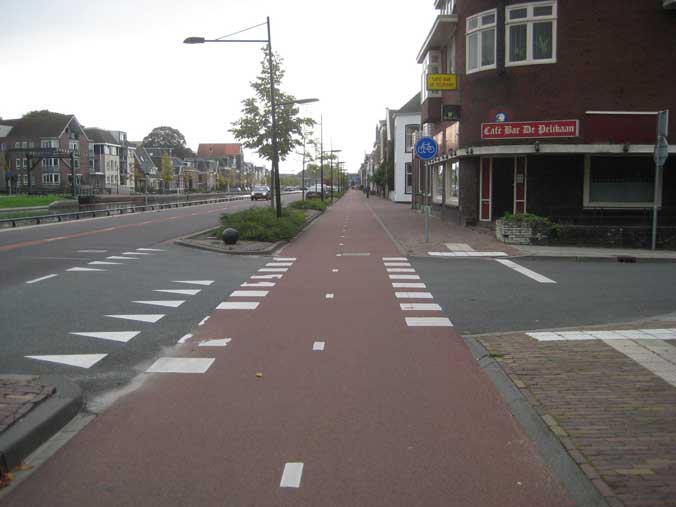 [/img]
http://www.aviewfromthecyclepath.com
Not being given enough space really annoys me. There's a ~300m of road I regular cycle to get between two trails. EVERY time at least one driver squeezes me. The worst example was when a driver didn't see the big yellow ambulance with lights and siren on coming the other way and had to abort getting past me nearly hitting me.
Riders like this bloke annoy me. "Oh, sorry cars it's your road, I'll ride in the gutter to stay out of your way"... grrr!
cyclepaths are not the whole answer - and are not in the netherlands. 20 mph limits, giving priority to cyclists over cars and considering bicycles as equal in road design and planning is what is needed
give it 25 years and everyone will be in flying cars so we'll have the roads to ourselves.
wont there be flying bikes then too?
^^^^ That pic from Netherlands, why are there no students / single mums with pushchairs / dogwalkers / iPod daydreamers walking along it ?
scruff - Member^^^^ That pic from Netherlands, why are there no students / single mums with pushchairs / dogwalkers / iPod daydreamers walking along it ?
Because and angry cyclist will give them what for if they do - and almost everyone rides / has ridden a bike.
I've given up belling or excusing myself when avoiding pedestrians on cyclepaths, I just ride round them now, often very closely.
why are there no students / single mums with pushchairs / dogwalkers / iPod daydreamers walking along it ?
Because it's not "shared use", there's a perfectly good pavement next to it, and, going by a recent visit to Amsterdam, cyclists over there ride like utter mentalists on heavy decrepit bikes that would kill you slowly from tetanus even if you survived the initial impact.
There is also evidence that segregated space for cyclists can simply move the accidents to junctions where the routes cross with other traffic. It certainly makes people feel safer and so more likely to get on a bike, but the obvious answer isn't always correct.
What 'Bez' is talking about, and a truly segrgated infrastructure (like our cycling friends over the water have), are two completely different things.
+1!
We need a *decent* segregated cycling infrastructure, not the half @rsed poor attempt we have at the moment, which is probably why most existing cyclists are against it. Cycling's always going to remain a minority activity until that happens since 99% of the population don't really want to cycle at 20mph in "primary position" just to get to work or the shops safely.
Because it's not "shared use", there's a perfectly good pavement next to it,
As there is on half the cyclepaths I ride, but no-one seesm to have any idea what the red tarmac , white line and pictures of bicycles are for. Although motorists do also think they are a good clear space to park on.
There is also evidence that segregated space for cyclists can simply move the accidents to junctions where the routes cross with other traffic. It certainly makes people feel safer and so more likely to get on a bike, but the obvious answer isn't always correct.
Thats because its not built properly. Cyclists need protecting most at juncitons and thats precisely where most existing cycle lanes dissappear, hence making it more dangerous.
Can you tell me why I get and ad to meet motorcyclist female on your vid dezb 😉
horatio - much of the netherlands does not have a segregated system in towns and villages - it has a 20 mph limit and cyclists get priority. with everyone sharing the road. Main roads you get higher speed limits and segregated cycleways - in towns and villages less so - its 20 mph limits and bike priority
There is also evidence that segregated space for cyclists can simply move the accidents to junctions where the routes cross with other traffic.
Go on then. And don't link to that John Franklin article, it's a load of cherry-picked drivel.
Wasn't so long ago they were talking about increasing clearance distance, but that never happened?
Because it's utterly impossible to police. You going to get a tape measure out and say "I'm sorry sir, you passed that cyclist with only 2' 8" instead of the required 3', have 3 points on your licence." And what happens when I'm filtering up the middle of stationary traffic with 6" space either side, could a driver have a go at me cos I'm not 3ft away? Totally pointless and it's already in the highway code that drivers should give "as much space as they would to a car" anyway.
I'd be happy with being treated the same as a horse - you watch car drivers slow down, pass wide, slowly apply the throttle to keep the noise down yet 5 minutes down the road, they'll be trying to barge past a cyclist, revving and hooting.
Segregated cycle lanes are not the answer and, as Bez says, they often do more harm than good. Just some mutual respect would be nice.
[img] [/img]
part of the problem is that people never give that much space to a car either...
You couldn't give that much space to a car and overtake it on that road.... The picture is therefore completely misleading.
There is also evidence that segregated space for cyclists can simply move the accidents to junctions where the routes cross with other traffic.
Go on then. And don't link to that John Franklin article, it's a load of cherry-picked drivel.
from the layperson pov there does seem to be an issue especially those lanes that suddenly (at 90degs - why is it 90degs?) end and require youto rejoin the main carriage way.
Some interesting stuff in here about segregation of motorists, cyclists and pedestrians:
http://tomvanderbilt.com/traffic/the-book/
It doesn't always have the effect that people assume, and in some cases it can actually increase accident rates. This appears to be because motorists drive faster and take less care when segregation is in place.
I think the Netherlands has around 27k km of segregated paths and 9k km of shared routes, so a substantial amount of their network is not segregated. The Dutch have done some interesting stuff with removing road signs and markings in urban spaces, which forces everyone to actually negotiate how they travel through the shared space, reducing accident rates, and in some cases actually reducing journey times because everything flows more efficiently.
I don't think bicycles and other traffic are fundamentally incompatible, and the best way to improve our roads would be to get more people cycling. That seems to be the single biggest factor in why the Dutch system is so successful - everybody cycles, so everyone automatically looks out for bikes and treats them with respect. Vanderbilt writes about how we only really notice what we expect to see. So, as bicycles are relative rare in the UK, motorists are not really looking out for them, and react more slowly when they encounter a bicycle.
But is Dutch cycling safe because it's ubiquitous, or is it ubiquitous because it's safe? David Hembrow (who writes the blog linked to above) makes a really strong case that it's the latter. Holland does have a strong tradition of cycling, but then so did Britain, at one point.
And no you can't do "cycle superhighway" type lanes everywhere but the Dutch seem to be really on top of traffic management, so if you do have to use a road it's generally quiet and the speed of the cars is restricted.
rootes1, what are "those lanes"? Again, if you're talking about cycle lanes in England they could be miles better than what we've got at the moment.
Defend your position - [u]at least[/u] 1/3 of the way out from the kurb - works for me - when I forget I soon get reminded!
typical dutch urban road - note no cycle lanes 20 mph limita dn cyclists have right of way
A road - segregated cycle lane that cannot be used for parking
Minor road - low speed limit - bikes have priority
Defend your position - at least 1/3 of the way out from the kurb - works for me - when I forget I soon get reminded!
I understand the reasons for this - but are people not then worried about being straight rear ended?!
rootes1, what are "those lanes"? Again, if you're talking about cycle lanes in England they could be miles better than what we've got at the moment.
@ MrAgreeable, like this - being spat of the cycle lane at 90degs onto the exit of the roundabout..
this type of thing
http://g.co/maps/5b94p
Some interesting stuff in here about segregation of motorists, cyclists and pedestrians:http://tomvanderbilt.com/traffic/the-book/
It doesn't always have the effect that people assume, and in some cases it can actually increase accident rates. [b]This appears to be because motorists drive faster and take less care when segregation is in place[/b].
Again, that's generally an argument used against the poorly designed non-segregated cycle lanes we have in this country. Because it gives motorists the impression of segregation, and so they can carry on as they will, so long as they don't go over that white line they believe they're driving with due care. Meanwhile some poor cyclist has their elbow hanging over that line...looking at the curb....looking at the line....nervously looking over their shoulder... That's not segregation.
much of the netherlands does not have a segregated system in towns and villages - it has a 20 mph limit and cyclists get priority.
It's interesting that [i]legally[/i] they have priority. In that if you hit a cyclist, it's your fault. If a cyclist hits you....well it's still your fault. So it's no surprise motorists avoid them like the plague.
The biggest thing in the cycling nations though is the fact that everyone cycles. And even as an 'experienced' cyclist in this country, I rarely feel safe on the roads, and so encouraging cycling to people who need convinced of why they should be cycling is a difficult task. If I didn't do it already....without a perceived safe infrastructure, weighing up the odds, I don't think I'd take it up as a practical means of going from A to B.
I don't think I'd take it up as a practical means of going from A to B.
Correct.
I did 41miles on my bromton yesterday for work purposes ( i use it a lot for site work/ visits)... delightful parts along the Thames to horrors on industrial roads in barking dodging skip wagons..
new blue lane thing along side the A13 was very good though if noisy!
double post
this type of thing
http://g.co/maps/5b94p
Yeah, that's pretty typical of cycle lanes in the UK unfortunately. I'm not talking about a painted-on line, or a pavement that's been magically converted into a cycle track by putting up a blue sign.
I meant proper, separate infrastructure like the Dutch path pictured above. We have a handful of tracks like these in Bristol (sadly far too few) and they are by far the most pleasant places to cycle. This is despite suffering from being overcrowded, meandering or having OTT anti-motorbike measures to negotiate.
I tend to ride where the inside of the passenger side tyre would be on a car, on the country roads I ride it's pretty easy to see where that is. I will move over a bit if it's safe for me to do so (eg not too pot-holed) and safe for car to overtake me.
The thing that astounds me is the number of people who'll overtake on blind corners, utter madness!
some little chav left me about 5 inches earlier, shame I didn't catch him up.
If there is no room to overtake then I am afraid I hog the lane - I have a few sections of my commute that are like this and I have only ever had one beep (well several from one driver) - I slowed and then gave him the bird I am afraid as he then burned rubber only to hit the next jam - cock!
typical dutch urban road - note no cycle lanes 20 mph limita dn cyclists have right of wayA road - segregated cycle lane that cannot be used for parking
Minor road - low speed limit - bikes have priority
Maybe we're arguing the same thing, these are what i'd consider part of a cycling infrastructure.
Using the roads at the moment is like trying to fit a square peg into a round hole. The roads have just been exculsively designed around motorised traffic, meaning the only safe way to use them is to cyele s if you were motorised traffic, hence the John Franklin book. it all just needs designing with cyclists in mind as well.
Existing cycle paths seem to have been designed to get cyclists out of the way to improve traffic flow and let the cars drive faster.
On the way to woking theres even more poor examples, such as shared-use unlit pavement where you cycle directly towards the oncoming traffic and cross numerous blind driveways. utterly horrendous at night.
Claiming the lane (or "primary road position" if we're being PC) is the recommended way to ride. You might get honked at, but that means you've been seen.
How about some nice big bright 'Give cyclists space' STW stickers for our back windows - spread the word Herefordshire Council did some a few years ago and yous till see them around
There was a "Give Cyclists Room" campaign a few years back which was all about selling stickers. The whole thing folded after a while though (dunno why).
[img]  [/img]
This is how some of the cycle lanes are in Portland, Oregon. It works well until you rejoin a shared section of road. Reducing the through flow of car traffic in the city centre means more cyclists use the bike lanes.
Penalties are high for motorists who hit cyclists there, it's the best deterrent.
[img]  [/img]
Herefordshire Council
The same organisation that replied, when asked by the DfT what cycling provision they required from the developers of Asda and the alterations to the roundabout adjacent to it (the one you can see from space)
"Cycling provision? Errrrr...... No, we don't need any"
This is on the one end of the only river crossing in the city. (yes, there are other bridges, but the other road one joins prior to the "roundabout")
HoratioHufnagel
the point being that segregated cycle lanes are only a part of the Dutch answer.
Other road engineering and legal stuff are other parts
And attitudes to cyclists!
In case anyone has missed it this describes the shift in emphasis that led to teh situation in teh netherlands now.
It didn't just happen - its deliberate policy over decades. Interesting the assumed liability for car drivers ie that they are assumed at fault unless (on the balance of probabilities) they can show otherwise is relatively recent - in the 90s IIRC.
I'm on a cycling forum and we're arguing over giving cyclists space, ffs, can we not agree on anything in this place.....
Yesterday I cycled in the snow, 250m abs and 4 foot drifts that are still in place.
It was a challenge. Cars stuck everywhere, a tractor came to pull some out.
I helped push one who had been stuck in his words for 20 minutes...
After that one road to work, one guy not 2 foot of my back wheel as I slipped and slided, I had to move out of his way, I don't normally do that on principle but my kids need me.
Another guy less than 80 meters to a red light, puts his foot down to overtake to stop in front of me, at the red light.. he slips a little sideways in the slush, a car in the other lane swerves scared to death, I shit myself.... The junction has a cyclists box at the front.
Both cars has been stuck for a while....but its still ok to sod the cyclist.
I have ridden in many, many countries and the UK is the worst (excluding India). In France a car will sit behind a cyclists for hours.
UK car drivers are an absolute danger and I'm one....
The very fact we are arguing on this forum rather than doing something about it, probably says a lot as to why.....
4 categories of driver in my opinion
Good ones, drive well etc etc
Bloody minded, the road will be three cariageways without a lane and they will still buzz you
Naive, sat at a junction unsure as to whether to pull out on you until vital seconds later they do. Slowing to a stop when they approach you turning right then realise they have right of way. Starting to pass then discovering there isn't room and procrastinating dangerously. Passing you insanely close due to a crossing point chicane yet swinging away afterwards despite having passed you. Looking you in the eye as they figure how to lest turn after passing you.
The latter is obviously the majority 😉
......4th one....ride bikes in their spare time...
Infrastructure is not the answer. IMO it's a huge part of the problem. It suggests cyclists should not be in the road.
The reason I'm at risk of getting killed or injured when I ride my bike is mainly cars/vans/lorries not driving safely - at an appropriate speed and giving me appropriate space. it's not the car, it's the way it's driven...
We need behavioural change
Which will come partly from proper enforcement of the law, or at least some kind of consequence for drivers who put their convenience ahead of the lives and health of cyclists.
We need behavioural change
Undoubtedly. I recently started commuting the 8 miles to work by bike, and based on this limited experience of a few months, impatience and intolerance is the biggest problem we face in traffic. People are not prepared to wait even a second to get past. I could give a long and tedious list of driving imbecility, there's at least one instance a day, but I'll spare you and just give one recent example as I think it's illustrative of why things are the way they are:
Last week I was cut up by a learner in a fully badged-up driving school car with an instructor in it. They sat behind me for a few seconds, whilst I passed a row of parked cars sitting well out of the door zone and holding the lane, as you do if you want to not die. They clearly got tired of waiting after a whole five seconds or so, and booted it to get past me despite there being oncoming cars clearly visible - this is on a busy, slow-moving 30 limited road outside a hospital at rush hour, so they weren't going to be getting anywhere particularly fast either way. Because of the oncoming cars they then had to cut back in sharply, forcing me right up against the cars I was passing. I don't know if the instructor pulled the wheel or not, but he very deliberately stared me down as they drove past inches off my bars, with no sign of apology or acknowledgement of error, as if to make it clear that he thought I shouldn't be in the middle of the lane holding his oh-so-important lesson up for five seconds.
I'd love to be able to give that learner the benefit of the doubt, but I see no way that it could have happened without the teacher telling the driver to do what he did. I was so stunned by the look on the instructor's face as his pupil forced me out of the way that I wasn't able to get the reg plate or driving school name. If this is how they're teaching kids to drive it's hardly surprising that we're scraping so many people off the tarmac, is it?
When you see an AA driving school car being driven by an instructor with a mobile phone to his ear you realise there is no hope for any improvement in driving standards anytime soon.
And this is the nub of the issue - he's clearly not fit of attitude and should not be a driving instructor. Using a phone is a conscious decision, not a moment of poor judgement.
But all I could do was look, see and be appalled. No time to get evidence to get in front of his employer so he was retrained, disciplined or sacked...
Many thanks for that video TJ.
The reason I'm at risk of getting killed or injured when I ride my bike is mainly cars/vans/lorries not driving safely - at an appropriate speed and giving me appropriate space. it's not the car, it's the way it's driven...[b]We need behavioural change[/b]
Indeed. Across the board. But with regard to this subject and in seven+ years of riding the same roads, it's the greying individuals that get closest and scarily don't seem to realise, although tossers with a stereo so loud it's shaking the road and [b]some[/b] van drivers are running a close second, with the former at least giving a little notice before they squeeze through the [i]impossible[/i] gap.
Folk over seventy should be tested very regularly as to their ability to drive safely IMO, but my ignorance in matters DVLA will no doubt bite me on the arse in this instance...
I give the same room I would a car.
Bit biased as a fellow cyclist, so I give a bit
more room and patience.
It's not worth injuring someone.
Bit biased as a fellow cyclist, so I give a bit more room and patience.
That's it... in a nutshell.
The drivers who squash cyclists are not cyclists. All drivers must become cyclists (a bit).
What's easier, changing the behaviour of millions of drivers whose attitudes are currently reinforced
by their friends, workmates, and countless sub-Clarkson articles in local papers?
Or setting aside a fraction of the current road budget to build separate, quick and effective cycling infrastructure?
At best, all the current provisions for cyclists do is suggest that we should be allotted a space on the road. It's almost always a strip a foot wide, with a van parked in it.
Unless that separate, quick, effective cycling infrastructure is going to take cyclists off [b]every [/b] road in the country, there us always going to be a need to share. As this is plainly unachievable, we need to concentrate on training and attitude. Personally, I think segregation is the wrong answer anywhere.
Another point: campaigns that just focus on "cyclists"are doomed. We're a tiny minority of road users who are widely regarded as jumped-up sanctimonious fitness freaks. I've said it before but campaigns like the Sustrans "Free Range Kids" one are far more savvy than Cyclesafe.
If separate infrastructure is the wrong answer, why do countries with extensive separate infrastructure have much higher rates of cycling, and much lower accident rates?
The argument that we'd have to build a cycle path next to every road is a straw man. As other people have pointed out, on this thread, even the Netherlands don't do this.
A nice "Give Cyclists Space" video from CycleGaz:
There is no proof that the latter is due to the former. As TJs vid points out, the attitude in many of these countries starts out a lot different. So, I would argue that higher cycling rates results in more investment in infrastructure, not the other way around.Mr Agreeable - Member
why do countries with extensive separate infrastructure have much higher rates of cycling, and much lower accident rates?
It definitely lies in the attitudes towards cyclists by the drivers. Over here in Germany all drivers are instructed specifically about how to behave around cyclists. All drivers when turning right will look over their shoulder to check the road is clear of cyclists. Failure to do so means three points on your license if caught. Also in the event of an accident the driver is automatically deemed at fault unless he or she can prove otherwise. It's not perfect though as I have had a few drivers here use their car as a weapon to force me off the road when they have thought I should be using a cycle lane.
Nice PICKFORDS didnt pizza me, thankfully.
I think there's a lot of variability in what people think they should be doing. I was abused by a "cyclist" in a car a few weeks back for being in the primary position approaching a roundabout on a 30mph dual carriageway to turn left. If I'm close to the kerb I am guaranteed to be cut up by someone from the outside lane veering left to get round me, despite the two lanes continuing after the roundabout! I was quite amused when I caught him up by his opening gambit of "I've got 6 bikes", which apparently gives him some authority on these matters?
Ok, can anyone give an example of a country that has Dutch or Danish levels of cycling just as a result of training?
Can anyone give an example of a country where cycling rates have declined after building cycle paths?
Thought not.
http://www.worldwatch.org/node/6261
In the Copenhagen metropolitan area, more than a third of residents pedal their way to work. With bicycle lanes that crisscross the city and bicycle bridges spanning many roadways, cyclists can often ride with ease.Yet more cyclists are complaining that cramped lanes pushthem closer to cars or buses. A 2006 Danish Transport Research Institute poll found that 47 percent of cyclists feel unsafe riding on Copenhagen streets. A decade prior, 40 percent expressed such concerns.
So, I would argue that higher cycling rates results in more investment in infrastructure, not the other way around.
Druidh - that is exactly the opposite of the dutch example - they invested in cycling infrastracture which increased the amount of cycling. Cycle lanes are a part of the solution but your criticism is valid in some respects - cycle lanes are only a part of the solution. other road engineering needs to be reweighted away from priority to cars and a behavioural shift is needed.
assumed liability and 20 mph urban limits with the shared space concept would help greatly as well
Having cycled a fair bit in the low countries the need for the 3 things together - cycle lanes on main urban roads, cycle priority in minor urban roads and assumed liability are the way to go.
The Netherlands made this change over a couple of decades. We could too
TJ - what was the overall numbers of cyclists/mileages like before the big push in the Netherlands? Wasn't it already much higher than in the UK?
Personally, I rather like the centre of Amsterdam. No cycle lanes there, just huge numbers of cyclists and roads that aren't express-ways for cars. 20mph limits have a massive role to play, though I'm not sure how we define "residential". Certainly, any street which is a cul-de-sac with only houses must qualify and I think we could do a lot by the use of different/raised road surfaces, no white lines etc. Neither do I think that the sort of experiment now going on in Edinburghs QBC is doing the right thing - not while there is still so much on-street parking.
TJ the video you posted is interesting. The most interesting point for me was the insightful government who decided that they should be smart with energy; as opposed to completely ****less with it and spunk their precious commodities up the proverbial wall.
We could too
But we won't because no government in the UK is likely to have any energy conscious policies - ever IMO
Druidh - Plenty of cycle lanes in the centre of Amsterdam. They are everywhere Plenty of road engineering in favour of cyclists at junctions as well. I have cycled around the city a fair amount - I have family there. The roads yo see that are "just huge numbers of cyclists and roads that aren't express-ways for cars." are the 20 mph limits roads - all the main roads have segregated cycle ways. Amsterdam you either (in the main) have 20 mph limit roads with bicycles mixing in and having priority or you have higher limit roads with segregated cycleways. Some of the more minor roads have cycleways as well.
A few pictures.
Edit - this one shows it well - this is just outside the city centre -(10 mins walk from dam square) Main road with segregated cyle lane - side road with 30 kph limit and cyclist priority.
http://g.co/maps/vjfjm
down by the central station - main route - cylce lanes
http://g.co/maps/dyxbu
Singel canal - 20 mph limit, on street parking, cycle priority
http://g.co/maps/7hstr
Main route from station south - oh look segregated cycle lanes
http://g.co/maps/qwd4b
main route just outside the centre - cycle lanes
http://g.co/maps/vnsbf
south city centre - on street cycle lanes
http://g.co/maps/t4zca
have you ever actually ridden round the city?
Cycling was higher in the Netherlands in the 70s than here but the difference was not so great. However after the investment in cycle facilities cycling increased - it was the investment that led to the increase in cycling. Cycling decreased in the UK with the presumption in favour of the car
AS for the 20 mph limit - its more or less blanket in all urban areas apart from main roads in the Netherlands. The only solution is to rebalance the priorities on the roads away from cars and towards cyclists as they have done. Not just a few cul de sacs but its the norm.
again - in the Netherlands there is on street parking in most of the 20 mph limit areas
There's nothing in that article that says the numbers of cyclists in Denmark, or even Copenhagen are declining. They're talking about how to get 50% of journeys made by bike!
Project, a quick call to the logistics manager of the local Pickfords for an apology wouldn't go amiss. The big companies don't like their reputation being risked by their employees.