[url= http://www.independent.co.uk/news/science/close-encounters-of-the-asteroid-kind-130000-ton-asteroid-to-make-closest-ever-flyby-of-earth-8480449.html?origin=internalSearch ]The Independent - Asteroid to miss the Earth by 17,000 miles[/url]
The article states that there are half a million rocks orbiting the earth. If so, can some explain how we have managed numerous lunar missions, with spacecraft travelling at thousands of miles per hour, but without being struck by any of these rocks?
Just lucky i guess.
Edit: Thousands of miles an hour? are you sure about that?
Edit Edit: Been doing some research (looking at google), turns out they do travel at thousands of miles an hour. Who'd of thunk it? not me thats for sure.
Space is really big.
Space is big. You just won't believe how vastly, hugely, mind- bogglingly big it is. I mean, you may think it's a long way down the road to the chemist's, but that's just peanuts to space. </DNA>
It's actually a real problem these days, not just with natural debris but the amount of artificial crap floating around up there. An errant paint chip can put a fair dent in a satellite.
Nice Troll - most of the crap orbiting (near orbit)the actual earth we have put there ourselves and it is now getting a serious concern for the various space programs for working kit that is in orbit and for sending up new kit and ships.
When they say that there are millions of rocks "orbiting the Earth" is that actually what the article said (I can't be bothered to read it) or did it say they passed through Earths orbit?
Edit: Thousands of miles an hour? are you sure about that?
Yes. The Apollo capsules travelled at 39,000kph (25,000mph) [url= http://en.wikipedia.org/wiki/Apollo_10 ]Source[/url]
To the OP - the 500,000 figure does not specify the orbit of these rocks nor how often they approach the Earth. And space is really really big.
It's actually a real problem these days, not just with natural debris but the amount of artificial crap floating around up there. An errant paint chip can take out a satellite.
Was it the last Stargazing Live where they covered this in some detail? - IIRC satelites may start needing routine matenance as the plasma bursts on the surface panels caused by flecks of paint hitting them is becoming an issue to longevity....and every ~10 years or so a satellite does get destroyed in a collision with something, be it asteroid or our orbiting space junk.
I suppose even though there so many rocks floating about, there is still quite a slim chance of one happening to be in the same place as you because of the sheer huge area they cover.
We track most biggish stuff in orbit around the earth. This lets people plan where a spacecraft has to be at a particular time to avoid it. Quite simple really, but a LOT of maths.
Wow. That is a lot of crap to avoid.
[img] 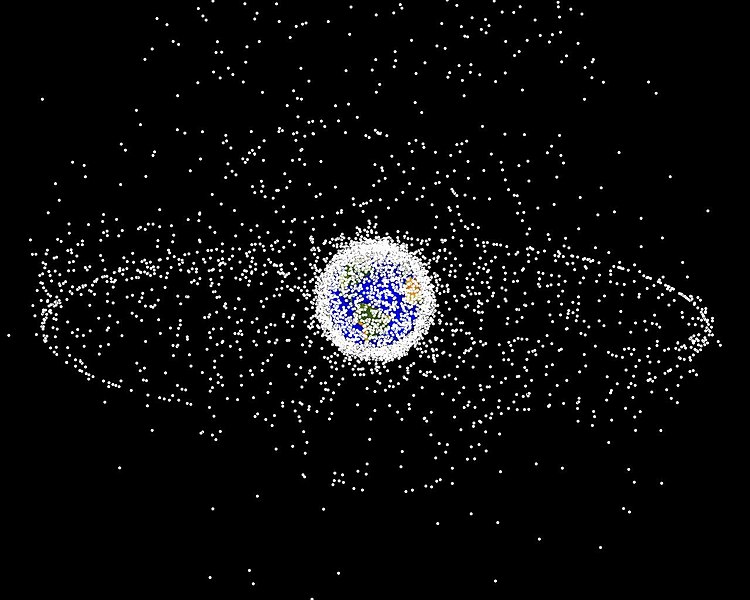 [/img]
For a giggle:
The distance from the Earth to the Moon is: ~384,400 km
The volume of the space is 4/3 pi * the distance cubed: ~237924270443818612 km3 (I think...)
If it's occupied by 500,000 rocks, then there is the probability of one rock every 475848540887 km3
Easy for a small spacecraft to miss
When they say that there are millions of rocks "orbiting the Earth" is that actually what the article said (I can't be bothered to read it) or did it say they passed through Earths orbit?
The article says 'circling the Earth', which isn't very specific- I suppose you could say that comets 'circle the Earth' but you wouldn't worry about spacecraft colliding with them.
Anyway, to the OP/Troll's main question: it's not like Frogger up there. Spaceships getting hit by things is a serious hazard in orbit and it's much worse since the last moon landing in 1972 but that's because of all the man-made stuff, not asteroids. But going to the Moon is different because, as above, space is big.
[img]  [/img]
@ spongebob
... If so, can some explain how we have managed numerous lunar missions, with spacecraft travelling at thousands of miles per hour, but without being struck by any of these rocks?
Because there are no asteroids flying around the hangars at Area 51.
The asteroids aren't orbiting the Earth, they are orbiting the sun. There might be half a million crossing the earth's orbit maybe.
Space junk however is orbiting the earth, at close range to so it's pretty packed in there.
The Earth has been struck many times by errant rocks and other stuff. Google Arizona Crater, Tunguska, Chixulub(sp?) crater, etc.
think how big the UK is compared to the earth. there are 70 million people in the UK, yet it's quite easy to be a long way from any of them. then imagine 0.5 million rocks spread out over the area of the earth's surface, expanded for whatever height we're talking about. now the rocks are more than likely a bloody long way away.
that's how.
But every landing [i]was[/i] struck by a piece of orbiting rock.
The Moon.
Mwahahahaha
Paint chips?
Have they never heard of Hammerite?
Wow. That is a lot of crap to avoid.
Not really. If the crap was drawn to scale, you wouldn't be able to see it.
Wasn't a troll, it was a valid question!
Spacecraft hitting a tiny piece of space debris as 25,000mph would definitely cause a significant, if not major Damage. This assumes the said space debis is stationary, but the newspaper article stated that these rocks are orbiting the earth's atmosphere at thousands of miles mer hour.
Given that a bullet travelling at around 680mph can pierce several layers of sheet metal, a pea sized piece of space rock would do more damage striking a spacecraft at around 40000mph (assuming the rock is doing 15000mph and the spacecraft is doing 25000). My guess is that the pea sized fragment of debris would penetrate its way in one side of the craft and straight out the other!
You can argue that space is very big, but how do the scientists know where the clear part of space is ? For example, how do they detect particles as small as a few cm careering through space more than a few thousand miles away? Or even 100 miles away.
A lunar rocket would have travelled at least 500,000 miles. So not one debris strike happened, but apparently there are 500,000 space rocks orbiting the earth. It think the newspaper journalist might be sensationalising his piece!
I can't believe that some people still believe man has been into space
Look at the flag, sheeple !!
I'd worry more about crossing road road tbh
I can't believe that some people think that people still haven't been into space. This is what Buzz Aldrin thinks:
It's incidental, but there was a lot less near-earth orbit 'space junk' back when people were landing on the moon, which has not exactly been done many times at all.
I bet Brian Cox knows, he's dead clever, an space is really, really big !
A micro metorite one of the things initialy suspected of causeing the oxygen tank failier of appollo 13 - but it was later atributed to damaged insulation causeing wireing to shortcircuit.
Space probes have been flown through the rings around Saturn and through the asteroid belt with no problems (yes they did aim for the gaps but you can't see small rocks that far out...)
Space is very, very big though.
By the way, the International Space Station does get hit by small debris, the Cupola (the viewing port) got hit a year or so back, made a nice little pock mark in one of windows... http://www.spacesafetymagazine.com/2012/06/14/micrometeroid-hit-iss-cupola/
[img]  [/img]
but the newspaper article stated that these rocks are orbiting the earth's atmosphere at thousands of miles mer hour.
What rocks in Earth orbit? There's loads of space junk and debris swirling around up there, but no [i]rocks[/i] in Earth orbit. That article is typical junk journalism, written by someone with scant grasp of what's being told to them. What they [i]mean[/i] is that there are tens of thousands of rocks that [i]intersect[/i] the Earth's orbit, a completely different thing, because if they were actually in orbit they'd be no real threat to the planet at all, only to other orbiting objects.
A large rock: meteor, asteroid or comet nucleus, would be a serious threat; something weighing around 100-200 tonnes would pretty much destroy a large town or city, because it wouldn't burn up on atmospheric entry. Even a non-solid object like a comet nucleus would devastate a city.
[img]  [/img]
This is the Siberian forest after the Tunguska event in 1908, where something exploded around 3-6 miles up. Imagine that over London, or Paris. http://webodysseum.com/history/tunguska-the-most-powerful-explosion-by-an-astronomical-object-in-modern-times/
You can argue that space is very big, but how do the scientists know where the clear part of space is ? For example, how do they detect particles as small as a few cm careering through space more than a few thousand miles away? Or even 100 miles away.
1) Big **** off radar dishes keep a track on the larger debris....and by larger I mean the size of golf balls.
2) Small stuff can I believe...be shielded against pretty effectively using similar techniques that were developed to shield tanks from armour piercing shells (spaced armour/spall shields)
I would start a Moom topic here every day just to keep watching that Buzz Aldrin video.
" you're a coward and a liar and.....NOT THE FACE, NOT THE FACE!" 8)
that video has just so cheered me up this morning.
There's an [img] 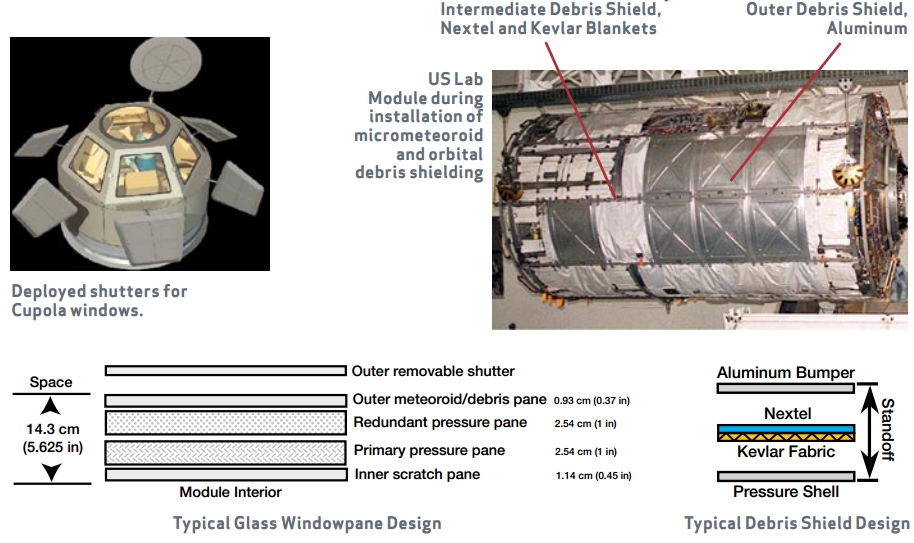 [/img] showing the armour plating used on the ISS.
What rocks in Earth orbit? There's loads of space junk and debris swirling around up there, but no rocks in Earth orbit.
I can see a pretty big one most nights 🙂