UPDATE: Reviews section refreshed, redesigned, searchable: Go take a look
Can’t believe they actually pay people to write this stuff!
They're conservative, so they want conservative articles so their readership read them.
There's way more on social media, I think oil companies are paying bot networks (or people with the intelligence of bots) to bang on about how terrible EVs are.
Nah wasn't him
Turns out it was a chap in carnoustie.
Vauxhal mokka e. - not like a vauxhall was going to be a crock of crap
Not like them .
Have you ever bought a car that performed the advertised mpg?
Yes I skimmed through the moaning about range I will admit. I’m assuming Jaguar are particularly bad at exaggeration because our Tesla and Zoe both do about 85% of advertised range even in the winter, which is closer to manufacturers claims than most normal cars.
Charging away from home is something that most electric car owners very rarely do so this again is an issue that seems to be contrived in order to make a point.
Giles Coren was the writer in The Times. He lives in London and has no off street parking and decided an EV was a good idea. He always has to use public charging which is just stupid.
So he bought a poor one (disclaimer - I love Jags but even I wouldn’t buy an iPace).
He’s then slagged it, and EVs, off regularly in the paper.
The Times (and the rest of the News Corp papers) are anti-EV and anti-Net Zero. I probably should sub to something else.
To top it off, the rumour is after he sold the iPace he bought another EV…
Sorry yes I failed to mention he thought it would be a good plan to get an EV with no ability to charge at home, then also used that as a reason to say they’re rubbish.
They're not rubbish, they just take some getting used to. Buying one with no means of charging at home does complicate things.
To be fair to GC though, the availability of public infrastructure has got worse with the increase in popularity. I've had EV's for a good number of years now so have seen the difference. If you're using one with an ICE mentality then your experience will be bad. They're not, they're just different.....but life is a LOT easier when you can charge from home!
Out and about today so popped into nearby BMW dealership to have a good poke around the i4.
The showroom car was an mSport so a bit different trim above the base, but a quite impressive bit of kit. Lots of space inside, nice layout on dash, good hatch for bikes and dogs 🤪
Thought this belonged here. Guess the ami doesn't have to pass normal safety tests as it's a quadrocycle, but this is pretty bad
bensales - Giles Coren was the writer in The Times. He lives in London and has no off street parking and decided an EV was a good idea. He always has to use public charging which is just stupid.
I've not had a problem in over 3 years of exclusively public charging. Thanks for those words of support 🤪
Giles Coren was the writer in The Times. He lives in London and has no off street parking and decided an EV was a good idea.
Unless London had changed a lot since my last visit he doesn't live solely in London
As I watch my family strike out on foot across the fields into driving rain and gathering darkness, my wife holding each child’s hand, our new year plans in ruins, while I do what I can to make our dead car safe before abandoning it a mile short of home, full of luggage on a country lane
whatgoesup
Full Member
@iainc – take one out for a drive, they make even more sense then!
I’m getting one in the autumn, on a lease through work 🤪
Vauxhal mokka e. – not like a vauxhall was going to be a crock of crap
Not like them .
Of course not, they're just another Stellantis appliance.
I've had ICE cars break down too so...
molgrips
Anyone seen that new Nissan drivetrain that’s a BEV with no charging port and a petrol generator instead?
This sounds like what's in the latest Honda Civic.
This sounds like what’s in the latest Honda Civic.
nah its closer to the vauxhall ampera or the bmw i3. The engine has no connection to the wheels and instead just drives a generator. The civic is a traditional hybrid (the engine drives the wheels at times)
at certain times iirc the ampera could link the engine to the wheels, not sure on the i3
The one reason why I’d think that the Nissan approach is good is that presumably I wouldn’t take much of a move to make the generator hydrogen powered and boom - the perfect green car once and if ever we sort out the issue of making hydrogen available, cheap and safe??
I know Toyota have done it already but it’s about 90 grand and there are only about 3 of them out there.
Thought this belonged here. Guess the ami doesn’t have to pass normal safety tests as it’s a quadrocycle, but this is pretty bad
That's absolutely outrageous in 2023. Thats not actually far off the turn down the hill into town for me on an NSL A road that would see similar approach speeds. Considering it's built to a restricted speed I'd like to have expected that it could at least handle itself at that speed.
Looking at the comments it doesn't even have an anti-roll bar???
The one reason why I’d think that the Nissan approach is good is that presumably I wouldn’t take much of a move to make the generator hydrogen powered and boom – the perfect green car once and if ever we sort out the issue of making hydrogen available, cheap and safe??
A hydrogen powered ICE requires significant beefing up, a standard petrol engine wouldn't hack it.
Lots of people talk as if burning hydrogen is ideal, but it's not. Assuming you can generate it, you need to liquify it. That takes a huge amount of energy, it's really hard. Then you need to transport it which is very difficult. And once you've gone through all that, you're actually much better off using it in a fuel cell than burning it, it's more efficient.
Toyota make and sell the Mirai commercially, to fleet owners with their own fuelling stations mostly, but that's a fuel cell vehicle not an ICE.
@molgrips - the obstacles you describe are being overcome at a tremendous rate. There are a couple of UK companies actively exploring an extensive Hydrogen refuelling network similar to the Tesla supercharger model. We all know the story as it's well a trodden path, the technology will advance through time until it becomes viable.
The Toyota story could be such a success, but as you rightly say, it's just not quite there just yet. What do those cars offer in terms of mileage?? 600+ or something like that?
The one reason why I’d think that the Nissan approach is good is that presumably I wouldn’t take much of a move to make the generator hydrogen powered and boom – the perfect green car once and if ever we sort out the issue of making hydrogen available, cheap and safe??
Well, not hydrogen, because it's really not actually very useful.
But, you can start playing around with different combustion cycles, the current one we use in most cars is optimised against half a dozen conflicting requirements. One pair of which is low emissions and responsiveness to the throttle. They are a bugger to balance between.
If you can buffer between Engine => battery => Throttle you can start playing around with things like miller cycle engines, which really don't like to change speed very much, but are capable of lower emissions. And there are far more aggressive cycles you can use as well. With an engine running at steady state against a fixed load it becomes possible to reduce emissions by orders of magnitude. The I3 with range extender and ampera were getting there.
As far as I understand it the only way currently to use hydrogen is for it to be essentially an electric car, with a hydrogen fuel cell powering an electric motor, hence the comment about the Nissan, which is essentially that except it has a petrol powered generator.
I don’t think you can make any sort of ICE powered by hydrogen at the moment.
There are a couple of UK companies actively exploring an extensive Hydrogen refuelling network similar to the Tesla supercharger model. We all know the story as it’s well a trodden path, the technology will advance through time until it becomes viable.
A BEV will travel 3-4 times further on the same amount of electricity as a FCEV. It gets worse if you try to burn the hydrogen in an ICE when a BEV will go at least 6 times further. So if we take the hydrogen path we'll need at least 3-4 times the wind turbines and solar farms to make the green hydrogen than if we take the BEV route. That's why for road transport hydrogen is dead in the water. In any case we'll need all the green hydrogen we can get our hands on to replace the grey hydrogen made from methane that today is being used to make fertiliser. There will be none left over for FCEV or to burn in ICE. As for storing and transporting hydrogen its incredibly inefficient and difficult. That's why most hydrogen today is made next to where it will be used.
I don’t think you can make any sort of ICE powered by hydrogen at the moment.
You can but again why would you? From Bamford's own lips "There is a problem where we get the fuel from."
The Toyota story could be such a success, but as you rightly say, it’s just not quite there just yet.
It's pointless, in most situations. You need to start with electricity, use it to create hydrogen which in inefficient, then compress it which also uses a ton of energy you're not getting back, then you have to physically ship it to where it's needed - also taking energy. Then you put it in your car and get 60% of its chemical energy back as motion, or 40% depending on if you burn it or use it for generating power. All so that you can drive an extra couple of hours without compared to just putting the electricity directly in your car in the first place!
Toyota are hardly selling any Mirais, meanwhile BEVs from every other manufacturer are flying off the shelves. BEVs work really well, for most users. Creating an entire new infrastructure, and still having all the above mentioned problems does not make sense. For outliers who're justified, we're better off keeping petrol. And no, you who wants to drive for 5hrs without stopping instead of 3 because you want to doesn't count as justification.
If we didn't have BEVs and needed another low emissions solution then maybe. But we do and we don't.
Wow molgrips its like you read my posts.
Re Hydrogen: it's often talked about as though it's a fuel. It's not*, it's a form of energy storage.
It's benefits are rapid refuelling compared to batteries and the ability to be used in an ICE, using existing ICE technologies with some fairly mild development needed to make a petrol or diesel engine capable of burning hydrogen (as per the JCB example above).
It's downside is pretty low conversion efficiency from the source (assuming electricity) to final output, the conversion from elec to H2 via an electrolyser can be fairly efficient (80-95% ish), and then a fuel cell is 40-60% efficient and an ICE will be around 30-40% efficient. A battery by comparison is around 77% efficient in total, so something like 2-3 times the amount of useful output vs a Hydrogen ICE engine.
As, breakthroughs in nuclear fusion aside, generation capability will be limited we need to make the most efficient use of what we've got which right now is batteries.
So, in the short term it looks like - Batteries for applications where recharging is feasible (i.e. passenger cars) or hydrogen for applications where it is not - ICE initially, moving to fuel cell as technology improves(e.g. lorries, industrial equipment etc). Of course this will change - Hydrogen is not the only form of chemical energy storage for example.
*unless it's made from oil, which isn't the long term aim.
Using hydrogen for cars is just dumb. Fuel cells are at most 60% efficient but in reality it's closer to 40%. By the time you then scale the fuel cell size to peak power required, the car must be big as the fuel cells are not compact. If you don't do this, you need a battery (which you'd need anyway for recuperation) or capacitors.
Moving hydrogen around in it's liquid form for mass use just won't happen, especially if both homes and the aviation sector uses it. LH2 leaks through everything, even some dense metals like steel alloys, when it does, it embrittles them. its thermal expansion coefficient is horrific - just a few degress is an exponential increase in pressure. Its tendency to explode at even tiny vapour concentrations is terrifying, so it must be kept in motion. It would have to be transported everywhere at -253degC or below.
Heathrow currently uses 22.5m litres of jet fuel every day. That would need to be ~100m litres every day. the sea level losses caused by moving that to the airport in its liquid form would have a FAR FAR higher climate impact than actually burning jet fuel.
For hydrogen to work, it has to be moved around as a gas and liquified on site close to where it's needed, but even then. moving electricity around is MUCH easier and more efficient that moving hydrogen.
Also bear in mind that to fuel even a fraction of the worlds projected need for H2, you'd going to need 60+bn litres of fresh, very pure water...where are you going to get this from? Especially in California, the middle east? Africa? Yup, desalination - possibly the most damaging thing to happen to the environment in recent decades...both from a waste and energy consumption perspective.
Hydrogen will have it's place, but it's essentially as a chemical storage battery for applications which need VERY high energy density where there are no alternatives. Power storage for demand use and Aerospace.
Home heating should be electric, cars should be electric, they need the least infrastructure changes and have the most flexible means of energy generation.
It’s downside is pretty low conversion efficiency from the source (assuming electricity) to final output, the conversion from elec to H2 via an electrolyser can be fairly efficient (80-95% ish), and then a fuel cell is 40-60% efficient and an ICE will be around 30-40% efficient. A battery by comparison is around 77% efficient in total, so something like 2-3 times the amount of useful output vs a Hydrogen ICE engine.
You forgot the compression, cooling and transportation part. Here's a useful visualisation of why hydrogen is a waste of time.
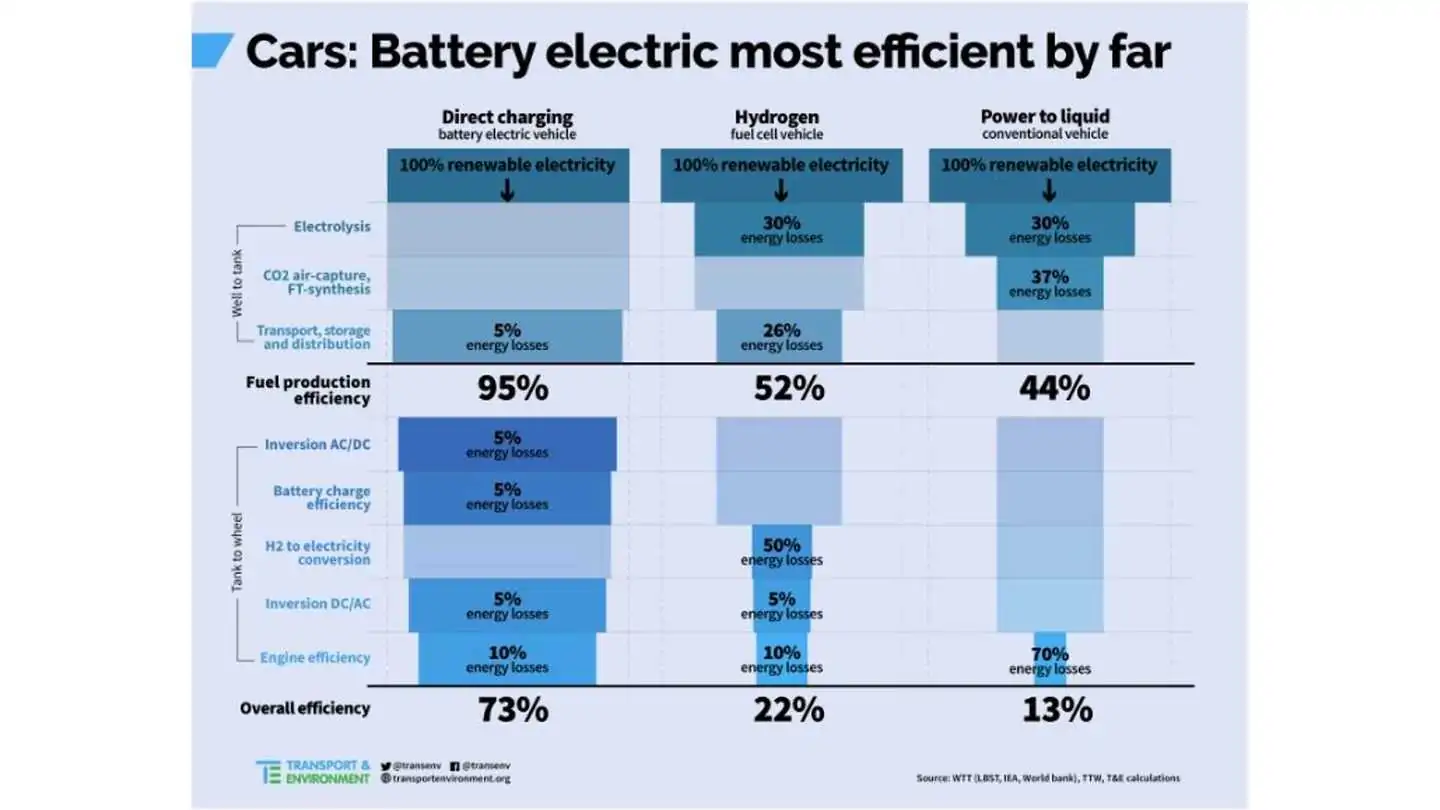
But.. but.. refuelling time is shorter...
Direct burn hydrogen also has issues in that unlike a fuel cell whose only emissions are water, burning of H2 does create significant amounts of NOx and small quantities of Carbon Monoxide. This is another reason why home H2 boilers are a bad idea.
But.. but.. refuelling time is shorter…
Is it though? Is it really? FOR LH2 you have to pump at low flow rates to prevent explosion, you have to used fixed, non-flexible hoses to prevent embrittlement, and you need four times as much (volumetrically) as petrol.
Is it though? Is it really?
I don't know, I'm just repeating the poor reason that most pro-hydrogen people seem to think is important enough to build an enormous new infrastructure from scratch.
Yes, BEVs take a bit longer to charge, but honestly we need to just deal with that. If ICEs had never been invented you'd break your journey for 30 mins every 3 hours without a second thought. That would just be the way the world is, and it would make no difference at all to anything.
the obstacles you describe are being overcome at a tremendous rate. There are a couple of UK companies actively exploring an extensive Hydrogen refuelling network similar to the Tesla supercharger model. We all know the story as it’s well a trodden path, the technology will advance through time until it becomes viable.
Tesla spent millions/billions on it's super-charger network as they knew it was a key component in generating enough of a market in EVs that they could sell lots of cars. I don't really see the same on the hydrogen side, it probably doesn't make much commercial sense to invest in the infrastructure without the pay off of selling a lot of highly profitable cars off the back of it (and Toyota aren't going to be making the sizeable margins that Tesla have managed).
No doubt hydrogen has some advantages over a normal BEV but it's sort of missed the boat as well, most investment is focused on the charging network now as there's enough demand to make it commercially viable. Maybe there's still time for hydrogen to go mass market but as every year passes it looks increasingly unlikely. At this point it would probably take huge government investment to get it off the ground and I don't see any sign of that.
China might be it's best hope, if they can gain enough traction there and the current influx of new Chinese brands in the BEV market (in the UK, Europe and US) generates a positive image for them then there's a chance cheap Chinese hydrogen fuel cell cars will enter the market to but that's still likely years away (if it happens at all). I'm not convinced the Chinese manufacturer influx (without partnering with Western companies) is going to end well in the BEV market, let alone the fuel cell EV one.
I’m not convinced the Chinese manufacturer influx (without partnering with Western companies) is going to end well in the BEV market, let alone the fuel cell EV one.
Why do they need help from western companies? In most cases their EVs are every bit as good as anything built in Zwickau or Detroit. Its not like western legacy auto is doing any better than China with BEVs.
But.. but.. refuelling time is shorter…
That's the last (ish) part of the electric car problem.
Many many more people would have them (even with massively reduced range) if you could charge as fast as a fuel car.
Tesla spent millions/billions on it’s super-charger network
Important to stress that their 'network' is on a network in the logical sense, not the physical sense. The hard parts - the generation and the distribution of fuel - were already there and very well developed. Who the heck is going to want to pour money into starting from scratch? When the results aren't as good?
That’s the last (ish) part of the electric car problem.
It's not actually a problem though, not really. More of a very mild inconvenience.
Why do they need help from western companies? In most cases their EVs are every bit as good as anything built in Zwickau or Detroit. Its not like western legacy auto is doing any better than China with BEVs.
Dealer and servicing network, market knowledge, industry connections and consumer reputation to name a few. Rightly or wrongly Chinese companies in some industry sectors have a bit of a trust barrier to overcome, I think that does apply to BEVs. What happens if a safety issue is discovered that warrants a recall? Western companies aren't exactly always forthcoming in that area, will Chinese companies be worse? Even if they're no worse than Western companies they'll be judged more harshly.
I agree a Chinese BEV is likely as good or better a product than what most of the traditional Western car manufacturers are currently churning out but those manufacturers can trade off their existing reputations and probably get a bit more leeway with any shortcomings than a new entrant to the market might get, especially one from China.
I think a fairly big part of Polestar's success is most people assume it's just Volvo's EV arm but ofc it's a partnership (more an acquisition) between a massive Chinese company and a Western car company with a strong reputation (and solid dealer & servicing network, you can take a Polestar to many Volvo service centres rather than just one of the handful of 'Polestar Spaces').
BYD, Nio, XPeng etc. may gain some market share based off reviews and cost/feature advantages but it might go sour quickly without a decent servicing network (covering warranty and repair issues) and I can't see residual values being great (for those that factor that into a new car purchase), online only purchasing (maybe with a handful of 'experience centres' dotted around the country) works for some sectors but possibly not great if aimed at middle class retirees etc.
I think a fairly big part of Polestar’s success is most people assume it’s just Volvo’s EV arm but ofc it’s a partnership (more an acquisition) between a massive Chinese company and a Western car company with a strong reputation (and solid dealer & servicing network, you can take a Polestar to many Volvo service centres rather than just one of the handful of ‘Polestar Spaces’).
Er you do know Volvo Cars aren't a western company any more? They're owned by Geely.
Many many more people would have them (even with massively reduced range) if you could charge as fast as a fuel car.
Charging speed really isn’t an issue (or at least won’t be once the network is developed and home / destination charging is commonplace).
Assuming starting each journey from home with a full charge and being able to charge at the destination (7kW chargers just fine for this) then the only need to charge up when out and about is on a genuinely long journey. If you plug into a fast charger and don’t have to queue (the lack of a queue big is really important here) then 20-30 mins later you’re back up and running. As said above that’s just part of normal stopping regime for a long journey.
Who the heck is going to want to pour money into starting from scratch? When the results aren’t as good?
Many car manufacturers trying and failing to do so though even with "simple" electric car charging . Seems it's not as easy a network to set up as many think.
bear in mind that to fuel even a fraction of the worlds projected need for H2, you’d going to need 60+bn litres of fresh, very pure water
Edit - That is a well-made point. And that energy for splitting that water needs to come from somewhere. Perhaps using it more directly would be more efficient?
Sadly, hydrogen comes from methane cracking now. And that still takes a stack of energy. This hydrogen is brought to you by some of the same companies you’re already familiar with from other fossil fuel applications.
Hydrogen is not a viable fuel source [for vehicles]. It is vaporware. It is there to maintain the idea of clean-burn engines and to cause FUD over a move to BEVs.
On hydrogen, to shift the language from ‘fuel’ to ‘energy store’ is just sophistry. It gets ‘burned’ with either phrase.
On the petrol-powered Nissan electric car 🤦🏻♂️ the inefficiency of an ICE coupled with a closed-off battery powered car? I am at a loss for words on that one.
Er you do know Volvo Cars aren’t a western company any more? They’re owned by Geely.
Err yes ofc, that's part of the point though - Polestar aren't generally perceived of as a Chinese car company, much less Volvo. Volvo have a long history pre-Chinese acquisition and they associate that far more with the brand than it's current owners. It also no doubt helps there's a lot of Volvo parts used on Polestars and similar design language. A purely Chinese car company doesn't have that advantage (among other things).
It’s not actually a problem though, not really. More of a very mild inconvenience.
Unless you're a lone female and need to hang around some charging area for however long.
We've been through this before, charging parks tend to be out of the way and like it or not there are bad people out there.
Even Tebay has its chargers off in some far corner of the car park (southbound at least) meaning even if you head inside you still have a long walk to a secluded part of the car park.
This isn't a slight against EVs before anyone starts, just an observation based on our society. You can pretend it doesn't exist but it's not going to make the problem go away.
If you plug into a fast charger and don’t have to queue (the lack of a queue big is really important here) then 20-30 mins later you’re back up and running. As said above that’s just part of normal stopping regime for a long journey.
I agree. But...
The problem is increasingly the lack of queue, or having the chargers actually all working. In the 18months I've had an EV this has got noticeably more of an issue. The quantity of fast chargers has not increased anywhere near fast enough to keep up with the extra EVs now hitting the market. This is also an issue at destinations - my workplace has around 15 chargers at one office. This was great up to about last September / October - i could do a long journey in the EV, get enough of a top up to get home while working and then drive home. Then the new replacement company vehicles started to arrive and i was then only able to access a charger by arriving before 8am (i live 2hr from the office) and even then, not guaranteed. This means I now take a petrol car to these meetings (personal not company car) as I need to be able to get home without another 30 to 40 min stop on the way back.
It will get there, but my view on EVs for longer journeys has really changed in the last few months, simply due to the extra numbers on the road and the infrastructure not being up to the job yet.
We are off on holiday to scottish islands this summer, and despite our EV being much nicer and a bit bigger than the petrol car, petrol is what we will take so we can avoid charging queues and the added stress of fighting for a charge.

