UPDATE: Reviews section refreshed, redesigned, searchable: Go take a look
As a tangent, with the easy gully protection thing, snow stakes / pickets, as used in the Andes work surprisingly well in Scotland if the snowpack is up to it and are quick to place, or you could even use a Dead Man, bury an ice axe - very retro - etc. I'd also say that protection is always going to depend on conditions. You could, potentially, place an ice screw in a grade one gully in the Gorms, if the conditions were right, but you're more likely to find rock protection most of the time ime.
Anyway, if you're going to be wandering across the Cairngorm plateau, it's arguably more important to be able to micronavigate rather than place gear on relatively easy ground. Cairngorm white-outs are something else and it's very easy to wander off over the edge / fall through a cornice you didn't even see. There are great swathes of featureless ground and it's not much like anywhere in Snowdonia in that respect.
I'd just choose your weekend and weather carefully. It's a fantastic area when things are good, but a miserable, dangerous place when it craps out. Just walking out can be a brutal business.
Faindouran bothy is a good shout. In fact seeing as this is an MTB forum you could bike in from Tomintoul for 3 nights which would let you spend time in the middle of nowhere, have a couple of hill days while having the load capacity to carry in a bit of wood and coal.
About 14 miles from memory Much of it tarmac and most of the rest decent forestry style track.
In which case I think the clear solution is to put crampons on in preference to a rope.
Indeed, and I would certainly have crampons. I have a rope labelled as 'walking' rope or some such, it's really very light, so I don't mind chucking it in the bag.
So rather than slinging mud, can we focus on the real question here which is on an icy slope, how much could a roped up climber hope to slow the descent of his partner? Like Ed, I was shown how to rope up and move together on an Alpine glacier. I assume that if it's good enough to arrest people falling vertically down a crevasse, it would also work for someone sliding down a slope. The difference in that situation was that there were four of us roped up, and it would be likely on this trip that we'd only be two. That said I did half of Central Trinity Gulley roped up to a partner without putting in any gear, but that was mainly because stopping to un-rope would have been far more difficult and risky!
It's a fantastic area when things are good, but a miserable, dangerous place when it craps out
A fair point - would you go somewhere else for an easy winter adventure?
can we focus on the real question here which is on an icy slope, how much could a roped up climber hope to slow the descent of his partner?
The short answer is not at all.
Like Ed, I was shown how to rope up and move together on an Alpine glacier. I assume that if it's good enough to arrest people falling vertically down a crevasse it would also work for someone sliding down a slope
This is an incorrect assumption, a fall into a crevasse is very different from a slide on an icy slope. More often than not crevasse falls are short, often not even all the way in and there's a lot of friction with the rope running over the edge. It's also more likely to be the person in front that falls giving those behind a chance to react. None of this is likely to be the case in a fall on icy terrain.
One of my main climbing partners over the last 25 years is an MIC and has worked regularly at Glenmore Lodge. When we're out climbing together he often picks up on poor practice from other climbers. I think climbers moving together on easy but high consequence terrain with no protection is probably the most common thing he notices, it's usually accompanied by moans of 'why?why?'
A fair point - would you go somewhere else for an easy winter adventure?
The gorms are probably your best bet, just pick a good couple of days.
It's quite clear that you have absolutely no clue about the type of terrain we're talking about here or what constitutes best practice in moving across such terrain. And yet you continue to confidently spout nonsense to try and make it look like you know what you're on about.
Normally that wouldn't trouble me too much because normally it's low consequence stuff but on this occasion it is dangerous advice you're giving.
Spin true to Internet persona. Bigs himself up with references to his amazing mountaineering God mates and assumes the rest of us are idiots who struggle up Jacob's ladder at Chedar. I suppose if I found that quote funny I'd be accused of trolling, but it's hilarious. LOL
This was how I entered the thread and in typical style you decided to get stuck in
As for the rope, maybe a very short thin one, say 10m. Waist ties and a shoulder belay in case the lead climber feels uncomfortable. Enough to stop a slide but not a fall.
Not exactly controversial.
How many crevasses have you crossed, fallen into or held falls into? And yet you allow yourself an opinion about the amount of friction (**** all) and ease of holding a fall. In a crevasse fall you've got the full weight, free fall and you aren't dug in. On a gully slope you've only got a part of the weight because it's a slope, there's some friction slowing the victim, you're leaning into the slope and stable, and if there's a high chance of sliding only one person will be moving - the other will be dug in at worst, and have a foot on the axe with the rope on a crab through the hole with a demi-cabeston at best. I know which I'd rather try to hold - though I'd hope that good choices meant not needing to hold either.
All opinions and experiences welcome, Spin, but avoid the slagging off eh, you just make yourself look like a... and stifle the thread.
I have every confidence in Molgrips to research what he's doing and not take as absolute everything written here. He's fishing for ideas which we're providing and will make his own choices based on his own ability, experience, and research.
I continue to have a bit of rope in my pack for some trips that shouldn't need full gearing up because sometimes something is better than nothing. I've lost one good friend in a place that was easy peasy on the Monte Rosa because he wasn't roped up and a silly trip and slide ended a thousand metres lower. The vast majority of fatalities locally are either avalanche or silly trips/falls on easy ground that would easily be held.
A fair point - would you go somewhere else for an easy winter adventure?
The gorms are probably your best bet, just pick a good couple of days.
The Cairngorms are fab, stunning and arctic, but not when the conditions are crap. I once did a really nice winter two-dayer in the Lakes stopping in the Dubs Hut overnight. Nothing technical, but scenic and snowy. Tbf if you want winter, you're far more likely to find it in the 'gorms than the Lakes these days. Also, all this stuff depends on how capable you are, the thing with full winter conditions is that things go south quite rapidly if you screw up.
I'm not sure why I even bother engaging with you Edukator, it's entirely predictable how it will pan out. You'll ignore the actual criticism and weave a web of irrelevance round it, presumably so that you can maintain the illusion that you know what you're talking about. However on this occasion the advice you gave was actually dangerous so I felt I had to.
Edit: you people know the terrain better than me so I suggest Molgrips take your ideas on board not mine. It struck me he was trying to decide whether he needed a rope at all. In those cases a short rope is better than nothing IMO.
Sorry Edukator, I missed this edit to your original post. I agree 100% with your suggestion that the OP should ignore your advice to take 10m of rope on a Scottish gully climb.
There you go, we can agree on some things!
Edit to avoid escalation given your last post.
The short answer is not at all
SSerious and important question: do you have experience of that? I mean the two guys in the video are managing to stop or slow each other with the rope. Clearly if it's hard ice it will be different but as we know, snow varies a lot.
I suppose that, if you found yourself on a sheer ice slope where you felt at risk, you could pay the rope out and improvise a belay one at a time using an axe. In order to do that on demand you'd have to be wearing the rope in the first place so that might answer your mate's question of 'why?'
This thread needs more winter pics. And I know that a few of the posters here have an extensive back catalogue of stunning images...
A nice overnight and winter daunder up Mt Keen:
If you get the weather right, the Ochils substitute for the Cairngorms rather well...
something is better than nothing.
What would be best is the right stuff for the job, i.e. a rope that's long enough to be of use and the means to anchor yourself so that one falling climber doesn't mean 2 falling climbers.
It sounds like what you're actually talking about is something like confidence roping which has it's place but absolutely not in high consequence terrain like a snow gully.
SSerious and important question: do you have experience of that? I mean the two guys in the video are managing to stop or slow each other with the rope.
No, I don't have experience of trying to hold a sliding climber without a belay of any sort of even a bucket seat and I never want to. There are plenty of examples out there of it not working, that's why we use belays if we think a fall may happen.
I'm not really sure what that video is intended to show, it just looks like two guys larking around. What I'm taking away from it is that a. both times the rope comes tight despite the sliding climber not moving that quickly the other climber gets pulled off. b. He stops himself before the rope comes tight so the rope isn't doing anything. It's also in very soft conditions and not on particularly steep ground so not relevant to how it might play out on an icy slope.
Here are the options as I see them on grade I type terrain:
1. All of the party solo. This is likely to be the preferred option for most experienced climbers as it's quick and although the consequences of a fall might be high, the likelihood is very low. If you're not confident soloing then:
2. Pitch it. This is obviously slow but the safest option.
3. Move together placing running belays. This is a compromise between safety and speed. It's less safe than pitching but provided it's done right, safer than soloing. It also makes it very easy to switch to a pitched approach if necessary for certain sections. It is particularly useful if you have a mismatched party as the more confident climber can lead and quickly convert a runner to a direct belay if the second needs more security.
Roping up but not using any form of belay is quick but adds little to safety and as I've already said can lead to worse outcomes in the event of a slip.
Edit: IMO a lot of people placed far to much confidence in ice axe arrest. It does work but it's far from guaranteed and it's very easy to get it wrong. I've done it twice in earnest on icy terrain, it was absolutely ****ing terrifying, I got the axe in right away but I'd gone about 20m before I stopped and I'm in no doubt that my partner would have been pulled off had we been roped. This was on ground of about 30°, I can't imagine trying to do it in something like Aladdin's Couloir in icy conditions and it's wrong to consider it as a viable means of keeping you safe on that sort of terrain.
There are gullys you can wander up with a walking axe and no crampons in spring snow. There are gullys a bit steeper with harder snow which can be walked up with a walking axe and crampons. A bit steeper and a short rope used appropriately will provide some security for both climbers. There might be differences in ability and confidence that are compensated by a rope that means a lead can provide confidence and a tight rope if needed. And there's a difficulty beyond which a leader rack, ice screws and a long rope become a very good idea even if some people are quite happy solo.
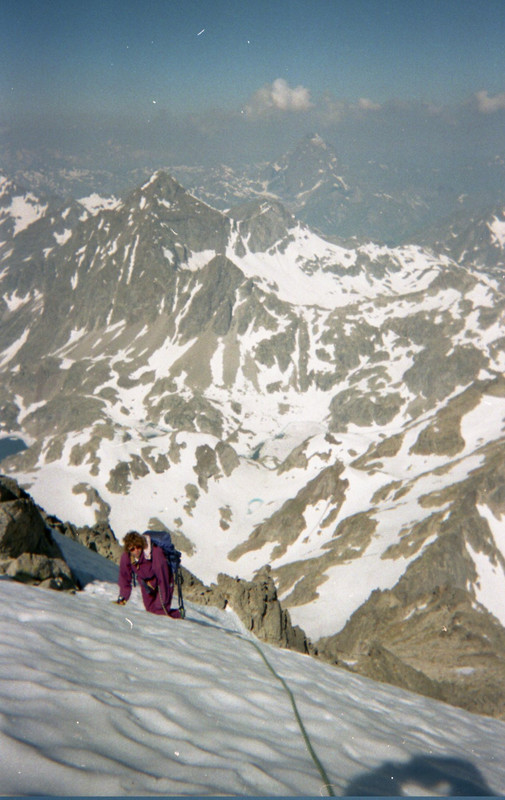
Someone asked for pics. Here's an old one with a 10m rope, 😉 moving together and I'm happy because whatever she does she's not going anywhere. I've reached the ridge where it's gradually flattened out and asked her to stop for a rest and pose for a pic. The were some very short precarious sections over a big drop on the ridge that followed, not difficult but a slip/trip/topple would have been a long fall - a risk avoided with a short rope and a stance. In fact the guide suggests an ice axe and short rope - we did it very early season when there was more ice and snow so used crampons too.
http://www.pyrenees-rando.fr/Pyrenees/04PyrAtlantiques/04Ossau/Palas/00Palas.htm
I've done one ice axe arrest for real, it worked fine but I was only wearing tights and had nasty weepy burns for weeks. A lack of concentration. The biggest mistake illustrated by the climber filming in the self arrest vid above is not getting the axe under you.
As for the rope, maybe a very short thin one, say 10m. Waist ties and a shoulder belay in case the lead climber feels uncomfortable. Enough to stop a slide but not a fall.
Not exactly controversial.
If I may be permitted to comment.... I think it is pretty controversial. It just feels totally pointless and unsafe. Can I double check that you realise you said " lead climber" not "second"?
Don't get me wrong, I've belayed off buried rucksacks, ice axes and frequently just placing my arse in an appropriate depression/concavity.... But that has been to bring up a second. Claiming that it is safe enough for belaying a leader seems a big step
Just reread and found this:
If it's the lead who's uncomfortable then really you should be turning around but it can be (perhaps false) confidence giving to have someone giving you a shoulder or axe belay.
Sounds like we may actually be more aligned on this one 😉
That's very generous of you giving me the benefit of the doubt, thegeneralist. You're right that I should have said "second" but I actually typed what I typed. 🙂
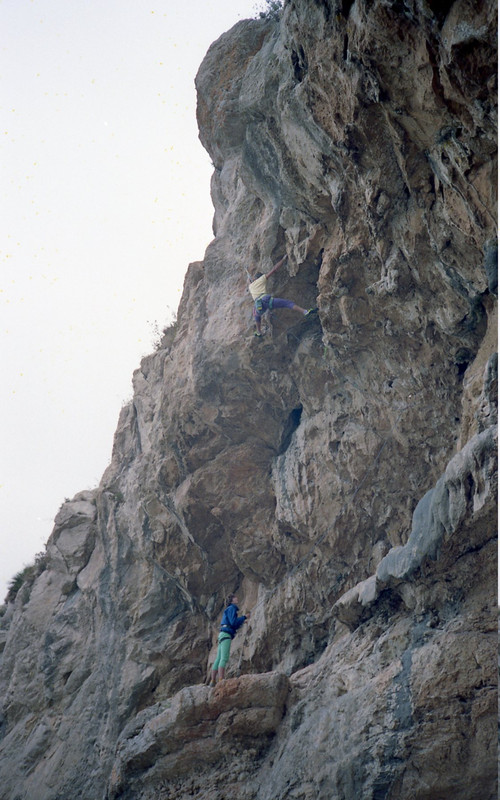
I've just checked with Madame, she remembers me asking her for a belay once, on a traverse when she was on a safe stable rock stance. I'm sure she'd have held me if I'd slipped. She was an excellent second when rock climbing: always slack when needed and running to take up slack to avoid a ground fall. She got used to being whipped off her feet and hauled up Spanish cliffs when I was red pointing:
Arguments like this are what annoy me about climbing. There isn't one single recognised safety process, there are just loads of opinions that get argued about all the time. And inevitably, what some people do is better than what other people do, but how do you know? If you have a new climbing partner how can you have any confidence in what they do if it's not what you're used to? And everyone hate being challenged, it causes arguments, so you don't do it. It's rubbish, from a procedure point of view.
Arguments like this are what annoy me about climbing. There isn't one single recognised safety process, there are just loads of opinions that get argued about all the time. And inevitably, what some people do is better than what other people do, but how do you know? If you have a new climbing partner how can you have any confidence in what they do if it's not what you're used to? And everyone hate being challenged, it causes arguments, so you don't do it. It's rubbish, from a procedure point of view.
There isn't really an argument here, at least not in terms of different valid approaches with reasons for both. There's someone who made a daft and potentially dangerous suggestion for the situation described and others who have pointed that out.
I don't see it as a problem that there are different valid approaches to safety. It's natural that there be more than one solution to certain problems and the same problem could have different solutions for different people. There's more than one way to skin a cat. I actually think that navigating this is one of the enjoyable challenges of climbing.
As for how you know who's competent and who's not, that can be difficult. I take it easy with new partners and don't get into serious situations until I've had a chance to assess them. I might take a shortcut in that if they come recommended by someone I trust. I haven't always got that right but fortunately it's never lead to disaster!
Edit: if you're really struggling with this, get some proper instruction, don't leave it to Muppets on the internet!
And everyone hate being challenged, it causes arguments
Any climber worth their salt will be happy to be challenged on their practice. If they react angrily that's a straight red flag. Ego should have no place in discussing safety.
True, Molgrips. All you can do is climb with someone regularly starting on easy stuff and build confidence in each other.
I did Ula in the Verdon with someone I'd met there and had never climbed with before, he was excellent, very reassuring. On the other hand I did a climb in the Lakes with a guy who was somewhat economical with gear, very worrying, and he died not much later in the Alps.
if you're really struggling with this
I'm not struggling with the safety aspect. I was taught how to belay and lead in a way that made sense and still does. But I really don't like the fact that it's so easy to make belay mistakes, and people don't like having it pointed out to them when they do things wrong. I certainly don't. And if you want an argument, mention assisted braking devices...
I have to teach my 18 year old nephew how to do all this. He's pretty flippant and also pretty gung-ho, although I suspect a good deal of that is an act. But how much? He's not as cautious as I was at that age, for sure, but he is responsible. But being an 18 year old, is he really going to think of everything and do it properly when he's belaying me? I mean it's not like I'm planning to do anything remotely difficult at this point in my life but still. There is very little that is foolproof in this.
I mean it's not like I'm planning to do anything remotely difficult at this point in my life but still.
I've just had a flashback to crossing Cairngorm plateau after a night snowholed overlooking Loch Avon. What should have been a 'out before the storm arrives in good weather' became 70mph wind with 110mph gusts, visibility down to 10m or so, with some added light snowfall to scour your skin and eyeballs off within about 10 mins of topping out the Saddle. The maybe 1.5km to get over the top and down into Coire Cas / Ptarmigan area is one of the most frightening, genuinely risky times I've had in the mountains. One chap, a 6'4" ex military Unit put his big overnight pack against his legs to put another layer on - and watched the pack and his 5'2" walking partner blow away. He rescued his buddy, but the pack was gone...so now we had one party member down spare gear, one missing ice axe, and one limping person, with another 7 of us struggling to do much other than kneel down in the gusts holding on to each other so we didn't get blown away, then compass and pace until next gust came.... Choice was pressing on pr back to Loch Avon and either a second night or long walk round into the gathering storm...It was a genuine feeling of everything unraveling faster than we could keep up.
Maybe an hour later we were wandering through the ski infrastructure on a windy day thinking 'wtf just happened ' and wishing we had got up at 5am not 6am to beat the storm...
I guess my point being that all Scottish winter hills adventures are at risk of becoming pretty heavy duty on the risk front, often out of your control.
It was last day of Winter ML so appropriate lesson for all of us.
How many crevasses have you crossed, fallen into or held falls into? And yet you allow yourself an opinion about the amount of friction (**** all) and ease of holding a fall. In a crevasse fall you've got the full weight, free fall and you aren't dug in.
I've been in a crevasse and held a crevasse fall or two. It depends a little on whether the glacier is wet or dry, but unless you're quite careless, you shouldn't fall in a crevasse on a dry glacier. On a wet glacier, the rope will cut into the edge of the slot which means the fall impact is reduced, basically the rope is running over a 90˚ edge which puts some friction into the system. It's a different scenario to one where you fall on ice and accelerate incredibly fast.
Guides - and others - moving alpine style, will or should be placing the occasional bit of gear/using natural features like spikes to reduce risk slightly, but the basic premise is that you keep the rope on so you can have some minimal protection on easier ground, but swap into a more protected mode when you hit difficulties. Guides are slightly different, they'll be more adept at bracing themselves to hold a slip - basically the initial stumble - before it turns into a proper fall, which is much harder to hold.
But basically it's easier to hold a crevasse fall because there's more friction in the system initially and you should have very little slack in the rope. It's not massively relevant to the Cairngorms unless you're roped and your partner walks off an edge, which I guess is somewhat comparable. The difficult bit then would be anchoring the rope securely enough to hoist your buddy up with a pully system, but again that's not really relevant here.
But yeah, Spin is right on this. I don't have any skin in this argument or care who's right or wrong, but having been tossed into a crevasse by Peruvian mountain guides and held the rope while someone else goes in and having taken a leader fall or two on ice, I can tell you that they are different. This has all gone a bit academic / people arguing on the internet, but that's my experience. YMMV.
I guess my point being that all Scottish winter hills adventures are at risk of becoming pretty heavy duty on the risk front, often out of your control.
And that basically, is the nub of it. The difference between the 'gorms and North Wales is that even if conditions aren't necessarily more severe - I've been blown off my feet in Snowdonia - the former are higher, more exposed to weather, and while on most Welsh mountains, you can drop off the side and into relative safety quite quickly, on the Cairngorm plateau it's a long way off and in bad conditions sometimes hard to walk at all, let alone walk and navigate precisely. It's just a more hostile environment if things do go wrong and to be treated with caution as a result. All imho/ime etc.
I have to teach my 18 year old nephew how to do all this. He's pretty flippant and also pretty gung-ho, although I suspect a good deal of that is an act. But how much? He's not as cautious as I was at that age, for sure, but he is responsible. But being an 18 year old, is he really going to think of everything and do it properly when he's belaying me? I mean it's not like I'm planning to do anything remotely difficult at this point in my life but still. There is very little that is foolproof in this
I'd maybe delegate that sort of stuff to some sort of winter skills course, Glenmore Lodge is excellent, ditto PyB.
This has all gone a bit academic / people arguing
Thanks for your input and I obviously agree with you as you are agreeing with me!
The point I am making is not an academic one, it's an incredibly important, practical point for anyone climbing on the kind of terrain in question.
There are comments on this thread which suggest some people believe there is a realistic chance of one climber stopping another in a roped slide on grade I terrain with no protection in place.
I've come in heavy on this because that is a false and potentially fatal belief. Roping up but not placing gear has lead to avoidable deaths and serious injuries in the past and will do so again. I really can't emphasize this enough and I'm really keen that this point not be lost in amongst any other noise.
I have to teach my 18 year old nephew how to do all this. He's pretty flippant and also pretty gung-ho, although I suspect a good deal of that is an act. But how much? He's not as cautious as I was at that age, for sure, but he is responsible. But being an 18 year old, is he really going to think of everything and do it properly when he's belaying me? I mean it's not like I'm planning to do anything remotely difficult at this point in my life but still. There is very little that is foolproof in this
I'd maybe delegate that sort of stuff to some sort of winter skills course, Glenmore Lodge is excellent, ditto PyB.
If your nephew is thinking uni at any point, all the national mountain centres offer free courses with the uni's still. Two of mine had a week at Glenmore Lodge on winter safety course for free.
If your nephew is thinking uni at any point, all the national mountain centres offer free courses with the uni's still. Two of mine had a week at Glenmore Lodge on winter safety course for free
Conville courses in the Alps too.
I'm slightly reluctant to post this given this:
people don't like having it pointed out to them when they do things wrong. I certainly don't.
However, it's important so here goes.
From what you've said on this thread I think you need to revisit the principles behind safe use of a rope on mountaineering terrain.
If your nephew is thinking uni at any point, all the national mountain centres offer free courses with the uni's still. Two of mine had a week at Glenmore Lodge on winter safety course for free.
What! Tell me more.....
I did Ula in the Verdon with someone I'd met there and had never climbed with before, he was excellent, very reassuring. On the other hand I did a climb in the Lakes with a guy who was somewhat economical with gear, very worrying, and he died not much later in the Alps.
I may be picky, but I'm very reluctant to climb with someone I don't know and trust completely. I once followed a pair up a south face in the Andes, a steep, icy, thing, who were having an ongoing argument about how safe the other's basic practices were when it came to placing and using gear. It seemed like a poor place to decide that you didn't trust your partner and have a blazing row.
I may be picky, but I'm very reluctant to climb with someone I don't know and trust completely
A few years ago I climbed a couple of times with someone who's climbing CV seemed absolutely solid. They'd been on the first ascent of winter routes up to VII and climbed with a number of very well known climbers. I'm happy that their belaying was competent but aside from that they were pretty much clueless. I had to shepherd them through the day on each occasion and it basically felt like a client guide relationship rather than a climbing partnership.
There were two incidents that would potentially have proved fatal for them had I not noticed and intervened. A very loose harness at the top of an ab and attaching themselves to the wrong end of an ab rope. The second of these still makes my blood run cold when I think about it especially as it was only because I was watching very carefully that I saw the problem. If it had been earlier, before I had twigged what they were like, I probably wouldn't have noticed.
The problem is that this individual genuinely believes themselves to be competent and actually has some pretty strong evidence to support this belief so some of the filters I'd usually apply don't work. The phrase I've heard used for this is unconsciously incompetent and it can be really dangerous.
once followed a pair up a south face in the Andes, a steep, icy, thing, who were having an ongoing argument about how safe the other's basic practices were
Don't tell me..... Did one of them have a Swiss army knife readily accessible in the top pocket of his rucksack 😉
Too niche?
From what you've said on this thread I think you need to revisit the principles behind safe use of a rope on mountaineering terrain.
I knew this was coming.
But this is the whole point of this tangential discussion.
Please take it in the way it was offered, as a piece of well intentioned, non judgemental advice.
Never to stop learning is a good life goal.
I do think though that there could be a benefit to wearing the rope, as said above, so that you can deploy a belay/some gear if conditions underfoot deteriorate. But back to the original proposal, this is an extreme edge case given what is being mooted. It would probably be one of those situations where you make a call on the spot.
benefit to wearing the rope, as said above, so that you can deploy a belay/some gear if conditions underfoot deteriorate.
If you want to be able to switch from unroped to roped climbing quickly then put on harness and rack at the bottom of the corrie and put the rope over the top of your bag so it's accessible. If you want, one of you can tie in, feed the rope into their bag and just leave an end poking out so the other can tie in to it.
If your intention for the route itself is to move together placing gear and the approach slopes are low consequence then there probably isn't much risk to roping up at the bottom.
If you want to be able to switch from unroped to roped climbing quickly then put on harness and rack at the bottom of the corrie
I read this as:
If you want to be able to switch from unroped to roped climbing quickly then put harness and rack at the bottom of the corrie
If you want to be able to switch from unroped to roped climbing quickly then put harness and rack at the bottom of the corrie
We left the quick draws in the car one day a few seasons back. There were some black looks exchanged before we worked out that we had enough other kit to cobble together 8 draws and do our intended route.
The point I am making is not an academic one, it's an incredibly important, practical point for anyone climbing on the kind of terrain in question.
There are comments on this thread which suggest some people believe there is a realistic chance of one climber stopping another in a roped slide on grade I terrain with no protection in place.
I've come in heavy on this because that is a false and potentially fatal belief. Roping up but not placing gear has lead to avoidable deaths and serious injuries in the past and will do so again. I really can't emphasize this enough and I'm really keen that this point not be lost in amongst any other noise.
Yeah, agree. 'Academic' was a poor choice of word, I was thinking that the comparison of crevasse and open slope falls doesn't really matter beyond understanding that holding any sort of slip on steep, icy ground is incredibly hard and, like you say, being roped just means you both go. You can go endlessly into the whole alpine style pros and cons, but the bottom line is, like you say, your chances of holding a slide on an iced-up slope without being anchored aren't great. It's like those horrible final pitches you get on Scottish gullies where there's a cornice above you and an easy snow apron with absolutely no protection.
But basically, yeah, if you're going to rope up and move together on 'easy' ground, be aware that you have very limited security from the rope unless there's some sort of anchor/protection and there's a good chance that you won't be able to hold any unexpected slip and you'll both be off.
Don't tell me..... Did one of them have a Swiss army knife readily accessible in the top pocket of his rucksack
Too niche?

Very droll 🙂 ... they were, I think, a Swiss guy and an American and the latter didn't think much of the former's anchors. I think they abbed off about halfway up a six-pitch route in the end, but they were both furious with each other, lots of shouting and swearing. It was quite alarming tbh. I know you can get an idea of someone's level of experience and basic competence from a quick chat, but it was a bit of an object lesson in being careful about who you climb with.

