
MegaSack DRAW - This year's winner is user - rgwb
We will be in touch
Well goodness me, isn't it way way easier? For me, at least.. maybe that's where I've been going wrong all this time! On the treadmill just now, I found it much easier to bounce along on toes rather than heel first. My tendons probably wouldn't take much of it on the road tho, but I reckon with a bit of training it'll come good.
Yeah - I'm gonna give this a go as I have foot problems which are mostly heel-related and running has always been out for me. It'd be nice to hear how you get on over the next few weeks/months.
Seen lots more tendon problems / plantar fasciitis in forefoot striker runners. HTH :wink:.
I'd hardly call myself a runner.. I'm talking 20 mins a week.. but I'd like to enjoy it more than the shambling mess I was previously doing. I seem to have strong calves from biking since they didn't ache at all (which is what some folk reported online when trying it) but I only gave it 10 mins in case I pulled something. My forefeet felt quite squashed too so I guess those muscles have some conditioning to do 🙂
These have been a revelation to me!
[img]  [/img]
[img]  [/img]
[img] 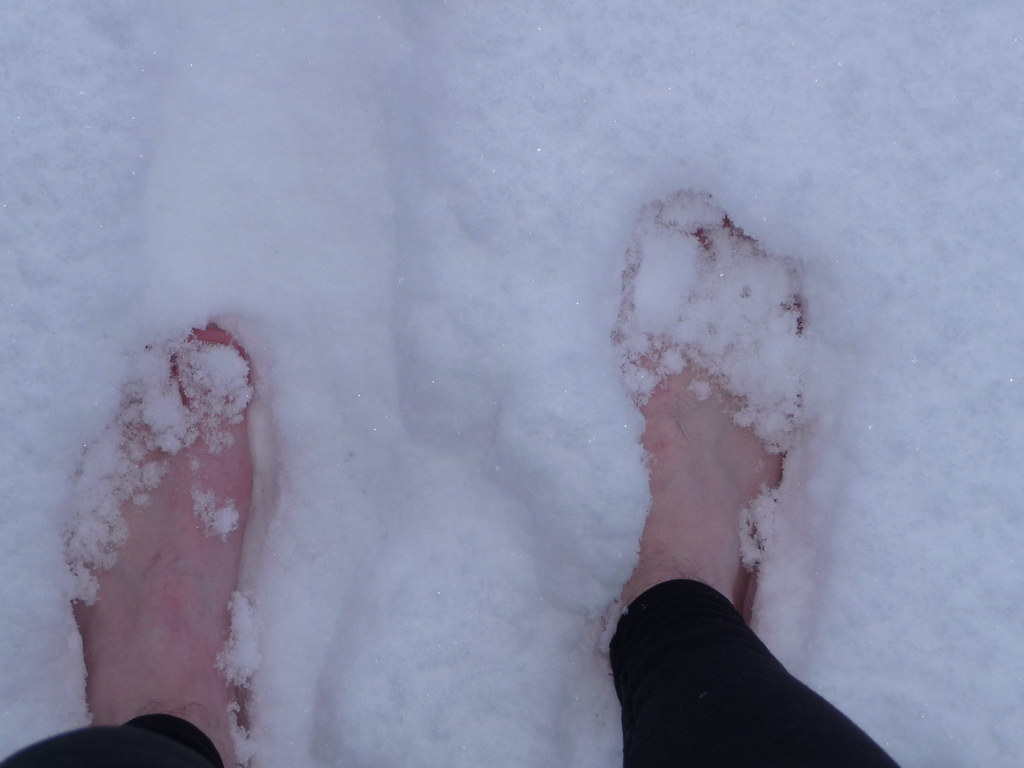 [/img]
Fingers crossed, these will turn up at work later this week 🙂
[img]  [/img]
Funny looking pair of gloves 😉
Thing is, I just bought some new shoes because they felt lovely and smooth as I smashed my heel into the tarmac.. not all that much padding under the toe tho.. maybe I need more new shoes 🙂
i have been threatning to buy some 5 fingers for months now... found some in Santa Cruz after searching all across San Francisco for them not finding them. Then i went and got my bank balance wrong and thought i had less money than i actually had so decided to leave them... doh.
Maybe get some soon...
When I was at Uni (1997) my mates lecturer was advocating that type of running then. I tried it and my calves ached like nothing before. I never tried it again, although I'm sure they're probably right.
Ron Hill spent alot of time runnin barefoot until he cut his foot on a piece of glass. Last photo I saw of him he was wearing regular running shoes
For me its:
[url= http://www.amazon.co.uk/Chirunning-Revolutionary-Approach-Effortless-Injury-Free/dp/1847392784/ref=sr_1_1?ie=UTF8&s=books&qid=1266879606&sr=8-1 ][img] http://www.chirunning.com/shop/image.php?productid=3 [/img][/url]
...building up to going barefoot in the spring tho.
What's with all the self help crap?
Just get out and try it 🙂
For a moment I thought it was written by Danny Dyer 🙂
Very recent study found heel strike running to be much more efficient
what a load of rubbish, just stick your Hi Tech Silver Shadow on an go running you girls.
I find I can run on my toes uphill but I can't see how not to heel strike when running downhill...
run up the hill and go down on the escalator then?
i am/was a keen runner until sesamoiditis forced me to stop, anything more than a 5 minute jog left me in agony for days.
in the last few weeks i've been running pain free by relegating my expensive running shoes to diy duty and instead running on my toes wearing these:
[img]  [/img]
they're very simple, i simply can't run in them with a heel strike, it IS hard work on my calves, but i've got no pain and can run again.
old school is best eh?
(yes, i've tried my new school shoes again; same painfull result)
I am seriously bemused by this trend. My boss is always banging on about forefoot strike and how hard it is, he got himself some of them monkey shoes^^. I think that if I was running 30-40 miles a week landing on my heels then I would have broken legs so it must be natural to try and avoid hitting the ground with your heel. Anyway, I'd not given it much thought till now.
I am seriously bemused by this trend.
Not really a trend. If anything running with a heel strike is a trend that has emerged over the last couple of decades.
Avoids the unnecessary impact on your joints, eliminates the braking effect caused by having the foot land in front of you, builds stronger feet, and is anatomically "correct". Why people run any differently I don't know...
watch you don't get a calf muscle (Soleus) strain like moi.
By toes do you mean forefoot?
It is most natural to do this as oppose to heel striking. The latter is a marketing gimmick. Many studies have shown that forefoot striking allows the natural shock absorbancy of the legs and back to counteract the force of hitting the ground.
Got some new Newtons coming in the post today, Warranty replacement and they were nearly a year old! Been running forefoot for 2 years now and it certainly feels better. When i force a heel strike now it feels so wrong.
However i havnt run for 2 weeks from shin pain! I am putting this down to upping speed and miles to soon aiming for a marathon pb. Either way i wont be returning to a heel strike ever again.
eliminates the braking effect caused by having the foot land in front of you
Yes! This is what I noticed.. Along with having to somehow roll my hips and body to bring my legs through.. there's a mirror in front of the treadmill, and my torso stays much more static and front on. In fact, I look like a sprinter.
This may have something to do with the fact that I am a natural sprinter anyway...
....and here are the bods from Harvard talking about:
Watched my missus get her gait tested the other day for new running shoes, guy doing it was pointing out the reasons we don't run on our toes as I was having this discussion with him after the last thread on the matter a few weeks ago. He seemed pretty convincing. That said, when just bouncing about up and down the beach I tend to run on the front of my foot, but long distance that's just too painful and tiring. The mechanics of your foot just dont seem to work front-first at a running pace. Jogging and toddling along maybe, but when running the extension of your leg just doesnt allow the toe area to come down first.
i don't know, i can run a 40min 10k on my toes...
(sounds like the dude at the running shoe shop is trying to sell you some expensive running shoes)
I think running on the toes is a misnomer. It is recommend that you should be landing on your forefoot/midfoot as opposed to the heel. The reason being the foot is designed that when it lands on the midfoot the arch collapses and gives you the shock absorption you need, when you land on the heel the knee is being used as the shock absorber. Something it ws never designed to do, and can only really do due to the design of running trainers.
[url=
the video i linked to above[/url] for someone far more intelligent than me explaining it 😉
At the end of the day its whatever works for you i guess. I was running 40 miles+ a week with 30 mile runs every now and again just by going out and running. Got injured and as a result am having to learn to run more efficiently. If you can run fine as you are then keep doing it.
[i]. The mechanics of your foot just dont seem to work front-first at a running pace[/i]
Try telling that to Zola Budd or Abebe Bikila 🙂
(sounds like the dude at the running shoe shop is trying to sell you some expensive running shoes)
Quite the contrary actually, he suggested the shoes she was in were fine and even tested her on 3 other brands to make sure they didn't adversely affect the way her foot hit the ground/rolled etc. He was employed by one major company launchnig new shoes, but was remarkably brand-unloyal considering. He obviously had more technical knowledge about the brand he was launching, but almost bent over backwards to help check the other brands out and even go down the price range.
But yes, it's interesting to see that many of the olympic teams use the pose technique which isnt really toe running but certainly is more that way.
run on the front of my foot, but long distance that's just too painful and tiring. The mechanics of your foot just dont seem to work front-first at a running pace. Jogging and toddling along maybe, but when running the extension of your leg just doesnt allow the toe area to come down first.
Pretty much rubbish I think.
Try running fast. What part of your foot hits the ground? It is always your forefoot, not your heel unless you are braking or descending a hill. When running at speed your torso leans forward meaning your weight and hips do so as well.
Of course running at speed over long distances is tiring but that is a function of distance over speed and not by the part of the body hitting the ground.
If the same distance/speed could be achieved by heel striking then he may have a point. What I suspect he is saying however is running fast is hard work so slow down and run on your heels. What he should be saying is running is hard work and you need to train the relevant muscles over a period of time to achieve this.
He is still selling traditional running shoes, the brand is immaterial.
Tell me which part of the great mans foot will hit the ground first?
[img] 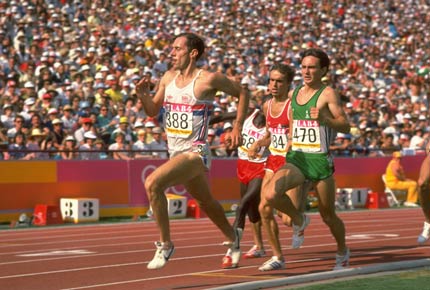 [/img]
coffeeking, I would add that most if not all sprinters run on their toes to your shop mans argument.
The main point to forefoot running is avoiding the long leg extension to gain speed and working at a shorter higher cadence. I suppose it like spinning the cranks of a bike rather than mashing a high gear.
I aint an expert on the matter though its just ime.
And in case you think its only specific to shorter distance runners, Ovett above in a 1500m.
Here is Haille winning a marathon. I suspect the heels of his shoes look brand new even after running 2:04!
[img] 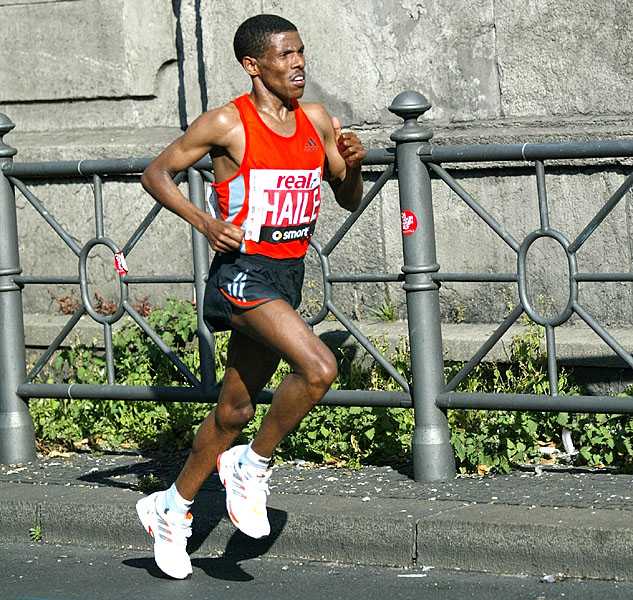 [/img]
but when running the extension of your leg just doesnt allow the toe area to come down first.
That's kind of the point I think. With heel running my foot was further out in front which meant that I was experiencing some braking as my foot hit the floor. Using my toes or flat foot I was forced to strike the ground closer to my body, which may have been the main reason I found it better.
I think the opposite of CK - that heel striking would work for slow gentle jogging, and toes for faster running. After all, in the 100m your heel probably never touches the floor. IIRC spikes for sprinters don't have spikes on the heel 🙂
Keva - Memberwatch you don't get a calf muscle (Soleus) strain like moi.
+1. Had to re-learn to heel strike first. Or just give up running as it makes me zzzzzzzz...
IIRC spikes for sprinters don't have spikes on the heel
IIRC only high jumpers have spikes in the heel area, all running spikes regardless of distance only have spikes on the forefoot.
I dunno, I was just going off what he said and my own experience...
Try running fast. What part of your foot hits the ground?
Accelerating - my balls of my feet, I lean forward and push backward (i.e. 100 and first 1/2 of 200m). But longer distance and constant speed I can't lean forward as much (obviously or I'd fall over) which means my body straightens up closer to vertical and my foot land heel first and in front of me. When I slow right down I can land forefoot first but it feels very un-natural to move that to higher speeds (even fast jogging), it feels forced and painful.
With regards to spikes, that's just to ensure power deliver on the push-off, which has little to do with how you land.
I think we all underestimate the remarkable thing we have, called a body...with dem bones connected to dem muscles with dem tendons and dem ligaments and the likes. It even tends to adapt to whatever style you have. Just get out there and do it.
That said, I'm sorely tempted by the five finger things. They're a pricey experiment though...
That said, I'm sorely tempted by the five finger things. They're a pricey experiment though...
Ain't they just? Think i will just wait till its warmer and i am in a field where i am sure there will be no dog eggs or glass and go barefoot.
In the mean time using these for all my running:
[img]  [/img]
Accelerating - my balls of my feet, I lean forward and push backward (i.e. 100 and first 1/2 of 200m). But longer distance and constant speed I can't lean forward as much (obviously or I'd fall over) which means my body straightens up closer to vertical and my foot land heel first and in front of me. When I slow right down I can land forefoot first but it feels very un-natural to move that to higher speeds (even fast jogging), it feels forced and painful.
But we are always pushing forward (accelerating) otherwise we would stop. Of course in the early part of the process the action is more powerful but the photo of Haille illustrates this.
Heel striking is possible through the whole cycle however it is less efficient than forefoot striking. The latter may be less comfortable but that is irrelevant.
absolutement Darcy however (and it is too late for old blokes like me) it is important to conentrate on style particularly in younger runners. A common example of this is very low knee lift in children (very common in young girls from what I have seen) which improves when they practice shorter distance running at speed. This improves posture and efficiency, as well as speed over all distances.Just get out there and do it.
I think the design of running shoes encourages heel striking, watch people running barefoot, and they will nearly all run on their forefoot. But once you start heel striking, it's a hard habit to break, and as long as your not injuring yourself, it's not really massively "bad" per se.
Fore foot running is the right way, try doing some bare foot running and see how you naturally run. It's modern shoe technology that has brought about the belief that heel striking is the way. If you are heal stiking you are sending the shock direct to your knees, just look at some people runing land directly on their heel. They bounce up and down as they go forward, that is a shock load going directly through the body via the knee. Think of your foot as sprung lever, you can see this in the way children run, it's more natural and fluid. A chap called Percy Cerutty wrote loads about in the 60's and 70's (Google him). My running coach over 30 years ago had us practice fore foot running for warm ups and warm downs (a habit I still have), this helped with are running at speed because it became our natural style. In recent years I have moved away from heavily cushioned running shoes and found no problems. Even been doing some bare foot running (try it you will love the freedom) and with those vibram toe shoes (they are great) but I do feel like a nutter in them at over 50 years old.
Hope that all makes some sense.
There is a load of marketing and rollocks said about heal striking running and forefoot running styles and shoes.
There simlpy is not one way to run. You run according to the conditions you are running on and in and according to your own body, health and fitness.
If you want to try barefoot running then it isn't just about how thin the sole is. There must be a much larger toe box at the front of the shoe to allow the natural spread and movement of the toes through the stride. Also there should not be restrictions on the Achilles which some shoes can cause.
I mainly run longer trail distances and would not be able to do so if I stuck to one type of gait, so to me the best shoe is one which is most adaptable.
as your not injuring yourself, it's not really massively "bad" per se.
Thats a fair point and any running is better than none from a health point of view but not from a performance perspective.
Aye indeed surfer, you're not wrong!
Jamie, they look wicked. Linky? (on phone today). Oh, 310XT delivered. Nice kit! Will be trying that software you recommended.
running fore-foot in modern running shoes (with a thick rubber heel) doesn't really work.
don't think that you've tried fore-foot running because you gave it a go in your nike-airs.
When you land fore-foot in thin-soled shoes (or even barefoot) you have an inch or so of empty space between your heel and the ground. The shock is absorbed by your heel decelerating through this space. Modern running shoes fill this space with rubber, which will only compress a few mm, which isn't enough. Your natural adjustment to this is to exaggerate the toe-point to reclaim the inch or so of empty space you need under heel. this might explain why fore-foot running feels weird to some people; they're trying to do it in heel-strike shoes...
Agreed ahwiles. I also found there seemed to be very little padding under my forefoot in the shoes I chose when using my heel striking gait. I could have done with a bit more padding and very much firmer.
Also found my heels came inwards more when running on my toes.
Thinking about it, the toe thing may be why I find it much much easier to run up steep hills than along the flat. Cos you have no choice but to use toes.
Those inno8 get some good reviews on the fra website from the barefoot community there. May have to add them to my innov collection!
As already suggested, Chi Running is definitely worth a read. Its especially good for "recreational" running where you are just trying to cover some ground at a relaxed pace without straining anything. A mate of mine worked up to a marathon and he found it very helpful.
awhiles.... do you think that could that have contributed to me straining the soleus in my calf ? ...I did build up the milage gently over a period of two or three weeks but got to about 5mile and the calf strained. At the time I was good for 9miles in about an hour running heel strike. I started forefoot at about 2-3 miles then started to build back up. Should I buy new trainers before continuing ? Im just starting to run again and am using a mixture of forefoot and heel strike in cushioned trainers and did 2-3 miles this morning... all good so far..
Gordon Pirie was a great advocate of the forefoot strike.
He wrote a great *free* book called "Running Fast and Injury Free".
POSE running is interesting. And there is the theory the speed of the runner dictates the foot strike which has been echoed by one of the replies. ie the faster you run the more likely you'll strike with the forefoot.
whilst this thread is here, can i grab a quick piece of advice 🙂
if I havent run before, which I havent! how long, far or how much should I aim to push myself on the first run?
is it better to go easy then run the next day or have a break or often and little or what!?
im 12.8stone 6ft totally mr average 🙂
thanks
al
Keva: there's nothing gentle about trying to totally change your running style in 3 weeks. that sounds very brutal to me.
it's not just a muscle thing, it's also a technique thing.
based on nothing more than my own lazy 'easy does it' attitude to more or less everything, i'd say 3 months would be more like it.
alexxx: go for a short run, something that'll take about 5 minutes. a short loop from home is good.
see how you feel the next day, and build up from there. don't go running 2 days in a row, until you really know how your body will react.
I have found that running on the balls of the feet ie. not on the heel, not quite on the toes, lifting the knees and consciously 'making circles' (like when trying to spin cranks smoothly) is a good technique for making good progress on smooth surfaces.
As a non-runner (but want to start soon given the crap cycling conditions) this confuses me to. As a couple of others have said surely it's down to the speed you're running at? When you're walking you heel-strike (at least I do unless I'm trying to sneak up on someone ninja-style...) and when you sprint your land on your fore-foot. So somewhere in between you switch from one to the other and this debate is more about what speed you transition at? I've not tried but I imagine a slow jog it would feel pretty odd trying to land on your fore-foot?
Gordon Pirie was a great advocate of the forefoot strike.
He wrote a great *free* book called "Running Fast and Injury Free".
We may have had this conversation before on another thread. I have read that and also the biography of Pirie who was ahead of his time with regard to some trainng techniques, such as interval training etc.
He was a world beater then and would still be in the top few in the UK now!
What [s]tyre[/s] heel-strike for snow? 😉
I have found that running on the balls of the feet ie. not on the heel, not quite on the toes
Clearly toe running means the ball of one's foot. It'd be impossible to run on ONLY the toes and not the ball..!
I have a pair of 'five fingers' which I was happy with for a couple of weeks.
That is until I used them for two sessions in two days, after which I felt like I had broken all of my toes. It took about three weeks to make a full recovery.
Did I just over do it on the amount I used them or is it possible to run too much on your toes, if you see what I mean?
I do like them and would like to give fore-foot running another try, but I am training for a marathon in May so can't really afford three weeks out!
Matt
alexxx, start easy, find a route that's about 15-20 minutes long, and aim to run it. You'll probably start by running a bit them walking a bit, that's fine, just over time try to shorten the walking bits, until you're comfortably running it all. then either lengthen your run, or speed up a bit, whatever. try to run a couple of times a week to begin with, and then just increase the frequency as you feel you can, aim to be running more days than not. LISTEN TO YOUR BODY. If it hurts, stop running, and rest.
[i]I've not tried but I imagine a slow jog it would feel pretty odd trying to land on your fore-foot?[/i]
Here's a simple experiment. Just take off your shoes and socks and try jogging on the spot (which is pretty the definition of the slowest possible run).
What bit of your feet are you landing on?
The tricks are to keep your running cadence far higher than your used to from plodding 180fpm or higher, keep your foot contact with the ground underneath your body, so no stick legs out infront and hoping the shoe cushioning will take the load, and try and lift your foot off the ground as soon as it contacts rather than pushing off, and bend the knees more. The things sort of feedback on each other, so do one and the others fall into place to a large extent.
The minimalist running group on google has a wealth of bedtime reading on the subject [url] http://groups.google.com/group/huaraches?pli=1 [/url]
This is quite good viewing if you've got a spare lunchtime [url]
But we are always pushing forward (accelerating) otherwise we would stop. Of course in the early part of the process the action is more powerful but the photo of Haille illustrates this.
None of those images really show anything as they don't show the forward front hitting the ground (unless I've missed one). To run at a constant speed you are not accelerating unless you class your air resistance as a major force. The body changes gait from when accelerating to when at constant speed, mine goes from forefoot to heel. It does that without any tuition, because it's the path of least resistance.
Heel striking is possible through the whole cycle however it is less efficient than forefoot striking. The latter may be less comfortable but that is irrelevant.
Comfort is just about the biggest factor you can imagine, slight discomfort causes gait adjustment. Same reason that your gait changes all the time - run on a soft surface and I tend to land heel first, run on a hard surface or try to accelerte in any direction and I switch to balls of feet. My body reacts as it always has since I was a kid - sprinting it switches to "power" mode and goes balls-first (ooh err) and constant speed reverts to what seems to me to be more economical heel first stride.
Just take off your shoes and socks and try jogging on the spot (which is pretty the definition of the slowest possible run).
It's not even remotely like a slow run though, in order to move forward you need forward leaning, a little. We're trying to reduce gait analysis to "this is how you should run, at any speed or instant". That's simply rubbish and not how it works.
/ignore double post
[i]It's not even remotely like a slow run though, in order to move forward you need forward leaning, a little[/i]
Excatly. You lean forward slightly. That's not going to make you start landing heel first. You're only going to start landing heel first with the combination of sticking your feet out infront of your centre of gravity and relying on a shoe to take that initial impact. If you run barefoot then you just don't do it, it hurts and doesn't feel natural - because it isn't. That doesn't mean that your heel doesn't touch the ground, just that it isn't the first point of contact.
It may be more economical too you however it appears to be rather unnatural to most others in this thread, maybe you have become accustomed to running on you heel however that doesnt make it natural or efficient.
A sprinter only accelarates through the first 20-30 metres? then resists the overwhelming force to slow down. Why does he cross the line on his forefoot if his body is slowing?
The image of Haille or Ovett dont show him hitting the ground I was illustraiting the movement in its most exagerated. Are you suggesting as both athletes near the ground their foot changes direction to land heel first? That would be very unnatural and I know (having the pleasure of being overtaken by Mr Ovett) not the case. Both athletes run on their forefoot.
because it's the path of least resistance.
This statement is incorrect. It is less resistance to run on the forefoot, or at least around the midfoot as many studies have shown. Heel first has a braking affect.
There also appears to be a positive relationship between performance and forefoot strike. In short slower runners are more likely to heel strike, faster runners forefoot strike.
When I was younger every time I built up my running to a decent frequency and distance I got really sore shins so basically gave up on it. Couple of years ago I tried running again and this time it wasn't just my shins but back, knees, ankles that were giving me gyp. I reckoned it couldn't just be old age so examined my running style and decided I'd been heel strike running which was encouraging me to run flat footed. I then changed to running using my fore foot which gave me some bounce in my stride and imediately my times improved by 30%. Took me 2-3 months to develop my achillies to the point where it stopped aching though.
Fuzzywuzzy:
So somewhere in between you switch from one to the other and this debate is more about what speed you transition at? I've not tried but I imagine a slow jog it would feel pretty odd trying to land on your fore-foot?
running and walking are different, not just variations of speed.
try running on the spot with a heel strike - how much slower can you go than running on the spot?
try running with a heel strike in barefeet, it's only modern footwear that allows you do this. and lots of people (myself included) find that the action/shoes involved actually cause lots of problems.
companies like reebok/nike/adidas/whoever would love to be able to present research showing that the more money you spend on shoes, the fewer injuries you will suffer, the problem they find is that everytime someone looks into this, the results are either inconclusive or very damning: running shoes are bad for you, and expensive ones are either no better, or sometimes worse.
[i]Did I just over do it on the amount I used them or is it possible to run too much on your toes, if you see what I mean?[/i]
matt_bi, probably too much too soon. If you've body's spent most of it's life running in a different way it's going to take a long time to adjust. All the muscles and tendons have been happily atrophying and have just had the shock of their life 🙂 Generally distances of 1-2 miles would be considered the maximum to try at first and wait for the feet to strengthen, which is a frustrating short distance for fit runner. If you're training for a marathon in May, and your not injured then it's probably not worth bothering with changing style mid goal.
[url= http://www.newtonrunning.com/run-better/optimal-running-form ]newton running[/url]
I rather like this animated video on Newtons site. They have prbably exagerated the heel strike a bit but it makes sense of things for me.
I dont work for newton, or run in there shoes exclusively but i have paid good money for their shoes so maybe a little biased.
Ian: this is exactly the dilemma i'm facing!
i've a half marathon at the end of april, i don't know if can run that far running fore-foot in my asics tigers. i don't know if i can run that far running heel-strike in my nike airs.
hmmm.
Listening to Radio 4 the other week there was an article on all the latest research point to modern shock absorbing trainers actually damaging peoples feet. They recockoned bare foot running was actually the best for your feet, and makes you run properly.
There must be some thing in it as not one training shoe company would comment for the article
Excatly. You lean forward slightly. That's not going to make you start landing heel first.
No, but to keep the speed up (rather than falling over) you need to place your foot forward. I suppose that just depends how far you lean and how fast you're running though.
I'm not against the idea, I've just not found it matches how I run "naturally" and I'm pretty used to running about barefoot if I'm honest.
This statement is incorrect. It is less resistance to run on the forefoot, or at least around the midfoot as many studies have shown. Heel first has a braking affect.
Heel first would have a braking effect if you impacted without hard and at a fairly high angle, but I'm not sure the angle of incidence is much of 90 when running on your heels. While you might assume that a smoother impact on the forefoot would not give a braking effect, you're still having to tense and load the calf to support it when you otherwise wouldn't (as much)? There's a positive relationship, but who says whether it's causal or consequential?
I'm open to ideas, and do normally assume that "natural" is usually the best option (we only use shoes due to damage from surfaces) but when running on grass I don't run "on my toes", when when running down the beach I land heel first unless sprinting or really soft sand. I just haven't seen this natural tendency to land that way, and knowing that just having the wrong support in my shoes makes me take notice of my foot position and angles, I'd have thought a shoe subconsciously forcing me to land heel first would have been a nightmare.
This probably partially explains why I was always able to sprint the 100m in 11 secs but couldn't push past 400 without dying 🙂
To run at a constant speed you are not accelerating unless you class your air resistance as a major force
Not really. You are constantly accelerating upwards as you push off, and gravity brings you back down. Acceleration in a vertical direction. Otherwise, running at constant 10mph would be as easy as riding a bike at constant 10mph.. and as we all know it isn't!
And as for the 'natural' way, the above reference to barefoot running are correct. It's not natural to run with a Nike Air under your heel, and that's only there to enable you to heel run. I have lovely cushioning on the heels of my shoes, and I didn't even touch it when toe running. If you want natural, take your shoes off and go run on some grass. See how much you heel strike then - if you do, then that's your natural gait. And btw that thumping sound in your ears could well be your brain wobbling about in your skull 🙂
Not really. You are constantly accelerating upwards as you push off, and gravity brings you back down. Acceleration in a vertical direction. Otherwise, running at constant 10mph would be as easy as riding a bike at constant 10mph.. and as we all know it isn't!
Obviously, I was discounting vertical accel as you need to put the same effort into that no matter how you're running or you merge with the floor 😀
If you want natural, take your shoes off and go run on some grass. See how much you heel strike then - if you do, then that's your natural gait. And btw that thumping sound in your ears could well be your brain wobbling about in your skull
As I say, I regularly do run (not for the sake of running) barefoot, never noticed it being forefoot based though. The thumping in my ears is my pulse due to lack of fitness, I assure you 🙂
I'd have thought a shoe subconsciously forcing me to land heel first would have been a nightmare.
Most shoes dont force this but they bring it about for a couple of reasons:
Firstly they "build" up the area of the heel which means if the forefoot striking first is quite subtle then the larger and pronounced heel area makes contact first. If the shoe was totally flat or without any midsole that encouragement would not exist.
They are also marketed in a way that actively encourages "cushioning" as being required, cushionless shoes would be more difficult to market (although the ones with the toes seem to be achieving this!)
Running is a popular pastime and companies need to make money out of it so they have to appear to give us something, bigger and bulkier shoes, changing materials, styles etc is a way of doing that. There has to be a market to be captured.
As for running barefoot I once finished 4th in a XC race shoeless after forgetting my racing shoes. I ran OK with the only downside being very sore feet later that evening whilst trying to dance!!!
Your shoe design points do make sense, higher heel would automatically put the heel down first, encouraging that I suppose.
Maybe it's time to try some 5 fingers, I like the look of them anyway 🙂
Coffeeking, I PMed you.. check your hotmail.. 🙂
Another [possibly] converted to the cult, Well done people! 8)
Give us some feedback if you get the vibrams.