
MegaSack DRAW - This year's winner is user - rgwb
We will be in touch
In a bid to try and counter my rather OTT calorie intake (as well as some cross training) I need to start doing a bit of lunchtime running.
Now, bar a bit of desultory gym stuff a few years back, I've done next to no running in the last 16-18 years (pretty much since I learnt to ride a bike, age 19) although I was pretty decent at school. Whenever I've tried running I've ended up killing myself and my legs are in agony for the next 3 or 4 days, plus my lower back tends to pack up. That's after maybe 20 minutes to half an hour. Any less and it doesn't seem worth the effort of getting changed and going out - I'm not even going to begin to get warmed up.
This forefoot running business sounds interesting (might solve the back issues?), but I've done some reading that suggests unless you're pretty quick, it's not worth bothering with?
I do have a pair of running trainers - nothing great - some Pumas I picked up in a sale a couple of years back - and I'm reluctant to spend a wedge of cash on something that may only get used a few times if it's going to continue to hurt that much!
Any advice? Thanks!
start by running 30 seconds, then walking 30 seconds. do that 3 x week for up to 20 mins for a few weeks - no more. then start to do longer periods of running. but the run/walk is an ideal starting point.
Have you thought about slightly less traditional style stuff?
The stuff this guy does is pretty inspirational:
Start off with shorter jogs for a few weeks and gradually build it up. To leasen the impact, try runs on grass, in the park and local fields etc.
lol @ nols
that vid is very funny but very good at the same time. I just can't imagine it being quite the same running around thetford forest or swimming down the derwent. Also his feet must be made of leather.
tails I know what you mean, a mate of mine sent it to me. First time I watched it I was like "you what..." I've just been reading about the dude, actually starting to think the stuff he does is pretty awesome. It kind of goes back to mucking about in the woods, like we all used to do as kids. Jumping on and off stuff, running for a bit, crawling under stuff. Certainly more entertaining than endless back smashing miles running in a straight line... also that bit where he's going like the clappers - look at how steady his head is, it barely moves.
also that bit where he's going like the clappers - look at how steady his head is, it barely moves.
He must have a long neck!!!
I thank you.
Whenever I've tried running I've ended up killing myself and my legs are in agony for the next 3 or 4 days, plus my lower back tends to pack up. That's after maybe 20 minutes to half an hour. Any less and it doesn't seem worth the effort of getting changed and going out - I'm not even going to begin to get warmed up.
If you're reasonably fit in any case from cycling or whatever then you will find that your legs start to hurt well before you get tired if you're not used to running. This is what I found when I took up running a couple of years ago anyway. You need to keep doing the shorter runs for several weeks and then gradually increase the distance as your body gets used to it.
A large part of it is finding the motivation to get off my arse and start. I've *never* done exercise purely as a health/diet thing. I ride my bike loads simply because I enjoy it, it takes me somewhere quickly, plus the adrenaline/control aspect. In comparison running just seems very hard work, slow, painfull and frankly pointless.
That guy in the vid is a bit wrong in the head. I take his point, but not in the UK! It would be good to start indoor climbing again, but it just costs so damn much for a couple of hours of an evening.
Last March I decided to try running. I was walking the dog for an hour every night and thought I might as well try running (I'd not run since school 14 years before). To start with I just went out in dog walking clothes, walked our normal route and ran little bits - like a hundred meters or so and then walked. Over the weeks I could go further and I set bits that I'd run and set bits I'd walk (these tended to be broken down into different fields).
I gradually started to run more of the walking bits and run longer between rests. I now do 6-8km non stop a 3 or 4 times a week.
The other night I bumped into some guys I know who were running and I ran with them. This was the first time I'd ever run with anyone apart form the dog so I was worried I'd be rubbish, to make it worse these guys have run marathons and organise local races. To my surprise I kept up fine and they actually ran at a slower pace than I do on my own (which probably shows I try to go too fast all the time). I felt great at the end, like the previous year had paid off. It's encouraged me to try to get better too.
So build up slow, don't worry about walking and being knackered and stick with it, oh and get a dog they take away the choice - your going out anyway!!
Go slow at first, don't get out of breath. I've been there before, bike fit and then with no running go pick of a 10K in 45 mins and be in agony for days. Don't bother with all this trendy forefoot nonsence, just concentrate on going slow and developing a good technique that works for you. Things to pay attention to
Head not too high up
Kick your legs up
dont drop your shoulders
use your arms
breathing rhythm
After 3 or 4 runs you should be able to add a bit of fartlek or a tempo run once a week
Like pepole say start real slow. Years of biking changes your physiology to suit biking. favouring (developing) biking muscles over walking muscles. it can be harder for a cyclist to start running to a couch potato. as the poster says, aches and pains for days. Again take it slow, and keep at it.
Agree with the 'go easy'
Also worth finding a club - you can learn huge amounts from running with others, more motivating + you can learn from everyone else's mistakes!
Re shoes, though, bad idea to use old ones, it's the fastest way to an injury. Get to a proper running shop, avoid the high st stores, get one that does running gait analysis (either on a treadmill or they watch you run) and let them recommend the shoes you need for your running style. Proper running shoes can be a lot cheaper than you think (c£50). And if you've spent the ££ you'll want to make use of it, which you can get you out running more often
Have you thought about slightly less traditional style stuff?
The stuff this guy does is pretty inspirational:
What a great video. Looks really fun.
That guy in the vid is a bit wrong in the head. I take his point, but not in the UK!
Why not? I've quite often done a bike ride to a river, swim down some rapids (swim against the current until you get bored then hammer it downstream), run back to where the bike is. And that's just in Derbyshire - must be loads of places in the lakes, Scotland etc. where you could do it too. I can think of somewhere 10 miles ride from central of London where you could do a nice run in woods, climb trees, have a nice swim & bike ride for that matter. Okay you're a bit limited by temperature / wussyness as far as swimming much in winter, but the rest of the stuff I don't see why not (and if you don't swim, then you can wear shoes too).
Joe
I started running back in October 09. Always used to hate running, and never "got it" but now get out about 3 times a week for a 4 mile loop. I would really advise running offroad. Not only is it easier, but much more fun, different terrain and challenges make it actually fun! I always seem to go out too hard at the start on long runs 😆
Try fell running. Much better than being bored on tarmac. At first it'll be mostly fell walking, but you'll soon get fitter. Even better, you may discover new bike trails; I know I have.
kennyp - Member
Try fell running. Much better than being bored on tarmac. At first it'll be mostly fell walking, but you'll soon get fitter. Even better, you may discover new bike trails; I know I have.
Yup. He's right 😀
Find a route that's about 3 miles/5k, if it's got a hill or two, mores the better. Pull on your shoes*, go run it, make space in your schedule to do this 3 times a week. Don't worry about timing it, in fact don't even wear a watch, and don't worry about walking, although aim to run as much of it as you can. Run at a comfortable jogging pace, not to slow, not to fast, a pace you reckon you run the route. Do this for a couple of weeks, or until you can comfortably run the whole thing. Then time it. Aim to take a few seconds off it each time you go out. Once you get down to a steady time. look to start lengthening the route, do 8km then 10km (if you fancy it). some folk love short runs, I find 10k pretty much the perfect balance between a good run, and not taking up too much time, or effort, so I tend to do one every day.
Listen to your body, if it hurts at any time, don't finish the run, stop, and walk home, and sort it out pronto. Don't go straight in at the deep end thinking you can run a sub 20 minutes 5km, start slow, but don't miss out a run either, the thing with running is; running... You get used to it, your body will get used to it, but only if you're consistent.
* Opinions will vary, but I've run my entire adult life, and my current running shoes are at least 4 years old and have thousands of km on them, I'm from the "pull on dabs, go run" school of running, others do it differently, and swap and buy new trainers all the time. Go with whatever makes it easy to run [i]for you[/i].
Try fell running
That would involve having some fells to run on...
I've got Wandsworth Recreation Ground instead. (which is exactly as glamorous as it sounds!)
Don't bother with all this trendy forefoot nonsence
Not sure what this means?
Are you refering to the debate the other day about heal/forefoot striking? if so you need to re-read it as forefoot striking is actually the least "trendy" thing I can imagine.
As in there is a big trend towards it at the moment
In your bare feet Jon run on the spot. Notice that you are naturally landing on your forefoot maximising the big spring in your leg that's your Achilles tendon which will shock absorb better than any £70 pair of Nikes. Also has the advantage of storing energy to propel you on your next stride. Couple of years ago before this forefoot running became fashionable I reassessed my running style due to back, knee, leg pain. I noticed I was heel striking and running flat footed so switched to landing on my forefoot. All the pain disappeared and I started running 30% faster. Another big advantage is running gear suddenly becomes cheaper as any cheap pair of trainers with a thin sole will do.
Like the other posters say build up gradually but also try to use your natural "barefoot" style.
Until you rupture your tendon...
Haze - Member
Until you rupture your tendon...
Anyone here done that? and how long were you running on your forefoot beforehand?
good stretch/warm down afterwards is key. if I dont then any run will have me hobbling around the next day.
There was a thread the other day about running, search it out as had some interesting nuggets on efficient running technique.
Jon, I used to do a fair bit of running and even did a marathon when I was much younger and less sane. My advice is two fold. First - get some decent trainers from a specialist shop. Have them fit the shoes for you. Some people over pronate or under pronate when running and a good shop will put inserts in the shoes to fix this.
2nd - stretch, stretch, stretch and oh yes, stretch. Do this before your run and after. This really helps cut down on the stiffness.
You'll always get stiff legs a bit, especially when starting out. No pain no gain and all that. Just take it easy and enjoy. Once you're over the initial few weeks it will suddenly start to come together and you'll feel your lungs and legs getting into a rhythm. Then you'll get addicted to the endorphins and end up doing 50 mile a week like I did !
if your lower back hurts, it's because your core is weak.
3x15min sessions a week of core exercises will sort that.
running more will not.
you can do it in front of the telly.
Anyone here done that? and how long were you running on your forefoot beforehand?
Not me personally, not through running anyway.
I've heard of a couple of examples though, would guess it'd take a fair bit...
In your bare feet Jon run on the spot. Notice that you are naturally landing on your forefoot
Because he's not sodding going anywhere, foot strike depends on how fast you're going
[i] Some people over pronate or under pronate when running and a good shop will put inserts in the shoes to fix this.[/i]
Except that there's not one iota of evidence that it fixes anything.
It's as mental as a beginner going to a bike shop and them analyzing your cycle style and recommending a downhill bike with stabilizers because you stay seated over bumps and can't track stand 🙂
The shoe inserts really worked for me. Back stiffness and knee pain was reduced when I started using them. They don't cost anything.
Can you really put stabilizers on a down hill bike. I'd like to see that. Could be a new niche sport.
I'll admit my Achilles was sore after runs for about 2-3 months after I changed running style but built distance up gradually without injury.
deft do you reckon this guy is going to land on his heel?
[img]  [/img]
Search out Hal Higdon and Couch to 5K both of which have helped me get to a 25minute 3 mile time. (I'm just over 2 weeks from completing the 5K programme). Helps with keeping the weight down for Fat Club as well.
"that" guy isn't running on his heels 'cause he's trying very hard to go as fast as he can, and to do that you need to be on the forefoot. Long distance stuff, it's not so clear, there's a real lack of evidence about whether forefoot running "makes" you go faster, or whether you just go fast because you're on the forefoot. Just saying it's "better" isn't really moving the debate forward any. heel striking isn't bad per se, as long as your not injuring yourself. There's a surprising lack of study or evidence either way.
Realistically though, start slow, get used to running, make it a regular part of your life, steady as you go. Will probably be enough to keep you injury free.
...do you reckon this guy is going to land on his heel?
I reckon he's going to land on his arse if he doesn't do his laces up.
Runnings been really good for me. Started about 5 years usually in winter evenings. The first time I ever donned some trainers and stepped out with the purpose of running I did a couple of hundred yards and was almost sick.
I now run 2/3 times a week usually about 4 to 5 miles 30 minutes or so not really bothered about the time or distance just enough to give me a hit of happy.
I enjoy cycling always have but running is much less faff, its also a great chance to listen to some music uninterrupted or just think.
As in there is a big trend towards it at the moment
Where?
My points on the other thread is that it is more natural to do this, not to do it because its "trendy"
The "trend" has been by the running shoe manufacturers marketing departments attempting to convince us that landing heel first is economical simply because trying to market shoes without huge amounts of padding and unnecessary cushioning is difficult.
Landing forefoot first appears (and I agree evidence is thin on the ground)to be both natural and more efficient. This is not a "trend" or if it is its possibly a few million years old! unlike the marketing of the last few decades!
there's a real lack of evidence about whether forefoot running "makes" you go faster, or whether you just go fast because you're on the forefoot.
I dont understand this however if the intention is to run fast then isnt it immaterial?
if you look at this (taken during a 2:04 marathon)
[img] 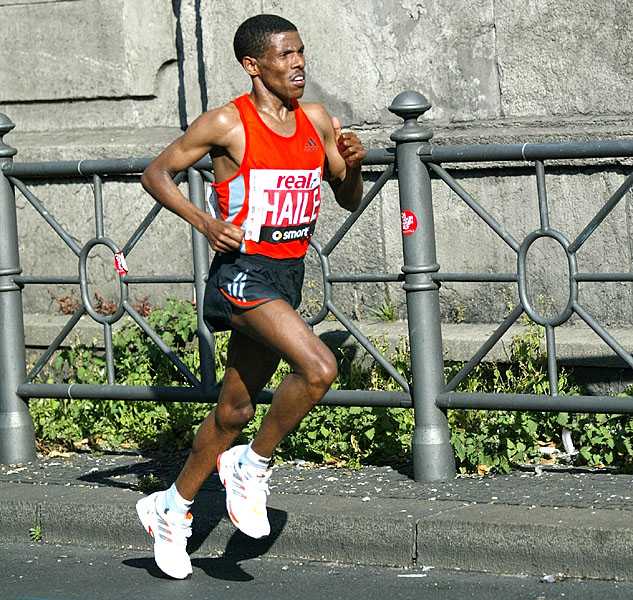 [/img]
It is clear that Haille is landing and pushing off on his forefoot, even though this second picture appears to contradict it.
[img]  [/img]
On both occasions he lands on his midfoot and rolls forward to toe off.
Of course he is an exceptional example but I have yet to see a top distance runner that lands heel first, I wouldnt say there are none.
Because he's not sodding going anywhere, foot strike depends on how fast you're going
Does it?
When Bolt is decelerating past the line, does he land on his heel? I suspect not. He uses his forefoot during acceleration and even during deceleration he is on his forefoot. Why is that?
I read the barefoot running posts the other day with interest, but then rapidly lost interest when I checked out the barefoot running forum someone had linked to and every other thread was someone asking about an injury.
I think the best advice I've read was from a book a friend lent me, which basically advised beginners to run with a comfortable, relaxed, natural gait and said that most people will start by running heel-toe but then will transition to toe-heel naturally as they get fitter/faster.
[i]but I have yet to see a [b]top[/b] distance runner that lands heel first[/i]
Well, durrr, they're all trying to run as fast as they can...Not jog around the park in an attempt to shed a few unwanted pounds, I'd bet money that if you asked a top runner to do 9min miles they'd heel strike occasionally.
Every-one has a gait and rhythm and natural pace that is their own, and that isn't always running forefoot. Forcing people into running a particular way is a short cut to injuries. Forefoot running may work for you, great, genuinely pleased that you've found a way of running injury free. May not work for other people. The important thing is to run in a way that is injury free [i]for you[/i]
I'd bet money that if you asked a top runner to do 9min miles they'd heel strike occasionally.
I've ran 4:21 (hardly a top runner) when running 8-9 minute miles I wouldnt heel strike simply because its not natural for me and I argue the bulk of runners, elite or not. Thats the point, its not about speed!
I've been running on and off for a few years, and steadily since May. Before May, I'd always suffered from some sort of pain when running - I used to get sore hip flexors, and other such things. I didn't run for a while and upped my weights in the gym to 2 or 3 sessions a week which seemed to do the trick.
The worst thing I think about starting to run when you are already fit is your body isn't running fit. The impact of running takes time to get used to. You need to start on a beginners programme of run walk before progressing up so your legs can get used to the impact etc. I'm now doing my first half marathon at the weekend, and my legs are struggling to adapt to longer miles i.e 10+miles.
Give it time, start slowly (there's no shame in a run walk programme, in fact some of the stuff i've been reading recently tends to suggest a run walk programme turns it into a interval session and thus more calories burnt) and make sure you've got decent shoes.
Every-one has a gait and rhythm and natural pace that is their own, and that isn't always running forefoot. Forcing people into running a particular way is a short cut to injuries. Forefoot running may work for you, great, genuinely pleased that you've found a way of running injury free. May not work for other people. The important thing is to run in a way that is injury free for you
That is exactly my point. Modern running shoes attempt to change this to something that for most is unnatural. I am not suggesting anyone "tries" to alter their natural running style but to be wary of shoes that do.
If you are a natural heel striker (and I suspect that is far fewer than the shoe manufacturers would have us believe) then fine, knock yourself out and get out training. If you are not then dont be told by shoe makers that you need a shoe with £50 worth of Gel/Air/Ionic EVA etc in the heel area. It is they that are forcing an unnatural style onto the bulk of runners.
[i]Every-one has a gait and rhythm and natural pace that is their own, and that isn't always running forefoot.[/i]
I'm not entirely sure that's true, but I'm happy too be corrected. I doubt anyone heel strikes on a hard surface if they run barefoot, it's just too painful because it's not the way your body naturally works. I've spent all my adult life as a natural heel striker, till I took my shoes off and instantly I wasn't.
Of course a sample of one isn't exactly conclusive 🙂
And while were on the subject (sort of)
A good example of this is a friend of mine who pronates badly but more severely on one side. He ran for decades at a reasonable level with his share of injuries.
I happened to be behind him in a group on one run and noticed just how bad the pronation was. He told me it caused him no problems except on the occasions over the years when he had taken peoples advice to control it by using orthotics or control shoes. On those occasions he ended up injured, when he left it alone he had significantly less problems.
Pronation is a natural shock absorbing method and his body adapted over 000's of miles of training to the excess. Trying to stop it caused the problem.
Thats not to say excessive pronation is a good thing per se but given a steady and sensible training build up the body adapts very well.
My opinions are open on foot strike being related to speed - to a point. Walking is a heel-striking motion and as we gradually increase speed you should see footstrike alter accordingly (barefoot). Trainers have obviously changed this a little.
T open up the debate more - I'm not a big advocate of stretching either.
I'm not a big advocate of stretching either.
Deja Vu? 😉
I have conflicting views on this.
Many of our top and most successful distance runners have ignored stretching. I think it was Bedford who said "when they start giving out medals for stretching I'll start doing it" He didnt but was the world record holder at 10,000m
Coe claimed stretching gave him 1" per lap and was an advocate, anyone who has ran 1:41 for 800m knows what he is talking about.
Noakes cited studies that showed stretching can actually increase the risk of injury!
My opinion is it has provided me with relief when injured over the years so my personal opinion I suppose is that there is some value in it.
I would always say however post run never pre run! (and there's another argument in itself!)
I agree. I can't imagine prehistoric man going "Whoah there Mr. Sabretooth tiger! What's with the whole chasing thing? Can't you see I haven't done my pre-run warm up and stretches routine yet?" 🙂
warm-up yes. warm-down yes.
stretching - never just before activity. never just after activity. done some on days off tho. when experimenting with aches and pains but it's not something I'd advocate religiously. If it works, great - but if you can get away without it - even better.
stretching has a benefit if its something you do as a regular activity - not as part of a warm-up. better muscle range of movement enhances performance but you don't gain flexibility in the few minutes of a pre-run/ride warmup.
the recent hoo haa about barefoot running ignored the surfaces we have to run on. it might be worth doing when we all have access to a groomed grass/dirt trail with no sharp bobbins to stand on. totally irrelevant and wasteful research otherwise
I've been running bf on the snow, ice, pot hole strewn and gravel covered lanes outside my house since Christmas without any problems. You get the occasional little bit of flint lodged in your foot, but it's not as traumatic as you might imagine. Feet have got a long way to go before there good for off-road though.
the recent hoo haa about barefoot running ignored the surfaces we have to run on
You're missing the point. It's [i]not [/i]about the surface under the foot.
better muscle range of movement enhances performance
In reality that's not really true - unless you're into gymnastics.
HTTP404 - Member
In reality that's not really true - unless you're into gymnastics.
Hmm...
Hurdler who can't lift their leg high enough - hits hurdles, goes slower, poorer performance.
Anyone doing a power sport (e.g. javelin) who can't use full range of muscle movement = less power = poorer performance.
Cyclist with poor low back flexibility = can't ride for as long because it gets sore = poorer performance.
I'm sure there are a lot of others as well.
You're missing the point. It's not about the surface under the foot.
surface is very much the point - you have to run [i]somewhere[/i], so whether or not BF running is 'better' is irrelevant unless you have a large bowling green to hand/foot
This forefoot running business sounds interesting (might solve the back issues?), but I've done some reading that suggests unless you're pretty quick, it's not worth bothering with?
Not read the thread, but:
Toe running (or at least putting more weight on my toes) helped me go from absolutely terrible to merely unfit. When running I used to think that I was going to explode and die, it was awful. Now I just feel tired, which is much much better.
Also, I don't know if anyone's said this, but get properly fitted for shoes at a specialist running shop. Big big difference with the comfort and aching body parts.
I agree. I can't imagine prehistoric man going "Whoah there Mr. Sabretooth tiger! What's with the whole chasing thing? Can't you see I haven't done my pre-run warm up and stretches routine yet?"
Hah. Prehistoric man died age 35 with a whole raft of terrible injuries. And chances are he didn't much care about his 10km personal best either.
Everybody runs [i]somewhere[/i] (regardless of barefoot or trainers). So with reference to the OP - it's not about whether barefoot running is 'better' - it's about foot strike. And barefoot running has always been an argument for a "natural" [i]forefoot[/i] strike. Eliminating surface it becomes about posture and technique.
al_f - There's a lot of literature for and against static stretching (in particular). It can introduce mobility into joints, ligaments, tendons that would not ordinarily be there which could then increase the chances of injury.
Cyclist with poor low back flexibility = can't ride for as long because it gets sore = poorer performance.
With that example, I am not even sure you know what the point of stretching is [i]supposed [/i]to be.
Wow, interesting thread, especially as after 11+ years of riding I keep dabbling (unsuccessfully) with running. A couple of years ago, I put on an old pair of cheap trainers, and being bike fit I started heading out this time of year 2/3 times a week, until I developed an excruciating sharp pain which ran up he back of one calf. I guessed I’d tried to do too much too soon. I packed it up for the year.
Last year I decided to have another go, but this time went and got fitted out with decent running shoes, at a running shop, tried a few evenings of really slow ‘trots’ around the block (about 3km), and as soon as I tried to increase the pace or length at all (week 3ish) I again developed same pain. My shiny new shoes are now collecting dust.
It’s that time of year again and I’m once again considering whether to try again.
I’m interested in the discussion about warming up vs stretching. What constitutes ‘warming up’?
And anyone else get the same type of pain (it feels like a really taut wire being stretched through the middle of your calf)?
[i]In comparison running just seems very hard work, slow, painfull and frankly pointless.[/i]
See that now rather sets you up for failure doesn't it?
Hard work - Yes, that's a good thing.
Slow - I've overtaken plenty of cyclists in the woods. I don't know who was more embarrassed.
Painful - in a nice way. Unless you're doing it wrong.
Pointless - that's the point though isn't it? Doing something pointless, well has it's own reward. Kinda like riding a bike and ending up back where you started.
Anyway, yes, start small. Build slowly, blah blah. HAVE SOME FUN.
🙂
HTTP404 - Member
al_f - There's a lot of literature for and against static stretching (in particular). It can introduce mobility into joints, ligaments, tendons that would not ordinarily be there which could then increase the chances of injury.
As far as I know there's no conclusive evidence that it does cause injury though, unless you've got a reference that says it does? Be genuinely interested to see it if you have.
With that example, I am not even sure you know what the point of stretching is supposed to be.
I suppose I should have said hip/gluteal flexibility as well, although if you have a localised lower back problem like sacroiliac joint dysfunction that's reducing that joint's ROM on one side and causing pain after pedalling for a long time then targetted stretching/mobility exercises are going to reduce that and improve performance, aren't they?
As an aside, the points about prehistoric man not needing to stretch are moot, I think, because prehistoric man didn't sit at a desk all day with poor posture making him less flexible, so he didn't need to stretch. 😉
[url= http://www.posetech.com/training/archives/cat_flexibility.html ]http://www.posetech.com/training/archives/cat_flexibility.html[/url]
and of course do read the free Gordon Pirie book.
a fair bit older in terms of style and ideas but still a good read.
http://www.williamsichel.co.uk/documents/Running_Fast_and_Injury_Free.pdf
As an aside, the points about prehistoric man not needing to stretch are moot, I think, because prehistoric man didn't sit at a desk all day with poor posture making him less flexible, so he didn't need to stretch.
Pirie uses the example of race horses not needing to stretch before a race.
Anyway, there's a difference between flexibility and stretching if you read into the POSE technique of running.
hip/gluteal flexibility as well, although if you have a localised lower back problem like sacroiliac joint dysfunction
You might as well ask, will stretching help my running if I have one leg shorter than the other? 🙂
What constitutes ‘warming up’?
From the door I simply run very slowly and get gradually faster over the first mile or so then slow down in the last 1/2 mile.
Only increase the speed when you feel ready for it. Run till your eye balls pop the rest of the way then slow down near the end.
Simples
[b]HTTP404:[/b] Thanks, interesting stuff and will have a read later, but I was kind of meaning peer-reviewed clinical trials rather than anecdotal reports on forums/commercial websites. 😉
The Pirie book is interesting and has some good bits but has a bit too much "this guy I know ignored my training advice and now he has diabetes" rubbish in it which hurts the credibility of the rest IMHO. I guess it's the same as everything, pick out the good bits.
You might as well ask, will stretching help my running if I have one leg shorter than the other?
As an aside Cruz (olympic 800m Gold medalist and 1:41 runner) had one leg significantly shorter than the other. By significantly I mean over 1" IIRC.
I am sure they were queing up to shoe horn him into special shoes with orthotics etc. I am not aware he did anything but allow his body to gradually adjust.
The Pirie book is interesting and has some good bits but has a bit too much "this guy I know ignored my training advice and now he has diabetes" rubbish in it which hurts the credibility of the rest IMHO. I guess it's the same as everything, pick out the good bits.
Pirie was an exceptional talent however some of his views were very strange.
As an aside Cruz (olympic 800m Gold medalist and 1:41 runner) had one leg significantly shorter than the other.
Apparently he was fast only in the clockwise direction ... 🙂
al_f - yes, definitely pick out what works for you. I keep an open mind about these things and am in awe at the speed/pace of top marathon runners (twice my pace!). Long past my prime, short legs and dodgey knees - I need to squeeze out every ounce of performance.
Hard work - Yes, that's a good thing.
Slow - I've overtaken plenty of cyclists in the woods. I don't know who was more embarrassed.
Painful - in a nice way. Unless you're doing it wrong.
Hahahaha... see, there are some folk that are good at running, and some that aren't. The ones that are just cannot understand how terrible an experience it can be for those that are not.
Of course we know about the enjoyment of hard physical work, we are cyclists. There's good hard work and bad hard work.
Running for me, and some others on here I guess, is just murder. I'd cycle up Alp d'Huez with a big grin on my face, but running for half an hour is extremely unpleasant.
I am trying to do it more so that I can be better at it.. but simply saying 'have some fun' really marks you out as the former category 🙂
I know what you mean molgrips. Up to last year running was something I did to achieve something else rather than something that gave enjoyment in itself, it was a chore with the occasional glimpse of something nice but mostly a chore which I couldn't understand why people enjoy it. I had a feeling that people who said they liked it were probably deluding themselves, in much the same way that people who think vegetables taste fantastic.
Now I really enjoy it, I'm still crap at it but love it! Dunno what's changed though, so not very helpful for you 🙂