
MegaSack DRAW - This year's winner is user - rgwb
We will be in touch
Well I am reading a book about superstring theory - "The Elegant Universe".
It seems that superstrings can only be explained mathematically, on account of them being the basic building blocks of the universe. I for one have still not got my head around what energy or mass actually IS, if that makes sense.
What exactly is a superstring, and how does it vibrate? Do they need something to "make" them vibrate?
And also, are they 3 dimensional objects? An realy chapter describes them as "1 dimensional loops". Well my humble brain can only conceive of a 2 dimensional loop, so there could well be something I am missing.
Can anyone here explain superstring theory in a way that makes sense?
Think you need to go for a bike ride!
No I can't, sorry.
The sums are too difficult for me as well.
I suspect you are right, I do need a bike ride.
i suspect if you can't grasp the idea of a single dimensional structure then you'd best give up before you get to the multi/infinite dimensional models!
I gave up after reading Schroedinger's Kittens, that was complex enough for me
What tyres for a differant dimmension?
shwalbes are priced for another dimension
No - I can understand one dimension, but how come superstrings are a "loop"? I am more than happy with multiple dimensions, it's this dimension I can't get my head around. Later on in the book, it then says that superstrings do occupy space, but then special relativity breaks down at distances of the plank magnitude.
[img] 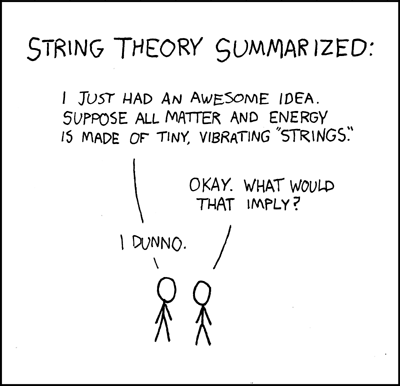 [/img]
(from [url= http://xkcd.com ]XKCD[/url])
First of all: yer old-skool quantum mechanics of the Standard Model is very good at describing matter and forces at a sub-atomic level, but in terms of concepts and ideas that really don't have any direct equivalent in everyday experience.
Next up: string theory is an attempt to understand what the Standard Model derives from, in terms of yet deeper layer of even more un-intuitive concepts.
So basically, it can't really be understood in any sort of everyday terms 😯 In particular the idea of "vibrating" loops of "string" is only a very loose metaphor, at best.
In "traditional" particle physics the basic objects (quarks, electrons, photons) are (at least in some respects) pictured as point-like. A point is "zero dimensional" in that can have no internal structure.
String theory says these fundamental objects are better described like little loops, but curled up in more dimensions of space than we are normally aware of. Loops are one-dimensional in the same way that a straight line is one-dimensional, but embedded in spaces of higher dimensions.
One of the problems with the Standard Model is when you go to really tiny distances near a point particle the equations for field interactions "blow up". One of the arguments for string theory is it sidesteps this problem (no point particles).
However it turns out that mathematically consistent string theories require 11 dimensions, the maths behind it all is staggeringly complex and no-one really knows how to solve it properly. After thirty odd years of research (and many hyped-up pop science books, such as The Elegant Universe) there are no testable predictions from string theory and no sign of any ever being produced - hence a bit of a backlash developing against the amount of prestige and funding its proponents get (see Lee Smolin's book, The Trouble With Physics).
I thought string theory explained why, regardless of how careful you are, any rope ends up in a fankle?
[i]no-one really knows how to solve it properly[/i]
Stoner and Excel... think monkeys and typewriters...
The idea of strings is more about the mathematics behind it all, which deals with a few issues better than other theories.
It's very difficult to explain Superstring theory in words as so much will always be missing, compared to a mathematical understanding.
It's well beyond me I'm afraid!
Are these Simpsons individual stringettes but bigger?
42?
I *strongly* suggest that before starting on The Elegant Universe, you read The Fabric of the Cosmos by the same author. It's an excellent book - actually a sequel - but the string theory is cut back a bit and you get a much stronger introduction to the concepts behind it.
There are a series of videos which go with the book, all free and with excellent production values, and will make things a helluva lot easier to understand.
http://www.pbs.org/wgbh/nova/elegant/program.html
I'm a condensed matter physicist rather than a particle theoretician so I don't know anywhere near as much about string theory as I'd like to... but I want to point out that in 4D space-time you can easily have a spatial 1D loop (the "loop" part takes part in time rather than space). You should be thinking in a minimum of 4 dimensions before even starting to tackle strings.
As far as mass and energy are concerned, I like to think of mass as frozen energy. You can think of particles as vortices of energy if you like. I strongly recommend you read [url= http://www.amazon.co.uk/Vortex-Key-Future-Science/dp/1858600197 ]"The Vortex: Key to Future Science"[/url] before anything else. I read it years ago and it changed the way I think about fundamental mass and energy for the better. As a scientist, I don't agree with everything in the book - some of their conclusions are a little too far-fetched - but the basic hypothesis is sound and the concept warrants further research. From a holistic perspective I'm sure you'd love it.
Flaperon - thanks for that link. Am going to watch Man U tonight but will save these for later.
I have a PhD in theoretical particle physics and can honestly say that a large number of physicists, including myself, regard string theory as total $h1T£. Seriously.
FallOutBoy - that's useful info. Are there any popular science books that you would recommend then? What about "The Road to Reality" by Roger Penrose?
I have a new theory: Spaghetti String Theory - put spaghetti in pan (energy superstrings), heat it up, stir with spoon (vibrate), add meat balls (planets) and sauce (dark matter), eat (suck into black hole). Its so simple, nothing to prove other than it tasted as good as you expected. Guess what I am having for tea!! omnomnomnom
Simon R - Its difficult to know the level, particularly as its been about 10 years since I read anything of that sort. Most of what I've seen recently is media hype. The best thing I ever remember reading was 'The Cosmic Onion' by Frank Close. In fact I would recommend anything by Frank - I not read any of his other books but he is an excellent speaker at conferences.
The problem with books on string theory /supersymmetry is quite simple. There is no experimental evidence. For string theory there wont be in our lifetime, which leaves mathematicians free to indulge themselves in all sorts of esoteric nonsense! Non of it likely to be realised in nature.
I should point out that Penrose's most notable work involves the Einstein's General Relativity/ blackholes etc. for which there is evidence and ongoing experiments... but I'm not qualified to express any informed opinion since its not my field.
... but I'm not qualified to express any informed opinion since its not my field.
Not often you hear that on here!!!
Supersymmetric theories have been employed in heavy ion physics for a while and are now starting to be used in condensed matter by several of my collaborators, for instance to describe quantum phase transitions in 2D systems (e.g. superconductor/superfluid to insulator). These are phenomena which clearly are realised in nature.
While I'm not going to try to claim that all particles are merely strings on the surface of an n-dimensional hypersphere - I'd be way out of my depth, it certainly isn't my field either and as has already been stated there's no experimental evidence - I don't think it's fair to write off string theory completely, particularly when we are only just beginning to understand how to apply supersymmetric formalisms to (potentially simpler) problems outside high-energy physics.
show off
(winniesmith: proud owner of a 2.2 physics degree)
FallOutBoy - don't forget Einstein's attitude to Quantum Mechanics lest this come back to bite you. 🙂