Forum menu
It's great that you are in that position, but for the majority I suspect the financial aspect of installing solar heating, insulating a home etc is a fairly important factor.
Come off it. This forum is filled with people agonising over which new £3000 bike to buy.
I've had a good look through the Energy saving Trust site, Ransos. The only reference to £55 I can find is the figure given for what you can save by properly insulating your hot water tank and lagging the hot pipes. Now if you can save £55 I suggest the total typical consumption figure must be somewhat higher. Could you link your source please.
What does that have to do with the demographics of the UK?Come off it. This forum is filled with people agonising over which new £3000 bike to buy.
I just don't see that financial payback is relevant (unless you don't have the money) - the main thing is that it makes sense in carbon terms.
Solar thermal saves only a small amount of gas. Gas produces 1/3 of the carbon electricity produces per KWh. So I don't think it makes much sense in carbon terms, either.
I've had a good look through the Energy saving Trust site, Ransos. The only reference to £55 I can find is the figure given for what you can save by properly insulating your hot water tank and lagging the hot pipes. Now if you can save £55 I suggest the total typical consumption figure must be somewhat higher. Could you link your source please.
http://www.energysavingtrust.org.uk/Generate-your-own-energy/Solar-water-heating
"Based on the results of our recent field trial, typical savings from a well-installed and properly used system are £55 per year when replacing gas heating "
Insulating your loft/roof is a no-brainer really.
In the grander scheme, we need to be reducing electrical energy use.
Not only is it more expensive, it's a good bit more carbon intensive. Look at your lamps (there's a variety of CFLs on the market with different start up times and CCFs so do some research and buy the correct type for you) look at appliances, plug-top timers are cheap and easy to set up, buy AA+ rated kit.
http://www.energysavingtrust.org.uk/Generate-your-own-energy/Solar-water-heating
Your link Ransos, sorry it's in full, the buttons have vanished to link it. I know how much hot water three very economical people use and a saving of only £55 is nonsense. It assumes the solar water heater only contributes 20% to water heating which anyone who has used a solar hot water heater will tell you is wrong. They (Energy Saving Trust)reckon you can save as much just by lagging your tank.
Edit: I found it eventually. 🙂
We're currently having some walls internally insulated as part of a refurbishment project and I haven't even bothered to work out the extra financial cost - it probably won't pay back in pure financial terms
If you're doing it as part of a bigger project it might well payback, because the trades are all onsite anyway. The other benefits are a more pleasant home environment and reduced mould/ condensation.
I haven't included the photovoltaïque which will pay for itself in 6.5 years.
Thank god for that, because if you had I would be asking:
Where were the working bits of the PV made? (I'd guess either somewhere like China or Japan). How do you make silicon (or CdTe if they are of that form). Its not exactly a low energy process. Panels roughly "break even" on energy (in terms of kWh required to produce the panel) in something between 2 and 8 yrs depending on the panel design and the latitude its mounted at. Paying for itself financially and in energy terms is not the same thing since there are better rates for PV. But here is the point people seem to miss: if the panel was made in China it was made using dirty coal power. So the global environmental impact of making the panel is much worse than using clean coal (or other western power) in Europe for the entire payback period. If the panel is Japanese in origin then it almost certainly relied heavily on nuclear power to make it - which most of the people who fit them seem uncomfortable with. In addition, for reasons nobody has ever explained PV panels are exempt from ROHS regs and so potentially a "disposal timebomb" full of lead, cadmium etc...
Whilst over a 20+ yr lifetime of a panel it will save energy they aren't 'saving' energy from the day they were installed due to the invested energy within them. Financial investments, recovered over several years may make sense. I'm not so sure that makes sense for carbon.
Quite frankly PV panels, certainly in the UK are just Eco-bling.
I know how much hot water three very economical people use and a saving of only £55 is nonsense.
This was the result of a field trial. You're confusing evidence with personal anecdote.
Here's my personal anecdote, which is the opposite of yours:
My last two quarters' gas bills were a total of £85, no heating was on during that period. From my annual non-heating total of £170, we subtract gas for cooking and the inefficiencies of the solar panel (let's assume it provides an average of 50% year round, and we use say 20% of the gas for cooking). Then we subtract the cost of the electricity for running the pumps.
£55 is absolutely spot on.
What does that have to do with the demographics of the UK?
Sod all.
But so what?
I just kind of took it for granted that I was addressing the users of this forum, not the nation as a whole.
these threads are like some kind of stw hormone cycle that comes around every couple of months. I don't have the energy (wahey!) to get involved in them any more.
Poly he is further south but I tend to agree with you - photovoltaics are not really a part of the solution in the UK at present efficiencies / manufacturing cost / lifetime environmental penalty
Taking 50l/person/day [url= http://webarchive.nationalarchives.gov.uk/+/http://www.berr.gov.uk/files/file16568.pdf ]from here[/url] thats 200l per day for a family of four, or 73 000l per year.
start temperature of water is 10°C. Final temperature 50°C, change 40°C
Q = 73000 x 4184 x 40 = 14966168000J
= 4157 kWh (assuming perfect lagging and no heat losses.
At 8p per kWh that's £332
The Energy Saving Trust either can't do maths or think that solar panels provide less than 20% of hot water needs.
You aren't going to get water at 50°C for more than a couple of months in the UK. Average winter temp is 4.4°C and our winters are loooong.
Gas isn't 8p/kWh, more like 4 or 5p/kWh.
Regardless of insulation, there will always be heat losses.
The Energy Saving Trust either can't do maths or think that solar panels provide less than 20% of hot water needs.
Your calculation is irrelevant. It's a theoretical example for a specific case. By contrast, EST did a proper field trial. When you've done one of those, come back with the results, and we can discuss it.
In any case, your savings calculation is way off. It's nearly double the total amount of non-heating gas I use in a year. Family of 3.
My Solar World panles were made in Germany as was the rest of the system. They've already paid for themselves in embedded energy terms.
Using your own figures Ransos. £170 for the year based on summer hot water and cooking use. I assume you have a couple of weeks holiday and the water takes more heating in the winter. Say £190 per year for hot water and cooking and you've forgotten to add in the water heater in the washing machine (and dish washer if you have one) so we can add another £20.
£210 - 20% for cooking = £168. 70% produced by solar = £117
Using your own figures Ransos. £170 for the year based on summer hot water and cooking use. I assume you have a couple of weeks holiday and the water takes more heating in the winter. Say £190 per year for hot water and cooking and you've forgotten to add in the water heater in the washing machine (and dish washer if you have one) so we can add another £20.£210 - 20% for cooking = £168. 70% produced by solar = £117
You really should stop making assumptions. No holiday this summer. Year-round efficiency of solar panel likely to be less than 50%. Dishwasher and washing machine are cold fill only, like most of the population.
£170 year-round less 20% cooking = £136. Less 50% efficiency (optimistic) for panel = £68. Less electricity for running the pumps, let's say £10 = £58.
£58 against the EST figure of £55. Time you learned to add up...
I've done a proper field trial too with a system designed by a bunch of solar fans and plumbers on a forum.
It uses two tanks:
the solar tank heated only by a heat exchanger fed from the solar panel. The system thermosyphons as the tank is above the panel, thus requiring no pumps or control gear and eliminating risk of back-syphoning. It's all double lagged. The solar tank feeds the house direct in Summer (six full months this year).
The second tank is a small (50l) conventional tank with an immersion heater. In Winter the water pre-heated by the solar tank enter the second tank and we switch on the immersion heater as needed. Most of the heating is still solar except for a month either side of the Winter solstice.
I know many commercial sytems use only one tank, are insufficiently insulated, run energy greedy pumps and simply don't deliver their promises. However, I feel an organisation such as the Energy saving Trust should base their findings on a system at least as good as a monkey with blow torch can cobble together in his shed.
Should EST base their study on a) a custom-designed highly unusual system or b) the type of system most people have or would buy?
Even if your system supplied 100% of my hot water, it would still only save £136. If a typical installation costs £4,800 (EST figure) that's a 35-year payback! So a more typical installation is perhaps a 70-year payback. Wouldn't that be longer than the operational lifespan of the equipment?
Carbon saving is also low.
Another round in circles argument in which you criticise me for using my own system as an example then use yourself as an example of energy needs and pick a 50% figure out of fresh air for solar hot water heater contribution.
The Energy saving Trust is not usuing accepted levels of hot water consumption as reported by many government and non-government organisations. I suspect the system they used only included one tank and the temperature selected meant that the solar panel hardly ever circulated in winter.
The Energy saving Trust is not usuing accepted levels of hot water consumption as reported by many government and non-government organisations.
No, they're using what happens in the real world. Because they've measured it.
I used my own example because the plural of anecdote is not data. Your example is worth no more than mine, which is why we refer to independent studies.
Ransos,
Do you not see the general problem in arguing that the theoretical output of a system is a more reliable measure of it's efficiency than the actual measured output?
which is why we refer to independent studies.
Which probably aren't worth that much either. 😆
From CIBSE;
8.3 Payback times
8.3.1 Economic payback
The simple economic payback times (the time in years taken for the cost savings to offset the initial capital cost) for some swimming pool heating systems and air source heating systems can be under 10 years but, in general,the payback times for photovoltaic and solar thermal systems are long and may be longer than the lifetime of the system. However, these estimates do not include potential fuel price increases and any grants or other incentives that could reduce the payback times substantially. The installation of a solar
system may also increase the value of a building.
8.3.2 Energy payback
The energy payback time (the time needed in years for a system to
reimburse its energy content) is between 2 and 4 years for solar thermal systems and between 3 and 5 years for photovoltaic systems, depending on location and whether it is roof or façade mounted.
8.3.3 Carbon payback
The carbon payback (the time needed in years for a system to offset its carbon content by carbon savings) for solar thermal systems is about 2 years and for photovoltaic systems between 4 and 6 years, depending on the technology used.
Capturing solar energy
CIBSE Knowledge Series: KS15, 2009
If anyone wants a copy, let me know.
Do you not see the general problem in arguing that the theoretical output of a system is a more reliable measure of it's efficiency than the actual measured output?
What matters is what happens.
Which probably aren't worth that much either
Trans: I don't like what they found so I'll call it rubbish". 🙄
People can spec and buy the system they want. People buy and spec the car/bike they buy and don't always make a sensible choice as this forum often demonstrates.
The Energy saving Trust is there to advise and should therefore do some research and spec an efficient system that they can then advise to people viewing thier site.
You can buy a system that relies on using electrically heated water to prevent freezing (a colleague of my wife was horrified to find that was how his expensive commercial system worked). You can buy systems based on thermal stores and pumps which at have anti-retun valves and anti-freeze in the primary circuit but don't circulate much in Winter. Or you can buy a system that serves as a pre-heater so provides all your Summer needs and makes a good cntribution in winter. The EST (I'm getting tired of typing Energy Saving Trust) should spec a system that is capable of saving more than it says lagging a tank will.
Trans: I don't like what they found so I'll call it rubbish".
Like you're doing?
From CIBSE
in general,the payback times for photovoltaic and solar thermal systems are long and may be longer than the lifetime of the system
Which is what I've been saying...
By all means install solar thermal if you want to, but don't kid yourself that it saves much money or carbon.
ransos - my parents got well more than that from their system -payback was around 15 years. Got the water hot enough to use some of the time and the rest gave a significant boost as preheat. Sophisticated system allowing it to be used direct or as a preheat. Installed in Scotland 20 years ago - modern systems should be better
The Energy saving Trust is there to advise and should therefore do some research and spec an efficient system that they can then advise to people viewing thier site.
The purpose of the report was to determine the effectiveness of systems in the field. That's what they did. The results may be taken as advice that typical systems don't save much money or carbon.
Hopefully, the results will motivate the market to do better.
Power stations are very expensive to turn up/down
With the exception of gas-powered stations and pumped storage stations.
"in general", what mean "in general"?
What mean "for some swimming pool heating systems"?
What mean "However, these estimates"?
These are the statements that mean independant reporting is vague not some smartarsery comment.
ransos - my parents got well more than that from their system -payback was around 15 years. Got the water hot enough to use some of the time and the rest gave a significant boost as preheat. Sophisticated system allowing it to be used direct or as a preheat. Installed in Scotland 20 years ago - modern systems should be better
I'm happy for them.
"in general", what mean "in general"?
What mean "for some swimming pool heating systems"?
What mean "However, these estimates"?
These are the statements that mean independant reporting is vague not some smartarsery.
Trans: I don't like what they're saying so I'm reduced to nit-picking.
Tell you what. You convince yourself of whatever you like. I'll stick with the evidence from reputable sources.
Trans: I don't like what they're saying so I'm reduced to nit-picking.
🙄
Maybe we could create a computer model of a central heating system taking into account all the known feedback cycles and predict how hot the water will be? 😀
42?
I've already quoted the price of my own system, 1100e. The biggest double-glazed Velux window I could buy (non reflective glass), 25m of 18mm copper pipe and fittings, insulating materials, a 150l tank with an exchanger coil, some fittings and welding gas. My own hot water consumption I estimated as around 150e (similar to yours, Ransos) and last year it was down to less than 50e (I'm assuming all excess Winter electricity consumption is down to hot water when in fact it's also down to more lighting, Madame baking etc..)
So even in economic terms I get my money back in 11 years. No boiler to service, no standing charge, no pumps, no electronics, low depreciation. Nothing to do apart from clean the glass now and then.
200 - I claim all the hot air to heat my flat 🙂
edit - too slow
Tell you what. You convince yourself of whatever you like. I'll stick with the evidence from reputable sources.
Are you saying that Edukator is not a reputable source?
So even in economic terms I get my money back in 11 years. No boiler to service, no standing charge, no pumps, no electronics, low depreciation. Nothing to do apart from clean the glass now and then.
I'm happy for you, really. But it remains the case that your results are highly atypical. It seems that most systems never pay back.
Given that you doubled the price of gas in your calculations, I also question the accuracy of your figures.
"in general", what mean "in general"?
What mean "for some swimming pool heating systems"?
What mean "However, these estimates"?
These are the statements that mean independant reporting is vague not some smartarsery comment.
Take it up with the chartered institute.
With the exception of gas-powered stations and pumped storage stations.
Gas turbine or gas powered or both?
pumped storage doesn't contribute enough to be considered though does it? (we only have 1)
Are you saying that Edukator is not a reputable source?
I'm saying that an anecdote is not evidence.
pumped storage doesn't contribute enough to be considered though does it? (we only have 1)
errmmm- rather more than that 2 in Scotland 2 in wales
On a rainy day (hence the posting 😉 ) in SW France the water from the solar tank is running at 24°C. So, even less than a month from the winter solstice the sun is still providing nearly half the energy to heat our water.
So, even less than a month from the winter solstice the sun is still providing nearly half the energy to heat our water.
More like one third. In SW France.
My gas price is from the British Gas site for the first 2500 kWh. It's about the same I was paying before I cut the gas off. Do you use more than 2500kWh a year? If so, start insulating.
errmmm- rather more than that 2 in Scotland 2 in wales
My mistake 😳
They still contribute a [s]fractional proportion[/s] small amount of our energy requirements though.
Edit; fractional proportion? WTF?
Tap water at 10°C and I'm happy to shower at 40°C. 24°C is nearly half. A kettle on the wood burner provides water for washing up at this time of year.
My gas price is from the British Gas site for the first 2500 kWh
Typical domestic annual consumption is around 16,000 KWh. You're cherry picking the initial units to support your argument.
I originally quoted a saving of £100 to £200. Cherry picking results in a saving of £200 based on a family of four using 200l a year of water at 50°C. Using the higher consumption tarif the saving would be £100.
I'm making a clear distinction between my own case and the average case which is what the EST should be basing their savings on.
Does the site you took 16 000kWh from give a break down including domestic hot wter and heating? Because sites I've seen that give typical domestic gas consumption of 16-20 000 kWh generally attribute about 4 000 to domestic hot water.
regardless of the debating, what's good for SW France isn't necessarily good for the UK. I suspect TJ wouldn't get as good results in Edinburgh.
Having said that, edukator has applied renewable technology intelligently (which we should do) and is reaping the rewards. I genuinely admire him for that and hope that it continues to perform for him.
Thank you, Wrecker. Southern England gets about 3/4 of the solar intensity we do. A bigger more steeply inclined thermal panel would be needed but it would still work. The photovoltaïque pay back would be over eight years. Return on investments in insulating materials would be quicker in the UK. The investments I've made wouldn't have the same return periods but overall the saving would be greater.
[img] 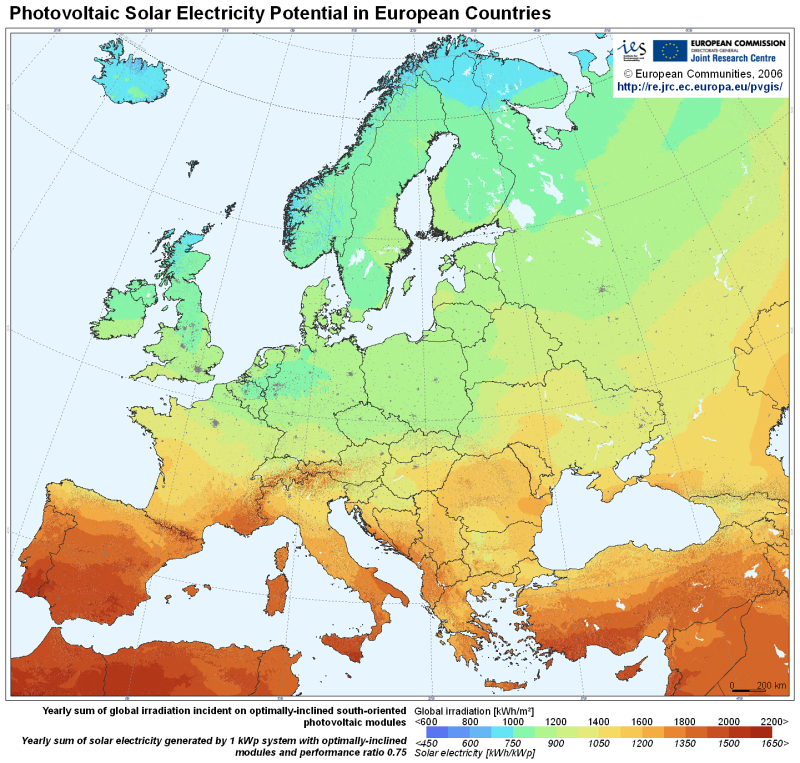 [/img]
I'm saying that an anecdote is not evidence.
I think an anecdote generally refers to a story about someone that your mate might once have known who probably did something (maybe). Or was it his sister?
My experience of paybacks in SW England has been that it hovers around 10-12 years. For many commercial clients, that is not seen as an effective investment (they can use their money better elsewhere). These are companies which advertise their green credentials. Others put tiny "token" panels in, then advertise that they are using renewables!
Looks good on the CSR report.
Does the site you took 16 000kWh from give a break down including domestic hot wter and heating? Because sites I've seen that give typical domestic gas consumption of 16-20 000 kWh generally attribute about 4 000 to domestic hot water.
Hot water and heating are not separated for billing purposes. For a typical house, the annual bill is 2,500 units at 8p and 13,500 units at 4p. That means that any savings due to solar thermal will be at 4p, not the 8p you quoted.
Did we already do "Extracting nuclear fuel needs a lot of carbon based fuel"?
Or my favouite
"16% of current nuclear fuel is from decomissioned warheads - what happens when the nukes run out?"
When the nukes run out, we'll be relying on reasonably plentiful, but low-grade ore. Low grade ore results in lots of CO2 emissions......
And is a finite resource although amounts are disputed - its some decades at current usage rates and the pro nuke folk want a massive increase in teh number of reactors built
We've gone a bit far from the original topic, which was the cost and safety of nuclear power. (I was quite fascinated to find this thread in a site devoted to mountain biking, BTW.)
With regard to safety, the correct question is "Compared to what"? For that, I would refer you to the ExternE project, which assessed the total life cycle risk of various electric generation technologies. This means building/decommissioning the plant, finding/mining/transporting the fuel (if any), routine emissions, and accidents. It found that nuclear was roughly comparable to renewables, and much safer than coal, oil or gas in terms of deaths per unit electricity generated.
Accidents happen in all technologies; they're just much more dispersed and less detectable long term than radiation. To the poster who said the Fukushima residents could "never return", consider this:
http://www.pcf.city.hiroshima.jp/kids/KPSH_E/hiroshima_e/sadako_e/subcontents_e/15fukkou_1_e.html
Perhaps the real subject of discussion should be our modern near-pathological avoidance of any risk whatsoever (as if that were possible). Low level radiation is (a) universal, and (b) a very small cancer risk. The more foam-at-the-mouth estimates of the deaths from both Chernobyl and Fukushima result from misapplying the Linear No-Threshold (LNT) hypothesis at very low doses to enormous populations. Almost nothing else in toxicology works that way.
Considering cost, the cost of nuclear is almost entirely the initial capital investment (same as for wind, solar and hydro). What drives that up is not technology, but political opposition from groups who have become adept at using the legal system for obstruction.
If you've read this far, take a look at a talk I gave back in the spring (yes, post-Fukushima) called "A Rational Environmentalist's Guide to Nuclear Power": http://www.scribd.com/doc/54904454
Considering cost, the cost of nuclear is almost entirely the initial capital investment
Decommissioning.
waste disposal
far higher than the cost of building the reactors - an open ended unknown cost
over the population of the planet means many many deathsa very small cancer risk.
Edukator - MemberDoes the site you took 16 000kWh from give a break down including domestic hot wter and heating? Because sites I've seen that give typical domestic gas consumption of 16-20 000 kWh generally attribute about 4 000 to domestic hot water.
My usage in the last year was about 7000kwh gas, used for central heating and hot water. And electricty was around 4600kwh used for lighting, power points, cooker and general house hold electronics.
This cost me about £600 in leccy and £600 in gas, so it was under £1200 total.
On the Original Post
Chris Huhne says:
“The nuclear industry was like an expense-account dinner:
everybody ordering the most expensive items on the menu
because someone else was paying the bill.”
Britain’s Energy Secretary Chris Huhne
"Britain is still paying for nuclear-generated electricity consumed a generation ago because of the hidden costs of an industry reared on the expectation of public subsidies, the Energy Secretary Chris Huhne said yesterday. Half of the budget of the Department for Energy and Climate Change goes on cleaning up Britain’s legacy of nuclear waste, which includes the world’s largest stockpile of civil plutonium waste. That is £2bn a year, year in and year out, that we are continuing to pay for electricity that was consumed in the 1950s, 1960s and 1970s on a false prospectus."
http://climatetoday.org/?cat=12
Decommissioning.waste disposal
far higher than the cost of building the reactors - an open ended unknown cost
A cost we're going to cover anyway - to deal with the stuff our grandparents have left us.
a very small cancer risk over the population of the planet means many many deaths
but not as many as will die while fitting solar panels to roof-tops.
Awhles - but if we build more reactors these costs will rise. thats no argument for building more
rise yes- but not in proportion.
if it costs £100Billion to build a long term storage facility to cope with the stuff we've already got, it won't cost twice as much to deal with twice as much waste.
whether we like it or not, burial will be our long-term solution to waste.
finding/developing a site will be expensive, this is a price we already have to pay - thanks grandad.
while we're down there*, we can build an extra chamber or 10 (30 instead of 20, or whatever). and we can stop worrying about 'the energy crisis'.
(*a mile or so down, under some really boring** geology)
(**not moved in a few hundred million years, not going anywhere in the next 100,000)
radon gas kills 2000 people every year in the uk - modern, air-tight houses will make this worse.
energy efficiency kills.
awhiles - however the reprocessing costs will be proportionate as will the decommissioning costs
Only a few accidents over the years:
http://www.guardian.co.uk/news/datablog/2011/mar/14/nuclear-power-plant-accidents-list-rank
The following is a brief history of recent incidents at French nuclear sites:
June 2011: A minor and fairly common incident that involved internal leakage at EDF's Paluel 3 nuclear reactor was reported by French investigative website Mediapart, knocking 2 percent off EDF shares briefly.
November 2009: A fuel assembly rod got stuck in the pressure vessel at EDF's Tricastin plant in southeast France, raising the risk of an accident. A similar incident took place in September 2008 in the same reactor during refueling operations. It took two months for engineers from EDF and French energy group Areva to stabilize the position of the rod and proceed with its unhooking and removal.
July 2008: Thirty cubic meters of a liquid containing natural uranium was accidentally poured on the ground and into a river at Areva's Socatri site in southeastern France. The spillage happened while the tank was being cleaned at the complex, part of the Tricastin nuclear site, which houses four nuclear reactors. The pure uranium was much less dangerous than enriched uranium, but France's ASN nuclear watchdog rebuked Areva for mishandling the accident.
December 1999: A massive storm provoked the partial flooding of some reactors at EDF's Blayais plant in southwestern France. Many nuclear opponents said the flooding nearly caused a major catastrophe because it briefly cut off power at the plant.
March 1980: An accident at EDF's Saint-Laurent nuclear reactor in central France caused two fuel rods to melt, seriously damaging the reactor and causing the most serious accident in France's nuclear history, classified as level 4 on the International Nuclear Event Scale which runs from zero to 7.
http://www.spiegel.de/international/germany/0,1518,635788,00.html
http://www.economist.com/node/9595481
pro nuke folk want a massive increase in teh number of reactors built
I am pro nuclear. I do NOT want to see a massive increase in numbers of reactors.
There, proved you wrong.
There, proved you wrong.
Sorry, but I'm quite sure I can find a link to prove you wrong.
errmmm - dinna get it Buzz. so you are one that says nukes are needed for us but not for other countries? Or that we need new nukes but not any more than we have now?
If you believe nukes are the answer to global warming / energy security tehn a massive expansion of them is surely the only logical thing
over the population of the planet means many many deaths
No, it doesn't, it simply doesn't.
You're extrapolating downwards using the theory of "no safe dose"
For example, 30 sievert equivalent exposure can kill 1 person, therefore a total release of 30000 sievert equivalent in an accident where a million people get exposed will result in 1000 deaths - in actual fact, if thats spread over a million people, each person might only get a tiny, tiny exposure and there would be NO adverse clinical effects ever.
Its like saying that a dosing a million people with a million Paracetamol tablets would kill ten thousand of them, Statistically arguable, though we know very well that its bollocks.
Statistical extrapolation that bears no relation whatsoever to actual life.
zulu - wrong there is no safe minimum dose for radiation. All radiation is mutagenic - its nothing like a chemical poison. radiation doses are also cumulative.
So yes - any radiation released into biosphere will mean more deaths.
no safe minimum dose for radiation
utter balls 😆
You'd better move the **** out of Edinburgh then! All that Granite, somebody could drop dead!
Ever had an X-Ray TJ?
Ever flown in a plane?
If I give one million people one X ray - how many of them will die 🙄
the United Nations Scientific Committee on the Effects of Atomic Radiation (UNSCEAR) wrote in its 2000 report[12]Until the [...] uncertainties on low-dose response are resolved, the Committee believes that [b]an increase in the risk of tumour induction proportionate to the radiation dose is consistent with developing knowledge and that it remains, accordingly, the most scientifically defensible approximation of low-dose response.[/b] However, a strictly linear dose response should not be expected in all circumstances.
the United States Environmental Protection Agency also endorses the LNT model in its 2011 report on radiogenic cancer risk:[13]"Underlying the risk models is a large body of epidemiological and radiobiological data. In general, results from both lines of research are consistent with a linear, no-threshold dose (LNT) response model in which the risk of inducing a cancer in an irradiated tissue by low doses of radiation is proportional to the dose to that tissue."
also
http://www.abc.net.au/science/articles/2011/03/31/3177889.htm