UPDATE: CLASSIFIEDS section refreshed, redesigned, searchable: Go take a look
Another round in circles argument in which you criticise me for using my own system as an example then use yourself as an example of energy needs and pick a 50% figure out of fresh air for solar hot water heater contribution.
The Energy saving Trust is not usuing accepted levels of hot water consumption as reported by many government and non-government organisations. I suspect the system they used only included one tank and the temperature selected meant that the solar panel hardly ever circulated in winter.
The Energy saving Trust is not usuing accepted levels of hot water consumption as reported by many government and non-government organisations.
No, they're using what happens in the real world. Because they've measured it.
I used my own example because the plural of anecdote is not data. Your example is worth no more than mine, which is why we refer to independent studies.
Ransos,
Do you not see the general problem in arguing that the theoretical output of a system is a more reliable measure of it's efficiency than the actual measured output?
which is why we refer to independent studies.
Which probably aren't worth that much either. 😆
From CIBSE;
8.3 Payback times
8.3.1 Economic payback
The simple economic payback times (the time in years taken for the cost savings to offset the initial capital cost) for some swimming pool heating systems and air source heating systems can be under 10 years but, in general,the payback times for photovoltaic and solar thermal systems are long and may be longer than the lifetime of the system. However, these estimates do not include potential fuel price increases and any grants or other incentives that could reduce the payback times substantially. The installation of a solar
system may also increase the value of a building.
8.3.2 Energy payback
The energy payback time (the time needed in years for a system to
reimburse its energy content) is between 2 and 4 years for solar thermal systems and between 3 and 5 years for photovoltaic systems, depending on location and whether it is roof or façade mounted.
8.3.3 Carbon payback
The carbon payback (the time needed in years for a system to offset its carbon content by carbon savings) for solar thermal systems is about 2 years and for photovoltaic systems between 4 and 6 years, depending on the technology used.
Capturing solar energy
CIBSE Knowledge Series: KS15, 2009
If anyone wants a copy, let me know.
Do you not see the general problem in arguing that the theoretical output of a system is a more reliable measure of it's efficiency than the actual measured output?
What matters is what happens.
Which probably aren't worth that much either
Trans: I don't like what they found so I'll call it rubbish". 🙄
People can spec and buy the system they want. People buy and spec the car/bike they buy and don't always make a sensible choice as this forum often demonstrates.
The Energy saving Trust is there to advise and should therefore do some research and spec an efficient system that they can then advise to people viewing thier site.
You can buy a system that relies on using electrically heated water to prevent freezing (a colleague of my wife was horrified to find that was how his expensive commercial system worked). You can buy systems based on thermal stores and pumps which at have anti-retun valves and anti-freeze in the primary circuit but don't circulate much in Winter. Or you can buy a system that serves as a pre-heater so provides all your Summer needs and makes a good cntribution in winter. The EST (I'm getting tired of typing Energy Saving Trust) should spec a system that is capable of saving more than it says lagging a tank will.
Trans: I don't like what they found so I'll call it rubbish".
Like you're doing?
From CIBSE
in general,the payback times for photovoltaic and solar thermal systems are long and may be longer than the lifetime of the system
Which is what I've been saying...
By all means install solar thermal if you want to, but don't kid yourself that it saves much money or carbon.
ransos - my parents got well more than that from their system -payback was around 15 years. Got the water hot enough to use some of the time and the rest gave a significant boost as preheat. Sophisticated system allowing it to be used direct or as a preheat. Installed in Scotland 20 years ago - modern systems should be better
The Energy saving Trust is there to advise and should therefore do some research and spec an efficient system that they can then advise to people viewing thier site.
The purpose of the report was to determine the effectiveness of systems in the field. That's what they did. The results may be taken as advice that typical systems don't save much money or carbon.
Hopefully, the results will motivate the market to do better.
Power stations are very expensive to turn up/down
With the exception of gas-powered stations and pumped storage stations.
"in general", what mean "in general"?
What mean "for some swimming pool heating systems"?
What mean "However, these estimates"?
These are the statements that mean independant reporting is vague not some smartarsery comment.
ransos - my parents got well more than that from their system -payback was around 15 years. Got the water hot enough to use some of the time and the rest gave a significant boost as preheat. Sophisticated system allowing it to be used direct or as a preheat. Installed in Scotland 20 years ago - modern systems should be better
I'm happy for them.
"in general", what mean "in general"?
What mean "for some swimming pool heating systems"?
What mean "However, these estimates"?
These are the statements that mean independant reporting is vague not some smartarsery.
Trans: I don't like what they're saying so I'm reduced to nit-picking.
Tell you what. You convince yourself of whatever you like. I'll stick with the evidence from reputable sources.
Trans: I don't like what they're saying so I'm reduced to nit-picking.
🙄
Maybe we could create a computer model of a central heating system taking into account all the known feedback cycles and predict how hot the water will be? 😀
42?
I've already quoted the price of my own system, 1100e. The biggest double-glazed Velux window I could buy (non reflective glass), 25m of 18mm copper pipe and fittings, insulating materials, a 150l tank with an exchanger coil, some fittings and welding gas. My own hot water consumption I estimated as around 150e (similar to yours, Ransos) and last year it was down to less than 50e (I'm assuming all excess Winter electricity consumption is down to hot water when in fact it's also down to more lighting, Madame baking etc..)
So even in economic terms I get my money back in 11 years. No boiler to service, no standing charge, no pumps, no electronics, low depreciation. Nothing to do apart from clean the glass now and then.
200 - I claim all the hot air to heat my flat 🙂
edit - too slow
Tell you what. You convince yourself of whatever you like. I'll stick with the evidence from reputable sources.
Are you saying that Edukator is not a reputable source?
So even in economic terms I get my money back in 11 years. No boiler to service, no standing charge, no pumps, no electronics, low depreciation. Nothing to do apart from clean the glass now and then.
I'm happy for you, really. But it remains the case that your results are highly atypical. It seems that most systems never pay back.
Given that you doubled the price of gas in your calculations, I also question the accuracy of your figures.
"in general", what mean "in general"?
What mean "for some swimming pool heating systems"?
What mean "However, these estimates"?
These are the statements that mean independant reporting is vague not some smartarsery comment.
Take it up with the chartered institute.
With the exception of gas-powered stations and pumped storage stations.
Gas turbine or gas powered or both?
pumped storage doesn't contribute enough to be considered though does it? (we only have 1)
Are you saying that Edukator is not a reputable source?
I'm saying that an anecdote is not evidence.
pumped storage doesn't contribute enough to be considered though does it? (we only have 1)
errmmm- rather more than that 2 in Scotland 2 in wales
On a rainy day (hence the posting 😉 ) in SW France the water from the solar tank is running at 24°C. So, even less than a month from the winter solstice the sun is still providing nearly half the energy to heat our water.
So, even less than a month from the winter solstice the sun is still providing nearly half the energy to heat our water.
More like one third. In SW France.
My gas price is from the British Gas site for the first 2500 kWh. It's about the same I was paying before I cut the gas off. Do you use more than 2500kWh a year? If so, start insulating.
errmmm- rather more than that 2 in Scotland 2 in wales
My mistake 😳
They still contribute a [s]fractional proportion[/s] small amount of our energy requirements though.
Edit; fractional proportion? WTF?
Tap water at 10°C and I'm happy to shower at 40°C. 24°C is nearly half. A kettle on the wood burner provides water for washing up at this time of year.
My gas price is from the British Gas site for the first 2500 kWh
Typical domestic annual consumption is around 16,000 KWh. You're cherry picking the initial units to support your argument.
I originally quoted a saving of £100 to £200. Cherry picking results in a saving of £200 based on a family of four using 200l a year of water at 50°C. Using the higher consumption tarif the saving would be £100.
I'm making a clear distinction between my own case and the average case which is what the EST should be basing their savings on.
Does the site you took 16 000kWh from give a break down including domestic hot wter and heating? Because sites I've seen that give typical domestic gas consumption of 16-20 000 kWh generally attribute about 4 000 to domestic hot water.
regardless of the debating, what's good for SW France isn't necessarily good for the UK. I suspect TJ wouldn't get as good results in Edinburgh.
Having said that, edukator has applied renewable technology intelligently (which we should do) and is reaping the rewards. I genuinely admire him for that and hope that it continues to perform for him.
Thank you, Wrecker. Southern England gets about 3/4 of the solar intensity we do. A bigger more steeply inclined thermal panel would be needed but it would still work. The photovoltaïque pay back would be over eight years. Return on investments in insulating materials would be quicker in the UK. The investments I've made wouldn't have the same return periods but overall the saving would be greater.
[img] 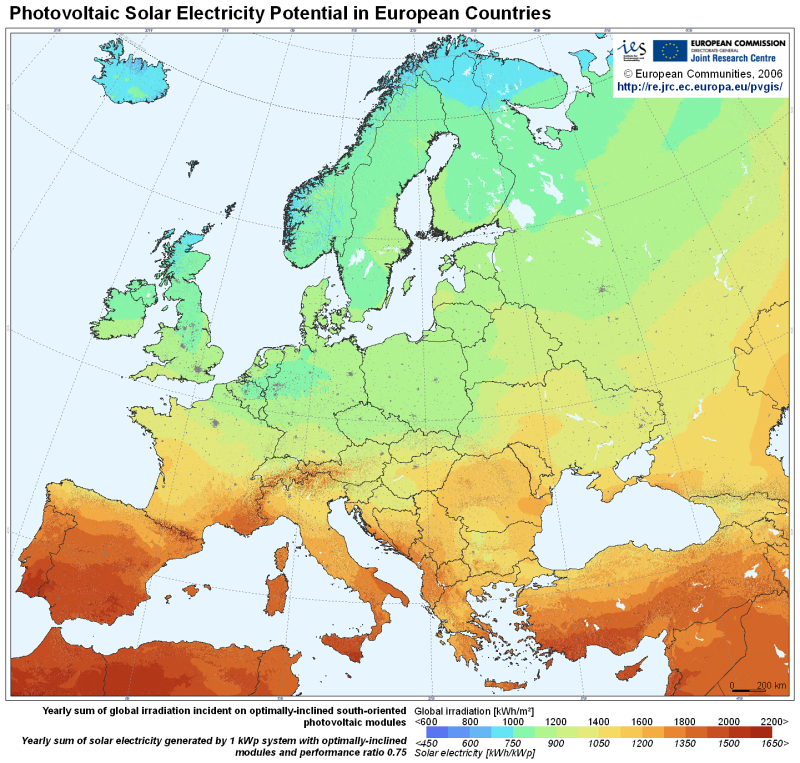 [/img]
I'm saying that an anecdote is not evidence.
I think an anecdote generally refers to a story about someone that your mate might once have known who probably did something (maybe). Or was it his sister?
My experience of paybacks in SW England has been that it hovers around 10-12 years. For many commercial clients, that is not seen as an effective investment (they can use their money better elsewhere). These are companies which advertise their green credentials. Others put tiny "token" panels in, then advertise that they are using renewables!
Looks good on the CSR report.
Does the site you took 16 000kWh from give a break down including domestic hot wter and heating? Because sites I've seen that give typical domestic gas consumption of 16-20 000 kWh generally attribute about 4 000 to domestic hot water.
Hot water and heating are not separated for billing purposes. For a typical house, the annual bill is 2,500 units at 8p and 13,500 units at 4p. That means that any savings due to solar thermal will be at 4p, not the 8p you quoted.
Did we already do "Extracting nuclear fuel needs a lot of carbon based fuel"?
Or my favouite
"16% of current nuclear fuel is from decomissioned warheads - what happens when the nukes run out?"
When the nukes run out, we'll be relying on reasonably plentiful, but low-grade ore. Low grade ore results in lots of CO2 emissions......
And is a finite resource although amounts are disputed - its some decades at current usage rates and the pro nuke folk want a massive increase in teh number of reactors built
We've gone a bit far from the original topic, which was the cost and safety of nuclear power. (I was quite fascinated to find this thread in a site devoted to mountain biking, BTW.)
With regard to safety, the correct question is "Compared to what"? For that, I would refer you to the ExternE project, which assessed the total life cycle risk of various electric generation technologies. This means building/decommissioning the plant, finding/mining/transporting the fuel (if any), routine emissions, and accidents. It found that nuclear was roughly comparable to renewables, and much safer than coal, oil or gas in terms of deaths per unit electricity generated.
Accidents happen in all technologies; they're just much more dispersed and less detectable long term than radiation. To the poster who said the Fukushima residents could "never return", consider this:
http://www.pcf.city.hiroshima.jp/kids/KPSH_E/hiroshima_e/sadako_e/subcontents_e/15fukkou_1_e.html
Perhaps the real subject of discussion should be our modern near-pathological avoidance of any risk whatsoever (as if that were possible). Low level radiation is (a) universal, and (b) a very small cancer risk. The more foam-at-the-mouth estimates of the deaths from both Chernobyl and Fukushima result from misapplying the Linear No-Threshold (LNT) hypothesis at very low doses to enormous populations. Almost nothing else in toxicology works that way.
Considering cost, the cost of nuclear is almost entirely the initial capital investment (same as for wind, solar and hydro). What drives that up is not technology, but political opposition from groups who have become adept at using the legal system for obstruction.
If you've read this far, take a look at a talk I gave back in the spring (yes, post-Fukushima) called "A Rational Environmentalist's Guide to Nuclear Power": http://www.scribd.com/doc/54904454
Considering cost, the cost of nuclear is almost entirely the initial capital investment
Decommissioning.
waste disposal
far higher than the cost of building the reactors - an open ended unknown cost
over the population of the planet means many many deathsa very small cancer risk.
Edukator - MemberDoes the site you took 16 000kWh from give a break down including domestic hot wter and heating? Because sites I've seen that give typical domestic gas consumption of 16-20 000 kWh generally attribute about 4 000 to domestic hot water.
My usage in the last year was about 7000kwh gas, used for central heating and hot water. And electricty was around 4600kwh used for lighting, power points, cooker and general house hold electronics.
This cost me about £600 in leccy and £600 in gas, so it was under £1200 total.

