
MegaSack DRAW - This year's winner is user - rgwb
We will be in touch
In a typical midweek way I was distracted from work by Facebook and someone posting a maths problem involving triangles. I can't figure it out so I wondered if the hive mind could. From the picture below try and find the angle x.
[img]  [/img]
10 deg?
x = 30
angles of a triangle all add up to 180.
I did it with a bit of trial and error but sure there will be a better way
If x = 30 then angles at E are, 30, 30 and 120.
this then makes angles at D 40, 100 & 40
The angles don't make sense. At the X in the lower part, the 50 is a larger angle than the 130...
[img]  [/img]
why are the 50's in the middle larger than the 130's?
The angles don't make sense. At the X in the lower part, the 50 is a larger angle than the 130...
its not drawn correctly,
i assumed the 50/130 were written in the wrong angles...
It's not to scale, just a hand drawn copy which is why the physical look of the angles is weird.
It'll not be drawn to scale, to stop you measuring the angles.
There are various facts you can work out, using the sum of the angles in a triangle being 180deg and the sum in a quadrilateral being 360deg. Some rearranging and substituting should get you [i]x[/i].
i assumed the 50/130 were written in the wrong angles...
making the angles of the right triangle add up to 100?
Never assume as it makes and ass of u and me
Nope 20 deg
JoeG - MemberThe angles don't make sense. At the X in the lower part, the 50 is a larger angle than the 130...
Angles are correct, originator can't draw worth a damn though...
Edit: and I'm sllloooowww 😀
20 degrees
I drew it out in CAD!!
How can we trust a question set by someone who can't even draw 10 triangles to scale?
*tuts*
Hmmm I can't find a way to quickly calculate x so I'm going to guess that you have to calculate all four unknown angles which will mean a system of 4 equations with 4 unknowns simultaneously.
20 by trial and error, but isn't this one of thse questions where you create two forumulae for x and the other unknowns and then use simultaneous equations/subtsituting the values of the two unknowns?
Thats what im doing at the moment, but I havent done this stuff for 20+ years.
Good to know I still can though.
Anyone solved it without brute-force/IT witchcraft? Just genuinely interested in an elegant solution. I probably still won't get it but hey.
And LOL at the protractor-wielding literalists
cmon bigyinn - one of us has to get the formula. I am even trying extending the lines outside the triangle.
60?
[img][url= http://farm8.staticflickr.com/7428/12088092873_fa7175d99a_o.jp g" target="_blank">
[url= http://www.flickr.com/photos/55623703@N05/12088092873/ ]angle[/url] by [url= http://www.flickr.com/people/55623703@N05/ ]Adam Branston[/url], on Flickr[/img]
Well that's what it's supposed to look like anyway!
ads beat me to it.. CAD for the win! 😉
I thought it might have something to do with simultaneous equations, but I can't remember how to do them anymore!
Look forward to the answer and workings... for when this does the rounds on FacePoo. 😆
you have to use the 'bigger' triangles as well as the small ones - there's about 10ish triangles in there and you can use the larger ones to help calculate the angles on the smaller ones.
I make it 80 - I'm no mathematician though
I can't do maths without computer aids any more. Actually i never really could, just did enough to pass the right exams!!
Computer aids? that sounds nasty! 😯
So no one's solved it formulaicly? (sp)
If y is the upper angle at D, x = y-10. I guess you play with that a bit more?
I just substituted some unknown angle values using the (x+this+that)=180 in a couple of places - gave a formula but , meh
This is annoying me now. 20 seemed to work, but here is a formula attemp
CDB = 140
EDB = 130-x
CDE = 140-x
therefore, 130-x+140-x = 140
270-2x =140
-2x =140-270
-2x = -130
x= 65
but that looks wrong
I did it using known angles and substitutions and got x = 70, assuming the diagram is not to scale...
Are there lots of right answers?
x = 20 degrees?
EDIT: Put in other symbols for the other unkown angles (y, z, etc.), then as sum of all angles in each triangle = 180, re-arrange equations to the form of e.g. y = x + 50 + 30 and then put that into the sum for a triangle that you've used 'y' in and solve to find x? I imagine there's a clearer way of expressing that!
Come one I've refreshed enough times now. Someone put me out of my misery.
Edit - and before someone says - I know it's ****** 20!
Or, you can use the existing angles to give a set length to a particular side, and then calculate the relative lengths of the other sides, forming more triangle using 90 degrees where necessary, in order to calculate the angle that way. But that'd just be complicated 😀
Any triangle out of all the options that take in X works if X is out 20 and the angle at D above 40 (With me) has to be 110 to work in all options that use that angle.
The answer is indeed 20.
It's non-soluble without a length as the angle changes dependent on the height of the major triangle.
Assume the top triangle is
20
a b
and the complementary angles are c and x, so
20
a b
c x
we need to find a,b,c and x. Four equations and four unknowns;
a+b=160
a+x=150
b+c=140
x+c=130
Now you can solve these either as a matrix and take the inverse of the 4x4 or you can back substitute;
[160] [1100] [a]
[150] = [1001] [b]
[140] [0110] [c]
[130] [0011] [x]
Unfortunately the determinant of this matrix is zero, so there is no inverse. Hence no solution to the four equations. The problem is ill posed.
For back substitution;
c=130-x
b=140-c = 140-(130-x) = 10+x
a+b = a+(10+x) = 160 so a+x = 150
Hence you really only have three equations and four unknowns. That's why it is on Facebook 😉
Maths is more fun than bike fitting 😉
Cheers tired, that was becoming somewhat annoying!!!
Yep, Thanks Tired! I wasted about 15 min on that!
It can't be insoluble, can it ? After all, somebody managed to draw it.
Must be calculable using sin/cos etc I'd guess
(then again, I said 80 degrees)
You are welcome to try, but you will need a scale (length) before you bring out the Cos or Sin rules big guns 😈
60 degrees
It's non-soluble without a length as the angle changes dependent on the height of the major triangle.
That's the bit I don't get. We know the shape can't change (it can't be a taller and thinner for example), so the whole thing can only scale in unison.
You are right, but it is ill-posed. Unless anyone spots an error in my alebra. Didn't see one. four unknowns but only three independent equations. That means you can find x in terms of a ratio of another angle you can't find. So you'll have to draw it.
Ask yourself why it might be on Facebook 😉
Tired, if you think it is ill-posed, you find two solutions and draw them accurately 🙂
Never was much good at geometry, but I'll have a think about it. I think it must have a neat solution.
At airport waiting for a flight so this is perfect :))
@Tired's got it with the comment that the solution can be an equation, it doesn't have to be a single number ("42" and all that 🙂 )
Will double check once on plane where I can write out the various equations. @Tired you kissed the chance to accuse everyone else of going off at a tangent ... I'll get my coat
There's only one answer.
You can reduce the problem to the one quadrilateral at the top, CDE and the centrepoint.
We know its 4 angles: C=20° (given), D= 180°-40° = 140°; C= 180°-30°= 150° and the bottom 50° (given).
fixed angles = fixed shape, the 4 angles given by the line joining C and D are also fixed.
It is not ill posed I am working through it at the moment but I think the key is that the main triangle is an isosceles triangle and therefore your four unknowns can be reduced to three as you know the two sides are equal.
If it turns out you can produce more than one answer by solving simultaneous equations, one of them is going to be obviously unusable, like a minus angle or something otherwise irrational.
Initially it looks unsolvable, but when everyone started saying the answer was a nice convenient round number, I've been scratching my head.
Of course, they may now pipe up and tell me their CAD software was rounding!
The most distubing thing about this is that it looks uncannily like my writing...
your four unknowns can be reduced to three as you know the two sides are equal.
That's what my 11 year old son said - I made him have a shower so didn't have to hurt my brain any more.
Lord, there are some folk making this look very hard! The answer has been stated at least twice already!
and since then, there's been another question:
Can you prove it with a formula, rather than with Autocad or a pen, paper and protractor?
Probably not, but working out the answer didn't take autocad/pen/paper or protractor - Just the knowledge that the 3 internal angles of a triangle sum to 180.
3 internal angles of a triangle sum to 180.
No way!
Probably not, but working out the answer didn't take autocad/pen/paper or protractor - Just the knowledge that the 3 internal angles of a triangle sum to 180.
No it doesn't as the unknowns cancel each other out.
try again
I can work out loads of angles that work that it could be, but no single one for certain.
Show your workings
60 with proof coming up.
Basically, mirror triangle EB(centre) around E. You know the angles at E must sum to 180, so it's 30 + 30 + 120. x = half 120.
[img] 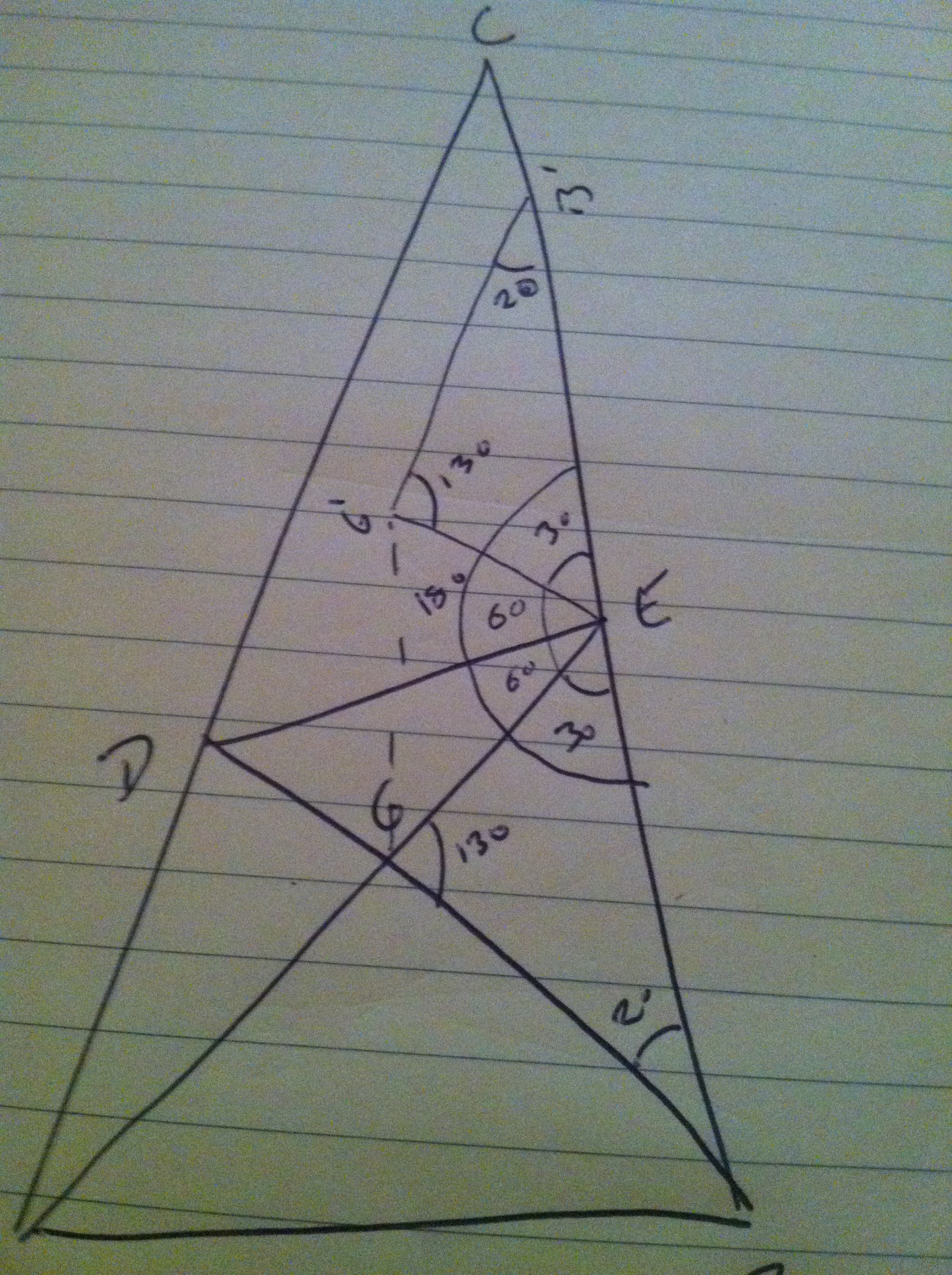 [/img]
twice.
I made it 60, but can't be arsed posting my working out....
The answer's 20.. but I can't get an elegant solution.
Brute force - define the base as length 1.. and then you can get the lines:
AC => y=x tan80
AE => y=x tan 70
BC => y=(1-x) tan 80
BD => y=(1-x) tan 60
Calculate the intersections to give points D and E as:
x y
D: 0.233955556881022 1.32682789633788
E: 0.67364817766693 1.85083315679665
This gives line DE a slope of 50 degrees to horizontal - so the angle between AE and DE is 20 degrees.
I'm sure there must be a simpler way - but I'm too tired!
Can't you stick any number in?
My head says you shouldn't be able to but I've tried with x=10 and x=20 and it seems to add up.
Probably just made a mistake though
As I showed, geometry does not work. However trigonometry does:
Four applications of the Sin rule to find the lengths of the inner l1,l2,l3 and l4 from vertices and midpoints to the crossover, then the Cosine rule to find the distance across the triangle and finally the Sin rule again will get you to (excuse the lack of brackets:
Sinx = (Sin60/Sin50)(Sin10/Sin40)Sin50/Sqrt((Sin10Sin60/Sin40Sin50)^2 + (Sin20Sin50/Sin30Sin70)^2 - 2*(Sin10Sin60/Sin40Sin50)*(Sin20Sin50/Sin30Sin70)Cos50)
EDIT:
Here is the proof:
Denote the midpoint F and assume AB is 1
Then:
Sin rule 1: BF/Sin30 = 1/Sin50
Sin rule 2: BF/Sin130 = EF/Sin20 so EF = (Sin30/Sin50) * (Sin20/Sin130)
Repeat:
Sin rule 3: AF/Sin60 = 1/Sin50
Sin rule 4: DF/Sin10 = AF/Sin40 so DF = (Sin50/Sin50) * (Sin10/Sin40)
Now we have two sides of the inner triangle and the angle 50, so it's cosine rule time
DE^2 = DF^2+EF^2-2*DF*EF*Cos50
that gives us the third side of that triangle so we can use the Sin rule one last time
Sin rule 5: DF/Sin50 = DE/Sinx
Hence Sinx = DE*Sin50/DF
back substitute for DE and DF and you should eventually get the solution above.
Simples?
Markie, you've assumed that line DE is at 90° to CB. Not sure how?
TiRed - Lovely. 😕
and then? 🙂
Blinded by maths here, and I did a few courses on projective geometry and linear algebra at uni. 😳
TiRed, I started off on my own equations earlier, thinking I was getting somewhere, then it all started to look very familiar. Looked back up at yours at the top of the page. then packed it in!
Actually there was a small typo in one line (STW is not the place to type algebra)
Here is the proof:
Denote the midpoint F and assume AB is 1
Then:
Sin rule 1: BF/Sin70 = 1/Sin50 so BF = Sin70/Sin50
Sin rule 2: BF/Sin30 = EF/Sin20 so EF = (Sin70/Sin50) * (Sin20/Sin30)
Repeat:
Sin rule 3: AF/Sin60 = 1/Sin50 so AF = Sin60/Sin50
Sin rule 4: DF/Sin10 = AF/Sin40 so DF = (Sin60/Sin50) * (Sin10/Sin40)
Now we have two sides of the inner triangle and the angle 50, so it's cosine rule time
DE^2 = DF^2+EF^2-2*DF*EF*Cos50
that gives us the third side of that triangle so we can use the Sin rule one last time
Sin rule 5: DE/Sin50 = DF/Sinx
Hence Sinx = DF*Sin50/DE
back substitute for DE and DF and you should eventually get the solution above.
WAIT !!!!
It's all a trap - if you look really carefully at the original image you can see the faint outline of a treadmill at the bottom
😯
This is a "well known" mathematical problem. I think it is called Langley's triangle? You can prove it without triginomety by projecting additional points outside the triangle.
EDIT: Google says the original Langley problem was slightly different angles - but same concept. Here is the solution for that: http://www.gogeometry.com/LangleyProblem.html
That proof doesn't work because the second isosceles triangle does not come about as the angles are different - trig works as follows using excel so I think the answer should be 20 deg.
BF 1.226681597
EF 0.839099631
AF 1.130515875
DF 0.305407289
DF^2 0.093273612
EF^2 0.704088191
DE^2 0.467911114
DE 0.684040287
Sin X 0.342020143
X 19.98060704
But really smart people came up with [url= http://www.cut-the-knot.org/triangle/80-80-20/IndexTo60-70.shtml ]these[/url]
TiRed - your original had typos in two lines and it is simples for someone who said it couldn't be solved - just kidding I had forgotten the Sine and Cosine rules.
x=35
Angles at plane E are therefore:
115 + 35 + 30 = 180
The other angle within the triangle x is in is 95
Angles at plane D are therefore:
45 + 95 + 40 = 180
The triangle CDE has the angles
C=20 which we already knew
D=45
E=115
Which add up to 180
mefty's link to classic 80-80-20 triangle problems and variations gave me a little more satisfaction.
I managed to work one of them through to get the x=20 answer, but it was very tricky.
I used this method to find the classical framework (where the bottom angles are 50 and 60):
http://www.cut-the-knot.org/triangle/80-80-20/Classical5.shtml
Then applied this over the top:
http://www.cut-the-knot.org/triangle/80-80-20/60-70Sol1.shtml
It all felt like a leap away from where I was trying on my own though.
Nasty.