UPDATE: Reviews section refreshed, redesigned, searchable: Go take a look
Interesting read in the Guardian today - especially the physical media -v- streaming revenue split.
I can't help feeling there's just too much choice out there now though - my SM feeds are chock full of bands that all offering the same thing with very little that makes you sit up and take notice.
And for the small artists it seems to be more of a side hustle/hobby now rather than a way of earning a reasonable living. But has that always been the case?
https://www.theguardian.com/music/2026/may/01/chaotic-future-indie-music-labels-sub-pop-rough-trade
But has that always been the case?
Yes. I know people with long music careers... and they've always had to have one foot in another job. But on top of the music industry nonsense, arguably it's harder to live on a low income these days, so being "music only" is even less of an option. There's a reason successful artists often have rich parents.
Oh... buy physical... and where possible buy it direct from the artist or their label.
And it's bandcampfriday today... only buy via Bandcamp on these days where they don't take their cut.
Someone scraped all the music from Spotify and made graphs from the data https://annas-archive.li/blog/backing-up-spotify.html. This one explains a lot:
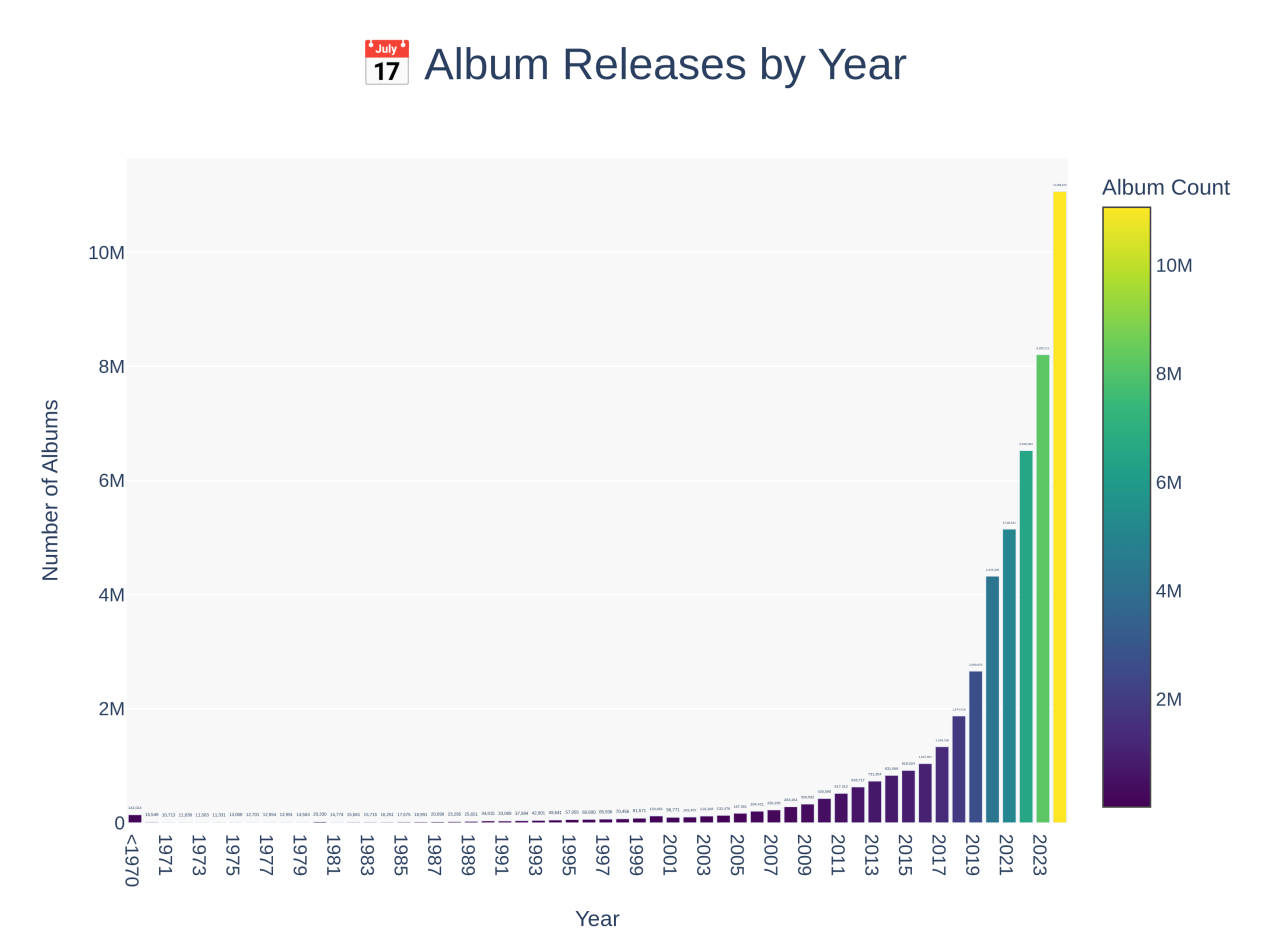
being a musician is tough and always has been - its worse now its all digital and that streaming is the main form of consumption. its widely accepted that if the indusrty hadnt ridiculed metallica (when they sued napster) the industry (and streaming revnue) would probably be in a much much better place.
For digital items, Bandcamp's fee is 15% so its not completely bonkers outside of teh friday events.
Oh... buy physical... and where possible buy it direct from the artist or their label.
It's more difficult than it used to be - I always buy CDs, but the last few albums I bought took some tracking down, I suspect because labels are doing much smaller runs of physical media these days because of the dominance of streaming. I didn't even think of Bandcamp - will try to remember in future - but the usual places didn't have Still Hungry (DJ Format & Abdominal), Black Pumas' album toko a bit more searching than usual etc.
Choice isn't a problem, choice is good.
The problem is the modern mindset that music is a guaranteed shortcut to fame and fortune.
The graph is insane, how much of that is AI do we think? I'm guessing the vast vast majority of it?
This is the bit that rings true
there is a gutting of mid‑tier artists – the kind that can have a good, steady career that pays the bills, but is not at superstar level. Now, it’s either really working or you’re just accruing debt – there’s not a lot in between
The graph is insane, how much of that is AI do we think? I'm guessing the vast vast majority of it?
And it's driven largely by the economics - and processes - of Spotify. Per stream income is so small that it's a numbers game for the labels: just pump out as much "content" as possible, safe in the knowledge that cumulatively they'll rake in enough for your private equity owners to make their cut.
And Spotify itself has long been using session musicians on a flat rate (ie no royalties) and latterly "AI" to produce huge amounts of filler for their playlists. Spotify makes the tracks, doesn't pay anyone for them, AND they take up listening time for which Spotify would otherwise have to pay actual money to labels making actual music
The graph is insane, how much of that is AI do we think? I'm guessing the vast vast majority of it?
there'll no doubt be a bit of that in the very last bar. But theres also far less gate-keeping. Back in the day it was such a major investment, not in music making but in mastering, pressing, printing, distribution, warehousing, local and national advertising and so on that the bar to making a song publicly available let alone a whole album was very high - all costs that needed to be met upfront before one song is sold. In a streaming era the returns are very low but the bar to even be in the marketplace is also very low. And that market place is doing all of the above - the streaming platform is hosting, promoting and distributing so that you don't have to.
Its certainly the case that streamers should be better remunerating artists but a step towards that could be creating a better bar to entry - have less dross sitting there taking up resource and absorbing income as its destributed gazillions of tracks that have hardly been listened to (and take actions to prevents bot-farms streaming bot-made tracks and hijacking revenue that should be going to artists)
You are either making a $200 million dollar blockbuster or indie flicks., the mid tier has disappeared thanks to everything consolidating around streaming platforms and big studios, largely because there is no sales of physical media anymore.
but the usual places didn't have Still Hungry (DJ Format & Abdominal), Black Pumas' album toko a bit more searching than usual etc.
remember that - actually having to find stuff. I've got records that took me years to find. Barry Adamson - there was one particular Barry Adamson track I wanted- but every record shop in Liverpool, Manchester, Birmingham and Leicester- my stomping ground at the time always had a 'Barry Adamson' divider and nothing ever, ever in it. After 4 years the copy I found was white label with the track listing in biro on the wrong sides of the disk 🙂
Then when you found it..... not even being able to listen to it until you got home. Reading the lyrics on the gatefold of Pauls Boutique printed on a pure magenta background so when you got to your stop and looked up there are was a big green rectangle superimposed over everything
Remember not even be able to remember a new bands name and flicking through the racks hoping to have a revelation. I was once looking for New Kingdom's first album but couldn't remember their name but instinctively looking under 'K' again and again while my brother was looking for a early Bristol /Triphop era album muttering 'it was something like Horses Head'
Remember that? Things? Remember? Waiting for things?
Isn't it interesting that song prices are all the same. A stream, or a physical single by an artist costs the same whether the song was recorded on a Ukelele next the campfire onto tape recorder or some epic recording of a 1000 massed choirs and orchestras. They all have the same price. Same price whether they are one of the greatest songs ever written or some utterly misguided dud
You wouldn't price pottery in the same way, or cuts of meat, or cars
With digital media, the barriers to releasing an album are much lower. So there's a lot of artists releasing albums that are purely digital, they get paid per stream and there's no commitment to production runs of physical media and distribution. Sunk costs are therefore relatively low, I reckon pretty much anyone could release an album nowadays.
Rightly or wrongly, the industry used to act as a filter. Now there's no filter it's even harder to make it in the music industry.
Napster et al shook everything up and the industry dropped the ball, they didn't see Spotify/Deezer/Apple coming as they provided the streaming services that the labels didn't. That shifted the power to them, the industry - whether that's artists or labels - no longer have the power they once had, it's the streaming platforms that can make or break an artist.
Me. I'm a vinyl kinda guy and I try and buy from indie stores or artists directly. It's much easier to remember the artists I like when there's an album in front of me too.
But has that always been the case?
Pretty much, but there were better opportunities to get into impossible debt in the past.
Napster et al shook everything up and the industry dropped the ball, they didn't see Spotify/Deezer/Apple coming as they provided the streaming services that the labels didn't. That shifted the power to them, the industry - whether that's artists or labels - no longer have the power they once had, it's the streaming platforms that can make or break an artist.
It's not the first time thats happened - the music publishing industry seems to have repeatly been its own worst enemy. They resisted the recording and sale of music because their business model was for sheet music - used be the only way to hear a new song was to buy the score and play / sing it yourself. The publishers resisted recording sales for fear people could hear and remember musics rather than buy it.
Then they were resistant to radio play, then they were resistant to recorded music being played on the radio. The needle time agreement lasted in the the late 80s and limited the amount of recorded music a radio station could play each hour - at the start of the agreement radio stations could only play 5 hours of pre-recorded music in every 24. But 'needle time' is why radio stations had so many phone-in and games, quizzes and DLT making strange guttural noises all the time becuase they had to pad out the time between records
The problem with digital sales wasn't Napster - it was the device manufacturers. Devices that could hold a play 1000s of songs were on sale but non of the music publishers were selling content to put on them. That was the publishing industries failing as they forced a situation where people could only put bootleg material on the players - when the industry caught up the value of 'a song' had been established as 'free'. And really we can tut at Spotify and the rest for how little the pay artists but they are what the are becuase of the void the publishing industry created for them to grow into.
Being on the receiving end of that - as someone who works in the production of film and tv - the streaming industry has taken a very deep breath before committing to projects going forward. I've been bumbling along fine becuase I've had got fingers in lots of pies - but theres a lot of people in that 'High End TV' fields that have been on the skids for 6-7 months and a lot of production has stalled and the streamers dither.
I've also got a mate that works in film and tv (he's a DP) and he's said similar, Game of Thrones kept half of the UK film industry going and similar premium TV like Rings of Power and Andor helped too. But its completely unsustainable. Apparently Disney spent over $600 million on just 2 seasons of Andor, that's just mental. No one is going to commission stuff with those budgets anymore.
Apparently Disney spent over $600 million on just 2 seasons of Andor, that's just mental.
indeed and yet Disney makes more of its profit just from selling churros than from all of its film and TV activities combined.
but the usual places didn't have Still Hungry (DJ Format & Abdominal)
Oooh I'll have to hunt that down.
And Sony makes more money from selling digital cameras and digital image sensors than film, tv and music combined.
Anyway that all a bit OT, here a really good you tube video on another casualty of streaming, the (not so) humble music video
And Sony makes more money from selling digital cameras and digital image sensors than film, tv and music combined.
they make the alot of the camera sensors that go in everything else too
that may change in short order - the mega dollar blockbusters are part of an arms race between the streaming platforms but.... thats not necessarily what the audiences are watching. There was a period last year where between two mega-budget leviathans in Netflix's top 3 most streamed was an old ITV drama 'Cleaning Up' that Netflix had paid £40k for - more viewers than 3 Body Problem that cost $20m per episode. And a lot of the young folk now are watching old fashion terrestrial TV repeats on Netflix rather than the frankly tiring over-long, over loud big budget stuff. Won't take them long to realise that a lot of what they are watching on their subscription is actually available to them free on UK catchup services. Being on the receiving end of that - as someone who works in the production of film and tv - the streaming industry has taken a very deep breath before committing to projects going forward. I've been bumbling along fine becuase I've had got fingers in lots of pies - but theres a lot of people in that 'High End TV' fields that have been on the skids for 6-7 months and a lot of production has stalled and the streamers dither.
The recent Star Trek academy wasn’t doing well,at $10-20m per episode
As part of their bid to get people interested, Paramount released the first episode of its new Star Trek series, Starfleet Academy, for free on YouTube. At nearly the same time, as counter-programming, the YouTube channel Red Letter Media released a video discussing what many consider Star Trek’s greatest effort, Deep Space Nine.
Both have now been online for more than twenty-four hours, and the results are shocking. Paramount’s new series only has 82,000 views. Red Letter Media’s Star Trek: Deep Space Nine discussion has 380,000 views. There are far more people interested in revisiting the franchise’s golden age than there are viewers willing to sit through an hour of their latest effort.
Being on the receiving end of that - as someone who works in the production of film and tv - the streaming industry has taken a very deep breath before committing to projects going forward. I've been bumbling along fine becuase I've had got fingers in lots of pies - but theres a lot of people in that 'High End TV' fields that have been on the skids for 6-7 months and a lot of production has stalled and the streamers dither.
I've also got a mate that works in film and tv (he's a DP) and he's said similar, Game of Thrones kept half of the UK film industry going and similar premium TV like Rings of Power and Andor helped too. But its completely unsustainable. Apparently Disney spent over $600 million on just 2 seasons of Andor, that's just mental. No one is going to commission stuff with those budgets anymore.
I think that the AI stuff will absolutely hammer film and TV, perhaps not next week but it’s too seductive to not use.
The graph is insane, how much of that is AI do we think? I'm guessing the vast vast majority of it?
And it's driven largely by the economics - and processes - of Spotify. Per stream income is so small that it's a numbers game for the labels: just pump out as much "content" as possible, safe in the knowledge that cumulatively they'll rake in enough for your private equity owners to make their cut.
And Spotify itself has long been using session musicians on a flat rate (ie no royalties) and latterly "AI" to produce huge amounts of filler for their playlists. Spotify makes the tracks, doesn't pay anyone for them, AND they take up listening time for which Spotify would otherwise have to pay actual money to labels making actual music
All filler no killer 🙂
I think we’re going to have to burn the data centres down,these American companies have literally destroyed everything they touch. 🙂
but the usual places didn't have Still Hungry (DJ Format & Abdominal)
Oooh I'll have to hunt that down.
Think I got it from musicmagpie in the end, but turns out they have it on Bandcamp too, £10?
Currently only buying product(cds n t shirts)from gigs, most of which are less then 200 punters. Seeing a lot of gigs by people who are now retired, however they've been playing for 40 years. Original music does seem to be folk who are passionate about their own music(a fair few have tribute or covers bands to subsidise their own music). Some of the music may not be to my tastes but at least I haven't heard it before.
I don't pay Spotify. I've had an account since the beginning, and they were always offering me free trials - usually either one or three months. In December they offered me four months, so I took it. Time was up this week. So I cancelled, and when the 'Tell us why' screen popped up I took some small comfort from ticking 'Other' and writing 'Because you are bloodsucking parasites bleeding the industry dry'. Don't suppose anyone will read it.
@ onewheelgood I agree with you Spotify and others are making life difficult for artists, particularly new artists. They pay a pittance. However unless you're paying some other way by buying downloads or cds or concert tickets you are accessing some artists work but paying them nothing.
Spotify will give the artists their pittance whether I pay for a sub or put up with the ads. But I go to gigs, and own 400+ vinyl lps, getting on for 1000 CDs, and I've bought some digital downloads from artists websites or Bandcamp. So yes, I'm supporting artists I like.
- @onewheekgood That's all good then I have a pal who does go to local bands gigs but also plays music on YouTube (not YouTube Music) which obviously is free he doesn't buy any music and tells me that it's bloody awful the streaming sites are ripping artists off by paying them a pittance. All this while he's playing music free. He's a good guy but has a blind spot where listening to music is concerned
A producer I follow released a track recently. I bought the digital file, but actually wanted and would've paid more for a physical copy. However I understand that to him its both expensive and risky to create a cd or vinyl. What if not enough people order a copy?
So the digital copy sits in my phone, probably forgotten until I stumble across it. Maybe I could burn a cd (hello) and print off some artwork, but hmm, seems like a bother.
Anyway,. not sure what my point is, other than that I like physical media.
The graph is insane, how much of that is AI do we think? I'm guessing the vast vast majority of it?
Im not completely convinced Ai is a bad thing in the creative industries, if it is used as a tool to eventually come up with an end product.
Take graphic artists creating wonderful things using computers as a pencil/brush. Certainly at one point you needed serious drawing skills, but not so now.
Shop around and you can get a fully printed CD in a card sleeve for less than £4 in runs as low as 10.
I have better music production on my phone than in the first studio I used 25 years ago.
Using someone like DistroKid I can get my music on all the major streaming platforms.
A local guy just got invited to do the score of a major film because the director heard it on tiktok.
Tell me again why we need record labels.
being a musician is tough and always has been - its worse now its all digital and that streaming is the main form of consumption
Is it though? Before streaming and social media, how likely was it that even the best band in the world would have been spotted in some shithole pub on a tuesday evening, playing an unpopular genre infront of someone witha budget prepared to acquisition new talent and promote them to gigs/recordings (despite the music not being on trend)?
Hmmmm well looking at that graph you can hardly see the number of albums released in the 80 and 90s whereas now over 10m, I’d say getting your wares in front of someone is going to be pretty hard now due to you being 1 of millions of wannabes.
But thepodge is right there’s still talent coming thru without the labels.
I thought that songwriters now get a bigger share of the pie (50%).
I still prefer to purchase cd’s, as through a high-def mp3 player with wired headphones, they sound astounding.
ive yet to try Apple Lossless via subscription.
Surely beginning of the end for cd sales was distribution of unlicensed mp3. Yes the big steamers exploited the gap that created. But the young people of the early 00s said firmly that were happy with 128kb/s mp3 for free and paying nothing to the artisr

