If you’ve got hydrogen around the battery on the dead vehicle then you probably don’t need to jump start it! (Assuming the battery is not goosed, and you’ve not been trying to use a charger on it!). Explosions are real, although less common with modern maintenance free “sealed” batteries.
Don't forget to have the jumper idling BEFORE you start connecting things....or you may find you've 2 flat batteries and no running car.
If a car battery is really flat it's best to connect the jumper and leave it a minute or 2 (jumper just revving slightly) to attempt to get a bit of juice into the flat battery. Particularly helpful if your jumper leads aren't very thick.
Also make sure the cars aren't touching. That doesn't need saying though really...I mean we don't go around scuffing into cars carelessly too often.
Connecting the jump lead to the earth on the engine, if that's accessible, it's not only safe but it cuts another bit of copper out the circuit and potentially gets the voltage up further as a result. Sometimes every bit helps.
As for why to rev the jumper, I have had the jumper drop revs and nearly stalled as the last connection was made. The sudden demand from the alternator, and jumper being a small car. Diving in the open door and giving a few revs saved it.
Also make sure the cars aren't touching.
Why would that matter? They have a common earth via the cable and plastic/paint are insulators. (Genuine question, have I missed something?)
Depends, the battery on a 3 litre straight 6 diesel should start pretty much anything instantly. The battery on a 1 litre 3 cylinder petrol might not even start a big motorbike... Needs to be running. A bit faster. Also means you can catch things if the voltage dips too far when you start the other car.That battery can supply enough current on its own (otherwise the good car wouldn't be able to start either), which is why I said that you shouldn't really need the good car to be running at all.
For maximum shits and giggles one of my previous employers had a requirement that you should be able to jump any diesel engine in our range using a 24v truck battery safely. Due to the number of outfits sending out truck mechanics if a diesel car called for recovery (in the 70s). No idea if it was true, but we all used to go outside to watch them testing, slamming the starter pinion into the ring gear with almost twice the speed it needed, and the (factory standard) jump cables going all shiny as they started to overheat. Thankfully deleted when we did a major overhaul in the early 00's.
Why would that matter?
Because if one car is positive earth and the other negative earth and the car bodies touch and make contact you'll short both batteries. Not really a problem as the positive earth cars have long since gone to the scrap yard.
Get one of those portable battery booster things, possibly not the cheapest on temu 🙂
I don’t really like jump starting peoples cars with jumper leads as modern cars can be grumpy.
Oh, and really give it some beans on the good car
This is a good idea, preferably for several minutes, and if the donor car is a diesel, that’s even better. Diesel batteries, IIRC, have more juice in them because a diesel takes more energy to get the engine to start, compression ignition ‘n’ all that.
modern cars can be grumpy
It isn't modern – it's 15 years old (and diesel). 😀
Oh, and really give it some beans on the good car
Yeah, we did that – I had to ask the guy to start is car and rev it a bit as he had no idea.
Jumping, I've frequently had both cables hooked up on the dead car, waiting on the good car to move and pop a bonnet.
I'll pay more attention next time.
I used to have to start an old Mercedes md trac800 by crossing the poles on the starter with an old cheap spanner, that made some good sparks and got some welding action on the go.
Re. Starting the car with the good battery: if you don't you're trying to use your good battery to both start the other car and recharge its battery at the same time (it's flat, right?)
So yeah do it
Oh, and really give it some beans on the good car
How does that work on my EV then? 😂
Just use a power pack
Just use a power pack
It would be incredibly wasteful to buy a power pack (that may never be used again) when I have a set of jump leads in the car.
As I understand it, the alternator supplies the current to the battery and it does it based on load, so if more current is needed (like because of the draw from the bad car's starter motor), the alternator will supply it, and even a ticking over engine would be able to supply the amount of charge needed, right?
What am I missing?
The alternators output is on a curve, so yes in principal it's always outputting a constant voltage and the current will therefore be voltage / impedance, in reality the voltage / current is going to find a optimum based on the car batteries voltage and impedance at any given time.
The main reason is you still just don't want potentially two flat batteries, but the extra ~60A you get from the alternator won't do any harm either.
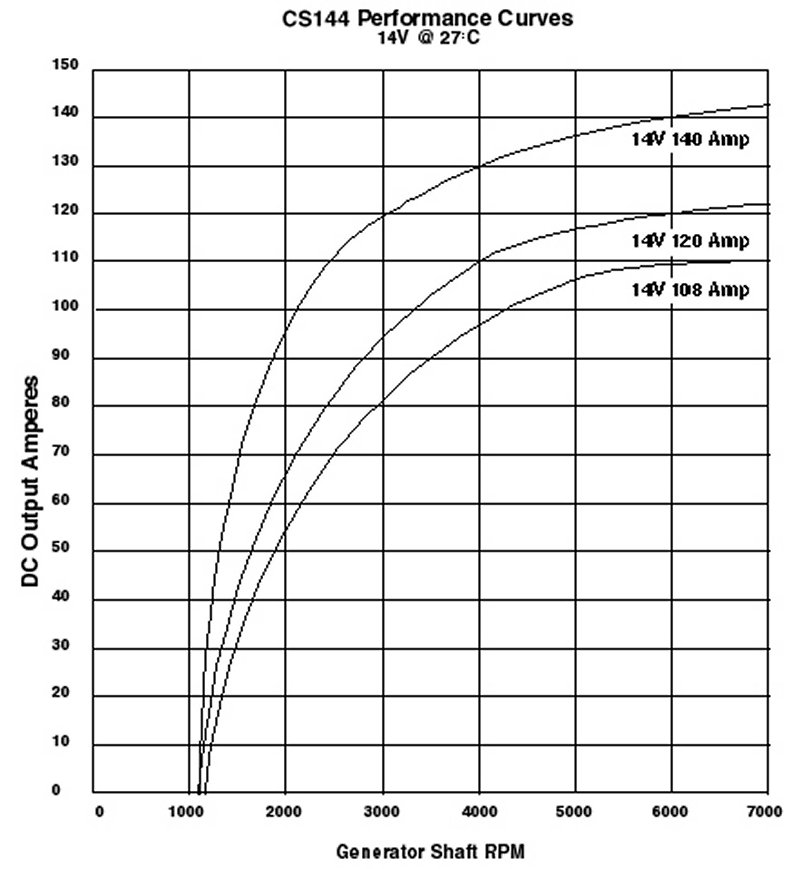
n.b. the generic graph below is probably for a truck or something, most cars have 60A alternators. And the alternator pulley is probably half the diameter of the crank, it'll hit peak output and start to flatten off somewhere around 3000rpm on the engine (i.e. the system is designed not to overload the regulator/rectifier section of the alternator when normal cruising down the motorway rpm's)
It would be incredibly wasteful to buy jump leads (that may never be used again) when I have a power pack in the car.
You can bump start older automatics ( I bet it wouldn't work on anything computer controlled) . You either need a very big hill of a vehicle to pull them because you need to get them to the speed where the torque converter locks up (about 35 mph on my mates old Mazda).You can’t bump start an automatic.
You also can’t bump start a diesel which we found out the hard way by trying to push start a rented minibus round a car park and writing off the engine in the process.
Having recently had to jump start a neighbour’s car there was something in the manual about putting the heated rear screen on to absorb any voltage spikes?
You can definitely also bump start Diesels. My mate has a farm with various 4x4s, Trucks ect scattered about and a collection of really crappy batteries. We have to bump start something most weekends.
It would be incredibly wasteful to buy jump leads (that may never be used again) when I have a power pack in the car.
It would be, yes. Obviously.
You can bump start older automatics ( I bet it wouldn't work on anything computer controlled) .
It depends on the design of the transmission. Autos need a hydraulic pump to be turning in order to engage gears. Some autos have one pump that runs off the input shaft (driven by the engine). If the engine isn't running, you can't engage any gears so you can't bump start them. Other designs also have a pump running off the output shaft. If the wheels are turning, you can engage gears and bump start the car. If your car has an auto transmission, best to assume that you cannot bump start it.
Edit: Here's an AI list of autos that could be bump started. Minis are the major exception.
| Transmission | Years bump‑startable | Reason | Source |
|---|---|---|---|
| GM Hydramatic | ≤1958 | Rear pump | |
| Chevrolet Powerglide | ≤1966 | Rear pump | |
| Fordomatic / Cruise‑O‑Matic | ≤1963 | Rear pump | |
| Ford automatics | ≤early 1968 | Rear pump | |
| Chrysler Torqueflite | ≤1965 | Rear pump | |
| Classic Mini Automatic / Austin America | 1960s–1970s | Unique dual‑pump design |
While this is true in theory there is normally enough residual ATF in the torque converter and valve blocks that if spun fast enough will cause enough drag to get the engine turning. As I said in my post I have actually seen this on my friends old (mid 90s) Mazda. We were bored one day and one of us had heard that you could bump start an auto if you went fast enough so we gave it a go and voila!You can bump start older automatics ( I bet it wouldn't work on anything computer controlled) .
It depends on the design of the transmission. Autos need a hydraulic pump to be turning in order to engage gears. Some autos have one pump that runs off the input shaft (driven by the engine). If the engine isn't running, you can't engage any gears so you can't bump start them. Other designs also have a pump running off the output shaft. If the wheels are turning, you can engage gears and bump start the car. If your car has an auto transmission, best to assume that you cannot bump start it.
Edit: Here's an AI list of autos that could be bump started. Minis are the major exception.
Transmission Years bump‑startable Reason Source GM Hydramatic ≤1958 Rear pump Chevrolet Powerglide ≤1966 Rear pump Fordomatic / Cruise‑O‑Matic ≤1963 Rear pump Ford automatics ≤early 1968 Rear pump Chrysler Torqueflite ≤1965 Rear pump Classic Mini Automatic / Austin America 1960s–1970s Unique dual‑pump design

