
MegaSack DRAW - This year's winner is user - rgwb
We will be in touch
Has anyone on here got one of these things? I think you have them as standard in zero energy houses, they basically blow the warm air out of your house and use a heat exchanger to warm the fresh air it blows back into and around your house.
Any experiences?
They will only work with properly air-tight house, built to accomodate them. Waste of money installing and running if on any 'normal' house.
On a properly low-energy, airtight house they are ace, and noticeable how nice the air is.
Go over to the AECB / Greenbuilding forums for lots of 'how it is' advice and uber tech stuff.
What matt really means is that they work at their optimum in an airtight house 😉
I have one here in the barn: It's far from airtight.
Originally I specc'd it to allow me to omit fitting ugly vents to all my new hardwood window and door frames. Then increasingly it made more sense in that the energy recovery would be greater than the fan energy cost and it would also maintain a healthy air flow in excess of that provided by standard trickle vents.
Implementing in a new build is easiest, in a conversion is harder, in a retro fit is hardest of all.
I put all my ducting in the loft, but also ran a single internal flue at the far end of the barn to try an initiate a full circulation through the building. It's not ideal, but it's seems to be working very well. The air always feels "fresh", we get no evidence of condensation build up in the kitchen or bathrooms, and it certainly helps clean cooking smells from the house in short order.
[img]  [/img]
[img] 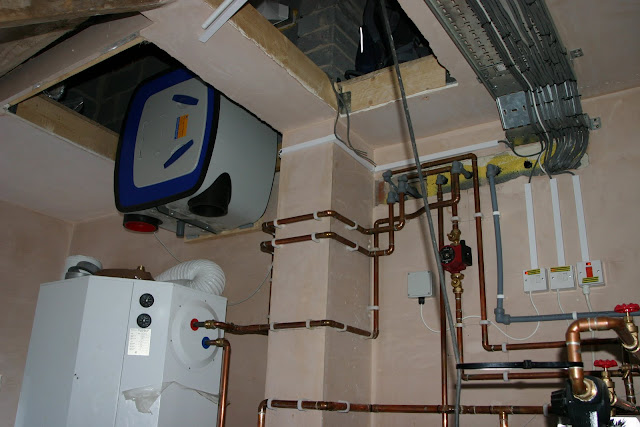 [/img]
The guys here were very helpful http://www.cvcdirect.co.uk/Whole%20House%20Ventilation/wholehouseventil.html
and I got my ITHO came from them
http://www.cvcdirect.co.uk/Whole%20House%20Ventilation/cvcdirect-acompe.html
What matt really means is that they work at their optimum in an airtight house
^This. But even your barn that 'isn't really airtight', probably is compared to OP's building who is clearly at the basics... 😉
I dont know about that.
When I fart, the letter flap rattles 😉
What's the proper name for these things in English? "Heat recovery ventilation" on that site but I've never seen that on STW threads. It's VMC-double-flux in French (VMC = ventilation mécanique contrôlée).
Proper name is MVHR Mechanical Ventilation & Heat Recovery
Thanks.
Danish house so it is fairly airtight. New windows and doors all round and a bungalow so it would be easier to fit than a 2 storey house.
Maybe I am being stupid but what are the window vents for?
I dont know about that.
When I fart, the letter flap rattles
*doff's cap to champion farter*
Window vents were used to let air in with old-fashioned single flow extractor systems. With an MVHR you don't need them.
Building reg Part F requires sufficient ventilation to allow a minimum number of air changes per hour etc. But Ive forgotten nearly all of it so you'll have to research yourself.
TBH I think it only applies to new build. Not sure if its a notifiable thing for refurb or works.
Some waffle here:
http://www.vent-axia.com/legislation/building-regulations
Approved doc here:
There's a simpler version that's just a flash extractor fan, vent-axia? Speced 'em but no onger in that game, can't remember how they worked out.
APF
There are standalone heat exchange extractor fans, but they dont provide background ventilation, only extraction. Whole house systems run all the time to maintain air changes.
This is mine having plugged it all in.
[img] 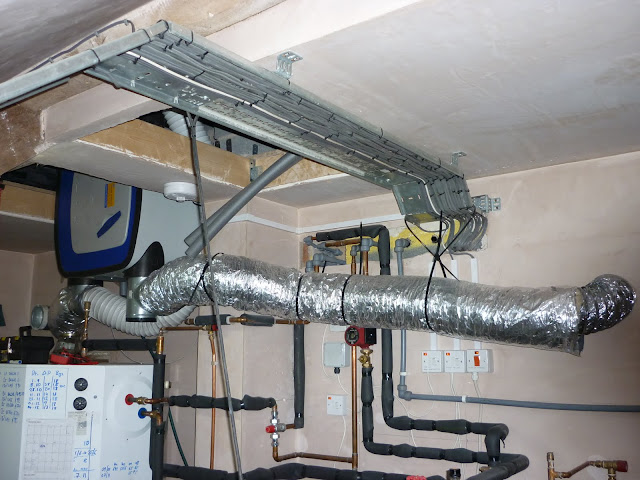 [/img]
There's an insulated extraction from the kitchen (foil running right), and another extractino from upstairs bathrooms that comes into the top of th ebox which you cant see. Then there's two supplys, one goes up to the bedrooms, and the other goes left back into the kitchen.
It's not ideal having the inlet (top right below) and extract (top left) so close but it does creat a circulation across the "warmest and dirtiest" air of the house. The hood is simply a grease and carbon filter with vent holes at the top left of the vent duct so that the partially cleaned air is taken out of the room by the MVHR. There's another inlet at the end of the house which helps with the circulation of general air.
[img]  [/img]
I used to sell them, there are a lot of myths surrounding what they can and can't do and what they should be used for.
The main issue with them is pressure drop through the ductwork. Generally they are small units, sized to fit above a domestic boiler, but some can be loft installed. The downside to this is the fans are generally low power due to their size.
Next issue is ductwork through a house, to fit in wall spaces and ceiling spaces it has to be very narrow and a lot of bends, this adds resistance and causes pressure drop. Next add your pressure drops across filters, heating elements, Heat exchangers and outlets and the air flow of many of these units drop to zero.
I've been in some properties when they have been installed well, but generally the house has to be built to accommodate them, or, as above, be in a building like a barn where running ductwork is not an issue.
The best houses i've seen them retrofitted to is bungalows where all the ductwork can be run in the roof space.
They can make a massive difference to heating bills and a well ventilated property is a lovely thing to have. However I can't stress how much these need to be designed properly.
If anybody needs any more info please pm me.
Next issue is ductwork through a house, to fit in wall spaces and ceiling spaces it has to be very narrow and a lot of bends, this adds resistance and causes pressure drop.
I'm probably wrong here, but wouldn't bigger and wider ducting have a greater effect on reducing pressure in a no thumb over the end of a hosepipe kind of way?
What kieran means is that retro fitting it means it has to be small bore to be accommodated in existing structures. New builds are great for being able to install full sized straight ductwork. Narrowness and bends create pressure drop at the intake valves, reducing the efficiency of the system.
EDIT, sorry, I get what you mean. No, bigger cross section without interference from bends, joints etc maintains flow rate.
No, bigger cross section without interference from bends, joints etc maintains flow rate.
The curves will have an effect but the duct size would, iirc, have the opposite effect as in narrow duct giving greater pressures, a bigger duct will just dump the air, given that the fans are the same. I used to have some tables for this a long, long time ago.
I think the purpose of the MVHR is volume movement, not pressure. You need sufficient pressure differential to get the air moving, but really you're after volume movement. I imagine there's an optimum relationship.
If you are thinking of running thro floor zones, beware of duct sizing & drilling/notching of floor joists.
New build is relatively easy if you use metal web joists. Retro into existing sw joists is more challenging with narrower depth joists.
You can also get systems that us the exhaust air from your ventilation to run thro a heat pump which is then used to heat the house. Look at the Nibe fighter as an example.
graham, is this your field?
Commercial & domestic energy assessor & building surveyor for my sins
oooh, v interesting. Self employed or corporate monkey?
self employed on the energy stuff, & employed on the surveying & Technical R&D stuff.
Just getting more into linear bridging which is becoming more of an issue.
Id love to catch up for a very boring beer one day with you.
Where's your local?
The curves will have an effect but the duct size would, iirc, have the opposite effect as in narrow duct giving greater pressures, a bigger duct will just dump the air, given that the fans are the same. I used to have some tables for this a long, long time ago.
Narrow / thin pipes have higher drag than fatter pipes - the pressure will be lower in a fat pipe, but the volume air flow will be higher (and a given fan size will move more air).
Local gone downhill, like the Farmers Arms Birtsmorton, have been know to stop by the Malvern Hills for a black pear or two.
Farmers arms is only round the corner from me.
And John at the MH hotel keeps an HPA cold for me 😉
And which is your local that's gone downhill then?
Stoner - like to see your place too someday, but sadly too far away!
Bear - if you're in the neighbourhood, you're welcome to drop in. Kettle will be on.
I reckon I know how Stoner's house better than my neighbours'.
Ed - Where are you in SW France? Heading there later in the year, I could nose around yours 😉
I was wondering if this could help our house. We've got a three storey new build house, and the upstairs is always way way hotter than the downstairs, which is often cold. My (not quite serious) idea was to get a fan and run an insulated duct down the outside of the building to suck the hot air from the upstairs and pipe it downstairs. Now I'm wondering if something like this could help. Not sure how though.
bridging floors internally is a pain.
running externally is going to be ugly.
EDIT Hey , Edukator, PM me.
Vent-Axia do small through the wall units - such as http://www.vent-axia.com/range/hr30w.html - which work well in retro fit of 'normal' houses. Used them to provide mechanical ventilation to internal rooms and in was and utility rooms.
running externally is going to be ugly.
Yeah, it'd really mess up the beautiful lines and soaring architectural splendour of my Wimpey semi-detached home.
Stoner - will do where abouts are you?
Im at the foot of the Malverns.
EDIT: but how did you know Id be too far away? 😉
YGM to the address in your profile, Stoner.
Edit: which I've got a reply to, thank you.
Stoner, we have had a similar conversation before or you have with someone else.
Might be down your way sometime soon actually as will probably be doing my wood pellet boiler training in Chippenham. That's not too far I think?
Not too far away but not close. About an hour and a half away. Who's doing your training?
Windhager.
molgrips - Member
I was wondering if this could help our house. We've got a three storey new build house, and the upstairs is always way way hotter than the downstairs, which is often cold.
One solution could be to move your thermostat downstairs, so the boiler will stay on until the downstairs is warm. Use the TRVs on your upstairs radiators to keep those rooms from getting too hot (setting "3" is usually about 20 degrees).
Windhager
arent we posh 😉
Well we do try. Just fitted one of their 35kW units, and pricing for another 45kW unit to serve 3 properties.
Possibly got the opportunity to quote for another system with one of theirs in it too!
Very nice bits of kit and one of the top 3 probably in pellet boilers I would think.
bloody ought to be at that price 🙂
Dobbo in here I think has one.
What size thermal store are you sizing with the 35kW and 45kW?
One solution could be to move your thermostat downstairs
It already is. There's just nothing to stop the heat pouring straight up the stairwell to the upstairs landing.
no thermal store with the 35kw one, there will be with the 45kw one because of the different load requirements.
Don't like thermal stores or buffers as they reduce efficiency but are necessary sometimes.
rather depends on the cycling efficiency of the boiler itself and the ability to maintain it's own tank of water.
I like thermal stores because they work well with solar coils. My neighbour though has an okofen and has his solar in a preheat tank instead with now thermal store. Too many pumps and sensors needed for my liking [luddite]
😉