
MegaSack DRAW - This year's winner is user - rgwb
We will be in touch
anyone know roughly what the total costs of installing a ground source heat pump system are? 10k, 20k?
It would be horizontal coils not a borehole, and 3 bed detached bungalow.
thanks
lots! probably the higher of your two prices, and maybe more
Not the same but we were quoted £6K for air sourced so this plus cost of pipes as a very rough guess.
Lakes - where are you?
Have a look at gogeothermal.co.uk
Guy called Tim Williams who knows his stuff and very helpful.
Ive seen figures of c. £1k per kW.
Depends on lots of things, but you need to think about type of heating (underfloor is best), level of insulation in the house, floor area, how many folk living in it (water requirements).
Without doing a proper survey, 10-15k would be my finger in the air.
If your in Scotland and want a formal quote, drop me a line, email addy in my profile.
EDIT: Unless you are able to do the groundworks yourself or the work is being done as part of a new build, our latest advice is that Airsource is a more economical alternative (based on Nibe and Danfoss pumps). The extra outlay of the ground collector offset against efficiency, will take over 10 years to recoup.
EDIT 2: You might want to hold off until the RHI payments have been confirmed too.
Have you really investigated it?
I know it's total hearsay, but the two I know of though personal friends, one has it completely removed and the other is regretting it & considering changing to a normal heating system at extensive cost (on a brand new build)
Hmmm.
Was just wondering about options for a house i'm thinking of buying. Its on oil at the moment (no mains gas anywhere near) and i knew there are grants / RHI payments available, but just wondered what total installed costs could be.
Anyone know if LPG is much cheaper than oil?
Anyone know if LPG is much cheaper than oil?
About the same - both expensive.
Halfway house options include getting a multifuel stove and plumbing that into a thermal heat store. You then have the choice / convenience of oil, but can also use the stove when you are feeling energetic.
Or of course there is the pellet / biomass option.
No doubt lots of ppl are very happy with it, I'd just advise investigating it throughly, considering the two cases I've heard of.
Should be seeing the 2nd person soon, so will ask him his current thoughts.
Talk to people who run the systems & not just companies trying to sell you it.
lakes - read some of the stuff Ive posted in here.
http://www.singletrackworld.com/forum/topic/and-the-heating-oil-cartel-swings-into-action-once-again
will pop back in and answer any question you have in a bit.
Talk to people who run the systems & not just companies trying to sell you it.
+1
Have you compared this with chp as a viable alternative? The boiler is the most costly and the more you spend up-front, the more efficient this will be.
Wood chip pellets are relatively cheap (at the moment, there are a lot of wood chip pellet power stations being built that will increase the cost of the fuel, trust me) and will provide electricity as a primary energy and the exhaust will provide usable heat for heating.
As long as the forestry sector responds to the increase in demand, there should be no major hike in cost.
I know it's total hearsay, but the two I know of though personal friends, one has it completely removed and the other is regretting it & considering changing to a normal heating system at extensive cost (on a brand new build)
Yup my brother had it installed at great expense and their heating bills are currently astronomical.
Yup my brother had it installed at great expense and their heating bills are currently astronomical.
I hope he's had the installers back to it. Setting them up to run efficiently requires experience. There are plenty of new firms setting up who don't have the experience to do the job properly.
Whereabouts are you Lakerider?
I only ask because I used to work in the green energy/eco field and might be able to introduce you to someone who can advise better.
Don't get hung up on putting in GSH just because the property is on oil. Many installs (e.g. 3 bed) can easily be £10k-20k, depending on bores vs trenches and the amount of additional groundwork/excavation necessary.
Oil isn't that bad at all, unless you're on an absolute budget. Sure, it tends to go up in winter before dropping again, but going for GSH or even ASH may not be necessary. Also depends on rads and boiler(s) etc - if they're crap then you'll probably need to replace them anyway. Plus GSH can ruin gardens, i.e. cool it down and prevent much from growing. Still relatively new in the UK, unlike Scandanavia et al.
What does the oil do? CH and HW? Is there an immersion?
Get the heat loss calls done for the house - if it is more than 50w/msq and you have radiators, then it's going to be a new heating system as well as the ashp/gshp install.
The Ecovision chaps seem fairly credible
£1000 per kw + a bit more for the ground source system. Not for anything else. Underfloor/connecting to existing system etc.
Also not including digging trenches or concrete required.
Existing house - Investigate the high temp air source units from Daikin and marry up with existing oil boiler.
Still not cheap but an awful lot cheaper than GS. The high temp units can heat radiators properly meaning you won't need to change them and if it can't cope or you undersize a bit then the oil boiler can kick in. Look at a buffer vessel for the air source to feed into and the oil boiler comes in when flow/return temps drop too low.
we've got air-sourced.. fantastic value for money but a little noisy
I have done a fair amount of evaluation of these systems for commercial installations. My comments would as follows:
1. Stoner is about right for commercial installations, approximately £1K per 1KW.
2. A horizontal loop is the second cheapest way of collecting heat so that saves money.
3. Evaluationing run cost savings is all about relative coefficient of performance and unit costs of enegy. In a modern commercial building you can achieve cop of 5+, 4+ are common. This means for every 1kwh of electricity you pay for you get 4-5 kwh of heat. A gas system can never have a cop of more than 1. However gas is to a commercial buyer typically a third of the cost of electricity. So if you want 4 units of heat, a gshp will cost you 1 in electricty whereas gas will cost 1.33. (Air source cops are between 2 and 3 and capital cost is less.
4. Add in subsidy which should be forth coming. In the commercial sector, the rhi is moving forward breakevens so it is starting to make sense to switch from mains gas.
5. Average life of heat pumps is 20 years so replacement costs are less, plus you only have to pay for the loop once, the last 100 years.
Have a look at biomass, probalby the cheapest fuel per kW
On commercial systems, Biomass is a lot more expensive than GSHP over a 20 year period.
Mefty - why is that? GSHP groundworks can be very costly, RHI payments for Biomass are very good too.
Ground source here. Had to dig up the garden anyway. I think the it was about 16k for the heat pump and all the underfloor heating for downstairs. Additional costs for groundworks and engineered floor. But the house is just over 3000 sqft so we needed a 8kw NIBE heat pump.
Been in three years and it's been fantastic. Cut our electricity bills by about 70% (but we did have storage heating which was useless and didn't keep us warm) Payback is going to take a while but as we have no gas here, it's a fantastic solution and I love the UFH.
Bear - Big commercial biomass boiler are pretty expensive, the capital cost on big systems can be 2/3 of the cost of a GSHP system, added to the shorter lifespan, higher servicing costs, lower RHI and fuel costs they seem to work out expensive. Having said that the comparison I was looking at involved a small bore field for the max heat output so was cheaper than some.
It's just a fridge in reverse. Bodge one up yourself: http://ecorenovator.org/diy-ground-source-heat-pump/
^ mefty is correct.
Be aware that COP's can vary lots - my boss only gets 2.5... 🙁
Also, if you have mains gas, work out that it has 1/4 the 'carbon weight' per unit of electricity - so unless your COP is more than 4-5, you achieve no saving in carbon emissions.
You achieve a huge saving in carbon if you are changing from oil, CoP is above around 2.5, which if designed properly it will be:
[url= http://www.carbontrust.co.uk/cut-carbon-reduce-costs/calculate/carbon-footprinting/pages/conversion-factors.aspx ]carbon factors[/url]
Oil including boiler efficiency is around 0.3kg/kWh
Assuming a CoP of 3, which is reasonable (4 or 5 as quoted above is not likely), you get around 0.17kg/kWh.
The key is that CoP, try to get it included in the contract, essentially, the bigger the loop the larger the CoP will be, and the installer should be able to provide you with calculations showing the ground temperature and CoP over 50 years. They will need your current heating bills to do this.
I have ignored hot water, as this will kill you CoP, you will need to heat this electrically. GSHP works best when the flow temperature of the heating is low, around 45 is what we generally work to. But this means your current radiators wont get the hopuse up to temperature, you'll need either underfloor heating or much bigger radiators.
also it will pay for itself quite quickly. Air source is yet to be proven as saving carbon I believe, for the same reason, the CoP is low when it's cold outside, ie when you actuually need it
I know Ive hung my hat on biomass and solar thermal ([i]q.v. ad nauseum[/i]), but I never thought of heat pumps as being particularly economically efficient unless they can be driven by a reliable, off grid, renewable electricity source, such as a water mill or combination of PV/wind/water.
Pegging a CoP to electricity costs means your costs are still subject to electricity generation inflation, although admittedly at the reduced at a factor of 1/CoP.
However, electricity inflation is not going to be any lower than RPI over the longer term. On the other hand, I believe biomass fuel supply will for sometime yet exceed demand keeping biomass fuel costs down. Entry to the biomass fuel supply market is not restrictive, the equipment is relatively inexpensive and the raw fuel source is plentiful as much of it is just wasted at the moment.
As captaindanger says above as well, GSHP is not particularly useful for providing domestic hot water. And to state the bleeding obvious it doesnt run in a power cut, although you could use an inverted battery supply but the pump power requirements would make it prohibitive. My biomass system can continue to run the UFH, radiators and DHW with <100W of electrical energy - very doable from a combination of an inexpensive inverter/100Ah battery and intermittent charging with a 2kW generator. A project for spring is to install supply switchover controls to give me this backup for my system.
I do however, think ASHP as direct replacement for electrical heating systems (i.e. storage heaters) is a great idea, if retro fitting wet installations is OK.
Having said all that, Im dying for an invite for Al to go and see his GSHP installation sometime 😉 😉
Im dying for an invite for Al to go and see his GSHP installation
Ah, *that* Al! I had visions of carbon fibre sheeting buried in the ground.
Whenever I've looked at air sourced (not in the same detail as the above) I've concluded it's worth doing only when I need to replace the existing oil fired boiler, but also have concerns about the noise.
Stoner - my evaluations are based on biomass feed costs rising with inflation, electricity outstripping inflation by 2.5% and gas outstripping by 4.5%. The latter two derived from a reasonable source, the former is a finger in the air, mainly because biomass was likely to be a non starter for other reasons.
The CoPs I quoted are independently audited real world numbers but I guess these may be being achieved partly because of the sophistication of the control systems, which are not cost effective for the domestic market. Therefore these may not achievable for domestic installations.
Higher temperature circuits are possible but generally the cop is lower for a higher temperature heat pump.
The thing about hot water is most people overheat the water and add cold water, a change in approach whereby you just use the hot water tap makes it work. A number of friends have GSHP systems and they work very well, but they are 5 bedroom + houses and they have land.
I should add I know little about the thermodynamics involved, I approach this stuff as a financier, not an engineer.
Unless you heat your hot water to a sensible level you run the risk og legionaires disease.
I am not convinced on heat pumps, and only install and recommend them in modern very well insulated properties with underfloor heating, hopefully with a heat recovery system.
And domestically unless you can do the groundworks yourself ground source is prohibitive because of cost.
Heat Pumps, especially Air Source, are fitted to get around building regs as they are an easy solution in most new builds and relatively inexpensive. Mind I don't like the monobloc ones as you end up having to put an additive in the entire heating system which one day will get drained and replaced by just water and then...
If you want to be properly green with your heating it has to be biomass and then the likes of wood chip or log boilers as pellets aren't green as they have to be manufactured plus I'd worry about the supply chain in the UK as the market is so small.
Ditto the remark on Hot Water temp. Must be stored at 55degC or above or risk Legionella. You don't lose much heat from modern cylinders anyway. Theoretically you can run a purge cycle once a week like some solar installations but I wouldn't recommend taking the risk. Daily heated to full temp.
as pellets aren't green as they have to be manufactured
quite true, but the energy required to kiln dry the source material is sourced from waste wood, the embedded non-renewable energy is relatively small. My boiler runs on pellets on one side (when Im lazy) and logs on the other (Ive literally just started a furnace burn before this post).
I'd worry about the supply chain in the UK as the market is so small.
TBH that's the thing Im least worried about. I have at least 4 local suppliers of pellets. I can chose based on quality and price and those that have invested in the hardware are hardly likely to stop manufacturing and as long as there's at least some consumers (and I doubt that number will shrink) they will continue to manufacture pellets.
As for legionnaires, this is where thermal stores are ace, as you derive your hot water indirectly but at mains pressure. It means 4bar+ showers and hot water from the tap you can drink. In fact I have one tap (in the scullery) that comes off the tank, before the thermostatic mixer, at 80+degs - hot enough to make tea, or more usually to put in the pan of potatoes to reduce the amount of stove energy I need.
Since it's on demand DHW, there's zero risk of Legionnaires.
And of course thermal stores make the use of additional heat sources a doddle.
I don't come across this from a green angle, I am only interested if it saves money, albeit with subsidy. None of this stuff will truly take off unless it can be shown to do this. The thing about heat pumps is they multiply energy albeit expensive energy and in the long run that is why they will be widely adopted. Once the market is educated, the loop will be valued in houses prices because it provides you with a 50-100 year energy source. As has been said the ground works are expensive but you only need to do them once every 50 years at a minimum, the capital cost of the kit is quite low especially when compared to replacing a biomass boiler three times in the same period.
55 C is still colder than most people heat their hot water and this sort of temperature I was envisaging as it is very achievable without hitting efficiency, it is my understanding when you get to 65 C that efficiency is starting to tail off.
I have a quote from Nu-Heat from me now. Main system supply only is a shade under £8k.
Stoner - Yes jealous but don't have the space to do such a venture which is the problem for most people. Plus the money.
Thermal Stores aren't for everybody either due to long heat build up times but if you can live with that after a holiday then it's no issue really. Problem is most people can't.
You've got a wood option though so the pellet side is a nice option to have as a backup/lazy option. What is it? Is it one unit or 2 separate boilers?
[i]I don't come across this from a green angle, I am only interested if it saves money, albeit with subsidy. None of this stuff will truly take off unless it can be shown to do this.[/i]
Indeed that's how I view most of this stuff but it's getting forced on new build now too which will drive prices down and technology up. Hopefully.
Although I like log boilers and if I were doing this house again I'd consider one in the garage linked something else. Might even be a high temp air source unit as it's a 70s house but I can live with underheating then put a stove in rather than one with a back boiler which does work mind. The electric boiler we have on top of the stove is an expensive early morning and keeping the house above freezing during holidays luxury.
From a monetary point of view I'd stick with Mains Gas still for quite a while longer if you can get it (and while you still can). Tech and knowledge will get better and prices cheaper.
From a monetary point of view I'd stick with Mains Gas still for quite a while longer
absolutely.
Here's mine, although slightly different now, as there's a solar thermal circuit Ive stuck in with a header tank.:
[img] 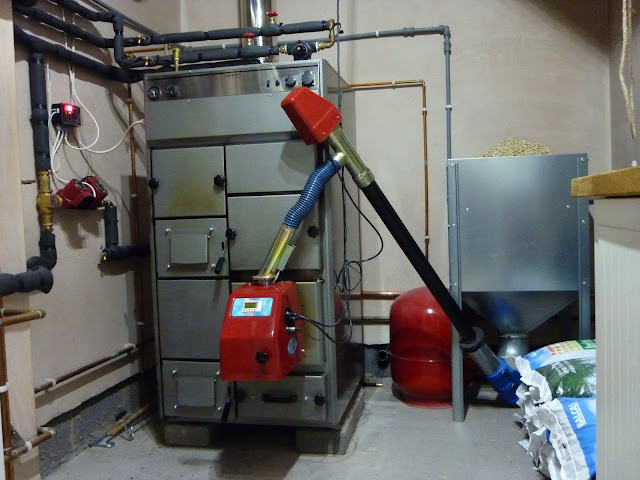 [/img]
Augured pellet feed to the right, log furnace to the left. Both heat the same water. A burn gives about 50kWh of energy, a bag of pelltes has about 50kWh of energy in them. Peak consumption in the middle of a cold winter is about 150-200kWh a day. My solar thermal provides around 50-60kWh a day which is my DHW requirement.
This is last year's fuel consumption and then with the solar thermal installed. This year's is much smoother but I havent enough data for a decent graph yet.
[img]  [/img]
As above though, I also take the economics as the lead, rather than the bunny-hugging.
[i]As above though, I also take the economics as the lead, rather than the bunny-hugging. [/i]
I'm going to call you on that one.
It's really all about playing with the big hunk of metal and fire.
That is a lovely looking compact unit and set up for the pellets.
WANT
its quite an involved system. You do have to work with it, its not for little old ladies to turn on and forget.
There is some dark art to getting the furnace burn right, and getting a feel for when the boiler is sooting and needs a clean and a service. But I can do it all myself (including repairs or part replacements) which saves money, but again adds to the involvement.
I currently feed it on 10Kg bags of pellets, but I dont like the waste of all the plastic bags it comes in and the delivery cant deliver the pallet direct to my store. So once Ive gone through the last tonne in spring, Im going to build plywood tank for about 2-3 tonnes blown bulk delivery with a hatch on it and manhandle 30Kg at a time into the "week store" that you can see above in a wheeled bucket. My store is only 15m from the tank.
So Stoner do you reckon your setup is cheaper than oil to run? Our oil boiler is getting pretty old now (25 years, but still running OK) and we're going to have to replace it at some point.
We have plenty of outbuilding space that we could put a biomass boiler in along with a big hopper for blown bulk delivery.
The main issue is that the building it would go in is about 30m from the main bit of the house - could the flow/return pipes be run that sort of distance through a suitably insulated duct?
sharkbait,
Im pretty sure mine is cheaper than oil now, although when I did the original sums when I was specifying it, it was, on paper, going to be a bit more expensive in the short term, but oil price inflation has already taken oil ahead of biomass since then, only 2 years ago.
Last figures I worked out are here:
http://singletrackworld.com/forum/topic/biomasssolar-eco-experts-advice-sought-stoner#post-2959506
if you use the average kWh consumption figure and british gas tarif structures, the weighted average cost of gas fuel is about 4.9p/kWh. At 90% efficiency for an A rated combi, that's a real heat generation cost of about 5.5p/kWhMy pellets cost about £259/tonne, with an energy density of about 4.9kWh per Kg, 5.2p/kWh
At 89% efficiency in my pellet boiler, thats 5.8p/kWh.With heating oil prices at around £300/500 litres and oil energy density of 10kWh/litre, oil boilers are a little more efficient at around 92%, so cost comes out at 6.5p/kWh
Those calcs rather surprise me. When I first did these figures 18 months ago, gas was loads cheaper, and oil was the second cheapest - something like 3.5p gas, 4.4p Oil and 5.5p wood.
What I missed out from that calc is the log cost. If I burn logs, my finger in the air estimate is that it costs me around 3.5-4p/kWh.
30m is quite a way, but my neighbour has his biomass boiler in an outhouse about 10m from his scullery where the pipes come into the house and distribution manifold. I saw him install the insulated pipe work and it's big stuff, something like 75mm thick (160mm+ dia) of armourflex insulation around a 28mm flow and return, in a plastic conduit. Not cheap stuff but Im assuming it's got excellent thermal characteristics.
The capital cost of my install was about £10k for the boiler and thermal store and another £2k for the solar thermal that did myself. I currently do not have any RHI payments becuase my particular boiler does not have MCS certification. This is because there's some uncertainty on how the govt want to treat log boiler efficiencies. You can more easily find certificated pellet boilers (the pelletmaster by woodviking is the sister unit of my big biotriplex thing and is certified) and that would give you an RHI income to offset the capital expense.
You dont necessarily need a thermal store, it just makes addition of solar thermal easier. If you were just going to use the pellet boiler all year round you could rely upon the tank in the boiler alone.
https://sites.google.com/site/woodviking2010/pelletmaster
the pelletmaster has a 220L tank and an indirect coil in it so you can use it for potable indirect DHW and as well as radiators and UFH if you have it. That boiler is about 5-6k + installation cost. You'll need to research how much the RHI might be worth I havent done it for ages.
If you're interested in the woodviking models, Id be happy to introduce you to a very excellent installer based in the south west, or the UK rep who I know quite well.
There are plenty of plastic underground heating mains available which are pre insulated.
Uponor springs to mind.
The life span quoted for them worsens the higher the temperature you put through them and if you can do it in a full length with no fittings underground is a better solution. Note "quoted"
I wouldn't even entertain metal pipes underground however well protected but I know there are welded systems out there that work fine.