Forum menu
I'd like to make one of these, as I can't really justify £50 for a bit of aluminium with three small LEDs glued in. There's no controls - just wired in series and connected to the 6V output from the front light. If I go on RS or similar there are a million choices for LEDs. How do I find the brightest available for ~2V volt drop? Most of the high power LEDs define a current rating rather than voltage. Would be grateful for any pointers!
Cheers,
Am I looking a tthe right sort of thing with these?
You can select the desired forward voltage in the selection tree on the left. That link should work and take you the the LEDs you need
Am I looking a tthe right sort of thing with these?
No, their fwd voltage is greater than 2v. Stick with RS, the ones on the link are all 2v LEDs.
Thanks. They seem to measure brightness (luminous intensity) in mcd. The max on RS is 80mcd; Rapid do one with 100,000mcd. Am I comparing like with like here?!
Cheers!
Those clear bodied LEDs have a very directional light output. So unless they are pointing directly at the observer, they wont appear to be very bright. But looking at them straight on, they are very bright.
The red bodied ones, emit their light in all directions.
MCD, it is measured in one point, ie. intensity. So the clear LED will have a higher number if it is measured directly in front of it.
If you were to use an integrating sphere and measure the lumens, ie, the total light output of the LED in all directions is measured, the lumen value would probably be the same for the clear and red.
Think of it as a torch with a focus-able beam. With a tight beam the light appears brighter than if it was set to light up a wide area. You have not changed the LED or the power to the LED, so lumens are the same. Just the intensity changes.
Sorry if I am teaching you to suck eggs, I used to build LEDs lights so became a bit of an LED geek!
Makes sense, thanks. They're so cheap (compared to CREE LEDs) I might just buy a selection and have a play.
Cheers,
The first thing to say is that LEDs really hate being "voltage controlled" rather than current controlled! As they act like ideal diodes, once the supply voltage exceeds their forwards voltage (typically around 2v but depends on a vast number of factors, including temperature!) they have a very low series resistance. Hence at 2.05v an led might pull 10mA, and yet at just 2.1v pull 500mA! And as that threshold varies, the current and hence brightness varies.
For this reason you'll find all high power/high current LED lights include a specific current controlled driver, that is fed by a voltage higher than the LEDs ever need, and that driver controls it's output voltage to exactly that necessary to drive a set amount of current through the LED. So a "1Amp" constant current driver does just that, increases it's output voltage to the LED under 1 amp flows, and as the LED forward voltage drop changes, it automatically modulates its output to keep 1 amp flowing.
If you just connect your LEDs straight to your battery, then:
1) the brightness will vary with battery voltage (which varies with state of charge)
2) the brightness will vary with ambient temperature, and led temperature (self heating)
3) your leds may well experience thermal runaway and fail as the current exceeds their limits
Now, you could just put a series resistor inline, and use that resistive element to provide a degree of current stabilisation, but the problem for anything battery powered is that the power loss in that resistor is "wasting" energy. Imagine you had a 4v battery and an system that had 1amp flowing around it. If your LED dropped 2v, and your resistor the other 2v, then 50% of the power would be wasted in the resistor and not used by the LED. IN effect, half your battery life gone, for nothing! The more power your system needs, the more it wastes!
For this reason LED drivers use switch mode BUCK converters, that are not resistive losses but inductive ones. They rapidly switch the current on and off to get to an average voltage for the led, but because they are either on, or off, and not somewhere in between, there are very few resistive losses and hence very high efficiency (typically >95%)
Look for "LED driver", they are not expensive!
look for the graph in the LED datasheet that looks like this
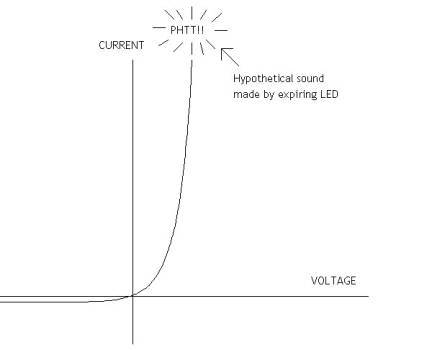
Is the output from the front light 6V AC looped through from the dynamo? Or is it a rectified DC signal?
If it's AC, then you might need to also find some way of rectifying it... or use anti-parallel diodes but depending on the hub this may pulse the LED's at slow speeds.
Also, if it is AC, then you'll not have the benefit of the standby function of the main light, and so as soon as you slow down or stop the rear light will go out...
Then, if it's rectified, then it's unlikely to be at 6V out of the front light, and more likely to be approx 3.8V...
I'd say a little more information is needed.
It's 6V DC out the back of the Supernova front light. The thing I linked to in the OP (this) is 3 LEDs in series fed by a constant-voltage source - it's marketted as being the 6V version (they do a 12V version for different front lights). I appreciate the explanation above - thanks - but this situation is a little different to a battery fed system. The product I'm trying to copy is extremely simple. I am guessing that the front light has a voltage regulator inside to ensure the rear gets exactly 6V to allow the LEDs to work properly without a current controller.
EDIT worth noting the dynamo which feeds the front light is a 500mA AC constant current device - the voltage isn't actually limited and varies with load. The front light must have a rectifier, current controller for the front LED and voltage regulator for the rear. I'm guessing.
Looking at the link in the OPs first post, all the electronics and standlight gubbins are housed in the front light.
This assumes the OP is in fact using the E3 light to power this DIY rear light. If not, yes, it will need some sort of voltage / current control.
I've seen close to 100v on a unloaded dynamo, at 35 mph. Be careful!
Sorry, yes, should have been more clear. I have the E3 front light already, so just looking to utilise the built-in 6V supply.
Just buy the real thing or you'll end up with something shit, unreliable, and if you're really lucky you'll Bork the rest of your setup. If it's half as nicely made as it purports to be it'll be worth every penny. And if your homemade job fails you'll be invisible.
Bikes are used in pretty harsh conditions for electronics.
you’ll end up with something shit, unreliable
Speak for yourself! I take a little more pride in the stuff I make - both at work and for a hobby. I run at least 3 lights for the reason that even good ones can fail, but I'd credit myself with being able to solder a few wires together and keep it waterproof. I was really just after some advice on bright 5mm LEDs, and piesoup has sorted me out there.
Tell you what mowgli, I'll 3d print a housing for you. Just cover the postage by chucking a couple of quid in a charity box.
What sort of clamp will you be using? Or I can print one that will clamp to the seat post. What's your seat tube angle?
The more people that tinker and make things, the better off everyone will be. We'll probably start to rely on it come Brexit!
I made my own dynamo light with stand light, I have yet to see a brighter LED dynamo light. It's not shit either. It survived Mountain Mayhem, two winters of commuting, and one 600km audax so far.
There is some fact up there- mostly captured by the graph
The http://350ma driver is a smart resistor - it has a very low resistance until it passes 350ma then the resistance goes up (googleAMC7135 to find the datasheet) -
Then get three LEDs http://LEDs and wire 3 in series (6 volt supply 2v across each LED)
I would get some M3 bolts and clamp the LED stars down on a strip of alloy (some heat transfer paste underneath), then solder them in series with the 7135 chip and cover everything except the LED dome with hot glue to waterproof
Then stick it on the things I have built thread 🙂
Thanks for the offer buddy - the housing making is much more my area of expertise compared to electronics! It's just a piece of 8mm delrin with the seatpost groove machined at the 74 degree seat angle to keep it horizontal. The two vertical holes either side will have M3 button heads through, and an o-ring will loop around those to hold it on the seatpost. I'll fill the void with epoxy to seal it up and set the LEDs in their pockets and have the wire hanging out the bottom.
I've made a couple of mtb lights with bflex drivers - still work ok but the battery is on the way out.

But Delrin will not transfer the heat
All LED hate the heat ( in performance and lifetime)
the Star it not enough surface area to cool it can you make the lid out of metal ? with the LED connected to that ?
N.
DohNut - the smart resistor looks like a good idea. I'm sure sure how much current the E3 can supply - 350mA might be pushing it? I've ordered some 40mA 5mm LEDs so will see how they do first of all. Main aim is to replicate the Supernova product first off - 5mm LEDs, tiny package, no cleverness.
The 40mA LEDs I wouldn't imagine should produce much heat compared to a star mounted one, but if it's a problem I can use alu plate just as easily.
There will be zero heat transfer required from 5mm LEDs. They will go pop before they get even slightly warm.
40mA * 6v = 0.24w. Nowt.
I like your design! The idea I have in my head for a very similar light to what you're making, is vertical in layout.
I remember the bflex drivers, i still have a couple lying around I think. Wonder if TaskLED is still going strong?
Far enough fella. It may have come across that way but I wasn't having a pop. If you'd mentioned bflex to start with I might not have said anything, but you started out trying to voltage control some LEDs you couldn't specify yourself....
Good luck with it.
I don't know if it's also worth trying to replicate the 'lens' that's on one of the LEDs. I've got a version of that rear light (built into a Canyon commuter) and the visibility of the 3 leds is really good but partly because of the beam/wide combo.
Most battery LED lights have some sort of lens or refraction element to create a larger point of light than a bare led would.