
MegaSack DRAW - This year's winner is user - rgwb
We will be in touch
So the government are going to plough money into reducing carbon emissions and bolstering the UK economy by supporting electric vehicles.
But given that the electricity has to come from somewhere in the first place (burning coal in power stations mostly), does this actually help much?
I'm guessing it must make a difference as our government wouldn't just support it in the hope it would be a vote-winner (oh, hang on...)
I suppose at the very least it moves pollution out of the city centres (?)
I think the only real benefit in our situation is that it gets pollution out of city centres. If we were Switzerland or Norway where Hydro accounted for a large proportion of the total energy supply then the benefit becomes far clearer in that pollution is far lower in total.
But that involves joined up thinking.....
No total benefit - in fact a small loss due to conversion losses - fossil fuel / elec / power rather than fossil fuel / power
its also easier to make a number of more efficient power stations, than it is to try and make millions of individual little engines run with the same losses.
Going back to the old 'what happens when the wind don't blow / waves don't rise / rivers stop flowing argument as well, many cars could be charged on a 'Economy 7' type tarriff - off hours and when there is more generating power in the system than demand.
Also work out that the average car journey length is just over 3 miles - persuading more people onto electric bikes / scooters / and cars would make sense and quite a saving.
I do think the market for an electric scooter would be a good one.
Also, factor in that making fewer journeys, walking and cycling more is a far more effective way of reducing emissions, energy demand, a healthier nation, a faster less congested nation etc etc...
Haven't they also come up with a new way of building the batteries, so they can be charged up very quickly? That would surely help people come round to the idea. I sometimes wonder if there'd end up being a shortage of battery ingredients but other than that I think I'd have an electric car if they were the same size as normal cars, and not too expensive.
£20m of the £250m is for infrastructure. So at £5000 each, that's what 46,000 cars subsidised, out of a driving population of at least 33,000,000...
So no, won't really make a awful lot of difference.
They should start with buses.
If people won't change their attitudes to public transport then electric cars will help. As richc said, power stations are more efficient, especially if they are sited locally to conurbations and minimise transmission losses.
Have a look at a project called Better Place (that might be wrong). They use a replaceable battery pack model to remove the charging problem. It's very interesting!
What they should really do is charge those idiots only driving 3 miles an additional you're too stupid tax, although what they should do about those people who drive about 400 - 500 yards to the chip shop..........
my mate gets 37mpg out of his Civic hybrid so it all sounds like a pile of crap to me. I'll keep my diesel that does 50+mpg thanks and avoid the shame of such a car.
The main issue is that it moves power generation away from petrol and onto central generation which in theory can come from any source (though of course this is mostly fossil at the moment)
To be fair though there is a lot of energy wasted in motor car with an internal combustion engine - ie the engine is constantly on, and is often revving way above the power needed to move it about. An electric motor can make smarter use of fuel regardless of where the fuel comes from.
Someone was telling me recently about an "electric" car which has a battery charged by a 125cc petrol engine. The engine runs constantly at the optimum speed/gearing for efficiency, which means it's never revving wildly and it's always converting its fuel to useful power.
The power does of course still have to come from somewhere, but even with fossil fuels it's easier to keep things cleaner at the source than in lots of engines and the source could be switched to something greener later.
The only nagging problem I have with the subsidy for electric cars is that we don't really want to encourage people to buy new cars at all- the green benefits of running the car are cancelled out by the energy/resources used to make it and most people's impact would be reduced by just driving the one they have now for as long as possible. OTOH if someone is going to buy a new car regardless then it's probably better if it's an electric one.
I do think the market for an electric scooter would be a good one.
Oh yes.
http://news.bbc.co.uk/1/hi/world/americas/2989000.stm
The CO2 produced by power stations as a result of charging up an electric car is less than the CO2 that would be produced by burning petrol or diesel. I seem to recall that it's equivalent to around 70-80g/ km which is better than any conventional car on the market. There's also the fact that emissions are at the power station instead of the tail pipe, so a benefit for urban air quality.
However, the fundamental problem is that electric cars are only suitable for short journeys; we should be encouraging people to walk, cycle or take the bus for these. Encouraging people to use an electric car may in fact create extra mileage from private cars, which is completely counter productive.
I did see a calculation somewhere that showed the CO2 emissions from electric cars are about the same per km as a fairly economical petrol car. Given that there is the potential to improve the efficiency of electric cars and electricity generation, electric vehicles could be a good solution for people who really do [i]need[/i] to drive.
What's really needed though, is more investment in cycling, walking and public transport...
I do think the market for an electric scooter would be a good one.
These are a common site in many Chinese cities; they are styled like conventional scooters but electrically powered. Presumably there are factories churning them out at a reasonable price, so it would just take someone to start importing them, set up a dealer / service network etc.
I've no idea how good they are, range, charging time etc, or how long they last, but the Chinese consumer is fairly savvy - if they didn't work there wouldn't be many of them about.
Mr Salmon. You don't want people buying new cars ?, if so, thats pretty harsh on all those whos' jobs rely on the motor trade. What would all those people do for a J.O.B.
Anyway, Has anyone here seen James May's review of the Honda saloon car which runs on Hydrogen ?. In his presentation, he makes some good [b]genaral[/b] points about car useage.
I agree, those using their car for the <3 mile journey are possibly being a bit irresponsible. But be careful, what would be the sensible minimum car useage distance ?.
I don't like electric cars, same if not more pollution, and as someone here has pointed out, it just removes the pollution out from under out noses, the high street. To a more remote location.
Out of sight, out of mind ?.
Consider also the energy intensive production process to create an item which is seldom recycleable such as a car battery, and contains exotic and toxic materials. Then, electric cars, for me at least, seem an unattractive proposition.
What would we do with the millions of batteries we'd have when they start to lose their performance ?.
Agree with another here who pointed to public transport.
I utterly hate cycling through my town centre for all the emmissions from tired old buses which kickout huge volumes of cr4p.
Perhaps local Gov should lead by example, rather than through the parking meter and clean its public transport act up first.
Running old diesel buses and telling everyone else that they've got to run an ultra clean car is rubbish.
I want clean buses, now !.
Solo.
I've looked up some numbers on the web. An electric car might expect to travel 70km on a full charge - which takes 10kWh. The long-term conversion factor for the national grid is 430g CO2/ kWh. So a full charge for the electric car would emit 4300g CO2. If it travels 70km per charge then this is 61g CO2/ km. That's comfortably better than any conventional car on the market (98g/ km for Ford Fiesta Econetic).
However, a new generation of diesel-electric hybrids is likely to hit the market soon, promising emissions as low as 80g/ km. That will be for a "proper" car meeting all safety legislation, and won't neeed recharging. So unless there's a significant breakthrough in battery technology, I just don't see a future for electric cars.
It's just not going to cut it for me
[img]  [/img]
Vs
[img]  [/img]
I thought the advantage was in efficiency: 20% for petrol cars compared to 95% for electric cars. Or something like that 😕
Also, more efficient to transport energy as electricity in wires than petrol in lorries to petrol stations.
it may be 95% for a car, but the efficiency of a power station brings that efficiency right down.
Yes a power station is SLIGHTLY more efficient than a modern car engine at creating power from the fuel so gram for gram less CO2 is produced, however the problem is that your electric car has/needs:
Charging - charging is not 100% efficient, neither is discharging (losses on both directions) and to add to that this only gets worse as the car ages.
The batteries used in the cars contain some really unpleasant chemicals that need to be mined, refined and packaged into cells that have a finite life of <10 years. Most of this production is done in other countries where emissions controls are lower.
Massive investment in infrastructure is needed and really is only useable for short commutes - I think the longest range I've seen on a production vehicle is around 200 miles. This means I'd need a second car (and the space it takes up, extra VED, extra insurance etc) to get to other places I visit other than work.
If we switch over to electric cars instead of D/P cars we need to significantly increase the number of power stations we have. We already have a problem with not enough power stations and whether or not to use nukes etc.
Bear in mind that a new car has to be manufactured, that takes a lot of energy too. And how many people can afford a new car? Personally I could be classed as "comfortable", I can pay my bills happily etc. I couldnt afford to buy a NEW car without some sort of finance deal which would mean me paying more in the end. Ive never bought a new car, IMO that's just throwing money away into something that depreciates by 50% in the first couple of years.
So assuming your elec car works at ~100g/km CO2 (at the power station, long tailpipe theory) why should I pay vastly more taxes, get no rebated etc for recycling my second hand TD that manages ~110g/km?
Personally I think it's just another giant vote-grabbing attempt with no thought behind it.
Also, more efficient to transport energy as electricity in wires than petrol in lorries to petrol stations.
Not sure that's true - I have no figures on the fuel economy of trucks but power transmission losses over wires are vast - think in the realms of 35%.
to only about double of an IC car....
Power Stations are about 40% efficient, and what about nuclear, renewable etc.
I agree coffeking, lets keep things exactly the same as they are now, we're clearly doing nothing wrong.
Why are we having this debate anyway, hydrogen is the way forwards.
Transpoting electricity via wire. Thats some wiring there, have you seen that stuff. What does it take to produce that, transport it, lay it, maintain it, etc. Hardly cheap and clean.
Tessla produced an electric car based on the Lotus Elise. Customers had to have 3 phase fitted to their homes to charge the thing !.
And do you want a 600Kg battery behind you when you hit something....
Solo.
Wiredchops - preeching to the wrong person, I work in renewable energy research 😉
I just dont think electric cars are the way forward.
Just a thought. Has there been any research into the physical effects on the human body from being in such a close proximity to a high powered electric motor. EMFs and all that jazz ?.
Solo.
They should just stop car production which must use a massive amount of energy & resources.
Cars are too cheap.
Cynic-al.
Ah, a voice of someone who has nothing to lose from such a suggestion. Lets stop the industry you rely on for work. 🙄
Agreeing with CoffeeKing.
Solo.
You don't want people buying new cars ?, if so, thats pretty harsh on all those whos' jobs rely on the motor trade. What would all those people do for a J.O.B.
That's a good point, but I'm not sure it's a reason to keep propping up something that is (IMO) becoming increasingly unsustainable- I'm talking about the current car-centric culture here rather than how they're powered. And if that car-centric set up is to be replaced with something else won't that create a lot of new jobs? I know it's easy for me to say when it's not my livelihood, but still, I think that in the long run keeping churning out cars to keep people in jobs might turn out to have been a bit short-sighted.
It takes approximately 5 tonnes of CO2 to manufacture a new car. If I switched from my current car (170 g/ km) to a more efficient car (120g/ km) it would take me 21 years (!) before the CO2 costs of manufacture are offset by reduced tailpipe emissions. Whilst I only do a low mileage, even a normal mileage would take over 5 years to pay back.
[img]  [/img]
Consider that the average car weighs 20 times more than the driver.... means that under 1% of the energy in that tank goes to propelling you if it's just you in the car.
Thank the lord for bikes, one of the few forms of transport where the user weighs more than the vehicle.
IMO there is an aweful lot of waste in society. Following on from TJ's point that we waste too much (such as household insulation etc), we waste a lot with car design too - approximately 1/3 of the fuel energy is "lost" to the cooling system and out into the environment. That energy can be harvested and fed back into the process and/or used to ease the mechanical load on the engine (thermoelectric alternators, currently being developed by BMW, not very efficient but worthy work). Braking energy recovery - vast wasteage could be recovered there fairly efficiently (as per the F1 cars) - cars at cruise take very little power/fuel, its mainly acceleration that uses fuel.
ransos - I agree, switching to a new car isnt a clever idea (especially when you do few miles), switching to a battery powered car is even more mental - go dig up the figures for the CO2 required to create the half-ton batteries used in them!
Solo I'm not being entirely serious, I know it would never happen, just a bit of a shame, capitalism & consumerism and all that.
You're still hauling around over a ton of stuff with you.
If we do 'need' cars then I doubt they would get much more efficient than this
[img] 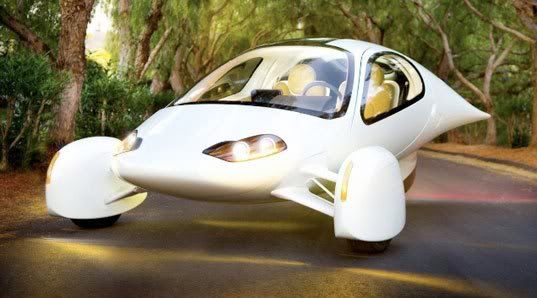 [/img]
How many billions of pounds does traffic congestion cost us every year then?
Mr Salmon.
You have a point, we can't just keep churning out cars with the happy abandon of a society that has been granted limitless space and resources, true.
It is cringe worthy to see six cars parked onto the bulging drive of a semi.
Don't deny that a few less cars wouldn't be a bad thing. Short sighted Govs to affraid to really grab the bull by the horns and try to re-configure car useage in the U.K. Must not upset the economy, etc. And its not just about taxing car users out of their cars either. However, it would be a little less painful for the motorist if they could actually see the benefits and not just dirty old smokers of buses chugging along the high street.
The roots of the car industry sink deep into the U.K.
As I pointed out, James May, while road testing the Honda hydrogen car, made some interesting observations about modern car use.
I don't want things to stay as they are, but I feel that electric cars are a 2red-herring".
I feel that we are right to want to find a cleaner alternative to burning 100% petrol/Diesel.
Solo.
How is all this hyrdrogen for fuel cells 'created'? persumably this requires a lot of energy?
Electric cars as they are now have certain useful applications such as city driving, which accounts for a lot of high-emissions miles at the moment.
They can also take advantage of renewable energy if/when its connected to the grid.
They can also take advantage of the kind of emissions control technology that could be installed at a power station but not in a car ie carbon capture/storage.
I read somewhere that suggested the CO2 emissions were equivalent to that of a 300mpg car, but I can't say how good their calculations were.
Range of electric cars is pretty bad currently, but take the Chevy Volt which is coming out later this year apparently. It has a 40 mile electric only range between charges then switches to hybrid power to drive indefinitely on petrol with fillups of course. How many times do you think a typical driver would go beyond that 40 mile/day range? I would probably only use the petrol engine once every couple of weeks in the winter time (when I'm not going to races).
One major argument for encouraging electric cars now is that investment in the technologies will produce a return in the future when the technology improves.
Which is partly why I bought a Prius which by the way does between 52 and 62mpg over a whole tank depending on the time of year and how much town driving there is. Typical would be around 57mpg per tank but bear in mind it's petrol which means that in terms of cost it's equivalent to about 65mpg in a diesel car due to diesel being more expensive. In CO2 emissions terms it's equivalent to a diesel that does 74mpg. And its emissions of other nasties are vastly lower due to petrol being a lot cleaner than diesel. And it's also a big car, the size of a Mondeo. So someone show me a Mondeo sized car that does 74mpg (or even 65 for that matter, or even 57) and I'll be impressed 🙂
It is cringe worthy to see six cars parked onto the bulging drive of a semi.
Number of cars is irrelevant, and you should think before you cringe -theres only so many people to drive them. When I stayed with my parents there were 4 cars on the drive of their semi, 2 of which rarely moved ever (one used for towing a caravan sometimes (<2k miles a year, rather than flying on holiday), the other a fairly rare sports car used for <4K miles a year) and considering I commuted by bike instead of using my very efficient diesel that meant the only car that moved regularly was the old normal family car for the person who has mobility difficulties. The number of times people who didn't know made smart-arse comments about more cars than people in the house, while driving around with their head aloft in their two brand new 2 litre petrols thinking they were being more green and holier-than-thou. Irritate me as much as the people who drive past and yell that you should be paying road tax for a bike, without realising I pay £350 a year in road tax but still choose to cycle to work and probably do fewer miles on the road than they do.
molgrips - how does your car, that does 57mpg, use less co2 than any other car doing 57mpg? CO2 output is related directly to fuel quantity used. And considering the CO2 output when burning D is almost identical to burning P, the only difference is the efficiency of the car.
So what you have is a petrol that gets 57mpg (good, for a petrol!) and so that costs less to run than a D that gets the same mpg, but you're doing the same CO2 output.
Bearing in mind your prius battery took a lot more energy to produce than a normal tin-box-and-engine car, the environmental benefits are questionable.
Yes being able to use CCS at the power station and the stations increased efficiency is good, cant deny that, but dont you see that if we start introducing thousands of elec cars we'll need many more power stations to come online ASAP - renewables research isnt ready for that, you could cover the UK in windfarms and we'd still not be able to cover that. So all you're doing is increasing the need and rate of increase in need for coal/gas/nuke powerstations. If some of the cash would be diverted into serious renewables research then thats a benefit but we'd still need more fossil fuel stations NOW to cope with the demand.
molgrips - how does your car, that does 57mpg, use less co2 than any other car doing 57mpg? CO2 output is related directly to fuel quantity used. And considering the CO2 output when burning D is almost identical to burning P, the only difference is the efficiency of the car.
Not so. A diesel car doing 57mpg will emit 135g CO2/ km whereas a petrol car doing 57 mpg emits 120g. That's an 11% difference.
It's because diesel is heavier and more energy dense than petrol.
Fair point ransos, but ultimately that still doesnt offset the extra manufacturing cost or the fact that the battery will need replacing as it becomes less efficient, way before the life of the car is up - this means that drivers will start using the petrol more and more (unaware), reducing overall efficiency and that the car will then become more costly to fix than its value - > scrapped vehicle. Plus we are comparing apples and oranges on effective engine size - you can get a 1.4D to drag around a mondeo sized body easily these days, returning upward of 60mpg. I've no idea of the size of the engine in the prius to be fair.
Plus you're assuming you drive the prius as per the vehicle testing agency specs - as highlighted by topgear recently but is true in actual driving - most people dont drive a prius and get the 57 that molgrips gets, many get a lot less as they drive as per a normal car which the prius doesnt like. I can thrash my 2litre D about all day and still get more mpg than the manufacturer specifies as combined - I rarely see <55mpg despite hoofing it a lot and see >60 on the motorway. With a prius, if you hoof it much at all you'll soon be dropping into the 30s. I'm not saying hoofing is a good idea, but it's what most of the public drive like!
Petrols emit more CO (twice as much). Diesels emit more NOx (20 times as much) - neither of these are problem gases on teh scale of CO2 until they're in a cramped place like a city.
Electric vehicles do have one thing, massive torque from 0rpm - this makes acceleration quick and easy, so despite the short range and low speeds it might still feel nice to drive.
CK.
Take a Chill-Pill, you seem to have some "baggage" related to when you lived at home. Don't take the frustrations about the issues you have about your unique home experience, out on me.
That remark was used to high-light the households where every family member has their own car, used regularly/daily. I was indicating how the car culture in the UK has developed. Thats all. The drive is full over night, empty during the day. All those cars on the road. Will every household be like that one day. Will every household have a seperate car for towing, a special sports car, a car for Monday, a car for Tuesday...
Should there be a limit ?, should people compromise the number of cars they own ? is there a place for the....multipurpose car ?.
As for those who would not be able to, or who would find it extremely difficult to travel without a car due to physical issues, the disabled, the infirm, etc. Of course I'm not saying that they should be denied transport.
But getting back on-topic, should that transport be in an electric powered car ?, imo, no.
Solo.
Solo - wasnt taking out frustrations on anyone, I have no baggage - I just find people a little too judgemental for their own good - you can't group all people as you do. Why is there a family living with all members having their own car - maybe because they all work a long way from the house and no-where near each other. Would it seem better if two people moved away to another house and parked the cars there instead (requiring the building, heating and maintaining of another house)?
While I appreciate your point of view that not everyone needs a car, and I find 2 people driving sod-all miles to 2 geographically close places of work is somewhat irresponsible, you can't simply say "theres X of you, you should have Y cars", every case is different. As I say, parking space-aside, the number of cars (particularly old ones, assuming we're not all buying lots of new ones) is not really important as only one driver exists for each. If you make people compromise you may compromise their career prospects, their earning potential and their quality of life. Is that right? Again, if we all started from a fresh slate something like a truly multipurpose car might make sense - a high efficiency diesel estate does most things (though mine is too small to tow a caravan and I'd need a bigger, less efficient over-all one to do so), but for those that dont have one currently you'd have to force them to buy one or people like yourself would frown on them. While I see your points I question the black-and-white basis on which theyre made.
I agree that (solely) electric power isnt the way forward though 🙂
what about shipping all that lithium about the world to create all the batteries that would be required. Most lithium come form South America by the way
I've never understood why people struggle to achieve the official economy figure for their car. Mine is only 37mpg, yet I average 43-47mpg, depending on the journey.
what about shipping all that lithium about the world to create all the batteries that would be required. Most lithium come form South America by the way
Ah, a voice of someone who has nothing to lose from such a suggestion. Lets stop the industry you rely on for work.
Good point. Anybody here work for BAT? Let's not even think of trying to decrease the size of their industry either, given all those jobs relying on it.
So someone show me a Mondeo sized car that does 74mpg (or even 65 for that matter, or even 57) and I'll be impressed
Maybe you could start by showing us how a Prius is Mondeo sized?
The Focus Econetic (a better comparison in terms of external size) does 65mpg, admittedly with a slightly higher CO2 figure, but without all of the problems associated with manufacture and disposal of the batteries. On top of that it drives better, has more cabin space and a significantly bigger boot.
Still, if the Prius makes [i]you[/i] feel better/smugger/more worthy...
ransos - you must be a smoooooth driver 🙂 Or do long journeys.
Depends what figures your choosing. Figures for my car:
Fuel Consumption (Urban) 40.9 mpg
Fuel Consumption (ExtraUrban) 65.7 mpg
Fuel Consumption (Combined) 54.3 mpg
Extraurban is average 40mph
Urban is average somewhere around the 20s IIRC.
combined is average.
Personally I average ~55ish, I have seen 68 once while slipstreaming a wagon at 56mph for 200 miles. 🙂
It depends how much like the official test track your driving is. Even a long journey on the motoway at 60 you'll struggle to achieve your extraurban figure. The urban figure I never fail to beat. The combined is about my average when used for commuting to work (20 miles a day, mostly open 60 roads). But bear in mind that different cars will react differently to the test. Some cars are much more thirstly on acceleration than others (heavier ones) so if the test for the figures doesnt include much acceleration they'll get worse figures in normal use than in test.
What happens t oall the 3 year old betteries?
I feel hydrogen fuel cell is a much better idea, although the initial outlay may be more expensive.
Electric cars are not as green as people like to make out.
Owning, driving and maintaining a car is still way too cheap, double or treble the costs and then see whether there's still problems with congestion and pollution.
CK.
Exacly ! the point I was making, every case is different. UK car culture encourages/entitles people to take the job which is a two hour commute each way, away from where they live. Our car culture throws up all types of car owning households now.
I was observing [u]our car culture[/u]. I cringed at all those cars going out everyday, onto the roads, thats all. 🙂
I'd take it another step further and ask. For those who work at a keyboard, why, in the 21st C are we still traveling to another place to use the works office and computer.
Can't we as a nation develop a remote working culture, which may just happen to reduce the number of cars needed/used on the roads on a daily basis.
Then we could all use the extra 2 hours a day for cycling, rather than commuting. 😀
I think that having to drive to work can actually hamper your carrer prospects, as we know, theres a limit on how far one can drive to and from work.
I don't want to endorse anyone having their career hampered for lack of ability to get to where its at, and so therefore, their quality of life.
However, there are some who would argue that some levels of quality of life are unsustainable. And our car culture allows people to live a long way from where they work. Is that sustainable.
Either way, you make some good points. 🙂
Ta
Solo.
The prius is a total red herring. An eco car ( a tuatology anyway) would be small and light with a long life span and totally recyclable. Think modern day 2cv.
Priuses are really poor over a total lifetime environmental audit - as are electric cars. All those fancy batteries and high tech stuff.
aP - you want to watch out, we'll have only bankers driving around soon, all living in a flat 2 miles from their workplace in the centre of london and all the normal workers will be unable to get to their place of work due to distances involved.
In actual fact all that'll happen is wages will rise to match, prices of products will rise to match wages and it'll carry on that way.
"I'd take it another step further and ask. For those who work at a keyboard, why, in the 21st C are we still traveling to another place to use the works office and computer."
Good question. I've been doing some research into this recently. I was surprised to conclude that for most people, commuting to work by car produces less CO2 than the extra CO2 arising from heating & powering your home during the day.
Of course there are other benefits - reduced congestion, possibility of giving up car ownership etc.
Bloody right there.
I am one of those people who has to travel 30 miles to work, in traffic. I would rather stay at home and work there but apparently that is not good working practice. I ask how is it not good working practive to have saved money, fuel and time to work in a more comfortable enviroment, away from people who have all manner of nasty germs which get passed around through air conditioning.
I was surprised to conclude that for most people, commuting to work by car produces less CO2 than the extra CO2 arising from heating & powering your home during the day.
So commute in winter, work at home in summer?
CK - the majority of car journeys are less than 3 miles, I'm not quite sure why a modal change would require wages to go up?
Just looked up prius battery life issues, seems low-mileage users suffer the most, as with most batteries if they are used at low duty but frequently they are pretty long-life items. People with <10K miles a year seem to be having issues with the battery keeling over, and its a £2-4000 replacement cost depending on model (but comes with a 7 year warranty, not that that helps the environment).
mol - get using that car, for your wallets sake!
Because its CHANGE that takes the doing, not the actual mode of transport. People live miles from work NOW, if you change how much their transport costs they arent all suddenly going to move house to nearer work. People do a weekly shop at the supermarket 3 miles away NOW, if you make their car cost more to run you'll have to increase the number of buses NOW or people can't get to them, and of course if car costs go up so will bus ticket prices as they're a business.
So commute in winter, work at home in summer?
Indeed(Or commute all year round by bike/ public transport/ car share).
Interestingly, homeworking is usually an environmental benefit in the USA. This is because they mostly commute by car, for long distances, and keep the heating/ aircon on during the day even though they're not at home. Eek!
Regarding the battery thing - the impact is probably overstated as it can be recycled at the end of its lifespan. I don't doubt that there is an impact, but is it a significant addition to the environmental costs of producing a new car? Probably not.
While they can be recycled it still takes a LOT of energy to do so, and since we dont curretnly have any of those batteries (practically) we're stil going to have to produce them from scratch now by mining the hell out of south america.
aP.
I think you're so wrong, jmo.
Taxing the ass off the car owner isn't the answer.
Reading the posts, looks like we're not having the wool pulled over our eyes. Seems that quite a few here think that the electric car isn't the "[i]way forward[/i]".
While I have mentioned the Hydro-Fuel cell car, it was more for the observations the road tester made about modern car culture/useage.
Hydrogen isn't really the answer. Imagine the cost in restructuring the worlds Petro-Chem handling infrustructure to handle pressurized, liquid Hydrogen. California, U.S.A. is trying it, but its costing them loads.
You basically have to start from scratch, I don't believe you can convert the petrol/diesel handling infrastucture of the world to handle (store, transport, pump) Hydrogen.
It may surprize some here to learn that the industry is spending serious time looking into alternatives. The [i]latest[/i] I heard is that Methanol is the future...
Or rather, synthesized methanol.
No major restructuring of the material hanlding infrastructure required, etc, its renewable, although not so sure about the actual emissions ( I didn't invent it, just telling what I heard).
Early days.
Solo.
Well, when you look at it - there's massive industry over capacity, the costs of running a car have fallen in real terms significantly since the early 70s, the price of fuel is within 10% of where it was 10 years ago, - congestion is a significant problem for pretty much every part of the UK. Why not make it equal the costs it causes rather than pander to people's desire for the cheapest?
It is solely because motoring is so much cheaper than it used to be that people are prepared to change their entire lifestyle and live 40 or 50 miles away from their work, employers expect their employees to be prepared to commute those distances and more vulnerable road users have been pushed off the roads.
Why not demand a quality of life distinct from having to run and use cars?
While they can be recycled it still takes a LOT of energy to do so, and since we dont curretnly have any of those batteries (practically) we're stil going to have to produce them from scratch now by mining the hell out of south america.
Yes, I'm sure that's true. But I'd be interested to learn how significant it is compared to the overall impact of producing a new car. Do you know of any research into this?
aP.
Some good points there, but raising the cost?. As others have pointed out, increase something that people beleive to be essential to their way of life, or even earning a living, and their wage demands will increase.
Look at housing. Prices go up, we all need more in the pay-packet in order to buy.
Yes, housing is more important than cars, but the principle is my point. Raise the cost and people demand more pay to afford it.
Furthermore, we in the UK pay £25 Billion in green taxes, yet we cause £5 billion environmental damage.
Oi !, Gordon, wheres the rest of it going !.
Ooh. Don't start me off 🙂
Solo.
Its about regulating demand. Ask yourself (or someone else) 2 questions:
1. Is traffic a problem for you?
2. If so what do you want to do about it?
I know, of course, that the answer to Q2 is make somebody else change rather than me because I am completely unable to do anything differently than I've become accustomed to, but driving in the UK is a chore - no matter what the petrolheads say, for 95% of the country driving is a chore - why not try and do something about that?
As a hint - it doesn't include electric/ hybrid (pertrol and diesel)/ hydrogen fuel cell/ flywheel energy sources in otherwise unchanged cars.
I would give up driving, in fact I didnt own a car or drive for seven years, then I needed to find a new job.
I hate driving, really should save it for taking the bike to foreign trails! I could easily work from home and have mentioned that on a number of occasions, even if I could cut down to three days at home and mid week in the office for catch up meetings.
My other option is to move closer to work, but then I would have to give up living in pastures green where all the riding happens. slightly catch 22 for me. maybe I should loose my job, get my lady producing babies and claim all the benefits of being unemployed and having offspring.....
Seems to be the way to go.
I ditched my car 3.5 years ago and I'm still loving it. You just don't realise how much you time you spend worrying about it and paying for it. Plus I can drink whenever I want, cheers!
I gave up driving (forced, due to car death and lack of finances!). It was the worst 18 months of my life. I had to beg and borrow lifts from people, rely on public transport that failed to get me in on time at least 10% of the time, took me longer to get to places. Meant I couldnt get to do my sports. That period made me realise just how nice it is to have the freedom a car provides. I did cycle to places but the constant rain and wind make anything more than 15 miles a real chore. I enjoy driving too, 95% of country driving is an absolute joy to me, even being stuck in a queue is preferable to being stuck on a train. My fun car is currently in storage and I really honestly do miss it and the smile it brings when I drive it. I've never had to worry about finances on my car, I've always bought cars I coudl afford to run and insure with cash I had in the bank. If I didnt have the cash I'd not buy the car.
ooOOoo - you cant drink and cycle you know, that's still illegal?
MD. Love that post. Yeah, I'd like to give up driving too.
aP.
Traffic is a problem for US. Seperate your hate of the car, from the proposed replacement of current cars with Electric cars.
If human kind finds a solution for a sustainable car, in whatever form that may take, then the car stays, and more importantly, so do we !.
I think we need to try to change car culture, find a [i]better[/i] way to get people to [b]want[/b] to use an alternative.
And where as taxation does have its place. Perhaps we need to change the record and use a less blunt instrument with which to clobber our problems. Aren't we cleverer than just to resort to the treasury all the time.
[i]is there a problem ?, [b]TAX IT LAD, TAX IT ![/b][/i]. Err, no.
I would like to see some of our Gov money go to incentivise employers to have their keyboard jockeys stay at home, use secure IT infrastructures, etc.
Can't we give it a go at least ?.
Solo.
As mentioned earlier solo, it costs more in energy to heat a home during the day than it does to drive to work? Interesting point though - I personally would love to work from home, if I didnt have to communicate with people face to face as part of my job.
Some good points in here
http://www.guardian.co.uk/commentisfree/cif-green/2009/apr/16/electric-car-government-subsidy
Also mentions using replaceable car batteries as an electricity store so that variable renewable energy sources become more viable!
Yes you could use the whole battery-as-a-storage-for-grid option, but then when the country sees a day or two of no wind no-one can get to work unless we have the fossil capacity backup, not to mention each house would have to have its own inverter technology etc (not that that's impossible, just more problematic than just plugging the car in).
CK.
Yeap, I hadn't missed that statement. However, (here it goes) how many homes have someone drive to work, but leave someone at home for most of the day, electrical goods on standby, etc, etc.
Yeah, I know we'll get into numbers, etc, and that probably isn't a worth-while exercise for this thread.
But as we're being saddle with Nuclear Power Stations then ultimately heating a home would release less CO2 into the atmos....err, maybe...
But then again, if cars become more fuel efficient....Yeah, that may be a point to consider. But there are other advantages to not having to drive to work.
This has been a good thread, I've enjoyed it :-), but got to go out now, on the bike. 😀
Cheers.
Solo.
err... where did I say that I hate cars?
What I hate is the awfulness that they create through waste and pollution, the destruction of our towns and cities and the disenfrachisement that they cause in society.
Do you actually live in the UK? Traffic is an enormous problem here, where I live it can take an hour and a half to drive 4 miles, tell me that there isn't something wrong, surely we should be looking for a solution that reduces our reliance on the thing that seems to cause a lot of problems.