UPDATE: Reviews section refreshed, redesigned, searchable: Go take a look
First large paragraph of text states loading/unloading permitted on yellow lines unless loading restrictions (yellow stripes up on over kerb) or no stopping (red lines) are present
https://www.highwaycodeuk.co.uk/road-markings.html
Pavement parking
And it's wholly endorsable with judicial use of a pram or wheelchair.
It may not be an offence most places for a vehicle to be parked on the pavement, it is illegal to drive on the pavement. So unless cars are being lifted into place on the pavement, the act of parking them is illegal.
edit; the Highway Code states that as a must rule (ie enforced by law, but I’m not convinced the referenced legislation has that effect).
I thought couriers just did what the **** they like, when they like, where they like, how they like?
I thought couriers just did what the **** they like, when they like, where they like, how they like?
The op's courier did .... He thought he was getting goose for din dins on Xmas day !
Others are trying to be correct by technicality.
Given its a detached house I guess it depends on how enthusiastically the area is patrolled. If a few of them have been hit with fines even if they win on appeal they might think its not worth the hassle.
On my cul-de-sac we have a residents scheme, thanks to some moron uni students, and we get frequent visits from the wardens. Front gardens are basically non-existent and I have seen a warden have a quick look up and down to see if it looks like a courier, at which point they lose interest, or not. If it was harder to check I suspect a fair few would end up with tickets.
"How do we define “unnecessary obstruction” and how does that relate to pavements?"
Pavement alongside a road is part of the road for most laws. Define? If it isn't an emergency and the pavement is completely blocked that is unnecessary. Likewise double parking to save walking 50 yards from a kerbside space. I used to do this stuff for a living. Don't believe me?
"It is an offence to obstruct a pavement, contrary to Regulation 103 of The Road Vehicles (Construction and Use) Regulations 1986."
http://www.pedestriansafety.org.uk/pavement_parking_q_a.html
When leith walk opened fully again after the tram works I kept on finding delivery vans parking on double red lines - but to get out of the way of the trams they mounted the pavement and blocked the cycleway. I asked a warden about this and they told me they had be told to go easy on delivery drivers. I made a formal complaint to the council. Whether my complaint made any difference I do not know but the policy was changed a few months later and now ( presumably after a few tickets) it no longer happens - so certainly there delivery drivers do not illegally park any more.
Wibble has said what many others have said, it’s why there would be reason they’ve previously getting a ticket.
Only if you don't read all what wobble wrote. But then I guess if we are making up what the parking. Restriction sign might say in our head.... Anything is on.
Just to deal with a few points that have been raised:
There are no kerb stripes
The notices just give times, nothing else and the "delivery" aka drive-by was within those times.
The choice of delivery day was the supplier's, not mine.
We have a driveway, the entrance is the same width it was in the 1930s when the house was built so although you can reverse a van into it, expecting a courier to do so would be unreasonable.
I spoke on the phone to the delivery manager for this region, not some call centre bod. Who rang the driver, who I then spoke to to arrange to meet up with him. That part at least was very good, except for the fact that it shouldn't have been necessary at all.
There is some history with the Council, the sixth form college across the road*, the bus company**, local residents and the yellow lines (now on both sides of the road). I recall the draft TRO which we had sight of actually mentioning deliveries and tradespeeps, hence my interest in the details - there has been neotiation with the Council over this and maybe things could be tweaked.
Related to the above, there is no parking on the kerb, with cute little notices to that effect. This is not the same as parking on the pavement as the road has those patches of grass between the kerb and the pavement. All twee and suburban like.
*The cause of the yellow lines was students/parents/taxis parking and waiting in the road, which is a bus route, also the school busses having to use it to gain access to park further up, (still a yellow line) to wait there until chucking out time. The school appointed traffic marshalls, but to no avail. We thought it all just added to life's rich tapestry, but some of our neighbours felt that getting stuck in your house for 15 mins by gridlocked traffic was unacceptable. Obviously, they had a point.
**As did the bus company, after one particularly bad afternoon gridlock a bus driver totally lost it, the bus company (Council owned} cancelled the route and hey presto, a yellow line appeared on our side of the road, to go with the one on the other side.
There seems to be a considerable amount of discussion about parking on pavements, blocking of traffic by parking at the edge of the carriageway or blocking of traffic by double parking.
I would assume as the op has stated there are single yellow lines that double parking is not a problem with the scenario that he encountered.
The op hasn't stated (edit seems my typing is too slow) if loading/unloading on the single yellow line would cause significant disruption to traffic, i.e. if the road is narrow, on a bend, by a junction or what the traffic count was at the time of the delivery. The op also hasn't seemingly mentioned parking on the pavement, or whether this would be necessary to avoid blocking the carriageway during loading/unloading (. Until that time it's all a bit moot.
We could also talk about the quality of parking at school drop off and collection times, or the parking of home removals vehicles..?
We could also discuss about the placement of vehicle trailers on single or double yellow lines, which the law does not consider to be parking or loading/unloading and which is perfectly legal as they do not have engines so are not classified as motor vehicles?
Only if you don’t read all what wobble wrote. But then I guess if we are making up what the parking. Restriction sign might say in our head…. Anything is on.
ironic.
The road markings should match the TRO, TTRO or ETRO so sight of the wording should not be required to know what restrictions there are. Reading Borough Council, for instance, recently discovered this and is having to offer refunds as a result.
It may not be an offence most places for a vehicle to be parked on the pavement, it is illegal to drive on the pavement. So unless cars are being lifted into place on the pavement, the act of parking them is illegal.
Is clipping the kerb when parking up classed as "driving on the pavement"? What if I pushed my car up onto the kerb? How about motorbikes, I used to routinely cross the pavement without a dropped kerb to shove mine up the garden path.
Define? If it isn’t an emergency and the pavement is completely blocked that is unnecessary.
How about partially blocked? The RAC (after a brief google) recommends parking partially on the pavement if the alternative would be to restrict passage on the road.
Likewise double parking to save walking 50 yards from a kerbside space. I used to do this stuff for a living.
What stuff did you do? Which law mandates against double parking, that's a new one on me.
I'm not defending any of this behaviour, I'm just saying that it's not clear. And it isn't. If it was then London / Scotland wouldn't have needed to bring in a bylaw explicitly prohibiting it. The law wouldn't expressly single out 7.5T+ vehicles as being not allowed to park on the footway if it applied to everyone.
On the street at my old house everyone used to park half-on the street except me because I objected to it on principle; after my third or fourth hit-and-run write-off I started parking up on the kerb like everyone else.
Point of note here is that pavement parking for regular vehicles isn’t illegal (aside from a couple of cities where it’s a local bylaw)
In addition to minus' post,
Highway Code Rule 145
You MUST NOT drive on or over a pavement, footpath or bridleway except to gain lawful access to property, or in the case of an emergency.
https://www.legislation.gov.uk/ukpga/Will4/5-6/50/section/72
Lawful access is about driving across the pavement to get onto a driveway, rather than abandoning the vehicle and walking 🙂
The road markings should match the TRO, TTRO or ETRO so sight of the wording should not be required to know what restrictions there are. Reading Borough Council, for instance, recently discovered this and is having to offer refunds as a result.
Well clearly not exactly. Only when interpreted according to , presumably, some piece of actual legislation affecting councils that has not so far been referenced on this thread.
Anyone got any ideas where to look for this stuff?
Anyone got any ideas where to look for this stuff?
TROs are usually held by the county council or equivalent; their legal department gets them at Court. Some publish them online and some don't, e.g. https://www.westsussex.gov.uk/roads-and-travel/traffic-regulation-orders/about-tros/view-tro-restrictions-by-map/traffic-regulation-order-tro-map/
How do we define “unnecessary obstruction” and how does that relate to pavements? “It was necessary to obstruct the footpath Your Honour, otherwise I’d have been blocking the highway and my chips were getting cold.”
"We" don't. The driver either pleads guilty or not guilty at which point a Court decides based on the situation at the time. Same for double-parking, etc.
Pushing a car could be "driving", although in the particular circumstances of R v MacDonagh (1974), it wasn't. https://vlex.co.uk/vid/r-v-macdonagh-792563369
McKoen v Ellis (1986) pushing a motorbike by the handlebars was driving if the ignition is on and the biker is wearing a helmet and other clothing
Is clipping the kerb when parking up classed as “driving on the pavement”?
That's classed as incompetent 🙂
TROs are usually held by the county council or equivalent; their legal department gets them at Court. Some publish them online and some don’t, e.g
Thanks @timba. Mine doesn't, well not all of them. But that is not what I was after, I am wondering where the language of yellow lines, notices etc. is defined. It must be done centrally somehow so there is consistency across councils.
The sign wording is here https://www.gov.uk/government/publications/traffic-signs-manual (Chapter 3)
I don't know where the legal templates are (if they exist) to put before a Court. There's a short legal section at the beginning of the chapter, but try your Local Authority solicitor
From Chapter 3^^ (page 144), is this it?
13.4.2. Standard exemptions to a waiting prohibition are not shown on the signs. These exemptions include stopping to pick up or set down passengers, and causing a vehicle to be stationary for the purposes of loading or unloading goods from that vehicle. Loading generally refers to commercial loading or to objects that are too heavy or bulky to be carried very far by hand, but does not include time for purchasing the goods. Where loading is not permitted, this is indicated on the upright sign. Loading restriction signs have a white background, to contrast with the yellow “no waiting” signs
“We” don’t. The driver either pleads guilty or not guilty at which point a Court decides based on the situation at the time. Same for double-parking, etc.
Precisely. If it were clear then it would be fixed penalty not a summons. Has it ever been tested in court or is this discussion all theoretical?
(I realise now that I was misunderstanding what people were referring to as double parking - I thought you meant both sides of the road.)
That’s classed as incompetent
😀 Well, again, that's not illegal either unfortunately.
If it were clear then it would be fixed penalty not a summons.
They are FPNs. Unnecessary obstruction, Wilful obstruction (different Acts) and Ride/Drive a vehicle on a footpath; all are DVLA code NE98 (non-endorsable). Accept the FPN ("guilty") or opt to go to Court
Has it ever been tested in court or is this discussion all theoretical?
Wilful obstruction has been tested many times since 1828 and includes things like shop keepers displaying goods on the pavement
Unnecessary obstruction is a Con and Use offence
Case examples: Solomon v Durbridge (1956), Nagy v Weston (1965), Evans v Barker (1971)
In his judgment Lord Glidewell L.J. cited the judgment of Lord Parker C.J. in Nagy v. Weston (1965) 1 All E.R. 78, 80 in which Lord Parker said:
"It is undoubtedly true--counsel for the appellant is quite right - that there must be proof that the user in question was an unreasonable use. Whether or not the user amounting to an obstruction is or is not an unreasonable use of the highway is a question of fact. It depends on all the circumstances, including the length of time the obstruction continues, the place where it occurs, the purpose for which it is done, and, of course, whether it does in fact cause an actual obstruction as opposed to a potential obstruction."
Unnecessary obstruction is a Con and Use offence
Sorry, I don't know what that means?
Sorry, I don’t know what that means?
Apologies are all mine.
Unnecessary obstruction
The Road Vehicles (Construction and Use) Regulations 1986 section 103. No person in charge of a motor vehicle or trailer shall cause or permit the vehicle to stand on a road so as to cause any unnecessary obstruction of the road. (Con and Use Regs go back decades, this is the current version)
Wilful obstruction
Town Police Clauses Act 1847, Section 28. Every person who in any street, to the obstruction, annoyance, or danger of the residents or passengers, commits any of the following offences, shall be liable to a penalty not exceeding level 3 on the standard scale for each offence, or, in the discretion of the justice before whom he is convicted, may be committed to prison, there to remain for a period not exceeding fourteen days...
...or who, by obstructing the street, wilfully prevents any person or carriage from passing him, or any waggon, cart, or carriage under his care
How about partially blocked? The RAC (after a brief google) recommends parking partially on the pavement if the alternative would be to restrict passage on the road.
On this particular road, not far from where I live, it’s very clear that you’re damned if you do and damned if you don’t; the plod don’t give a damn, ‘cos the alternative will piss off everyone.
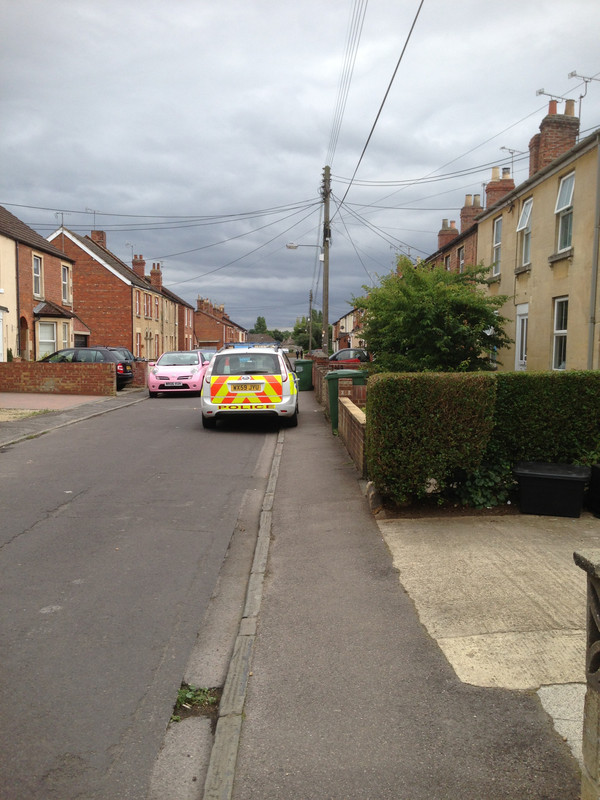
I thought couriers just did what the **** they like, when they like, where they like, how they like?
This time of year is a nightmare. Regular drivers get to know the area, know who's usually in, where to leave stuff if they're not and where to park to quickly drop 3-4 deliveries in one go.
Black Friday / Christmas means the courier companies employ all manner of extra staff who don't always know the area, hey're under pressure to fulfil a ridiculous number of drops... I had a crate of wine go missing (replaced by Virgin Wines) and then the other day got a photo of an Amazon package left on my doorstep, the courier having ignored all the info about leaving it with a neighbour. They often just stop, chuck the package at the door then bugger off again.
cos the alternative will piss off everyone.
You mean piss off other car drivers so you choose instead to piss of those with mobility impairments, children, and everyone who wants to use the pavement.
So I worked as a delivery driver during COVID. Minimum wage, stressful and a large percentage of people you delivered to were incredibly rude. I parked wherever the **** I could and gave zero shits about it.....take it up with the company/people that buy endless shite online was my stance.
You mean piss off other car drivers so you choose instead to piss of those with mobility impairments, children, and everyone who wants to use the pavement.
Exactly.
The obvious solution is to use a means of travel which is cheaper, healthier, uses less space etc.
I wonder what type of vehicle could do that?
Has it ever been tested in court or is this discussion all theoretical?
Commercial Motor magazine "know the law" 24th September 1971, Page 61
An important case from the road transport industry point of view is that of Vanderpant v Mayfair Hotel Co 1930, where it was held that the right of the occupier of premises abutting a highway to make use of it for obtaining access to his premises and for loading and unloading goods is subject to the right of the public to Use the highway. In other words occupation of premises does not give an unrestricted right to use the road outside. A vehicle left on the footpath and one on a grass verge are both standing on a "road" for the purpose of this regulation. https://archive.commercialmotor.com/article/24th-september-1971/61/know-the-law
the plod don’t give a damn, ‘cos the alternative will piss off everyone.
Like other emergency services it’s perfectly legal.
Looking at the guidance for the Edinburgh pavement parking ban emergency services only get an exemption for an emergency call not a blanket exemption
In Edinburgh the pavement parking ban has been a huge success. Round my way which is a very old street layout many streets you had to walk in the road. Now the pavements are clear. a lot of extra yellow lines were put down as well so narrow streets now only have parking one side on the road rather than two sides on the pavement. folk got used to it very quickly

