Have you watched the YouTube videos sadex? Buy. The. Bastard.
(The one from Neil)
Are they both 40th anniversary Squiers?
yes they are. i think gold pick guards came as standard with them. and tbh i quite like the gold, gives it a bit of glam. what do i know tho....
Have you watched the YouTube videos sadex?
(The one from Neil)
Buy. The. Bastard.
NBD for me. Been 5 string curious for a while and saw an Ibanez GSR205B on sale in a local-ish music shop. Went down today and picked it up for £249. I prefer a jazz neck to a P neck and was concerned that a 5 string would find really wide. While this one has the same nut width as my P, the neck is much slimmer front to rear and was really nice to play. Two passive humbuckers with a thunderous active bass boost circuit. Really light as well and the fret edges are lovely and smooth for such a budget bass.
Empty house this afternoon, so been shaking the radiators off the wall. Not as alien as I expected but missing my aim on the A string while skipping down from tbe G. Takes a lot of concentration to hit the right spot. Consider the big B is the selling point of a five, I’m really impressed with the G. Very piano like and nowhere near as jangly as the G on my jazz. Curious to try the B string with an octave pedal, but scared I discover the brown note.
Not destined to be my bass for everything but not a huge amount of money to try something new.

nice. i need to be able to handle 4 strings before i ever consider 5 😀
i also like the look of fretless, especially those without 'marked frets', they look so clean, the singlespeed of the bass world 😀
might be a while before i ever pluck up the courage for either tho.....
I've long compared playing fretless bass (which I've done for more years than I care to remember) to riding singlespeeds ( which I did exclusively for about ten years). The old adage "never complain, never make excuses " applies equally to both disciplines, I think - in other words, approach it with confidence and accept that there will always be disadvantages as well as advantages. And never, ever find yourself saying "I could have ridden that on my geared bike" or "I could have nailed that bridge section with a fretted bass". Because you know what people will say......"Why didn't you ride/play one then?"
any tips on creating your own riffs and the like to complement guitar players chords?
I’m round about that stage as well and have been doing so live streams this week on this theme.
You already know how 1,3,5,8 work together. I’d say next stage is to still use these notes but in different orders. You don’t have to start on the root. Start on the 3 for a change. Also remember you have the same notes below the root.
Rhythm also plays a part. Don’t simply play 1,2,3,4. Vary the note length. Leaving rests can be very effective.
After that, there are more complex stuff such as chromatic, pentatonics and modes but unless you a comfy playing around with the basics, they won’t necessarily add much.
How are you getting on with Bass Buzz? Still working through it or going down different rabbit holes?
ok thanks, and yes, i forget about the lower notes, i really ought to memorise the shapes below the root too.
How are you getting on with Bass Buzz? Still working through it or going down different rabbit holes?
enjoying it. think im module 14 at the moment. its slowed down a bit as i want to keep my 'arsenal' of songs up to scratch, ive got 8 now, so ill often just play through them which takes half hour or so.
i suppose i probably do a lesson every few days, its the long game for me. when ive finished it ill do it again. and yes, i sometimes go down the odd rabbithole 😀
away tomorrow on holiday so ill be a couple of weeks i guess with no playing, then ill be straight back into it.
cheers
well, i had my first 'performance' on saturday 😀
went to see my mates band in the local pub and as they were about to do blitzkrieg bop they called me up to swap places with my mate. good job id had a couple of pints. and more importantly, good job most of the crowd had too so they couldnt hear my mistakes 😀
it's all downhill from here 😀
ive got a short video of it but not sure how to insert into the post. i tried putting it on youtube but it wont allow it due to copyright which baffled me as ive seen loads of youtube videos of covers.
Well done, I seem to have got worse over the past month or so, it is like everything has started happening faster than my brain and fingers can react, I am certainly no where near performing in front of other people.
i need to be able to handle 4 strings before i ever consider 5 😀
Didn't stop me 🙂
Spotted someone selling a near mint LTD 5er near me for a song and couldn't resist. it doesn't take that much adjustment, especially if you play with a pick, hitting the A string accurately in a hurry can be tricky though.
After a bit of twiddling I managed to get her down to A drop G# this weekend which is I think as low as it'll go with the current strings and without some pedal wizardry.
Spent yesterday working out Electric Callboy's Techno Train, which is a lot of silly fun.
well i finished the bassbuzz course, it was well worth the money and ill repeat it at least once i think to pick up some of the things i might have either glossed over, or not been very good at. just working through some of the extra lessons now, first one being 'how to use a pick'. it didnt really tell me anything i didnt know, i was hoping for a few more tricks of the trade but hey ho. i seem to be most comfortable holding it in a way ive never seen shown before with index and 2nd (3rd?) finger supporting the pick rather than just index. i dont know whether to continue with this as its 'my style' or try to drop a bad habit and get used to the 'proper' way of doing it.
when the bass isnt with me ive spent a bit of time trying to learn the fretboard a bit better and can now find the notes of the music staff (stave?) on my fretboard quicker than before by remembering patterns, mainly by knowing the notes on the dotted frets.
i dont know my end goal tho. just to get better at it? yes. to jam with friends? yes, but i dont have enough music playing friends to jam with really so that wont happen. to play in a band? id like to, but see previous comment.
i know my major and minor scale shapes, my triads, my fifths and octaves and lower fifths, but i know id struggle with inspiration for bass lines. so whatever the guitarist is playing i could find the root pretty quick, and know what notes would go with it to a point, but id not have a clue what rhythm or notes to actually play to make it sound interesting, rather than just plodding away on roots and fifths say.
still relatively early days tho, but i wish id picked it up 40 years ago 😀
For learning the fretboard, this popped up on my youtube feed yesterday, I thought I would add it into my practice routine for a few weeks.
For learning the fretboard, this popped up on my youtube feed yesterday, I thought I would add it into my practice routine for a few weeks.
still dont understand the circle of fifths and why theyre using it here. why find B flat for instance? what use is it?
for me id rather be able to find all the whole notes A,B,C,D,E,F and G fairly quickly, and then go a fret above or below for a flat or sharp.
I don't think the circle of fifths is important in the exercise they are doing, its just an additional bit of background information. I try not to worry too much about that bit, the relationship of the circle of fifths will probably become clearer at some point in the future, it's one of those things that will probably just click at one point with experience. I prefer that they do mention it though just so it is logged at the back of my brain to start building up the understanding even if it really isn't very clear at the moment.
Sometime in the future I will probably look at doing more specific music theory classs, I expect SBL, talking bass etc will have courses that cover it aimed specifically at bass which I will do when my general playing has improved enough to start thinking about more musical expression rather than just playing along to existing songs. But that will probably be a couple of years down the road at least.
Wish I hadn't given them a click on that vid.
B flat made Chuck Berry famous, it's quite a nice key to sing to for blokes with a bit of range but who find C a strain. 🙂
The Circle of Fifths is, as far as I can determine, a statement of facts rather than a guide to anything. I have never learnt it, but can point to instances where it applies. That sounds odd, but if you were writing a chord progression, then you might want to use it, but as far as I can see, it has absolutely no practical application to learning anything. I read music, and have done since I was seven, and cannot remember ever using it other than to demonstrate what it means. I genuinely think it's a distraction!
If you read and play or sing from a written score you need to understand key signatures. You need to understand that if there are a number of sharps or flats in the key signature, you could do with knowing which notes you need to sharpen or flatten so that you can play or sing the right notes. Those sharps and flats appear in a given order, which is explained by, and possibly dictated by the Circle of Fifths, but it doesn't help to learn a really complicated series of diagrams and colourful illustrations when you can simply learn a mnemonic for the order of sharps, which conveniently is a palindrome for the order of flats. Beyond that, you can read a key signature simply by going up a semitone from the last sharp to find the tonic of a key signature with sharps, or go back to the penultimate flat to determine the tonic of a key signature with flats. It really is that simple. But if you don't read music what the hell's the point when you can simply learn the Major and Relative minor scales from patterns?
A lot of the stuff I play in church is either in B flat or E flat. A lot of the original recordings on YouTube are in those keys, and it suits the singers. The guitarist simply snaps on a capo and plays mostly campfire chords, and I use a D-Tuner and get on with it. It becomes second nature for me to read the key signature before I start playing, and play both major and minor scales to confirm where the flattened notes are.
I'd forgotten to post on here a project I played bass on last year, suspect there's maybe not many instrumental metal fans here but never mind 🙂
Fairly typical modern metal processing, mostly done on a Dingwall NG2 five string (played fingerstyle and slap), with the bulk of the tone dialled in using the always excellent Parallax plugin. Love it - a super versatile plugin despite it being so good at rock/metal.
Fan frets might be an option if anyone’s getting a refret.
i find fret less to be far easier.
Lacking inspiration: a loop station may be the way forwards. You could try playing orbitals ‘impact’, entirely on bass.
nbd: last bay bass. Promise!
I always hankered for one of these after they were discontinued.
You couldn't just convert to fan frets with a refret (and it would have to be a new board too) Different nut and bridge positions/angles for a start, which you couldn't obtain with a standard 34" neck and body, unless, for some reason you wanted fan frets with the E at 34" and the G at, say, 31" scale length.
For the massive amount of work involved to do all this it would be easier to build a whole new bass from scratch..
I stuck some nylon tapewounds on my bass last night, and I really like them. So far I have tried the normal round wounds that the bass came with, some flatwounds that I didn't really like at all (not just the overly flat tone for my tastes but my plucking fingers didn't seem to get enough purchase on them, just seemed to slip off rather then playing the string, not sure that makes sense it is difficult to describe). I then settled on half rounds which I thought were a good balance.
But the tapewounds are my favourite so far, they are smooth on the fretting hand, while actually having a bit of purchase for the plucking fingers, and while the tone still emphasises the bass they do have a bit more bite than the roundwounds and even the half rounds. I am not doing any slap and pop yet, which I suspect may be their weakness. I also went for 50-105s which I think would probably make them 45-100 or even 40-95 for a metal wrapped string, and I think I prefer the lighter gauge as well.
Assuming the strings that came on the bass were likely to be cheap crap, I probably haven't tried a decent set of roundwounds either. But given the cost of bass strings, I don't think I will keep experimenting at the rate I have up to now.
always excellent Parallax plugin
I tried that, but I don't think I understand it enough to dial in my tone, I have been using the Cory Wong plugin for guitar, and that also has some bass presets as well, so after changing my strings last night I tried that with the amp and cab sims turned off and into my orange combo amp, just using the preset with a bit of tube screamer is my sound for now, but I should really just concentrate more on practicing my playing more than going off piste wasting too much time messing with stuff I don't really understand.
I also downloaded the trial for the dark glass plugin, but couldn't get it to work on my pc.
Yeah Parallax is definitely not the most intuitive, its a bit of a handful and needs experimentation to make it work. Key things for me are to blend some of your unaffected tone with it to maintain some clarity (85% wet to 15% dry is a good starting point), don't go too nuts with the distortion levels, and run a lowpass EQ and a limiter after it. I just use the bog standard ones bundled with my DAW (Reaper.) Without the lowpass EQ filter getting rid of a lot of the high end I find it to be a bit of a fizzy mess.
The Darkglass VST for me didn't do anything that I couldn't achieve with Parallax, so I don't tend to use it.
Ampeg SVT-VR is another lovely amp/cab sim plugin if that's your thing. Great for older school rock tones and the UI is just an SVT head, so its a bit more intuitive than Parallax. You can just mess with it like you would an amp.
Both Parallax and Ampeg SVT-VR can usually be had with a big discount now and again. But agreed, you can spend hours not actually playing and just fiddling with this stuff, which is best avoided!
Fanned frets - I have two Dingwalls, they're both mint, and particularly when I'm in drop-A or something even more stupid, the longer scale length definitely helps with the tone, and especially the playability. However, for standard tuning stuff I'm more likely to play a regularly fretted, considerably shorter scale instrument. The fanned frets and longer scale length of the Dingwalls can make things higher up the fretboard a bit harder for me hit as precisely as I can on a regular fretboard, and for me at least, the fanned frets have no benefit tonally in standard tuning.
Lacking inspiration: a loop station may be the way forwards.
You are Ed Sheeran AICMFP!
Saw someone playing a 3 string contrabass balalaika and now I want one so bad it hurts!
Just look! 🙂 If, indeed, the picture is posted! If not, just imagine, or google it. 🙂


Lacking inspiration: a loop station may be the way forwards.
You are Ed Sheeran AICMFP!
KT Tunstall was there first.
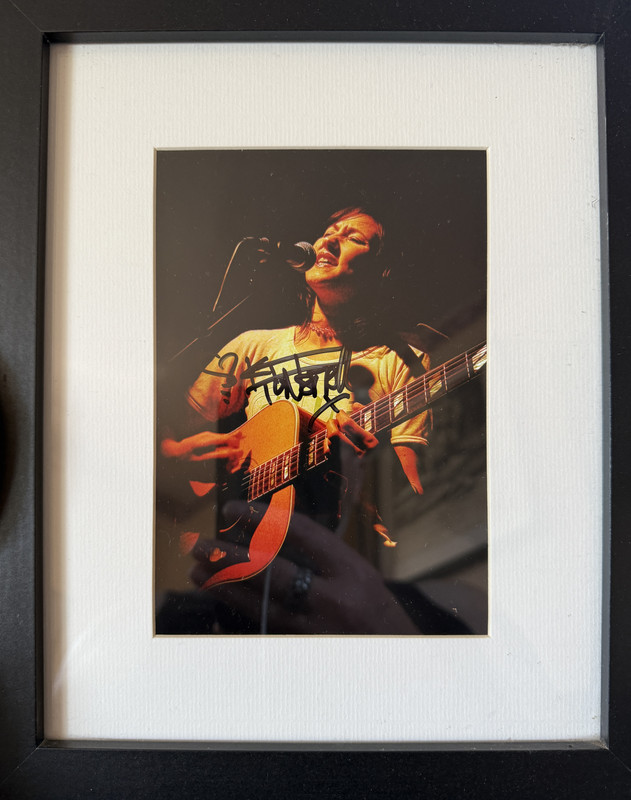
Supporting Joss Stone, before a last-minute appearance on ‘Later…” where she used one on “Black Horse and the cherry tree”, which caused a sensation.
That's the very thing! Really, REALLY want one. 🙂
Any tips on learning songs? Is it just a case of repetition until it sticks? I can learn a section but by the time I move to next one, it’s like the new part forces the first one out of my brain.
Basic 8th stuff isn’t too bad, as it tends to be a repeating chord sequence but anything melodic, I struggle to memorise even things I can sight play no bother.
It may be a bit boring, but I learn in chunks. Learn the first section, then play the first section into the next section so that it becomes a part of the whole. In other words don't stop and move onto another section, play section A until you've nailed it, then play section A again and tag section B onto the end and so on. Learning sections in isolation somehow stops me from being able to stitch them together. The only exception I'll make is when there's a really (initially) difficult riff/bridge or whatever, which needs more processing than the rest of the song.
Take Muse Micro Cuts. The notes are easy (-ish, albeit fast) , the rhythms are complicated by time signature shifts on the fly (the song switches between 4:4 and 3:4 and back again) Once I'd got that the incredible outro riff starts and that took a lot of slowing, nailing, then playing back up to speed.
Outro at 3m10s
I use guitar pro,
Guitar pro allows you to slow it right down, and can even just increase the speed a % or 2 at each play through.
Either learn 2 or 3 sections then join those sections to make a longer section, then learn another section add to the the longer section etc until I am playing thew whole song.
or for other songs where there are only some complicated bits, learn the first complicated section, then play from the beginning to the end of that section, learn the next hard section then play the song to the end of that section etc
Depending on the complexity of the song, a section might just be a bar or two, I just decide by looking at the song big the sections should be.
Also it is worth just looking at each section and trying to work out the fingering a little bit before playing it through rather than making it up on the fly.
Also if I am making a mess of it, I just leave it until my next practice, no point keeping practicing doing it wrong, that just embeds doing it wrong.
well, ive finished my bassbuzz course now, it was well worth the money and im going to slowly go through it again but this time using pick only as thats where i want to be.
i also signed up to a luke mcintosh (become a bassist) course, the 'critical mass bassline challenge' as it was on offer at less than £30 so i thought it was a cheap enough gamble to see if it gives me some skills to create my own lines.
and it does, its not as in-depth or visually effective as bassbuzz, but i think it was worth the money. however it just brought up a question in my idle sunday morning musing.....
roots and fifths. yep, i get it, they work well together. triads, ok im adding a note now and going root, 3rd and 5th. ah, pentatonic scales, right, the 'best' 5 notes of a scale..... and the critical mass course is suggesting ways of using this scale, lots of the best bass players use it, heres the double pentatonic box etc etc and i sort of get it and will practice these as time goes by.
however hes now introduced the 'hexatonic scale' which adds in another note that can 'just give it an interesting twist' and im thinking well..... we're only one note short of a full scale here now (heptatonic anyone? :D), so why are we actually calling them triads, pentatonics, hexatonics, why arent we just saying look, heres all the notes of a scale, knock yourself out and find something that sounds good to you, rather than limiting yourself to roots and fifths, triads, pentatonics, hexatonics etc....
he's also suggested trying some chord progressions but using the 3rd or 5th instead of root to give an interesting twist again. ive tried it on a few songs but it just doesnt sound right to me, but i get it, its all just experimenting and it might just sound right/interesting on the odd occasion.
.
however hes now introduced the 'hexatonic scale' which adds in another note that can 'just give it an interesting twist' and im thinking well..... we're only one note short of a full scale here now (heptatonic anyone? :D), so why are we actually calling them triads, pentatonics, hexatonics, why arent we just saying look, heres all the notes of a scale, knock yourself out and find something that sounds good to you, rather than limiting yourself to roots and fifths, triads, pentatonics, hexatonics etc....
Simplicity. Triads/pentatonics aren't just three or five random notes from a scale. They are defined intervals from the root that work together in harmony. Think of it like cookery. They form a basic recipe to which you can add complimentary flavours once your skills improve. You can't make a chocolate cake without the basic cake ingredients. That's what triads are, The intervals approach helps train the ear when you start out, and build on it once you get more experience .
yeah i get that, i spose what im trying to say (and not very well i guess) is that if you dont need to use all of the notes in a scale, then isnt the pentatonic just the same as a hexatonic scale 'but we're not using all of the notes', or a full scale 'but we're not using all of the notes'? so unless youre using all 5 notes, then why is it pentatonic?
i dont think im explaining myself very well am i 😀
It’s about simplicity as @clubby says.
Take the minor pentatonic scale. The notes are always 1,3b, 4,5,7b (or dominant )
The minor pentatonic is a dead simple pattern to learn, and coincidentally “fits” or works well harmonically with all notes in the major key as well as the minor. (Long complex reasons why, just believe!) So it is used by guitarists to create solos. Guitarists, being simple souls, can therefore learn the pattern, and instantly become the next David Gilmour. Apparently.
We bassists can use the same patterns and notes to create banging riffs and fills.
So, the five notes in the pentatonic scale are the seven notes of the major or minor scale with two notes removed.
You can add a note to a pentatonic that isn’t in the major or minor key to create a hexatonic scale. For example the blues scale is a pentatonic plus an augmented fourth. So although it has six notes, it’s played by first losing the 2nd and the 6th to create a pentatonic, then adding a new “blue note”
Similarly a harmonic minor scale is heptatonic, but is played by removing the flat 7 and replacing it with a raised 7.
So it’s all about whether all the notes were originally in the main key, or whether new notes have been added or substituted
Gilmour mixes and matches in his solos. Comfortably numb for example mixes blues licks with harmonic minors
You can add a note to a pentatonic that isn’t in the major or minor key to create a hexatonic scale. For example the blues scale is a pentatonic plus an augmented fourth. So although it has six notes, it’s played by first losing the 2nd and the 6th to create a pentatonic, then adding a new “blue note”
Similarly a harmonic minor scale is heptatonic, but is played by removing the flat 7 and replacing it with a raised 7.
ah that makes more sense. i hadnt twigged that these 'extra' notes werent in the main scale. i was thinking hexatonic was 6 of the possible notes in the scale.
thanks for your comprehensive answer
How the hell you play a normal acoustic guitar? My neighbour got himself a posh new acoustic and gave me an old, repaired Tanglewood he never plays. Really struggling with the string spacing. Can barely strum a chord without my fat, bassist’s finger muting half the strings. Occasionally play a beautiful crisp G but the rest of the time there’s at least one muted note. Tried a C and it sent my entire fretting hand and arm into cramp. I know it’s just a matter of practice but I manage 10-15 minutes before putting it away and picking up my reassuringly heavy bass, with its nice fat strings that don’t try to slice through your fingertips and slide back into the warm comforting feeling of an open E, vibrating my entire insides. Don’t know whether to keep on trying little by little or take it as a sign I picked the correct instrument in the first place.
Leave it be clubby, ‘tis the devils work.
Definitely some sort of magic involved. I'm a lockdown bass noodler and I also bought a cheap jazzmaster copy from HB, and play both just for fun. I don't have particularly fat fingers although my hands are quite big and like clubby really struggle on the 6 string getting clear chords because of inadvertent muting.
I watched a busker the other day - really closely, playing beautiful fingerpicking of chords and his fingers looked like sausages that had had the ends whacked down flat and I couldn't hear anything but crisp notes. I can't physically see how so must be black magic.
Guitars do take a long time to adapt to when you’re used to bass - the string spacing and tension is so different, as is what you’re doing with them. Try a Fender Bass VI if you get the chance, to get even more confused!
Quite a few of the guys at work are predominantly guitarists who also play bass in other bands and it’s interesting to see how differently they play bass to me.
On another note entirely, I’m being quite tempted by the Reverend Fellowship - it’s the Meshell Ndegeocello signature, basically a set-neck Precision. Partly liking the idea of a better P demo bass (we have a great one with flats but the one with rounds is just ok) but also wanting to finally get myself a nice P, mostly for nasty old school funk vibes.
And it looks so good! (this is where I try to add a photo and fail…)


Nice. I take it the single knob is volume? Lots of reviewers slag this off, but I have a Mark Hoppus Jag with no tone control and i wouldn't want the bass to sound any different, ever. What's even funnier is the guy who ripped signature instruments with no tone control was gushing about the Sterling Joe Dart, which has no tone control.
Actually it’s a stacked volume and tone (on top) with both having centre detents - really unusual!
I’ve got a Wattplower 2 which has the same pickup in a shortscale (and slightly closer to the neck) and it’s properly hot so I’m wondering if there’s potential for leaving the vol at half and using it as a boost sometimes.
But I know what you mean about not touching the knobs - when I’m trying to sound like someone else for a video then I’ll use them but for me I generally leave things flat and use my hands to change the sound. I play unplugged all the time at home so turning the knobs on that (hollowbody) bass doesn’t do anything!
Ordered it! And in the process of testing if I’d like it, I discovered something:
(TLDR: Downtuning doesn’t just give you lower notes, it changes your tone a lot. And uptuning will too, in the opposite direction. Try it, it’s free! (NB - neck relief/action will change but don’t panic))
I’ll try not to write an essay but today I was doing a test to see if I’d like the Reverend Fellowship (their Meshell Ndegeocello sig set-neck P-bass). I’ve been wanting a better P to wear rounds and I’ve been very impressed with every Reverend I’ve tried.
We already have a Wattplower 2 which has the exact same pickup but on a 30” scale. I’m not sure if most bassists know this but a short-scale bass is essentially a long-scale bass detuned a whole step (D standard) and then capo’d at the 2nd fret. Ok, so that’s 30.3” but it’s pretty damned close!
So I figured that if I tuned the Wattplower to F# standard it would have the almost the same acoustic tone as the Fellowship (pretty much the same woods and construction).
The other aspect is where the pickup is along the length of the string. On the Wattplower 2 the P is closer to the next proportionally than on a Precision. But tuning the bass up effectively pushes the pickup towards the bridge. Conveniently this puts the pickup in almost the exact Precision position as on the Fellowship.
Anyway, if you’ve played a Wattplower or heard Watt wielding it, you’ll know it’s a very fat little thing, very warm, a bit dark, just enough punch and growl to come through a mix. (If you don’t know Mike Watt’s playing, stop reading and start with Double Nickels On The Dime!) As shortscales go it sounds big, much bigger than a Mustang. However it’s not what I want in an old school funk weapon.
But tuned up to F# standard it sounds so much brighter, growlier, tighter, and yes it’s less fat and warm but also kind of deeper under there. This has me very excited for the Fellowship which should sound almost the same but will get me back to E standard.
And then that got me thinking - what happens tonally when we tune down? We’re slackening the strings like a shortscale so warmer and fatter and rounder with a less quick attack and also effectively shifting the pickup(s) towards the neck, so making the sound more deep, less bright, less midrangey.
It’s a much bigger change than I expected! (Caveat - this was through our prototype Zero amp and Big 24 cab so they’ll show up subtleties more than other rigs, they’re hyper accurate).
Anyway, give it a go!

