Forum menu
http://www.engadget.com/2011/10/17/remember-those-faster-than-light-neutrinos-great-now-forget-e/
"the GPS satellites used to measure the departure and arrival times of the racing neutrinos were themselves subject to Einsteinian effects, because they were in motion relative to the experiment. This relative motion wasn't properly taken into account, but it would have decreased the neutrinos' apparent journey time."
Doh....
well, there's a surprise, the maths was wrong.
To be fair to the original scientists, they said from the start that it was more likely to be an error in measurement.
They should have used a Tomtom with the Eurpean maps built in.
I'm surprised they made such an elementary mistake. I sense a cover up. The US Army must have bought the intelligence and don't want the russians to know they have a neutrino cannon that can shoot backwards in time.
I'm just a bit stuck now, no idea how to get back from 1856
Or someone has come back from the future to fiddle the results?
Ah you mean like this..
[img] 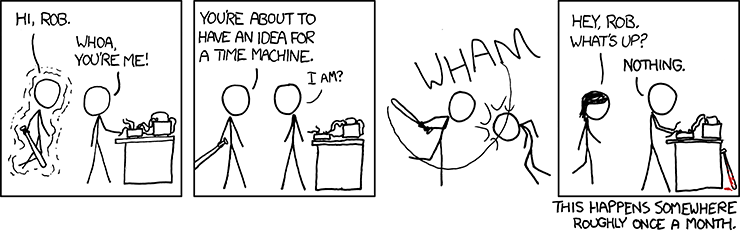 [/img]
?
I have to say that this is entirely predictable, the scientists involved knew it was almost certainly an experimental error and they still published.
Not only did they publish, but they hit the PR circuit and got blanket coverage on TV and newspapers down to dossers on internet forums like this.
The whole point is the sensation. I'm betting that around about now some people have to decide about the next few years funding for CERN and they have to make themselves look worthwhile. This is certainly true of NASA, they periodically spit out stories of life on the moon / mars / some other galaxy, almost always right before congress looks at their funding.
Real science is almost always massively parallel, slow, incremental and (in the short term) predictable. As i always say to students, if your experiment looks too good to be true, thats because it is.
Other articles that I can't find now suggest this debunking isn't the answer; GPS is already compensating for relativity, it wouldn't work otherwise, and it sounds like this new paper is published by someone who isn't actually qualified in the field. There is almost certainly an error, but problems with GPS relativity corrections isn't it.