UPDATE: CLASSIFIEDS section refreshed, redesigned, searchable: Go take a look
I'm not talking about ones which merely have a rigid fork, these usually have a long fork to compensate for the absence of suspension fork it was designed around. I'm talking about bikes cleverly designed to be great mountain bikes with rigid forks, free of the limitations of suspension forks (rake, length) and mindful of the way it rides rigid - i.e. reduce weight on front wheel etc.
The bootzipper is an example but its geo is old school - can you even get a 29 x 3.0 in the fork?!
I have a Stooge Mk4 which is fairly edgy with its geo especially the big fork rake.
Anyone else out there experimenting with new geometry specifically for rigid forks?
I'd love to try this: https://www.peterverdone.com/pvd-sopwith-camel/ alas it's one mans hobby horse not for sale.
[img] 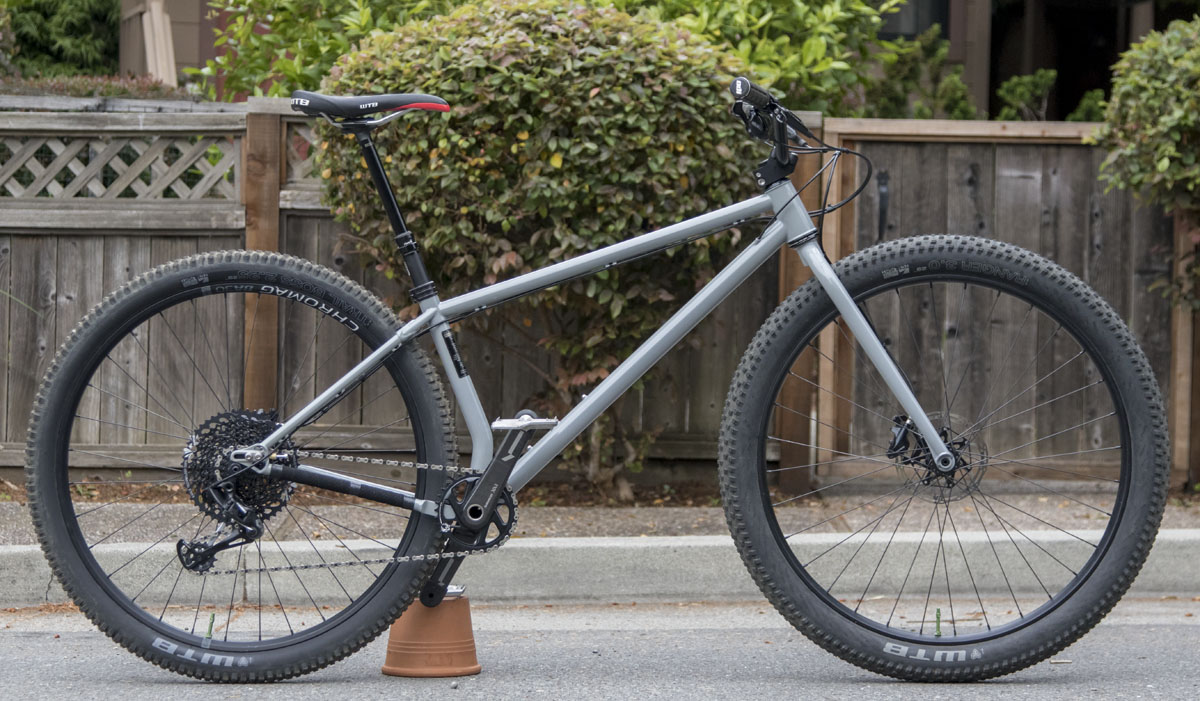 [/img]
I think weight is one of the last things on the mind of people making bikes like this!
https://nsmb.com/articles/personal-rides-andrews-custom-waltworks-v2/
https://www.jonesbikes.com/bicycles/
I don't mean weight as in the weight of the frame, I mean the balance of rider weight between the wheels
fundamentally you ride a rigid fork differently to a suspension fork, it seems to ride them fast down steeps / tech you need to put less weight on the front wheel than you would get away with on a suspension fork.
Therefore a frame which moves the front wheel forwards to reduce the weight on it may be desirable. The wheel might need to go further forward than with a suspension fork - so you kinda need a custom fork without going to ridiculously slack HA and then come into problems with flop and trail. The Stooge mk4 does this by designing around a big rake fork.
Seemingly the stooge does have a load of unnecessary weight in the twin top tubes and bi plane fork and a lighter frame with the same geo might be easier to lift over gates and fences.....
Jones doesn't publish geo charts which is weird.
“The Stooge mk4 does this by designing around a big rake fork.“
So do the Jones bikes. I’m guessing Jeff doesn’t publish geometry charts because even without them being available he gets enough imitators!
The truss forks are a good idea if you’re intending to ride hard - the amount of flex on any single crown fork when seen in slo-mo is pretty scary.
Love the look of the bike in the pic, would liek to try that.
The Surly Krampus was in its day, though the HA of 69 degrees seems old fashioned now.
7 (or was it 8?) years ago the idea of a rigid hardtail designed to be taken fast over and down stuff was quite groundbreaking. Add to that the invention of 29+ wheels then Surly seems pretty forward thinking.
I'd like to see an experiment where 2 bikes are compared with a stretched out wheelbase (e.g. PVD's bike up there), one slack like PVD's the other traditional HA, but equal wheelbase. The steep HA bike would need a really long top tube and it may be difficult to get it stiff enough without using carbon.
fundamentally you ride a rigid fork differently to a suspension fork, it seems to ride them fast down steeps / tech you need to put less weight on the front wheel than you would get away with on a suspension fork.
Not sure what this senetence means. I put more weight on the front of my rigid bike because it won't dive. Although I can't ride anything round here fast on rigid - just too rough. I like rigid because it's better for riding and climbing on medium to smooth trails, I have 2 FSs for going fast.
What is the stem on that PeterVerdone bike? Want one for my Stooge
I want that whole bike!
I've just realised what makes it look so strange, it's the 390mm seat tube length, with the 29+ tyres - there's not many bikes with the seat tube below the wheels.
What is the stem on that PeterVerdone bike? Want one for my Stooge
Some sort of top mount BMX stem I'd say.
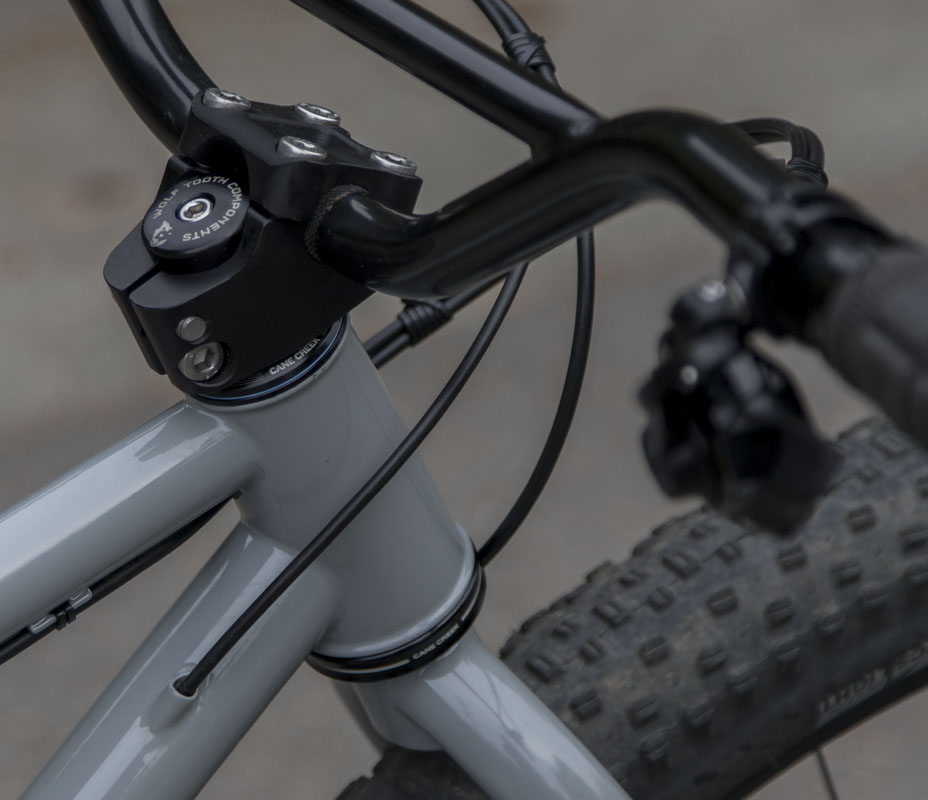
Doesn't look dissimilar to a Funn Funnduro stem:
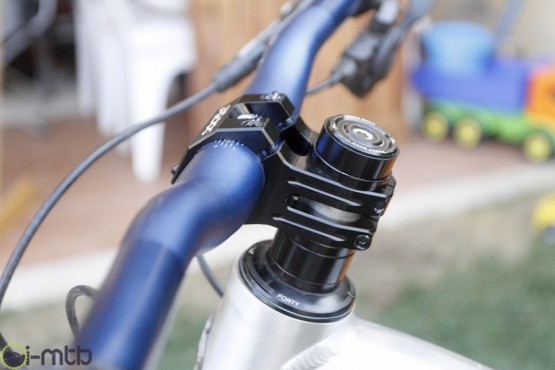
*edit* actually quite different! But that's the closest MTB stem I can think of.
Good work ajontom. Maybe a tad short anyway at 26 mm reach!!!. I'm on a 50 mm at the moment and fancy trying a 40 mm
The Ragley TD1 was rigid-specific. Also the original Genesis Fortitude, which had a slacker (69ish - not that slack now) HTA and lower offset fork to get the trail number and weight balance about 'right'.
From what I remember of the Mk1 Stooge when there was a drawing on the website, the front end (HTA and fork offset combo) was the same as a Jones though the Stooge was shown with a bigger 29+ front tyre lifting it up which slackened it off a bit. You get the same numbers from the original Jones bike with a 29+ tyre in the front. The Jones is much shorter overall though. Very easy to get off the back of, I know what you mean about less weight on the front. It's very easy to move weight around on a bike like that and quite different to riding a long reach bike where there's a longer sweet-spot for your weight and it works better with greater weight shifts. Not such a popular way to set a bike up now, it works though.
Add to that the invention of 29+ wheels then Surly seems pretty forward thinking.
One of a few things they've done that I expect they'd credit Jeff Jones' influence in. Jeff was on the biggest 29 tyres and rims available for a while before others really saw the benefits but it takes QBP's volumes to create a tyre range.
The Ragley TD1 was rigid-specific. Also the original Genesis Fortitude, which had a slacker (69ish – not that slack now) HTA and lower offset fork to get the trail number and weight balance about ‘right’.
It would need a higher offset fork to correct the trail shirley
Slacker HA reduces trail so you need a bigger offset to "correct" that. Hence the stooge 80mm offset.
I'm just interested in how people push the boundaries when freed from "industry standards" of suspension fork and fork offset. PVD makes his own bars/stems too to free his designs from those constraints too.
But apart from PVD and stooge nobody seems to be doing it much, probably there is no market for these bikes.
Yeah you are gonna go faster on an FS bike, but faster is not everything. Fast can be a lot of fun on the right rigid bike too.
Jeff Jones no geo chart? well why would I buy one or try one if don't know what i'm buying or trying? i'm trying to understand the nuances in geo for rigid riding, no geo chart makes that very difficult. If anyone wanted to "copy" his geo, they could just measure it from a frame or even just a photograph!
Good work ajontom. Maybe a tad short anyway at 26 mm reach!!!. I’m on a 50 mm at the moment and fancy trying a 40 mm
His philosophy is to put you on the shortest stem, and lengthen the frame to provide an appropriate reach.
A long front centre is everything, whilst keeping the head angle sane.
Actually he likes to fit to a 50mm stem, then you have an inch to reduce if the riding style changes.
Loving these bikes. My trail / xc is an inbred 29er and when I bought it it was considered a long top tube but I ideally wanted it a fair bit longer and a lower top tube. I hadn't considered headangle but look like I was on the right track, Shane I couldn't get it back then.
You can find difference between old Jones 29 and the newer SWB here https://www.jonesbikes.com/jones-plus-swb/ similar angles and rake to stooge mk3 and I believe the Jones LWB has same angles and rake as stooge mk4. Correct me if I'm wrong.
The Ragley TD1 was rigid-specific. Also the original Genesis Fortitude, which had a slacker (69ish – not that slack now) HTA and lower offset fork to get the trail number and weight balance about ‘right’.
Loved my TD-1, not quite sure why I sold it. Made an awesome ss.
Pinnacle Ramin 3 plus another awesome rigid bike no longer made...
From what I've been seeing, the most progressive off-the-peg rigid bike, at the moment, seems to be the Kona Unit, which looks very similar to Andrew Major's V1 Waltworks.
It appears that the Bootzipper falls almost exactly between the Kona and my old geo Karate Monkey. I think there's still a lot to be said for the older KM, but there are too many work-arounds needed for dropper use, plus TA's would be nice.
Peter Verdone is definitely pushing the rigid envelope though. His more recent rigid bike has some very interesting innovation regarding the stem/bar position, though I'm not sure how this would filter through into the mainstream.
There certainly seems to be a lot of rigid and singlespeed noise bubbling around at the moment.
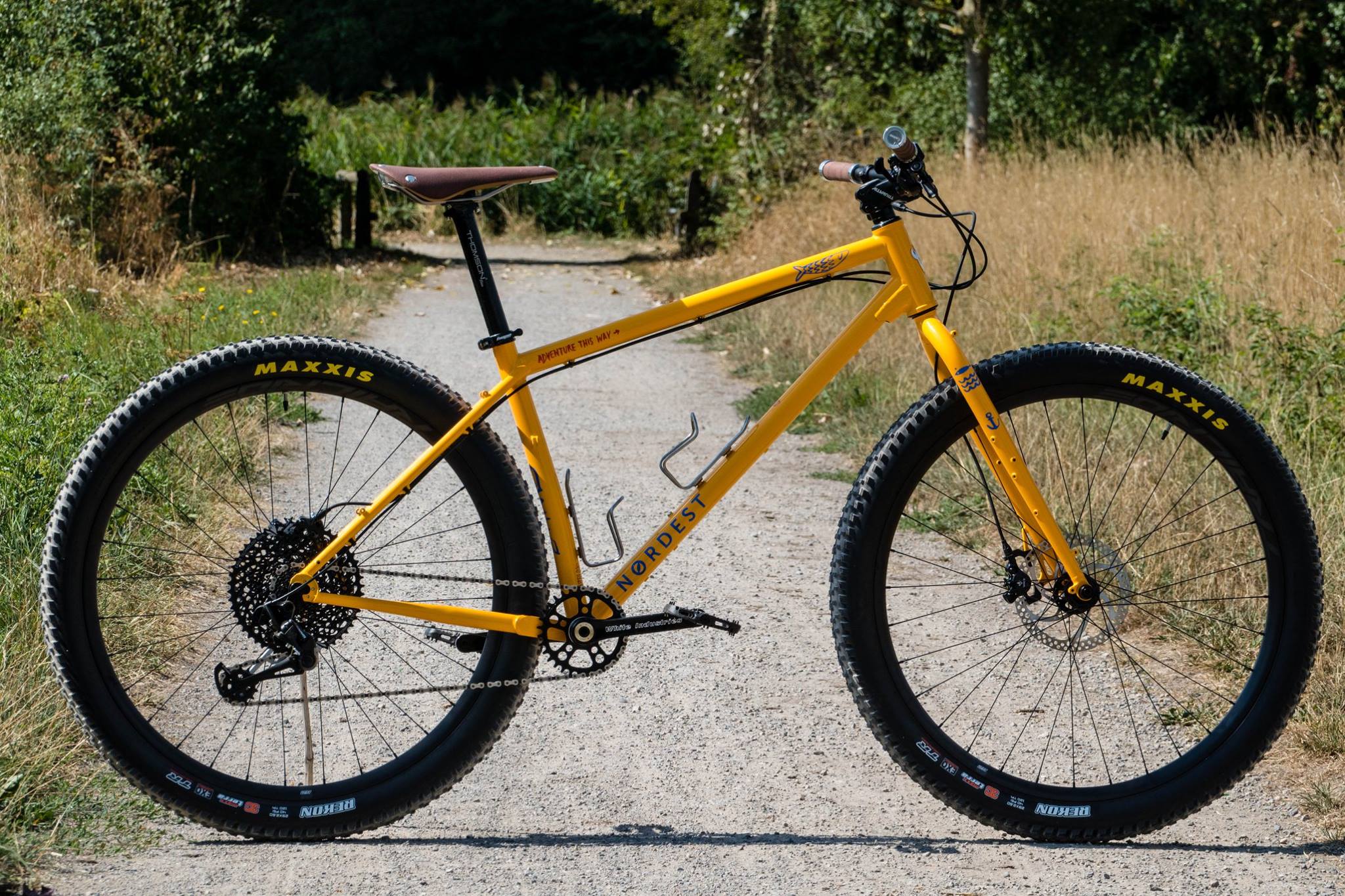
Not super slack at 67, but currently on sale for 399 Euro
https://nordestcycles.com/en/product/sardinha-frame
That PVD bike is lovely an all, but with such a slack head tube and only 50mm rake, the steering must be a bit rubbish, no? I'm sure it's very stable down the steeps though! And why such a slack and short seat tube?
Please don't ask PVD for the answers.....
The chainstays are really short, so the effective seat tube isn't as slack as the (bent to clear the rear wheel) actual seat tube looks. And he insists that huge droppers are essential hence the short tube. And his is the perfect tube bend and all other bends are useless. And all droppers have to be xx diameter and blah blah blah nothing else is valid and you just aren't worthy of his greatness.... http://www.peterverdone.com/the-right-way-to-build-and-spec-bent-seat-tubes/
It would need a higher offset fork to correct the trail shirley
Depends how you want to correct it / what's 'correct'? The Fortitude set up gives a long trail stable bike with a shortish stem, without pushing the front wheel out too far in front relative to the bar ie you didn't actively need to weigh the front too much, could ride it 'light' but not twitchy.
And he insists that huge droppers are essential hence the short tube.
They kind of are, if you want to corner a geometry like that well : )
Jeff Jones no geo chart? well why would I buy one or try one if don’t know what i’m buying or trying? i’m trying to understand the nuances in geo for rigid riding, no geo chart makes that very difficult.
I like his style.. There's no way you can predict how his bike rides from the numbers imho/ime. You'd get more from reading about them or talking to him about them - the numbers might even put you off if you made assumptions based on other more conventional bikes. Took me a while to really get used to riding mine, to learn new habits. Well worth it for how well the bike suits the local riding I do most often.
I should just rigid my 2020 torrent. It will be nuts.
the amount of flex on any single crown fork when seen in slo-mo is pretty scary.
Only if you have no idea how materials react to loading. If you find that scary I recommend never looking at a planes wings during takeoff or a ships companionway in rough seas.
Not sure what this senetence means. I put more weight on the front of my rigid bike because it won’t dive. Although I can’t ride anything round here fast on rigid – just too rough.
I'd suggest the latter is the fault of the former. I used to rip down heavily rutted cow fields and rooty woods on my old Diamondback ATB as a kid on 1.9s by keeping my weight well off the bars save to hold course. That's the technique that everyone seems to have forgotten and instead look to bikes with geometry based on the Jahre Viking to "solve".
I'm not saying those bikes don't have their place but they're by no means the only way.
But apart from PVD and stooge nobody seems to be doing it much, probably there is no market for these bikes.
I'll sound like a fan (I am) but the Jones LWB deserves to be on a list there. Influential and original bike. Another bike that rode very differently to what I expected, felt far more agile at times. He seems to sell some reasonable numbers of them.
the amount of flex on any single crown fork when seen in slo-mo is pretty scary.
Only if you have no idea how materials react to loading. If you find that scary I recommend never looking at a planes wings during takeoff or a ships companionway in rough seas.
This is true, though when people talk about +/-5mm offset and the difference it makes, yet the fork flexes back more than that under braking load ... ok so you're not steering under hard braking but that flex is still something we just get used to. the Jones Truss is a real eye-opener in what a rigid bike can handle. You only realise how precise it is when going back to a sus fork (XC 32-34s more than a bigger fork).
Lol, all my forks are 32s and none are XC spec. Funny how these things change.
“Only if you have no idea how materials react to loading. If you find that scary I recommend never looking at a planes wings during takeoff or a ships companionway in rough seas.”
I’m perfectly aware how materials react to loading but I was using a degree of hyperbole to point out an issue which clearly has a significant effect on handling, rather than talking about the obvious advantage in force vectors and resulting torques around a dual crown fork vs a single crown.
It’s not hard for a relatively aware rider to detect a change in head angle of one degree or a change in fork offset of 10mm. But the stiffest single crown suspension forks flex more than that in use and that will clearly affect how the bike feels. With a rigid fork you have no squish or damping to disguise how fork distortion in any axis is affecting steering behaviour and handling, and there’s also an argument that precise steering is even more critical when you can’t just hold on and hope your suspension travel will let you ride straight over everything.
2020 Kona Unit/Unit X doesn't look a million miles from that.
I love a good rigid bike, the way the geo doesn't change when riding steep drops as well as the climbing efficiency.
I had this custom built just over three years ago, I think it would still qualify as a fairly progressive rigid bike today...
[url= https://live.staticflickr.com/4270/34779725736_3d543b3186_4k.jp g" target="_blank">https://live.staticflickr.com/4270/34779725736_3d543b3186_4k.jp g"/> [/img][/url][url= https://flic.kr/p/UZnbKJ ]2017-05-22_12-18-06[/url]
It's by far the most capable rigid bike for full on techy, steep trails I've ever ridden. With a 3.00 x 29 Minion on the front it will charge through rough terrain at a rate no rigid bike has any right to.
I also have a Singular Swift, and a Bootzipper (both currently for sale if anyones looking) and there's really no comparison.
Looking at the Stooge MK4, I haven't ridden one but that looks like it should be a lot of fun. The geometry is getting so much better.
A slack HA and correct rake mean that it is very capable downhill while still steering nicely on flatter terrain
As others have mentioned above, there's always a balance between weighting the front wheel and not smashing your wrists to pieces on a rigid bike. Despite the likes of Peter Verdone spouting his nonsense, nobody has it 100% right. It's always a compromise.
In the three years since building this bike, I have changed my thinking slightly, and would do it a little differently today.
The main thing being that keeping that weight over the front wheel can be done more with the feet than the hands if the balance between the axles is right.
I've read Jeff Jones musing on this, and PVD makes a lot of sense on the subject too, but as above, nobody has it 100%. PVD is hard to read sometimes as he comes across as such a massive, massive bellend, but I love the work he does.
I’d suggest the latter is the fault of the former. I used to rip down heavily rutted cow fields and rooty woods on my old Diamondback ATB as a kid on 1.9s by keeping my weight well off the bars save to hold course. That’s the technique that everyone seems to have forgotten and instead look to bikes with geometry based on the Jahre Viking to “solve”.
In my experience rigid is rigid. When you get to really rough terrain the geometry is not going to help, it is still a rigid bike. Geometry clearly makes a difference with handling, and also making going downhill or uphill easier or harder but it won't smooth out a very rough trail.
I have to use a fair bit of techinque to ride my track geometry bike off road (especially steep downhills) but again technique doesn't make the bike comfortable and doesn't really make it any faster because it is still a rigid bike.
bedmaker
PVD is hard to read sometimes as he comes across as such a massive, massive bellend
He is that, but I suspect it's his on-line persona.
What he does do though is put his money where his mouth is, and not only rides the sort of bikes he prescribes, but also builds them.
In discussions about bike geometry I always bear in mind that people ride unicycles, so you'll probably find people who can argue for any style of geometry and it will be right - for them.
The ability to change your body's CoG has more bearing than any other factor IMO.
I think the comments on having weight in the right position on a rigid to protect hands are bang on. Jeff Jones and stooge have the same angles but I think the main difference is that the Jones has longer chain stays and a shorter reach, this helps that more centralised, upright position which probably helps with steep climbs and makes it more stable on descents, though maybe less agile.
You can almost gain this position on the stooge having a shorter stem and rotating the EBB to the front ime.
I had this custom built just over three years ago
Have you got a geo chart + what you would do differently?
I stuck a carbon rigid fork in my signal and it's surprisingly capable and comfortable. There was someone on here with a Solarismax and rigid fork which looked rather radical.

Mk.1 Surly Instigator with Krampus forks. Was a hoot to ride, but the Stooge then scratched the itch properly!

Geometry is -
HA 63
SA 75.5
Reach 450
Chainstay 440
BB drop 60
Fork has 100mm offset.
This gives mechanical trail and wheel flop figures very close to stuff already known to work.
The slack HA along with the large offset means the wheel sits way out in front and gives a feeling of invincibility on really steep ground, steering is still good though.
Doing it again today, I would -
Lengthen the reach to 500 and use a tiny stem.
Steepen the HA a bit and use less bonkers fork.
Put sliders on to allow chainstay length adjustment from 435-455.
Jeff Jones and stooge have the same angles but I think the main difference is that the Jones has longer chain stays and a shorter reach, this helps that more centralised, upright position which probably helps with steep climbs and makes it more stable on descents, though maybe less agile.
The Jones is probably the most agile mountain bike I've ridden, maybe inc the little HTs that were so much fun in the 97-2003 era. It's only the big wheels that stop it feeling as darty as a Chameleon or down-sized Kona did then. It made me realise that a short chainstay isn't anywhere near the factor that it's made out to be. The bar to rear axle dimension is important as that's what limits how far off the rear wheel you can get your weight - where your feet are / BB is relative to the axle influences the balance but it's something you adapt to easily. A bike with good F-R balance that is shorter overall takes less input or weight shift to influence. Pros and cons to that, and you can't get up steep climbs on the Jones geo in the saddle as easily as a longer bike but the pay off is very natural, agile handling on anything flowy or technical.
Bedmaker, the great thing about your bike is that it did look OTT, and if a bike like that's not OTT you won't know if you've gone too far or far enough.
I loved my Jones spaceframe with 29er wheels on and with a 4.3 fat front same diameter as 29er but wasnt so keen with a 29er plus on the front, but
When I came to need to sell a bike I sold the Jones as it just wasnt THAT much better than my pinnalce ramin plus for my needs
But a year later I did go see the main man at stooge for a spin on a speedball and tbh wasnt sold, but he let me have a quick spin on the stooge 3 27.5plus and it was bloody lovely feeling, if I get chance to buy one of those it would probably be the only thing that might replace my ramin, or more likely sit next to it lol
I should have grabbed one when I was there but I wasnt certain, I do miss the Jones too lol
Apologises for my covid ramblings I'm still recovering
GWS Mick : )
When I came to need to sell a bike I sold the Jones as it just wasnt THAT much better than my pinnalce ramin plus for my needs
I remember test riding the samples of that bike on B+ wheels and being both really happy that it was as much fun as my Jones, and disappointed that my expensive posh bike was only subtly better in some ways : ) Different set ups but similar results. There are times when I realise just how good the Jones combo of stiff fork and f wheel, balance and geometry is but I have to push it hard to get there and it's usually one of those *fk-sht-fk-spot where I'm going to hit the deck but then ride out of it* split second things. And when you see how some people can ride the Jones it does put things in perspective, I'm not at that level of riding.
Thanks mate 😉
The ramin is ace and like you say it's only occasionally but the thing i do miss I think is the truss fork
I'd have liked to tried a Jones diamond with truss and without truss just to see how different it felt and how the diamond compared to the spaceframe
But at the current time I'm just dreaming of riding the ramin when I'm up to it

