
MegaSack DRAW - This year's winner is user - rgwb
We will be in touch
After a recent tumble down a flinty stretch of downhill I realised that my non-existent first aid kit was an embarrassment, thanks to my fellow riders for bailing me out with sterile wipes, tape and other stuff to stem the flow of claret from my mangled shins. (luckily we have a vet in our group whose opinion is always valued post-crash. She occasionally does a nice job of sewing up our most reckless rider)
Lessons learned... I am now compiling the definitive mtb First Aid kit. A happy balance between comprehensive field hospital (heavy but effective) and a packet of small elastoplast (light but not cutting the mustard...)
What are the top bits of kit to include. Is there a supplier that's done all the research and sells it complete already...? Suggestions if you please?!
I have a life systems kit, cant remember the name but its RRP was £15 (F&T 3 for £15 deal) and I up armour it with foil blanket, disposable saline pod!, tampon and cling film (wrapped around the foil blanket).
Why? Foil blanket: keep patient warm, attract attention; saline, wash wounds/eyes; tampon, stem blood flow (break open and bind tightly in wound), cling film, wrap wounds in to hold bandages in-place & keep dry clean.
Can't go far wrong with a load of triangular bandages, lint or similar and some flexi-splints. Plasters for small wounds if you really must.
Ducktape. You'll be suprised what you can do with it when you can see your bone.
Funny you should ask that, one of our group took a major tumble after hitting a Bedouin's sheep at high speed on a rather sporty descent last weekend. Since I had to use some of my stuff I have reviewed my first aid kit which now includes:
For my own safety:
Resuscitation shield
Latex gloves
For bleeds & cuts:
2 non-adherent dressings
Extra large adherent dressing
Assortment of plasters including butterfly plasters
Breaks (collar bones, etc):
Triangular bandage
Misc:
2 cleansing wipes
2 sachets antibiotic ointment
1 sachet burn gell (hot disc brakes - ouch)
Micropore tape
In case I forget in the heat of the moment:
St John's resuscitation/CPR aide memoir.
All in a nylon pouch about 8 by 3 inches. Total weight, 100g.
I have never found a first aid kit on sale that contained just the right things I wanted. Or they come with extra things that are unnecessary, such as scissors. Buy a cheap one and then amend the contents to suit. And then hope you never need it.
[img] 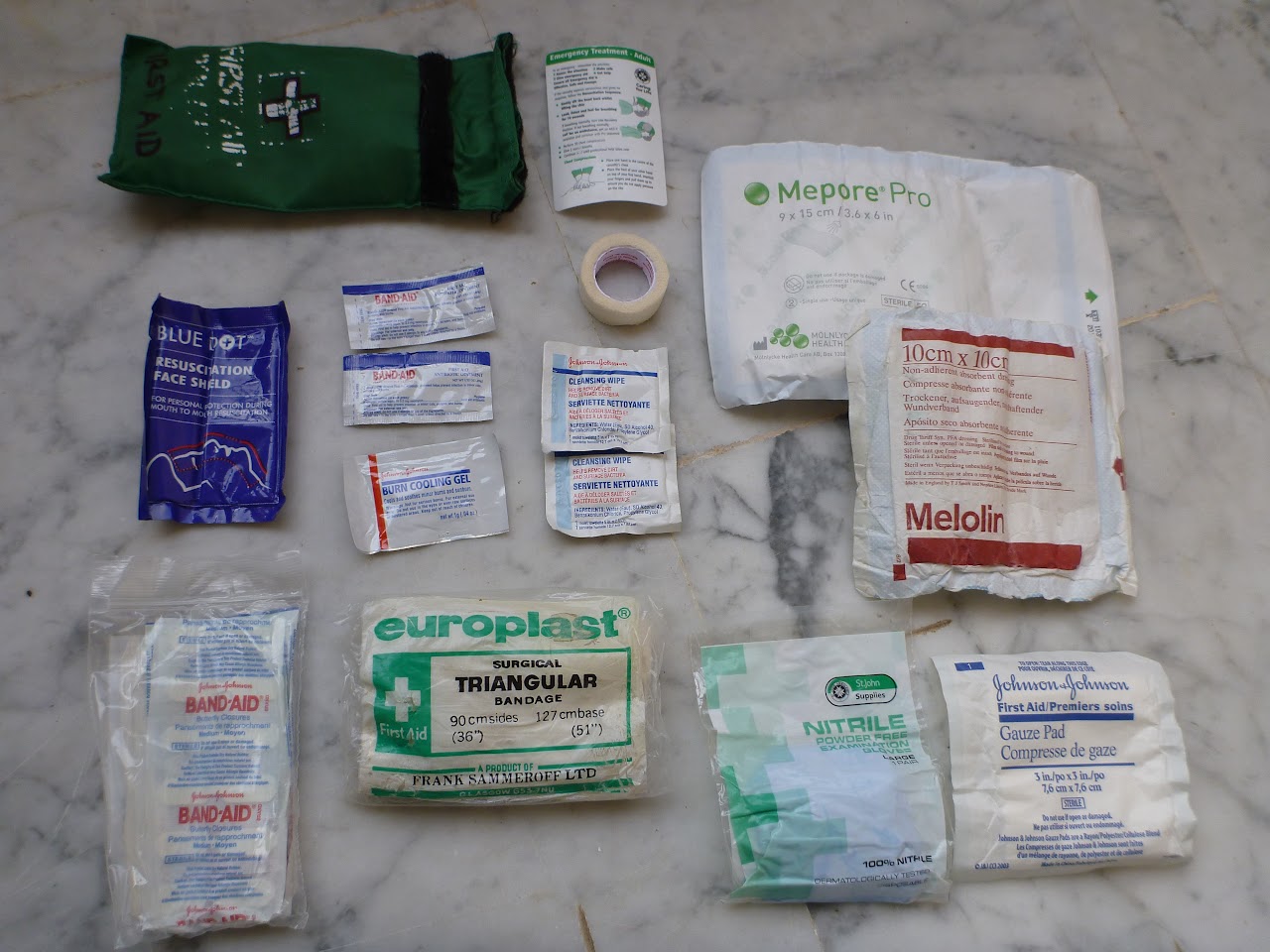 [/img]
[img]  [/img]
and a venflon :D.
Various sizes of various dressings upto about 6" square, roll of white tape (whatever its called), a couple of old tubigrips, foil blaket, emergency shelter/sleep sack, pasters, CPR mask, proper scisors (for removing clothing in a hurry). Fits in a 8"x4" nylon pouch (just, excluding the sleep sack).
Don't laugh, but I always carry womens sanitary towels in my first aid kit. Seems silly, but they are designed to soak up large amounts of bodily fluids are (semi)sterile and take up very little space. Normal gause dressing on a bad bleed, then said towel and pressure and you are better off than trying to make do with the pitiful bandages found in most first aid kits.
BTW, I don't carry a resusiaid in my first aid kit. It's in the top pocket of my backpack. The reason being is that the firstaid kit sometimes gets buried under jackets or other stuff in the back pack. If you need a resus mask it's life and death, seconds count. Getting to it instantly can help.
[i]took a major tumble after hitting a Bedouin's sheep[/i]
This wasn't the Quantocks, was it?
I carry a FFD on some rides.
http://www.cadetdirect.com/order1.php?pg=295
Things I carry with me include a CAT and a FFD from my Army kit (just in case), some of those steristrip things, nitrile gloves and some gauze. I've stopped taking the stuff that you jamb into a wound to stop catastophic bleeding in under three minutes, but do take that with me when I am on the range.
I've topped up my old faithful Gregson Pack first aid kit with a selection of different size/shape wound dressings from the chemist and a load of micropore and support tapes to strap them on with.
Inspirational as expected. Thanks AW for photos and everything. I've got an old dry bag which is a good starting point. Cadetdirect looks reasonable vfm to get the contents that I don't yet have...
Thanks again.
For general biking kit, you don't need a lot. I've done a bunch of specific outdoors-tailored REC first aid courses and they always spec a pretty minimalist kit and some nifty improv. Stuff that you wouldn't think of as first aid gear, like sanitary towels and tampons, work best, but near in mind you need to get pursue on it as well, so bandaging is a good thing to learn properly. Gaffer tape's an essential as well. Clotting packs aren't recommended due to allergy and "stuffing things into open wounds in a non-sterile environment" issues. I still carry one, mind.
Re Splints, particularly leg splints: last course I did, related to mountain first aid, we were told that it's not covered in detail any more. If you've got a casualty with sufficient damage to need immobilisation and extraction then: 1) so many people splinted badly and caused more damage (particularly going on the old advice of "move to an anatomically correct position"), and 2) first thing the MRT will do is cut off what you've done and vac-splint. Best thing to do is to keep the casualty comfortable, whatever position the limb's in, pack around them to immobilise and then just wait.
Also for the record - don't bother with triangular bandages, they're pointless. There's nothing you can do with one that you can't do, usually more comfortably, with another more versatile bit of kit.
This seems to crop up every few months, and we get great long lists of all the gubbins that then get carted around the country side.
Duct tape and handkerchief.
That's it.
These two, plus the knowledge to use them will get you sorted out.
Space blankets, antiseptic wipes, bandages, splints, gloves, cpr kit, are all not needed in my opinion.
Knowledge....
Mobile telephone or sat phone.
I can understand the idea behind tampons as a dressing if there is nothing else available. If you are going to go to a shop to buy them though why not just buy a [u]sterile[/u] dressing instead? You can get big thick ones (the kind the army use for gunshot wounds). I guess its different for me though , if I patch a client up with a tampax which then gets infected because its not sterile I haven't done my job right.
For major bleeds you need dressings and bandages (both sterile). They come in different shapes and sizes, some have the bandage attached and some dont. Bear in mind that most integrated dressing bandages are not long enough to be effective on anything other than a limb so check the lengths. You can get some several meters long that you could use on a chest wound for example. For a really bad bleed you might need to apply two dressings to stop it. If blood come through the second, medical advise is to remove them and start again with new ones. Do the math, you could run out of them quickly on a bad one.
On top of dressings and slings you could take foil blankets, pain killers, antihistamine, gloves, saline, scissors, tick removers, skin closures, spray skin, tape, rsas shield, cleansing wipes.
Think about worst case scenarios and go equipped for those..
Pyro - Member
Also for the record - don't bother with triangular bandages, they're pointless. There's nothing you can do with one that you can't do, usually more comfortably, with another more versatile bit of kit.
Apart from the intended use (immobilisation) they can be used for loads of other things in an emergency and may be the most versatile thing in any 1st aid kit. Yep you could improvise with an inner tube, gaffer tape or use up valuable sterile bandages... but they are small and light so why not carry them? I carry 4.
AMV - I would say they are the [i]least[/i] thing. While you can use them for other bits, there's nothing you can do with them that can't be improv'd with something else, when used as a sling they're ridiculously uncomfortable, and the newer lightweight paper-type ones that are in so many pre-packed kits are utterly useless in anthing other than a dry windless environment.
Oh, and tampons and sanitary towels [i]are[/i] sterile...
As crickey says _ although I used used a triangular bandange once to make a sling - a little bit better than using an innertube.
Knowledge is the key. I rarely carry a first aid kit - only if going right into the mountains. its only a very limited range of injuries when a first aid kit will make any difference.
I am happy 'carting' 100g of gubbins around the countryside. Yes, it's limited but it is [i]first[/i] aid.
Some cash to pay off the Bedouin for his totaled sheep is also useful. I think they use coloured pebbles in the Quantocks.
just out of interest, what's the value of absorbing a load of blood in a dressing as opposed to just applying pressure and letting any leakage, err, leak ?
or does a dressing help to spread the compression and avoid overdoing it ?
Pressure is what stops bleeding, not any specific dressing. Basically, if you press long enough, it will stop. Having loads of dressings tends to make people stop pressing to change them; defeating the object.
If you're not used to seeing it, its very easy to over-estimate blood loss; its like Vimto in that a little bit goes a long way.
And duct tape will double up as a splints, as a pressure dressing, as a temporary steristrip, and will fix your bike too.
It also serves as an indicator of severity; can't be fixed with duct tape?
Time to get help..
Hello, I'm a paramedic. I carry duct tape (wrapped round my pump.) If its a big day out and its remote riding I also carry zip ties.
Direct pressure will slow and stop bleeding. Dressing wounds can help provide that pressure and prevents contamination.
A small polycarbonate flask of rum for 'disinfectant' - apparently there are other uses. 🙂
Plus duct tape.
For those non-compressible wounds 😉
[img]  [/img]
pyro. agree on those paper ones but why try to improvise a sling when you can actually use one? A properly tied one is more comforable than an inner tube or a t-shirt and 4 take up less space and weigh less than a pack of lambert and butler.. Other uses - supporting a moving dressing (knee or elbow for eg), eye covering over a patch, protecting a dressing from the elements, elevating a bleed, packing round an impaled object before dressing, using as extra wrapping for a torso or head dressing, immobilizing a head in a suspected spinal... loads of uses... Yep you could use all manner of things to do these things, or you could put a sling in your first aid kit.
Imagine having a serious and painful injury wrapped up in duct tape... blood awful getting that stuff off and most likley any injury will be made worse in the process.
The point Im trying to make about tampons is that surely a dressing designed to stop a wound bleeding is the right thing to use to ... er... stop a wound bleeding. Sure you could use a tampax, t-shirt, table cloth, wooly hat, loaf of bread, your hand etc but if you are going to all the trouble to put together a first aid kit surely you should be putting wound dressings in it and not tampax?? Not convinced that they are sterile either.
J3FFo - thats that stuff
Powdered turmeric stops bleeding. Take a balti with you and if you get back safe you've got a handy post ride snack.
Duck tape. That plus spare clothes = sort pretty much any 1st aid issue.
Go on, challenge me.
(personal kit = duck tape, one sanitary pad, pile of plasters and wipes, pencil and paper, asprinx2, rescusi mask)
(work kit = duck tape, some wound dressings + pads, plasters and wipes, eye wash, crepe bandage, safety pins, paper + pencil, a 'how to' 1st aid leaflet, rescici mask, asprinx1, plastic bags)
STRONG painkillers...the rest can be improvised !
Guiding kit is based on:
Big military/paramedic type dressing
Couple of smaller dressings
Duct tape
Triangular bandage
Wee bottle of antiseptic
Gauze (for wipes) & plasters (because people ask me for them)
Once again, the whole lot got used over the course of the season, including going through 3 triangular bandages (broken collarbones).
I don't get the above comments about triangular bandages. It's the right tool for the job (immobilising arm/shoulder), does the job much, much better than inner tube or spare clothing (both worse than useless for a broken forearm or wrist) and can be pressed into service for all kinds of other binding/fluid absorbing tasks. What's not to like?
EDIT: Few other random bits and pieces as well, similar to matt's kit above (pad & pencil, resus mask, etc.)
Not realy required a first aid kit in the wilds of Surrey in the last few months, but on at least three rides various people have borrowed sterile eye drops from mrs k (she has them for her contacts) to flush mud out from eyes - can't remember the name but little plastic ampules, seem quite handy.
As an aside last first aid course at work (3 months ago or so) we seem to had dropped triangular bandages and were told not to use them, however we rarely evacuate a casualty, as a plus we were trained to self apply torniquets the new first aid flavour of the month?
[u]Space blankets[/u], antiseptic wipes, bandages, splints, gloves, cpr kit, are all not needed in my opinion.Knowledge....
Really? Tell that to the chap with the broken collarbone walking down throught the woods on (IIRC) Darkside?, in the freezing cold twilight in nowt but a wet T shirt and showing all the signs of onset of hypothermia.
Drugs - I always carry emergency antihistemine, 'buprofen and co-codamol. Only 'cos they wont let me carry morphine vials 🙁
There is a product promoted on chainsaw and arborist sites called celox. Specifically meant clot serious blood flow, read some bumf claiming to stop arterial blood flow. Comes in small sachets so won't take up much room in a bag.
[i]Really? Tell that to the chap with the broken collarbone walking down throught the woods on (IIRC) Darkside?, in the freezing cold twilight in nowt but a wet T shirt and showing all the signs of onset of hypothermia.[/i]
Sorry, but a bit of what is essentially tinfoil maybe better than nothing, but will do very little to prevent exposure/hypothermia. If you are going to carry something for that situation, at least get a full size survival bag.
I'll let the fact that a wet tshirt suggests a degree of unpreparedness go...
Space blankets are regarded as some kind of magical garment, but are amazingly over-rated in terms of what they actually achieve.
If you're getting to the point where Quickclot is needed, then you'd better hope you are somewhere that the local air ambulance can get in very quickly.
Some military surgeons in Afghanistan were finding with Quickclot powder that the chemical reaction that stopped the bleeding was also causing burns that worsened the injuries - I think it now comes in a different form, but it is still quite advanced field treatment and possibly not a general component to a first aid kit.
I'd go with a decent field dressing, to get the pressure onto a bleeding wound, and back it up with a decent large crepe bandage over the top if needed. When I did a stint in A&E as a student nurse the type of pressure dressing used was large dressing pads that don't look like they'll absorb much, some plain gauze, and then crepe bandage over the top. Got a feeling that an army first field dressing would do a similar job.
adrenaline hydrochloride is popular for cuts in boxing.
A whistle is handy if you are on your own in the middle of nowhere.
I can't escape the feeling that discussing adrenaline and haemostatic dressings in the context of what is essentially 'pony trekking by bike'* is over-egging the pudding just a little.
*copyright TJ.
You are correct
Tampons and sanitary towels are not sterile
Wouldn't stop me using them in a first aid situation though.
...again, the feeling that we need to assure the sterility of whatever dressings we use when the basic physics of any mountain bike injury would suggest a certain amount of contamination, strikes me as OTT.
😯 at all the above.
I'm a paramedic and it takes me all my time to remember to pack a couple of spare tubes and a pump 😳
I ride with other nurses, with GPs, with Consultants, with Doctors still in training, and we don't take anything first aid related at all. I appreciate that in certain situations like guiding, where you become responsible for others it is a help, but it's just not something I would ever consider.
YMMV.
🙄Pyro - Member
Also for the record - don't bother with triangular bandages, they're pointless. There's nothing you can do with one that you can't do, usually more comfortably, with another more versatile bit of kit.
[b]the complete opposite was taught on my outdoors first aid course[/b]
1) so many people splinted badly and caused more damage (particularly going on the old advice of "move to an anatomically correct position"), and 2) first thing the MRT will do is cut off what you've done and vac-splint. Best thing to do is to keep the casualty comfortable, whatever position the limb's in, pack around them to immobilise and then just wait.
they are also still teaching to return to "anatomically correct and splint
obviously the trainers (with their 20+ years as a casualty nurse and as current MRT members (one is even in the Keilder 100 pics)) could have been talking out of their arses, the course manual from the recognised body must be poo as well
Duct tape can do it all....
crikey - Member
Duct tape can do it all....
except absorb
wouldn't fancy getting it off if directly applied to a wound
Hence my handkerchief recommendation; and it can also be used to blow your nose, clean your specs and, most importantly, offer to young ladies when they become over emotional at the beauty of your something or other...
You need to remember that it's called FIRST aid. You're not going to be reducing dislocations and winning prizes for needlework. It's all about enabling a scoop and run approach to get the casualty in a safe situation. Duct tape is all you need.
Compound fracture - tape it to the other leg.
Dislocated shoulder or fractured collar bone - tape it to the body.
Blood pissing everywhere - stick an item of clothing over the bleed and tape it down to provide compression.
sbz -
compound fracture - fine, totally agree, but if it's a compound fracture you're going to want to dress the wound as well.
shoulder/collar bone - would take a sh*tload of tape, wouldn't stick well in the wet and would give p*ss-poor support, thus defeating the object of immobilising it, which is to allow the casualty to walk out of the situation. If you're just calling an ambulance, might as well not bother, casualty will naturally hold it in the most "comfortable" position.
Blood pissing - well sure, but are you volunteering to hand-over your spendy Fox bike jersey? A £1 dressing would be better...
Oh, and re. space-blankets - of zero use in wet conditions. They (slightly) reduce heat-loss by radiation, but make no difference to heat-loss by convection. And have you ever tried opening one out even indoors? Imagine trying it outside in the wind...
Improvising is all well and good, but lets not delude ourselves that it's somehow better than using the proper kit.
I carry a full kit for guiding.
Riding with mates, well most of the time it's already in the pack and it weighs so little and takes up so little space that I usually leave it there.
Riding locally on my own, I often go out with no pack at all.
Don't see the benefit of sterile bandages dressing when riding. your cut/graze/wound is not going to be sterile (dirty ground) and the dressing is going to come off as soon as you get back home.
How are people carrying duct tape in a camelbak? I don't have room for a massive roll. Any clever solutions?
Superficial - wrap 3m or so of it round your pump.
Funny how all the medics seem to carry bugger all / next to nothing..
vs The manual readers who seem prepared for a tour in Helmand??
Sounds like a good plan Stevo.
I know people don't think much of survival blankets, but having helped an injured cyclist who was stuck near Hope cross on a cool (ish) day, I reckon the cold/exposure is the biggest risk to life. The rider in question who was unable to move became very cold quite quickly. It was just a case of waiting for the mountain rescue to extract them, and there's not actually an awful lot that even the most experienced paramedics / doctors can do until help arrives. I suspect keeping people warm is one of the most important things.
As for minor cuts / scrapes, you don't have to be a doctor for those sorts of things.
I'm amazed nobody carries a large portion of MTFU...
stevomcd - if blood was pissing everywhere I'd use whatever I had to stop it doing so. I'd be very surprised if anyone else would do differently.
For those who say Sanitary Towels are not sterile... well neither is a sterile dressing as soon as you open it on the trail! The point is that they are arguably more compact than a similar dressing, specifically designed to soak up bodily fluids, perfect for dressing and applying pressure, easy to come by and cost effective.
A first aid kit does not need to contain the most expensive upto date and most sterile equipment you find in a hospital. It's first aid. The purpose of it is to make sure that the injured person is made as comfortable as possible and prevent (as much as possible) any deterioration before they can be evacuated. The most important things to do are maintain airway and circulation (mask in case of mouth to mouth) and slow down/stop any major blood loss (sanitary towels or your favourite dressing with tape, innertube, bandage or whatever you have to hold it and apply pressure to the wound) If the accident is serious enough that you are thinking about this stuff you are essentially concentrating on keeping the person alive while waiting for transport to hospital.
If it's serious do not move anybody unless there is a risk to their life where they are or they have stopped breathing and you need to resuscitate.
The number of times I've seen people be moved before any assessment after pretty severe head trauma is astounding. Concussed people will nearly always tell you that they are fine and don't need to go to hospital... They need to go to hospital!
😯 Brilliant! Pros and cons of various haemostatic agents, combat tourniquets, vs tampons and gaffs tape. Only on STW. Love it.
(if you really need kit that has been specifically designed for catastrophic haemorrhages and traumatic amputations, I suggest you may want to chose a different spot for your rides... Maybe somewhere without snipers and IEDs!) Blimey.
Got to support the comment on survival blankets - its a survival bag you need, either a metallic one, or a nice simple bright orange plastic one. Far more effective at keeping a caualty dry and warm(er) and take up hardly any more space.
Funny how all the medics seem to carry bugger all / next to nothing..vs The manual readers who seem prepared for a tour in Helmand??
If I was a trained and qualified paramedic, I might well be confident enough in my abilities to improvise with whatever happened to be in my/other people's pack at the time. However, I'm not - I'm a youth worker with a basic Rec2 First Aid certificate to validate my Trail Leader award. On one of our most recent rides, I had a kid who had a tumble and ended up with multiple superficial, but spectacular looking cuts and grazing. I had to sort him out, and deal with the rest of the group, and the calming power of pulling a decent sized first aid kit out of your bag, complete with surgical gloves "ready to go" when you open it is hard to over-estimate. It may well not be necessary, but it's a useful piece of 'showmanship' that communicates to a group of slightly freaked out kids that [i]"it's going to be okay, because I know what I'm doing, and I have the right kit"[/i]. At this time of the year, I tend to supplement my first aid kit with a thermal wrap (bivvy bag slit open with a space blanket taped to the inside) - again because it was suggested to me by the paramedic who ran the first aid course, so I'm doing what I was told by the people with more competence and experience than me.
When I'm out on my own, or with a mate, I have a little Alpkit pouch that has some Mepore and some tape, a couple of plasters and some Compeed (comes with me hillwalking as well.)
My mate tutted like skippy when I went back for my kit at Afan. Changed his opinion when his 12yr old lad went over the bars and mashed his arm on a big rock and I could patch him up enough.
Or the little lad who landed badly on jumps and cut a big gash in his chin. His Dad thought emergency medical treatement was to immediately phone Mum and tell her he had just tried to kill Johnny but not to worry!
MTFU - is that like snake oil then? FFS
Interesting thread... it is amazing how peoples opinions differ.
I'm not a medic, but I do know a little about first aid, and quite a lot about survival.
I have a pencil case in my riding pack which has a few plasters, alcohol wipes, roll of micropore, a few painkillers and other odds'n'ends, the thought behind this is it is nice to be able to patch up a cut/graze so you can complete your ride without bleeding everywhere.
If things got more serious i'd have no worries about using a shirt/jacket/dirty rag taped over a big bleed to try and stem the flow. if the injury is going to need a visit to hospital sterility of dressings/infection is the last of your worries at this point - the hospital will clean any wound properly, and probably give you precautionary antibiotics to kill any infection.
It is easy to get caught up with the idea that you need to drag a M*A*S*H hospital around with you, but unless you are in really remote terrain it is a bit overkill.
2 years ago I did a 4x4 trek accoss the Moroccan Sahara with a couple of mates, one of them caught his wedding ring on a bolt whilst jumping off his roofrack - result was wedding ring burried in his almost severed finger, and a 6 hour off-road drive to the nearest medical centre.
I cut the ring off with a dirty hacksaw, then bound his hand up with stuff from our (well stocked) first aid kit, when we got to the hospital the doctors told us if we'd not cut the ring off when we did he'd have lost the finger..
Happy outcomes from emergency situations depend more on what you do, than the gear you have to do it...
be interested to know who here actually is a qualified medic or army/armed forces medic.?
But first aid wise most of the typical gear will surfice, but the main things you will need are
tape(surgical which doesnt react to skin as duck tape can)
Dressings, various sizes(and no, not a chest one, if you needing one you really shouldnt be trying to DIY yourself tbh lol)
Then maybe some saline solution to clean the wound, though water out of camel bak will surfice.
that is pretty much it.
Bandages are ok, but medically people agree thatyou should not to attempt to move body limbs as it causes more pain and problems, so keep casualty comfortable is the best.
Bar this training is the best kit you have, so get on a lifesaving course, more people need to know how to do CPR and basic first aid than ever before.
Just shown this thread to Mrs FD who is an Orthopaedic/Trauma surgeon with Advanced Trauma Life Support training. She laughed at what most of you are carrying around, and nodded at what those with medical knowledge are suggesting, oh plus a mobile phone.
Drugs - I always carry emergency antihistemine, 'buprofen and co-codamol. Only 'cos they wont let me carry morphine vials
Do the right course and go far enough away from civilisation and you can administer Tramadol.
You need to remember that it's called FIRST aid. You're not going to be reducing dislocations and winning prizes for needlework.
The advanced version of the course I did covers stitching and the use of cannula (possibly) the basic version did dislocation reduction. This was in 2007 though. I need to go and do a refresher.
blablablacksheep - the thread is as follows - those with the skills at a professional level = duct tape, those without those skills = carrying the hospital stores round with them.
The most recent course I did involved stitching and canula stuff, the more basic version involved reducing dislocations and returning fractures to their anatomical position. Would I do any of that stuff in real life with my current knowledge? Not unless their life depended on it.
You'd have to be VERY brave to try and put a shoulder back in 'in the field'. Without an xray there's no way of knowing that there isn't an associated fracture, and you could make the situation much worse by pulling it. Perhaps if you're in the middle of the arctic and help can't come for 24 hours, doing nothing is potentially dangerous in terms of exposure etc, it's hard to imagine that scenario in the UK though. Otherwise just let mountain rescue extract and hospital doctors do their thing. A little bit of training can often be a bad thing.
I'm interested as to whether people think camelbak water is good for cleaning out (proper) wounds - E.g. if there's an open fracture or something. I suspect it's a case of balancing risk of infection from the mud vs risk from mouth-type bacteria. I guess if the wound is full of manure you're want to do something - Otherwise I'd probably just cover it up and let them sort it out in hospital.
Any thoughts?
How are people carrying duct tape in a camelbak?
Wrapped around your pump is a good suggestion, alternatively I carry a couple of metres wrapped around an expired credit card in my wallet at all times takes up almost no space and has been invaluable on many occasions, including mtb related first aid.
[img]  [/img]
Just shown this thread to Mrs FD who is an Orthopaedic/Trauma surgeon with Advanced Trauma Life Support training. She laughed at what most of you are carrying around, and nodded at what those with medical knowledge are suggesting
If she's happy to come and back that up in front of "InjuryLawyers4U", great, otherwise I stand by my earlier comments. I'm carrying what I was advised to carry by the paramedics who taught my REC2 first aid course. That way, if it all goes tits up in a bad way, my ass (and that of my employer) is covered on at least one front.
If Mrs FD has a sense of humour, you might pass on my niece's comment (she's in paediatrics) to the effect that [i]"why would you listen to someone who practices medicine with a hammer and chisel"[/i] - she was grinning when she said it mind 😀
[url= http://farm7.static.flickr.com/6217/6358339777_692408e78f.jp g" target="_blank">
Anyone fancy sticking that kind of joint back together after a wee first aid course?
Anyone fancy sticking that kind of joint back together after a wee first aid course?
Not in that state!
SBZ - "those with the skills on a professional level". I work as an event first aider for a commercial company, and tend to end up being on/helping teach four or five courses a year. Which category do you put me in?
It's an "each to their own" situation, really. I've had a bunch of trips whet I've needed nowt, then two weeks ago I ended up steri-stripping a cut to someone's forehead at the get in of a river trip when they got whacked in the bonce with a paddle while warming up. Not a major emergency, but head injuries bleed like a git and it was freaking her out. Couple of strips, ambulance dressing and Buff over it, helmet on and off we go. Like someone else said, the calming effect of someone having kit and the knowledge to use it can be pretty effective.
Oh, and no, I wouldn't fancy relocating a shoulder. We don't even relocate fingers. That way madness (and possibly litigation) lies. Have had training to do it on seriously remote expeditions, but bloody hope I never have to...
[i]and possibly litigation[/i]
Exactly!
Again I'm reduced to boggling at the idea that anyone would attempt any kind of dislocation reduction while out on a trail...
If you're happy to recognise the difference between a dislocated hip and a fractured neck of femur through a pair of baggy shorts, or the difference between a high humeral fracture, or fracture-dislocation compared to a dislocated shoulder you are wasted...
[b]The Golden Rule: If you can't fix it with duct tape, get some help.[/b]
I wouldn't put that shoulder back.... it's in joint
Litigation though, Crikey, only applies if you attempt something [i]for which you have not been trained [/i]. The "Good Samaritan" law (can't remember the proper name) upholds that - so if I bandage a serious head wound (however badly!) And the person subsequently bleeds to death, i'd feel bad but could not be sued because it's in my training. If I attempt an emergency tracheotomy because I saw it on the telly once, I'd be off down the proverbial in my barbed wire kayak.
(And no, I don't think I could recognise most of those things explicitly. Mostly it's the basic principles of first aid - keep 'em breathing, stop 'em bleeding and if it's serious enough to warrant it, get the big taxi with the blue lights on)
True, but the injurious consequences of an attempted reduction of a dislocated shoulder should mean no-one should be attempting it outside a hospital setting, especially not in mainland UK, when the ambulance is presumably on its way.
The duct tape rule...