UPDATE: CLASSIFIEDS section refreshed, redesigned, searchable: Go take a look
Lol.
I doubt that the adoption of road racing discs is going to be ended on the basis of one injury. The leisure market appears to be moving to discs, and manufacturers will want to standardise on one type of brake, so I think they will continue to lobby for their introduction. Pro teams will just ride what their sponsors tell them to.
I've been using discs on a road bike for 13 years now, for touring, commuting and winter training and have not had any issues with braking or tyre performance. They work OK. I think there are some issues to sort out for racing use, like compatibility, wheel changes, etc, and the transition period between rim and disk brakes in the peloton will be a bit awkward, but none of that is insurmountable.
Caliper brakes might stay on a bit longer for TT aero reasons.
yeah. You're right, you might be better off with discs if you don't have the experience or dexterity to modulate caliper brakes.
So calipers are harder to use and less 'modulate-able' than discs?
In breaking news....
[url= http://www.ukcyclocross.co.uk/articles/news/action-man-scar-caused-disc-brake-injury/#.VxDVgWBfC5w.twitter ]More disc brake injuries..[/url]
If they are set up badly, or the rider isn't practising enough.
I mean, this whole thread is about what the pros use. Not what sport riders want to use.
Maybe that's why everyone is so upset about this. They want discs so they can have one do it all bike, but they also want to look like the pros.
Some pros already have to use massive long and/or negative rise stems to get their position sorted on "standard" frames. Which the head tubes are longer than needed. So why not force them to use discs, that they don't really need or want.
ghostlymachine - Member
Maybe that's why everyone is so upset about this. They want discs so they can have one do it all bike, but they also want to look like the pros.
I'm not sure anyone on here (advocate or otherwise) really gives a toss about looking like the pros, nor are most particularly concerned with needing a specific bike to race on. What people are saying is that discs do offer an improvement in performance. I can hand on heart say this to be the case. I sold my Litespeed with rim brakes after riding my PnF (with discs) on road for a good while in spring last year. Getting onto the Litespeed in the summer felt...dangerous, to be frank. I'm sure I'd again adapt to it like I now do with the Kona, but still, there's no doubting the difference.
It's probably worth noting that neither team using discs in the Paris Roubaix were sponsored by Shimano/SRAM so the teams themselves chose to use discs.Some pros already have to use massive long and/or negative rise stems to get their position sorted on "standard" frames. Which the head tubes are longer than needed. So why not force them to use discs, that they don't really need or want.
I genuinely believe that in a Peloton in which all bikes use discs, that you'd see less riders on the ground after a crash.
Maybe that's why everyone is so upset about this
The person most exercised about this issue appears to be you.
Maybe that's why everyone is so upset about this. They want discs so they can have one do it all bike, but they also want to look like the pros.Some pros already have to use massive long and/or negative rise stems to get their position sorted on "standard" frames. Which the head tubes are longer than needed. So why not force them to use discs, that they don't really need or want.
I think there's more than an element of truth to this.
Personally, as per F1, I want the pros to be on bikes that, within reasonable safety limits, represent the pinnacle of the sport.
To draw parallels with motorsport, a lot of the time these days when you read about some Le-Mans winning racecar, the journalists comment about how intuitive and friendly it is to drive, as it's been made to be driven fairly fast lap after lap, not to extract an amazing qualifying time. This kind of disappoints me.
Similarly, I don't want to see pros on heavier, slightly slower bikes that are a bit more friendly to ride (i.e. brakes that are easier to modulate when the pros have learnt to brake with the current - fairly powerful if we're being honest - rim brakes no bother). I don't want to see them on bikes that are not as fast as one you or I could (given a large chunk of spare money) go out and buy.
Similarly, I don't want to see pros on heavier, slightly slower bikes that are a bit more friendly to ride (i.e. brakes that are easier to modulate when the pros have learnt to brake with the current - fairly powerful if we're being honest - rim brakes no bother). I don't want to see them on bikes that are not as fast as one you or I could (given a large chunk of spare money) go out and buy.
Yebbut, we all spent years riding bikes that were well suited to pro racing, with massive gears and requiring contorted body positions. Those bikes are rather less useful for a social Sunday morning club run.
I genuinely believe that in a Peloton in which all bikes use discs, that you'd see less riders on the ground after a crash.
I doubt it would make much if any difference when a crash happens in a bunch it is like dominoes, you hardly have time to realise what is happening let alone touch the brakes.
Getting onto the Litespeed in the summer felt...dangerous,
Really you must have rubbish calipers. I've just ridden my race bike after months on the winter bike with discs and I was pleasantly surprised how good calipers are.
dragon - MemberReally you must have rubbish calipers.
DA7900 on aluminium rims - so no, not really.
Going back to this original incident. I may be a bit dense here but I still don't understand how this incident is supposed to have occurred. As I understand it, he crashed into the back of someone without falling off. How does his left leg come into contact with someone's disc on the left hand side of their bike? It seems a strange scenario to me.
Just read an excellent dissection of these crashes on the road.cc site.
No actual evidence linking injuries to disc brakes. One crash didn't even involve either of the teams riding with discs.
All very strange.
So they should be fine then, not as good as hydro discs but certainly not dangerous.
Really you must have rubbish calipers. I've just ridden my race bike after months on the winter bike with discs and I was pleasantly surprised how good calipers are.
+1. Jumped straight from my disc commuter to my carbon rim- braked summer bike, and the brakes were the last thing I noticed (and if they felt different it wasn't worse).
Why are some people who dont race and dont ride in groups so keen that those who do, use a different technology that adds complexity, adds compatibility requirement, add additional cost, adds additional risk, when no one asked for them and the users dont want them.
If they are so much better you won't need to argue about it, the users will demand them, no one will buy rim brake bikes and it'll be the new standard, like say, tapered head tubes, there better so people demand them.
However withh disc brakes whilst I know lots of people spending a lot on new bikes especially now as we are going into summer and they are not buying disc bikes.
I'm not arguing that people should be forced to use them, it's choice.
Or rather it isn't, because someone had a crash, decided on the basis of somewhat sketchy if not outright unreliable evidence that an injury was caused by discs, and on that basis has forced the UCI to rule against them. So there is no choice.
In answer to numerous points.
Why do riders want discs banned, unless they think they are unsafe? (This doesn't make riders right, but surely they're not kicking up a stink for a laugh?)
Other risks. Motorbikes on the course. They are a different issue, and (arguably) there would be no race without them. There can be a race without disc brakes. And we are talking about introducing a risk unnecessarily, not managing a risk already there and longstanding.
You can always go wide however good your brakes are - the only thing for sure is that the better your brakes are the later you will brake.
I generally don't buy new bikes, but as someone who has ridden road bikes for 8 or 10 years and MTBs for the best part of 30 years I can't imagine riding an MTB with rim brakes and I have to this day never considered why on earth I'd need discs for the road. I have no problem with people choosing to ride discs. I wonder whether this issue will come up in club rides?
"Why are some people who dont race and dont ride in groups so keen that those who do, use a different technology that adds complexity, adds compatibility requirement, add additional cost, adds additional risk, when no one asked for them and the users dont want them." Nail. Head. Surely the key thing is what the pros want, after all they are the most important thing.
"I'm not arguing that people should be forced to use them, it's choice." By giving people that choice you are also denying others the choice of being able to race in a pro peloton that hasn't just introduced technology that is not proven safe (in the pro peloton).
How do you prove something safe unless you use it for a prolonged period, until either you gather COMPELLING evidence of injuries or find that you don't (which would 'prove' the opposite)?
At the moment it's being declared unsafe on the basis of one distinctly unproven incident, and opinion.
Why do riders want discs banned, unless they think they are unsafe?
Do they? Some do, but is it the vocal minority or is it genuinely the mass opinion?
Yebbut, we all spent years riding bikes that were well suited to pro racing, with massive gears and requiring contorted body positions. Those bikes are rather less useful for a social Sunday morning club run.
And it's fine that people want to ride something a bit more comfy and practical than what the pros choose to race on.
But to force the pros to race on something that is more suited to a Sunday morning club run is a bit daft. And I doubt many of the pros particularly want to use disc brakes - the manufacturers are however keen to sell it as an essential new technology that is "better". And in some ways it is, just not in ways that'll win you a race.
I don't care if pros use them or not but I will be getting at least a fork & front cable brake sometime fairly soon. I don't race and I don't do big group rides. Discs are way better for me on the road.
swift bike swap at the top of a col following an attack up the climb ?And in some ways it is, just not in ways that'll win you a race.
"How do you prove something safe unless you use it for a prolonged period, until either you gather COMPELLING evidence of injuries or find that you don't (which would 'prove' the opposite)?"
Very very difficult. But I would suggest that without the answer to that question one should take a different approach, perhaps asking questions like "how do discs improve pro cycling for spectators and / or riders?" and "if you were going to crash in a pile of bikes at 30 mph would you happily flip a coin as to whether you landed in the pile that had discs or the pile without, or would you choose the pile without?"
I note that no-one has explained to me how the UCI are ruining cycling by refusing to allow weight weenie bikes and making Lo Pros and 24" front wheels illegal?
"if you were going to crash in a pile of bikes at 30 mph would you happily flip a coin as to whether you landed in the pile that had discs or the pile without, or would you choose the pile without?"
Well, in the absence of any credible evidence I doubt it would make any difference... I wouldn't want to crash into a pile of bikes at 30mph full stop.
"if you were going to crash in a pile of bikes at 30 mph would you happily flip a coin as to whether you landed in the pile that had discs or the pile without, or would you choose the pile without?"
without and so would any sane person. I don't know how much more of a danger discs are in the pro peloton. But the guys who are actually doing the job don't seem to like them. How would people on here think if something that they viewed as a health and safety risk was imposed upon them in their workplace ?????
How would people on here think if something that they viewed as a health and safety risk was imposed upon them in their workplace
The truth is if I opposed something on H&S grounds for which I had no real evidence then the reality is that my management would impose it. I would then grumble & get on with it.
taxi25 - MemberHow would people on here think if something that they viewed as a health and safety risk was imposed upon them in their workplace ?????
If there was something that could make my job safer that was banned for no good reason I'd be pretty unhappy !!!!!
Coaster brakes work in the wet and don't ruin you rims.
Just saying.
how do discs improve pro cycling for spectators and / or riders?
Don't know yet - we haven't seen how much faster / later braking would be achieved on a big descent 😉
[quote=scaredypants ]
swift bike swap at the top of a col following an attack up the climb ?And in some ways it is, just not in ways that'll win you a race.
I think he was after something which will make you faster.
force the pros to race on something
How does the UCI [i]allowing[/i] discs to be used turn into "forcing" people to use them?
bails - MemberHow does the UCI allowing discs to be used turn into "forcing" people to use them?
TBH the anti argument seems largely based on there being simultaneously a performance advantage, which is dangerous because of different braking capabilities in the peleton, and also being no performance advantages.
Oh and as it turns out, also the ability for brake discs to cause injuries even in crashes where none of the bikes had brake discs.
Not quite sure I get you. I suppose a truly gifted pedant might say they'd make you "slower", but discs for a descent - way "shorter time for the trip", I predict. Well worth taking 5-10 seconds to swap bikes at the top (or, hey, just ride the "faster" bike all the way ! 😉 )I think he was after something which will make you faster
- IMO
- until tested
- unless you take GCN's word for it in that vid linked on this thread where they "tested" it
I do wish people would stop spouting this crap. It's nothing to do with absolute power, it's to do with how that power is applied and the modulation and control that you can have.
If the modulation is better why were almost no pros using discs in a muddy cyclo cross race?
as we all know, discs don't work at all in mud - and even if they did, they'd clog solid in about 20 seconds flat.If the modulation is better why were almost no pros using discs in a muddy cyclo cross race?
that's why mtbers have abandoned them for cantis and have a mechanic waiting every 2-3 miles with a clean bike instead
Shirley the half tonnes of motor bikes being badly driven are more of a hazard..
why haven't we seen a decapitated pro cross country racer yet?
Motorbikes are a problem, start thread and discuss it, thats not what this one is about.
XC racers dont ride in packs six deep with overlapping wheels 50kph.
But nobody has actually been injured by a disc rotor yet.. One guy crashed into non disc brake bikes and has blamed the rotor and another guy can't actually recall what he hit.. And from his injury it seems unlikely to be caused by hitting a rotor. Do the benefits of disc brakes outweigh the likelihood of getting injured by a rotor or is it just resistance to change and new technology?
But nobody has actually been injured by a disc rotor yet.. One guy crashed into non disc brake bikes and has blamed the rotor and another guy can't actually recall what he hit.. And from his injury it seems unlikely to be caused by hitting a rotor. Do the benefits of disc brakes outweigh the likelihood of getting injured by a rotor or is it just resistance to change and new technology?
Agree with this, it's easy to blame a new technology especially one they don't really want.
Cheers, Steve
[img] 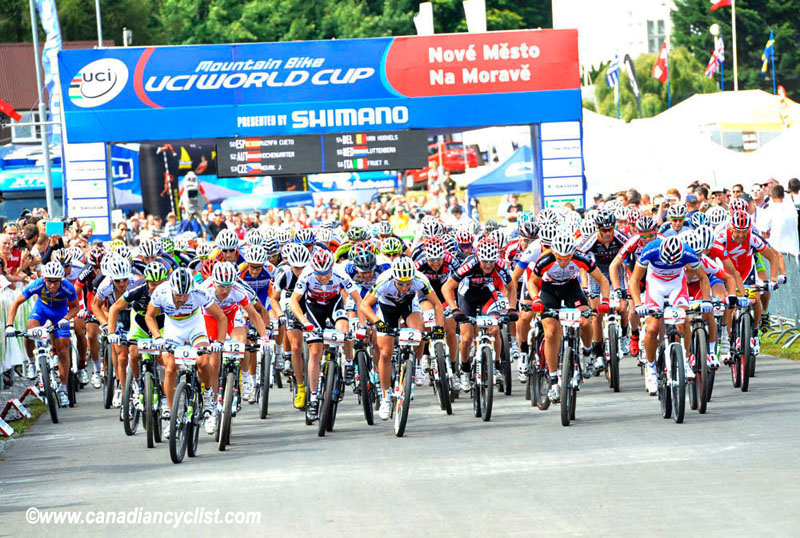 [/img]
Yes that photo exactly represents what an XC race looks like.
[img]  [/img]
[img]  [/img]
course, you're right - it only looks like that until they all try to squeeze together onto a 3ft wide path 😀
All this talk of spinning wheels and angle grinder esq discs. I've had a look at a fair few TdF crashes now on YouTube and in nearly, if not all circumstances, all wheels are stationary in a split second as the wheels and tyres inevitably touch something and then stop. The wheels and tyres are so light that there's little momentum in them, you can stop a road wheel at high speed with you hand on the tyre and it only slightly smarts.

