Me and a mate hired e-fats for an epic XC day in the alps, was great fun!
Me and laddo hired e-bikes one weekend at Comrie - camped the overnight, rode the trails then up to the loch above, what a great weekend!
Hiring works brilliantly imho.
“ I mean, sure, but the rider is still the heaviest part of the system.
Take that into account and the sprung:unsprung ratio looks much less significant. Probably less than 10% difference, even for light riders.”
But what you feel when riding is the grips and pedals pushing and pulling on your hands and feet - you are not rigidly connected to the vehicle. Yes, without the weight of the rider the suspension on a MTB barely works at all but that doesn’t mean you can consider the rider part of the sprung vehicle weight - it’s a separate mass connected with its own suspension of four limbs.
Sketch out some force diagrams of what happens when a bike hits a bump and you’ll see what I mean. Adding this much mass to the bike frame significantly changes the forces at your hands and feet.
“Concede that but a heavier bike still takes it out of your upper body as you throw it about. I used to hate riding bikes with panniers vs a rucksack as you couldn’t ride the bike in the same way. Now e-bikes do put (most) of the weight in the best place for it, but they’re still heavy.”
I don’t know if you’ve spent much time riding ebikes but it’s nothing like having a bike loaded with luggage - the extra weight is low and front-mid, which is the ideal place to add mass to a bike for stability without ruining the polar inertia.
Yes, it takes a bit more strength to manhandle an ebike but I’d argue that’s a good thing for your overall fitness, especially as you get older. I don’t think an ebike at speed feels heavy, it feels calm.
that doesn’t mean you can consider the rider part of the sprung vehicle weight – it’s a separate mass connected with its own suspension of four limbs.
What do you think supports that weight?!
If I put a car on top of another car, does it not count as sprung weight because it's got it's own suspension?
ebike here since november- im considering riding my ht more now its dry but still use the ebike a lot as for short blasts the ebike is more fun.
I’ve had ankle surgery that didn’t work and my lightweight ebike has got me out riding agin and in a good place. Not sure if I could deal with the full fat 50lbs + ebikes. The lightweight bikes are far better on my opinion.
Love my Levo sl.
“ If I put a car on top of another car, does it not count as sprung weight because it’s got it’s own suspension?”
This is a good example. If you put a car on top of another car and then proceed to drive it fast down a bumpy road and over a few humpback bridges, will the car on top stay where you’ve put it?
The heavier the bottom car vs the top car, the smaller the forces being transmitted between the two because the bottom car isn’t relying on the mass of the top car to load the suspension.
How rough a trail feels or how ineffective your suspension feels comes mostly down to the forces transmitted to your contact points.
Back to the topic, my hardtail is great for riding round here but I can’t squeeze two steep descents and a total of 1100’ of climbing into a half hour 6 mile commute home without an electric motor helping out.
The heavier the bottom car vs the top car, the smaller the forces being transmitted between the two
Can you explain with actual force equations / diagrams?
“ Can you explain with actual force equations / diagrams?”
If you pay me! 😉 If not then I’ve got a business to run, three small children to look after and a wife I’d like some time with. If I had more time then I might not have an ebike!
You can simplify it to a vertical force (ground reaction) into a spring (tyre) to a mass (unsprung weight) to a spring (suspension) to a mass (bike) to a spring (limbs) to a mass (body) with gravity and inertia affecting all the masses. That junction of bike mass to limb springs is what your hands and feet feel.
Obviously if you increase the bike mass then less force is transmitted to the rider - in a static or low frequency situation this difference will still be significant but less large but as the frequency increases the inertia of the bike mass matters more and more. If “obviously” doesn’t seem obvious then draw it out or borrow an ebike with half-decent suspension!

All of the “explanation” so far has just been “it’s obvious”.
Just wondering as I have very limited experience with ebikes. Can I get different pedals like the wah wah or big muff?*
“ All of the “explanation” so far has just been “it’s obvious”.”
Picture yourself riding a bike whose frame is filled with depleted uranium and weighs about half a ton. Just visualise how that’s going to react when it goes through a rock garden vs a carbon frame that weighs a hundredth as much. If you can’t imagine that then I really can’t help!
If adding weight to bikes really makes suspension work better, then why haven’t people started adding additional weights to ebikes?
“ Can I get different pedals like the wah wah or big muff?*”
I have two Barefaced Machinists on my board (sandwiching the envelope and phaser) but I’ll be damned if I can get them to interface with the threads on my cranks...
“ If adding weight to bikes really makes suspension work better, then why haven’t people started adding additional weights to ebikes?”
Because it’s harder to throw around a heavy bike (although not as much as you’d think). And more importantly, heavy bikes feel heavy in the shop, plus we have 100+ years of minimum weight being one of the most sought after specs on a bicycle.
Picture yourself riding a bike whose frame is filled with depleted uranium and weighs about half a ton. Just visualise how that’s going to react when it goes through a rock garden vs a carbon frame that weighs a hundredth as much. If you can’t imagine that then I really can’t help!
Yes, greater sprung mass will work better. That doesn’t equate to “but the rider doesn’t count as sprung mass” though.
A heavier load on suspension makes any friction from the seals less noticable so can see why it can work better with a heavier bike. Extreme loads that cause lots of flex might increase friction though. Also most forks are over damped for very light riders so having a few extra kg's behind them will make a big difference. My forks are plusher if I have a full backpack with 3 liters of water in it.
Personally, I wouldn't sacrifice the feel of a light bike just to make the suspension slightly plusher though.
A heavier load on suspension makes any friction from the seals less noticable so can see why it can work better with a heavier bike.
I think we all agree on that.
I just don’t buy that an ebike’s suspension works double better because it’s mass ratio is double that of a bike and you can completely ignore the mass of the rider.
“ I just don’t buy that an ebike’s suspension works double better because it’s mass ratio is double that of a bike and you can completely ignore the mass of the rider.”
That’s perfectly reasonable because none of that is true. An ebike’s suspension works better by an obvious margin (but one I haven’t quantified). You can’t completely ignore the weight of the rider because it clearly has an effect on the suspension - that’s why we tune suspension differently for two riders of similar speed but different weight.
But to treat the mass of the rider as equivalent to adding mass to the bike itself, that makes no sense. Watch a great rider taking a DH bike through a rock garden (Mont Sainte Anne WC DH comes to mind) and the rider’s and bike’s centre of masses move on completely different trajectories, with the rider travelling in much smoother curves whilst the frame gets bucked all over the place (despite 8” of very nice suspension).
Now you’ve made the point I’m going to be pushing hard to get ‘Huff-master’ and ‘Velocitron’ into widespread use…
Now this I can totally get behind!
Is £95 reasonable for a day’s hire?
I was expecting more like £70.
Prices have risen in the last couple of years (I noticed this when looking at hiring before Christmas at GT), probably linked to the cost new and keeping them running.
The folk I ride with who bought eBikes, only ride their eBikes now.
Probably linked to the terrain we ride in (Tweed Valley) and the type of rider that buys an eBike.
How different are they to ride?
Could you just hop on an eeb for the first time and have a good day riding technical trails?
I’m thinking of hiring one for a day on holiday.
Absolutely... I've hired and borrowed, I even took a e-roady thing out 2 weeks ago (my back still hurts) .. done huge days in Mallorca I'd have struggled with and borrow my brothers and mates e-things randomly.
If my mates taking his Kenevo today I'll definitely play again
I'm a big fan for a bit of occasional use but they are not bikes but motorbikes you have pedals on whatever justifications people come up with.
I’m a big fan for a bit of occasional use but they are not bikes but motorbikes you have pedals on whatever justifications people come up with.
Good, Glad we've got that point in. Again. 🤦♂️
One unsung benefit of eBikes, in terms of suspension kinematics, is that they don't reduce the rider's unsprung mass.
Makes you think.
Whether the riders weight and bike weight have different affects on the bikes suspension isn't ever going to be black and white is it?
There's going to be scenarios where the rider's mass and bike mass are moving in sync, just as there's going to be scenarios where the two masses will be moving out of sync, so I don't think either side of the argument can claim to be definitive.
I would argue that if you make the assumption that grip is the primary function of the bike, any rider worth their salt makes grip by loading up the bike, I'd stand by the statement during the rider loading the bike, the bike mass and rider mass are one and shouldn't be differentiated.
But if you're shooting for comfort, assuming rolling around something bumpy with the rider letting the bike dance, then they're two seperate masses doing two different things.
This all kind of highlights what so many suspension gurus say is difficult about developing mtb suspension, you have a rider jiggling about the place unpredictability.
“ I would argue that if you make the assumption that grip is the primary function of the bike”
Grip is only the primary function when turning or braking. When you’re travelling with constant velocity or accelerating due to gravity only then you need little or no grip.
“ But if you’re shooting for comfort, assuming rolling around something bumpy with the rider letting the bike dance, then they’re two seperate masses doing two different things.”
It was actually Rachel Atherton talking about technique that made me realise quite how separate a bike and rider sometimes need to be, when riding as fast as possible. Her suggestion of thinking “knees out” through rock gardens so the bike can go wild whilst you travel in as straight a line as possible.
“I’d stand by the statement during the rider loading the bike, the bike mass and rider mass are one and shouldn’t be differentiated.”
If that was true then riders would never have issues with arm pump.
Good, Glad we’ve got that point in. Again.
We all knew who was going to say it, just not when.
It's all just demonstrating it's not clean cut, right?
I'd add another scenario where the rider is loading up the bike, vertical pumps, so jump faces, back sides etc.
On arm pump, I don't think anyone really, really gets the cause, or else there'd be a solution that works. But in terms of the model we're discussing, the arms are either a rigid link to the riders mass if bike mass and rider mass are considered one, or they're a spring /damper in the rider and bike mass seperate model, you could quite easily rationalise arm pump in either model, agree? The arm muscles have to do work in either model and are subjected to vibration in either model.
“ It’s all just demonstrating it’s not clean cut, right?”
It’s never been clean cut, that was never my point. My point throughout has been that the greater sprung mass of an ebike makes the suspension work better - regardless of how you want to consider the rider’s mass.
“ But in terms of the model we’re discussing, the arms are either a rigid link to the riders mass if bike mass and rider mass are considered one, or they’re a spring /damper in the rider and bike mass seperate model, you could quite easily rationalise arm pump in either model, agree?”
As I said in an earlier post, the easiest way to understand this is to extrapolate the mass of the bike frame to a huge amount. As soon as you imagine that, then you see that the greater the bike mass, the better it isolates the rider from vibrations with an amplitude of less than the suspension travel, especially at higher frequencies where the rider can’t use their limbs as additional suspension.
The greater the sprung mass of the bike vs the rider’s mass, the more the forces due to bumps transmitted to the rider’s hands and feet tend towards zero. And vice versa, the lighter the frame and heavier the rider, the more the forces at the hands and feet tend towards the max.
If all that mattered was the effect of rough terrain on the forces at our centres of mass, then your argument would be justified. But in a world where we have to hold onto the bars and keep our feet on the pedals, then it really isn’t like that.
The greater the sprung mass of the bike vs the rider’s mass
But that's the whole thing though, it's ratio of mass of bike to mass of rider. Which is much less significantly changed than double for an electric bike.
Chief.
I'd not bother any more if I were you.
If he doesn't believe that the suspension works better so what?
I know both mine and Mrsstu's eebs act in the way you describe but I couldn't care less if a random disagrees.
Mrsstu is terrible to try and set a bike up for as she can't describe to me what's happening so I can try to make it better.
Her first thought on riding an eeb was. Doesn't the suspension work well, it feels like I have loads more grip.
What anyone else thinks is irrelevant.
"Chief.
I’d not bother any more if I were you."
Final attempt!
"But that’s the whole thing though, it’s ratio of mass of bike to mass of rider. Which is much less significantly changed than double for an electric bike."
It isn't ratio of mass of bike to mass of rider - however, even if it was, it appears you're trying to argue that you need to change something by double or half to make a significant difference? Am I the only person that considers the difference between 20 and 25 psi in my tyres really obvious? Or do I need to only vary them by going from 20 to 40 psi if it's too squirmy or from 30 down to 15 if it's too hard/bouncy?
I'm not suggesting that we should go adding ballast to our normal full-sus bikes, because there's more to it than the suspension behaviour but for the few months of overlap when I still had my Spitfire as well as the Levo and my hardtail, I spent quite a while pondering how to add ballast to the Spitfire for uplift days! And then I sold it because having more than two MTBs just confuses me.
I spent quite a while pondering how to add ballast to the Spitfire for uplift days!
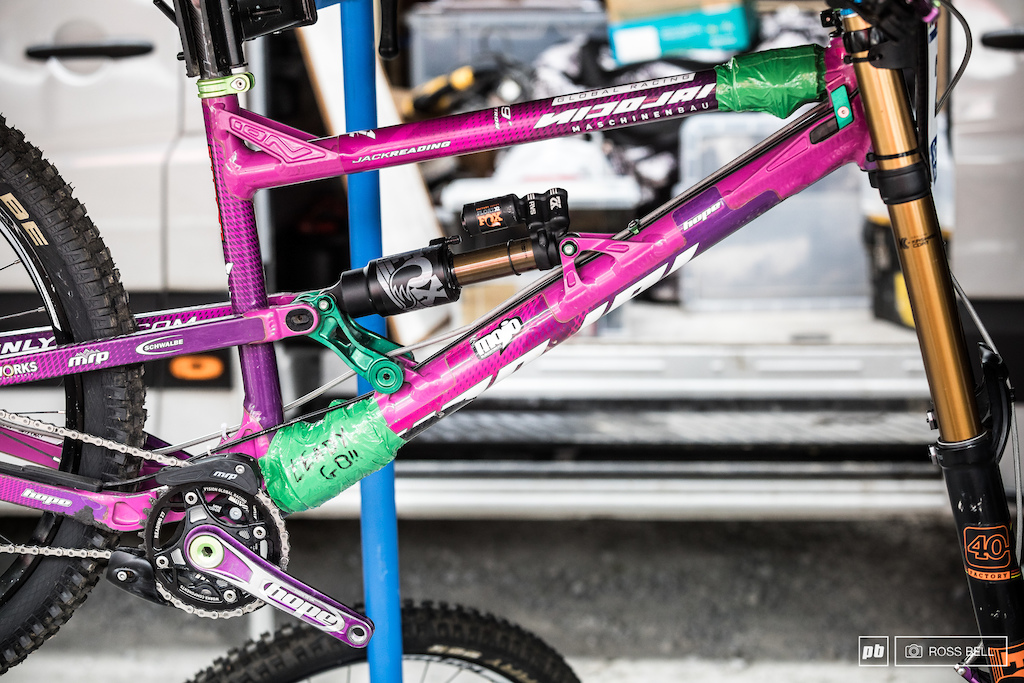
Jack wouldn't tell us the weight of the lead but just said he's been working with Chris Porter from Mojo, and through testing has found that by placing the extra weight behind the stem and at the bottom bracket helps to calm down the forces and roughness from tracks, keeping the ride planted.
It is track specific however as Jack says it feels good on the fast and rough tracks but made the bike feel a little dead on the tight and twisty sections.
however, even if it was, it appears you’re trying to argue that you need to change something by double or half to make a significant difference
No. You were claiming that the suspension changes were so significant because the sprung/unsprung ratio of the bike alone doubled.
I haven't been trying to claim that weight changes don't affect suspension, far from it. Merely that system weight is still important, and it's a much smaller ratio change.
“You were claiming that the suspension changes were so significant because the sprung/unsprung ratio of the bike alone doubled.”
Yes. That’s still true. However you want to look at it, the rider and the bike are not conjoined, they’re separate entities.
I think everyone debating is agreeing that the greater the sprung mass, the better (what is better though, grip or comfort, that's a whole other debate) the suspension is going to work.
The various affects of splitting that mass between rider and bike can be debated to death.
Something important that hasn't been mentioned is the inherently long chainstays on ebikes, surely this has to factor into the perceived increase in "calmness" and "grip".
@chief, I get your anology on arm pump and a really large bike mass, the anology can still apply to the one body model and the two body model. On a tangent, it's compromise though isn't it, who's going to ride a really, really heavy bike to cure arm pump, you'll be compromised on handling traits.
Aren't we also getting onto rider preference and styles now too, @chief it sounds like you're really concerned with how well the bike monster trucks through rough stuff, I'm more concerned with the bike doing what it's told, I'm sure that's driving our arguments a certain way too.
Jack wouldn’t tell us the weight of the lead but just said he’s been working with Chris Porter from Mojo, and through testing has found that by placing the extra weight behind the stem and at the bottom bracket helps to calm down the forces and roughness from tracks, keeping the ride planted.
It is track specific however as Jack says it feels good on the fast and rough tracks but made the bike feel a little dead on the tight and twisty sections.
They really built that up [edit: I mean they metaphorically hyped it up on the internet] for Ft Bill, then he snapped chain after about 30 seconds. Never heard it mentioned on any subsequent races.