UPDATE: Reviews section refreshed, redesigned, searchable: Go take a look
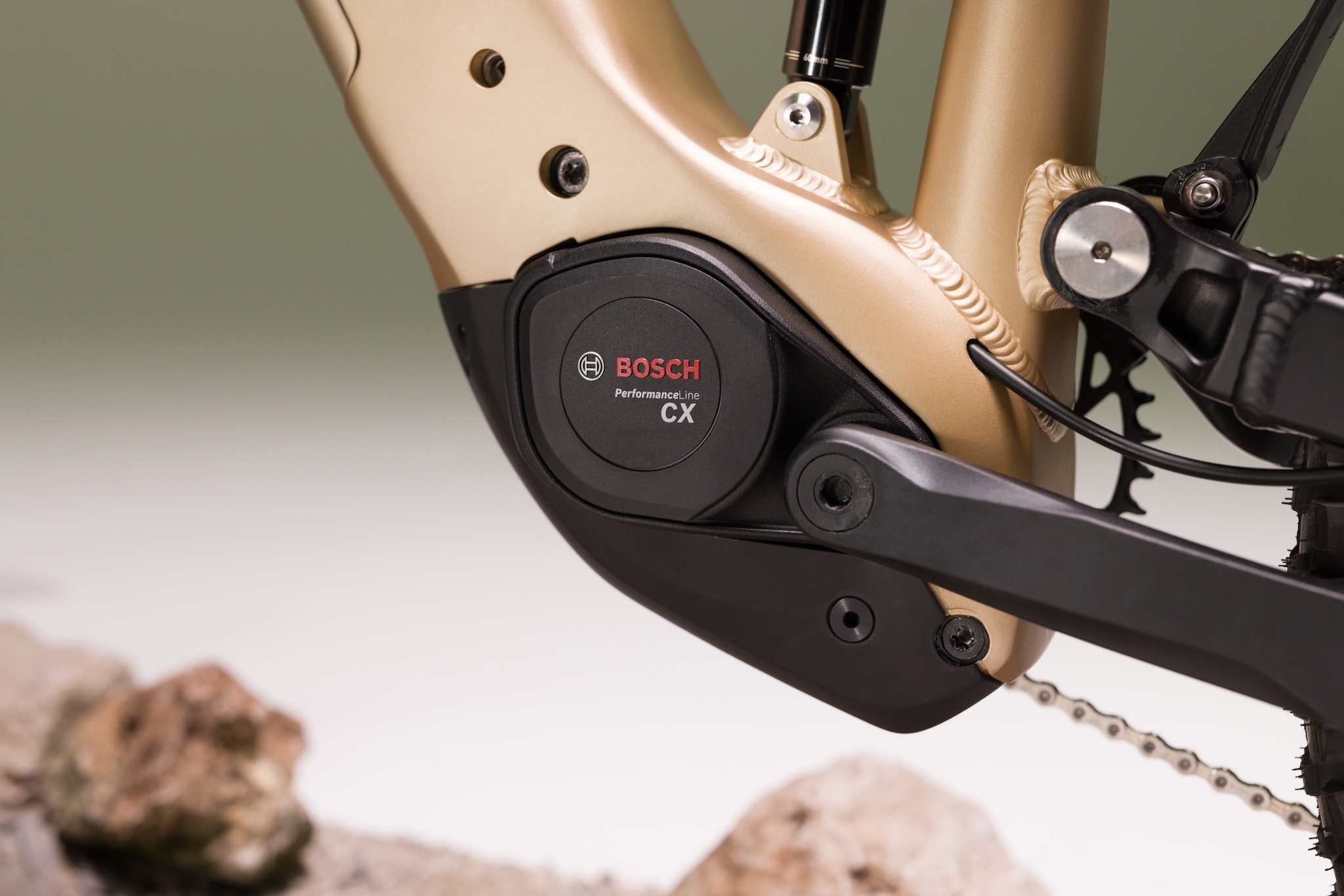
"Performance values" of the Performance Line CX/CX-R can be increased to up to 600% support and 120 Nm of torque.
It's mastering the steepest of climbs with ease what cycling is supposed to be about? I acknowledge that some people need some assistance to enable their enjoyment of riding but ebike marketing is starting to sound like Top Gear 15 years ago, "Moar powaaaar!" I'd like to say that ebikes can get in the sea, but the batteries would just add to the pollution.
It's mastering the steepest of climbs with ease what cycling is supposed to be about? I acknowledge that some people need some assistance to enable their enjoyment of riding but ebike marketing is starting to sound like Top Gear 15 years ago, "Moar powaaaar!" I'd like to say that ebikes can get in the sea, but the batteries would just add to the pollution.
A lot of people use the new FF ebikes as shuttle bikes really. They work well at a lot of the semi-official / off-piste places that are becoming a much bigger part of MTB in the UK. Personally, as an avid ebiker I don't think all the extra is needed or a good idea really. It's a marketing arms race and we face enough problems with the press using 'ebike' as a catch-all name for everything from a Surron to Deliveroo type conversation kits. Not to mention, batteries haven't grown that much bigger, so you can use your mad power ebike to do the boring up-hill bits super-fast, but you'll be heading home after an hour, or begging a cafe to let you plug your bike in with your 1kg / 12A charger in your pack.

What does this increased output do for motor reliability?
Surely it's like remapping a car: making the motor work harder without upgrading any of the hardware/parts. Bosch would've designed the motor around a maximum output but now they've decided it's safe to increase the maximum output? Just going to end in tears earlier, no?
I have a Bosch equipped EEB and I don't use the extra 15nm from the last upgrade! Not because I'm some super tech climber, quite the opposite, but I'm yet to come across a situation where I need it or where I think the rinsing of the battery and wear to components is worth it for a reduction of effort.
YMMV.
What does this increased output do for motor reliability?
Surely it's like remapping a car: making the motor work harder without upgrading any of the hardware/parts. Bosch would've designed the motor around a maximum output but now they've decided it's safe to increase the maximum output? Just going to end in tears earlier, no?
Tears for the riders but more money for Bosch when people have to replace the motors.
I'm sure the increases are all within safe operating limits of the motors though.
What does this increased output do for motor reliability?
Surely it's like remapping a car: making the motor work harder without upgrading any of the hardware/parts. Bosch would've designed the motor around a maximum output but now they've decided it's safe to increase the maximum output? Just going to end in tears earlier, no?
Sort of, but electrical motors are far simpler than car engines, there's no cooling or oiling system, just sealed bearings in a sealed environment with grease. Even with 1300w (on the Avinox) they're not spinning that fast, nothing like a power drill. Based on what I've read on EV motors, making more power is easy and reliable, it's all the car bits around it that are harder to support more power.
It's water / dirt ingress that kills ebike motors, but they seem more reliable than before, my friends with older bikes seem to be on their 2nd, 3rd, 4th even motor (all replaced free, even out of warranty regardless of brand).
Not sure I'd want to run £300 SRAM cassettes with all that torque and power, I'd want a full steel Deore for the sake of robustness and cost, they won't come with those because they're also fighting over weight.
Avinox did it to attract attention and press for a new motor, and it's become the thing they're all competing on now. Easy to drive the motor a bit harder at the expense of efficiency/motor life. Far harder to make a motor thats lighter/more reliable/rides more naturally.
According to this the Bosch was already dropping its power off quickly before this update. Admittedly that's nearly 9 minutes at full power but if you're using it to shuttle up big fire roads at full speed you'll hit that.
https://www.ebike-lab.de/en/thermik
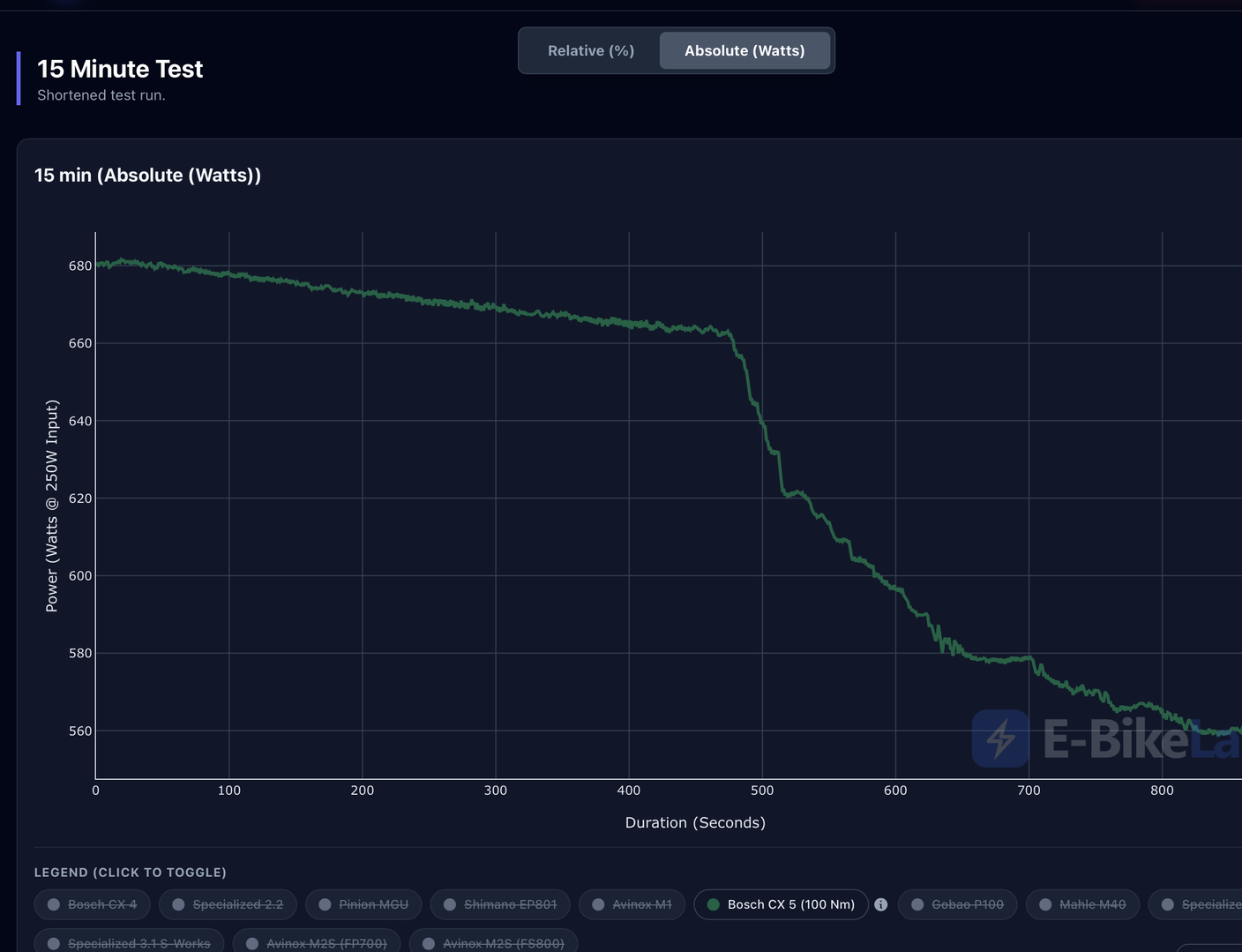
I'm trying to work out what this is describing?
Bosch eBike Systems is introducing the Drivetrain Tensioner for the Performance Line CX and Performance Line CX-R, bringing maximum control in technical riding situations. The software optimisation closes the freewheel between the motor and rear wheel, reducing the free travel on the pedal to a minimum and eliminating delay whilst pedalling. The result is almost instantaneous traction, even quieter freewheel, and the rider’s input converted directly into precise propulsion. This direct power transmission enables superior control and noticeably more agile riding behaviour, particularly on demanding sections, such as when starting off on a step or accelerating out of tight bends. In combination with the performance upgrade 2.0, the Drivetrain Tensioner can protect the freewheel, ensure a longer service life, and lower repair costs.
So it's maintaining enough spin to *just* engage the free hub on the rear wheel?
Assistance multipliers are starting to become a joke. The required input is getting so low they may as well just have a throttle.
I did say on another thread that DJI hadn't made some technological leap forward. They just did what all the other manufacturers could have done anytime they wanted.
And now they all will.
Great.
Assistance multipliers are starting to become a joke. The required input is getting so low they may as well just have a throttle.
The other problem is that sooner or later this is also going to invite regulatory action. Problem IMO is that 'off road' is a widely-abused loophole.
Assistance multiplier at 600% - what's that as peak output, have they gone over the 750W they suggested as a sensible limit?
Peak power is still 750W.
What can Bosch realistically do here...? Everyone I know looking at ebikes is talking Avinox, and that's at least partly due to the headline "W" figures (that they'll likely never use after some initial dicking around). So what do Bosch do? Risk losing sales and partner bike brands? Or risk destroying the equal access that ebikes and traditional bikes have here is Europe? Looks like for now they're willing to risk losing business, and all "power" to them for prioritising OUR access to the countryside and bike lanes over their own market share. But what happens next? They need help if they're to fight to maintain the current ebike as a bike class... and let's face it, they're not getting that help from the media who are all over the four figure W bikes right now.
Where are people using all that extra power? Climbing on a loose surface on the Quantocks Wednesday on my 2022 Orbea Rise in Boost , equivalent to Trail on a full fat ? I managed to lose traction and had to dab which annoyed me 🙄
I keep saying like others have it's all going to end in tears , it's a shame long term reliability and robust waterproofing isn't " sexy " in the eyes of the marketing bods .
Where are people using all that extra power? Climbing on a loose surface on the Quantocks Wednesday on my 2022 Orbea Rise in Boost , equivalent to Trail on a full fat ? I managed to lose traction and had to dab...
Avinox has a 47 (I think) position Hall Effect ring which significantly improves traction over the usual single hub or rim-mounted magnet. This means you are more likely to stay on until you go into a corner too fast and crash that way instead.
What can Bosch realistically do here...? Everyone I know looking at ebikes is talking Avinox, and that's at least partly due to the headline "W" figures (that they'll likely never use after some initial dicking around). So what do Bosch do? Risk losing sales and partner bike brands? Or risk destroying the equal access that ebikes and traditional bikes have here is Europe? Looks like for now they're willing to risk losing business, and all "power" to them for prioritising OUR access to the countryside and bike lanes over their own market share. But what happens next? They need help if they're to fight to maintain the current ebike as a bike class... and let's face it, they're not getting that help from the media who are all over the four figure W bikes right now.
So basically this:
...ebike marketing is starting to sound like Top Gear 15 years ago, "Moar powaaaar!" ...
Which some of us were concerned about a while back but obviously shouted down by the majority for whom it's just about "fun" apparently.
I'm increasingly inclined to ask who actually cares every time there's another E-bike announcement a few more Watts or Nm, or whatever...
Does any of it really matter or is it just another hype train? and consequences and impacts are irrelevant so long as number go up.
It's basically the same as car marketing at this point.
Which some of us were concerned about a while back but obviously shouted down by the majority for whom it's just about "fun" apparently.
I don't know which forum you are reading, but the majority on here start frothing at anything over and above what they deem acceptable
Peak power is still 750W
That all sounds a bit Japanese 280bhp gentleman's agreement (the issue is, is it not, that the power rating is based on the power deliverable over a set period without overheating?). As above I think this is going to invite regulatory action (and at risk of pearl clutching, risks off-road bike access in countries like the UK/Ireland where it's already limited)
I'd rather see eBikes become lighter with much longer range before I own one. I like big days out with lots of climbing over several hours. When the fay comes when I need the assistance from an eBike, I want to be able to do the same rides and not settle for half the distance/time.
Which some of us were concerned about a while back but obviously shouted down by the majority for whom it's just about "fun" apparently.
I don't know which forum you are reading, but the majority on here start frothing at anything over and above what they deem acceptable
From what I remember, much of what you describe “over an above what they deem to be acceptable” was as much about what is legal?
I'd rather see eBikes become lighter with much longer range
Same. Can't see the point in more torque/power.
Would rather have more range for big days out and lighter ebikes.
If we're not careful I can see ebikes over a certain power needing insurance and some sort of number plate.
I really like my ebike but it doesnt need more power. More range would be great.
From what I remember, much of what you describe “over an above what they deem to be acceptable” was as much about what is legal?
This. Use and abuse of loopholes to ride what are legally electric motorbikes risks heavier handed regulation for everyone, whether they’re on an ebike or not.
I’d suggest that this is a valid concern, rather than dismissing it as frothing.
I've got the Performance Line SX (2024/5) on my e-bike, it's due a service next week. It's not covered by this ^^ upgrade but there is (apparently) something already in circulation to boost the torque on mine a bit.
The amount that e-bike motors are restricted anyway (25kph cut off etc) you can safely boost them quite substantially before it starts to have any significant impact on life expectancy.
Agree on the comments above though. Longer battery life / greater range would be more useful than just ALL the power!
Peak power is still 750W.
No issue with that then (clearly I CBA to look it up)
Just now available at 60rpm cadence, instead of the previous heady 72... 🤦🏻
Now don't get me wrong, I love my eBikes... But I also love regular bikes, and I am still afflicted by the disposition to put work in to gain my reward too... Yesterday's ride for instance, 19 miles, 4200ft of climbing, mostly in Tour+ (which is turned down to 70Nm and 450W max on my Bosch CX powered Mondraker)... Used only half of an 800Wh battery, so had I been able to carry on, I should have been able to roughly double those numbers! Some people will burn a whole 800Wh battery in the same time, using far more assistance...
Anyway... Horses for courses... Cos I still prefer the Bosch SX motor personally, which even with its 60Nm update a few months ago (up from 55), it still needs a cadence of 96rpm to access its peak power of 600W (down from 104rpm!!!), which means it really rewards a high cadence "ride it like you stole it' pedalling style... Which I love, as it feels far more natural and engaging to ride.
That all sounds a bit Japanese 280bhp gentleman's agreement
Agreed... The difference being that that was an arbitrary gentlemen's agreement, to stop the focus on the power arms race and to focus on delivering improvements elsewhere to the vehicles they were developing, it has nothing to do with legality... The eBike motor manufacturers are already flouting the laws of what constitutes a Class 1 eBike, and willingly so, it won't take long for one person to ruin everything for the rest of us by pushing the limit too far and bringing blanket draconian laws in to control everything going forward.
I guess with the mega power headline grabbing motors, turning the power down via the app will give better range from a similar capacity motor?
I'd prefer a lower power / increased range and improved battery technology making the heaviest component lighter, personally.
My old tech Gen 3 Levo still had 22% left on its 700w battery when my friends Amflow had 6% left. All this extra oomph will only work for shorter rides.
I think auto mode and new traction control stuff is way more useful and interesting than extra power.
On a side note, on a family ride at Dalby on Saturday I only used 4% in 15 miles and that was pushing the wife up a long hill. Once you get the big bugger moving you don't notice the extra weight with the motor off. So in theory you can do as many miles as you want if you're not in a rush...
pushing the wife up a long hill. Once you get the big bugger moving you don't notice the extra weight
I assume the fat cow's not on STW, then ?
I’ve had the update on the App Store.
just updated the bike now and it only took a few minutes.
There’s a thing in the update info that you may not be able to access the full 120Nm until up to 24b after installing the update.
This seems to be the case on mine.
I've got the update but I had to uninstall and reinstall the app twice to get it to work, a quick ride up and down the road confirms that the bike definitely feels quicker
SX motor user here, the App has updated but when connected, the bike shows being up to date, so the power upgrade which didn’t apply anyway, but there are no other details in the upgrade that seem to affect the SX system
There was no mention of the Garmin live data upgrade in the app update description, so that might roll out later. I hope it does work with the SX system.
I'm currently on Flow 1.34.7 (1131) on a Gen 4 CX.... I don't see any upgrade available for me and I don't think I get anything out of this as far as I can see. The last update gave me Recorded HR as opposed to just dynamic HR whilst actually riding.
The update only works on gen 5 motors which came out September 2024 as far as I can see.
Gen 4 motors don't get the update to give more power. I've just updated mine and it doesnt have the extra power option in the mode settings.
Well, I've had an app update today but I don't appear to have any of the new features!
Tried uninstalling and reinstalling the app, no difference.
I've got the Performance Line SX (2024/5) on my e-bike, it's due a service next week. It's not covered by this ^^ upgrade but there is (apparently) something already in circulation to boost the torque on mine a bit.
The amount that e-bike motors are restricted anyway (25kph cut off etc) you can safely boost them quite substantially before it starts to have any significant impact on life expectancy.
Agree on the comments above though. Longer battery life / greater range would be more useful than just ALL the power!
There was an update in October ish that increased the torque from 55 to 60nm

