More random musings. There is a table of overall leverage on popular brakes that puts the Truck stuff Maxima up at about 49:1 and the Intend Trinity at 46:1. I think the Hope is around 40ish:1.
Now, given that there is a finite amount of space to swing a brake lever, the pads must be getting closer to the rotor.
I often find that I need to keep on top of rotor trueness to keep my brakes silent.
My question is this, do these hyper powerful brakes run the pads closer to the rotor and therefore make more noise? Given that UK riding is often wet and muddy, is this a point to consider and a reason to stick with Hope E4?
Larger master cylinder = more power I’d have thought.
Yeah, there's more going on here than those figures cover- like, you don't need more space to increase leverage, you can do that with how the lever actuates the piston. And the actual power is a function of that and also the size of the master cylinder vs the size of the piston. Obviously lots of variables impacting each other but I don't think pad clearance has a direct relationship there.
I appreciate that there are a lot of variables that impact on the performance of a brake. However, these ratio numbers combine mechanical and hydraulic leverage. The brake lever can only move so far. It's limited between the reach of the typical finger, back to the bar. If that is in a system offering 50to1 rather than 30to1, then something else has to give. I can't see how it wouldn't impact on slave piston travel and therefore pad clearance.
That is what Servowave and other cam systems try to address. Done right you have all the leverage once the pads hit the disc but more pad travel up to that point.
50to1 rather than 30to1
It can be both, like a falling rate suspension linkage. I’ve not looked at the tests you mention to see how they have arrived at their figures
Even the most simple lever (look at a Magura) may have a change in rate throughout its pull. Just like a simple single pivot no linkage suspension system can be tweaked with the mounting positions e.g. Orange
Larger master cylinder = more power I’d have thought.
Completely the opposite. Larger pistons in the calipers = more power. If the master cylinder piston is smaller relative to the caliper, the master cylinder piston needs to travel more to take up the free stroke. This is why Shimano use their Servowave levers - the leverage changes through the stroke to take up the freestroke quickly, but then give more leverage after that. It makes bleeding them properly really important.
whatevs, all i know is that i get far less hand fatigue with the new Hopes than any other brakes ive used: Shimano/Sram 4 pots (not tried trickstuff etc)
Riding different brakes; shimanos seem grabby, srams somewhere in the middle, quick squeeze tech4s didn't feel much different from my tech3s with lots of lever throw before power, but after a proper ride the difference is huge
Hayes Dominion A4 are also very powerful (41:1) and they run close when when the pads are new.
Never been a problem for me but with new pads they're noisy for a few minutes after splashing through a dirty puddle, and getting the rotor back in the caliper when refitting the wheel needs precision.
It's probably why they have the crosshair system grub screws for aligning the caliper. There's no way I'd have managed without it.
The Hayes rotors are 1.95mm, I wouldn't try to run 2mm rotors but some people have.
The spreadsheet is here.
I run Code RSCs with thicker HS2 rotors, and they don’t make any more noise than the thinner ones. They’re also pretty effortless and bombproof down long steep descents (2k vert).
As far as I’m aware, most brake callipers gradually move the pistons out every time that they’re squeezed, so the pads end up pretty close to the rotors no matter what.
As far as I’m aware, most brake callipers gradually move the pistons out every time that they’re squeezed, so the pads end up pretty close to the rotors no matter what.
All hydraulic brakes do that, that's how they self-adjust. However, the design of the piston seals will affect this. When you apply the brakes, the seals flex so that the piston can take up the clearance between the pad and rotor. When you release the lever, the seal returns to its original shape and retracts the piston. If the clearance is too large, the seal flexes too much and the piston slips through a little bit and takes up the clearance. You can set the clearances manually (by inserting a feeler gauge or shim between the pad and rotor when you center the caliper), but the pistons will reset themselves automatically as soon as the pads wear down. If you put a thicker or thinner rotor, the pistons will just reset themselves to that and it won't affect the pad/rotor clearance.
Obviously, if the system is old and hasn't been serviced, the seal can stick to the piston and they won't self-adjust correctly. Cleaning and lubing the pistons when you replace the pads should prevent this happening and give a consistent feel at the lever.
However, the profile of the seal will also affect how much they can flex - if they were very thin and wide, they wouldn't be able to flex much, if they were very tall and narrow, they'd be able to flex much more. Obviously, brake designers know this and specify seal profiles that flex enough to give pad clearance, but also self adjust easily enough to give a consistent free-stroke at the lever. This is designed into the brakes and there is no practical way to change the pad/rotor clearance that the designers have settled on as the best compromise.
When you release the lever, the seal returns to its original shape and retracts the piston
But there is a spring in the M/cyl and Shirley, that does a lot to retract the piston by pulling on the fluid, as its a closed system... It cant be all down to the tiny piston seals... or can it?
There's is a spring in the master cylinder but it doesn't do nearly as much as seal flex. It's more for lever feel.
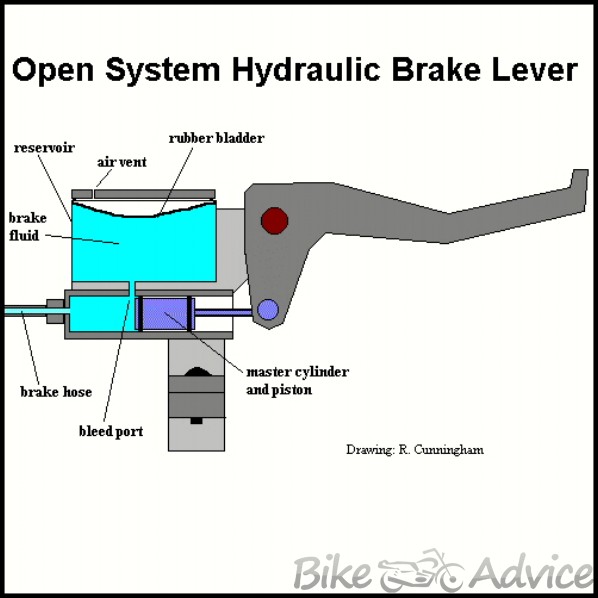
It is a closed system, but not all the time. Once the reservoir port seal on the master cylinder has passed the reservoir port as you release the lever, it becomes an open system again. This is how it draws in fluid to compensate for pad wear.
As about, the thickness of the rotor doesn't make a difference providing there is actually room in the caliper for the rotor, pads and designed pad clearance.
The point I'm making and the question I'm asking is this.
If brake A has a ratio of 25:1 and you set it up with 50mm of lever pull, then there is 2mm of clearance between the pads and rotors.
If super powerful brake B has a ratio of 50:1 and is set up with the same 50mm of lever pull, you only have 1mm of clearance between the pads and the rotors.
Does this smaller clearance cause more cases of rubbing in the wet muddy conditions we typically see in the UK?
I can see why 2.3mm rotors are becoming more popular than the typical 1.8mm. As discs get larger in diameter they become more flexible, thicker rotor material regains some of that lost rigidity (plus heat dissipation benefits).
All hydraulic brakes do that, that’s how they self-adjust
Pedant alert, but the hope brakes I have on my orange don't do this. You can't buy them any more though
But there is a spring in the M/cyl and Shirley, that does a lot to retract the piston by pulling on the fluid, as its a closed system… It cant be all down to the tiny piston seals… or can it?
Nearly all hydraulic brakes are an open system, closed systems are very rare. The spring in the master cylinder does not cause the wheel cylinder pistons to retract, that's done by the piston seals. They basically function as springs as well as seals.
The spring in the master cylinder just pushes the master cylinder piston back so that the transfer port from the reservoir is open. That allows fluid to flow from the reservoir into the master cylinder to take up the brake pad wear. Closed systems don't have that so the lever travel increases as the pads wear. Hope used to make closed systems, I don't know if anyone else did, open systems are a much better design, that's why they are nearly universal.
If brake A has a ratio of 25:1 and you set it up with 50mm of lever pull, then there is 2mm of clearance between the pads and rotors.
If super powerful brake B has a ratio of 50:1 and is set up with the same 50mm of lever pull, you only have 1mm of clearance between the pads and the rotors
I think the key point is that you don’t get the option of setting each brake up with the same 50mm lever pull. The amount of lever stroke is governed by the seal flex multiplied (probably now exactly but you know what I mean) by the ratio.
That’s why all else being equal more powerful brakes tend to have a longer stroke / softer lever feel.
If brake A has a ratio of 25:1 and you set it up with 50mm of lever pull, then there is 2mm of clearance between the pads and rotors.
If super powerful brake B has a ratio of 50:1 and is set up with the same 50mm of lever pull, you only have 1mm of clearance between the pads and the rotors.
If they are properly bled, a lot of that lever travel will be taking up the movement of the master cylinder piston closing the transfer port to the reservoir. Variable ratio levers like the Shimano ServoWave ones complicate things because they are designed to have less leverage in the first bit of lever travel so they close the transfer port quickly, then more leverage for power after it has closed. This is why they are utter bastards of things if they aren't bled properly. Having said that, a brake with a higher leverage ratio will have more lever travel, all other things being equal. Whether it's enough to really notice is a different question though. I suspect the noise issue will mostly come down to the rotors being straight, the calipers properly aligned, seals being clean and well lubricated, etc. much more than the leverage ratio.
I think that might be putting the cart before the horse. Also, while levers might not have exactly the same lever throw, they are limited in the working range by the human hand that operates them. You can design the lever throw as short as you like but there's a practical upper limit.
I'd say that the mechanical advantage of a system is designed first and more powerful systems typically have longer throw and a softer feel because of that mechanical advantage.
While the seal design is significant, it comes later in the process to suit the designed mechanical advantage rather than the mechanical advantage being designed around seal characteristics.
If you design a low advantage system, you can spec seals with a greater delta between inner and outer diameter giving lots of flex and retraction. If you used those same seals in a high advantage system, the pads would retract too far and cause the lever to bottom out. Those systems require a smaller delta between inner and outer diameter to ensure there is less pad movement.
My question is this, do these hyper powerful brakes run the pads closer to the rotor and therefore make more noise? Given that UK riding is often wet and muddy, is this a point to consider and a reason to stick with Hope E4?
And to answer the original question, probably not but it’ll depend on how much pad retraction (or seal flex) each brake is designed with.
I’ll add some personal experience with Trickstuff Direttissimas - having such a nice brake really encouraged me to get better at setup. Now I’m running a very true rotor with a very well bled brake and carefully aligned pistons. I have zero pad rub and they’re a complete joy to use with low free stroke (about 15mm) and a very smooth even power ramp up. They don’t have any more lever pull than a set of codes.
I think what I’m saying is yes more powerful brakes inherently have more lever pull but careful setup is more important.
Thank you for coming back to the original question. My current Hope Tech 3 E4 (4 bikes worth) are all set up similar to you, with minimal free stroke. Calipers are aligned centre and square with a feeler gauge. Hope floating rotors are running straight, true and centred at the start of a ride.
However, I do find that I need to tweak the rotors back to true quite often for a silent running bike. I don't know if this is just a consequence of these particular rotors or if it's where and how I ride. Given the wife's rotor need less attention than mine, there's certainly a speed/style influence on things.
Was just thinking that a Maxima or Trinity might mean more time required tweaking rotors.
I’ll say that I never have to mess with my rotors now. I’m running 2.0 Sram hsc which stay nice and true. I’d be very tempted by the intend brakes for ease of setup / bleeding.
I emailed them and they have a very honest comparison to the Direttissima basically saying they’re both great and don’t bother swapping. They said that when properly drip they have about 15mm of free stroke just like the Direttissima.
Oh, the other reason I looked at intend is that I’ve had made-of-cheese issues with the Trickstuff. They always sort me out quickly but:
Snapped lever screw
Snapped bleed port screw
Snapped banjo bolt (starting to think the problem is me)
Leaky calliper end hose joint
Leaky lever end hose joint - this one ended a ride this week
I guess they’re like other very high end things, a complete joy to use but require careful treatment and more upkeep.
My shigura set up runs with a really small clearance between the pads and the rotors. The magura storm rotors (2mm thick) were better than the Shimano they replaced, but the TRP R1 rotors at 2.3mm are significantly quieter and very rarely drag on the pads.
The heatsink they provide is a noticeable improvement too
Took me a while to get Hope brakes sorted on my Ripmo. 120kg of me needed 200 front and 180 rear discs with an otherwise std E4/tech 3 system.
Hasn’t put a foot wrong in at least 2 years and always gives great feel and power.
However, I have Zee brakes on another bike, also with 200/180 discs. Again standard and they are so immediately powerful it can be off putting if not used to or expecting the performance.
Equally impressed with both systems, although the Hopes are more shiny 😂😎
Hope E4 Tech 3.5 (Tech 4 MC, Tech 3 calipers with hybrid pistons) work really well with TRP R1 rotors which are 2.3mm. Got 4 of them as spares and if Merlin have them at a tenner again I'll get more.