UPDATE: CLASSIFIEDS section refreshed, redesigned, searchable: Go take a look
I’ve always had a soft spot for those gorgeous Proflex’s from the mid-90’s. Especially the linkage forks that they used, which seem to have gone by various names (Girvin, Noleen, K2). So, I thought that I’d have a go at making a full-size mock-up out of MDF (ostensibly under the guise of seeing if there was a practical reason why they aren’t more popular these days, but mainly just because). I’d be interested to find out whether I’m alone in my fascination? If you want to know a bit more about the fork along with some more images then I’ve written a short blog about it here (www.daveypushbikes.com/blog).
[img] 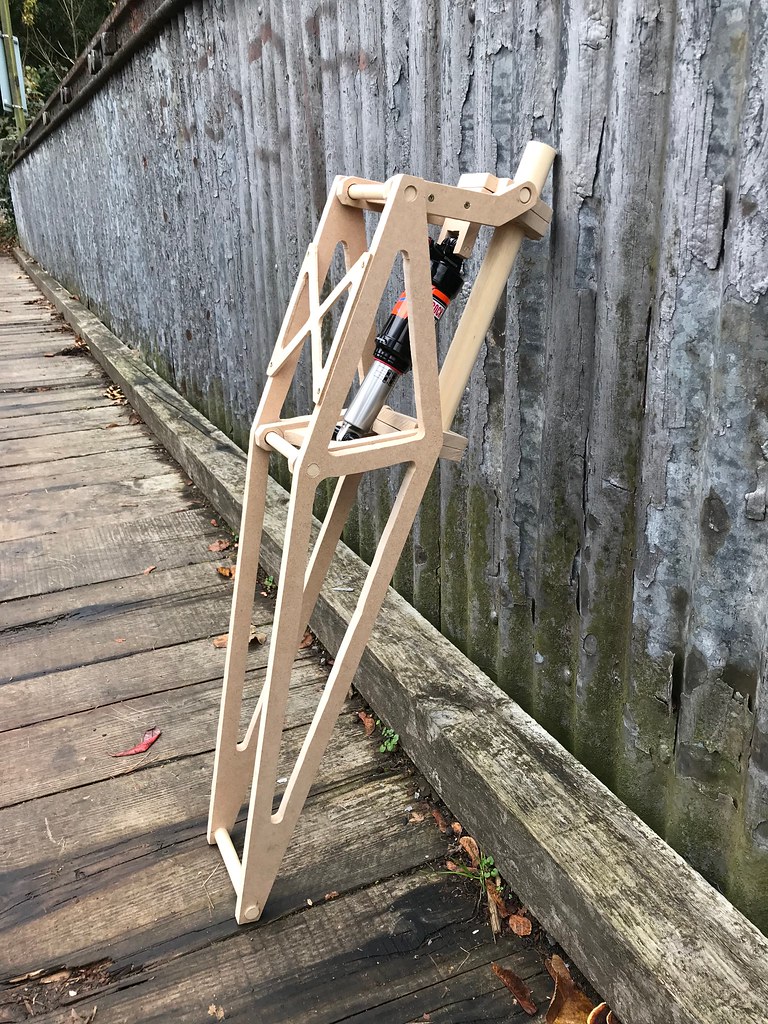 [/img]
[img] 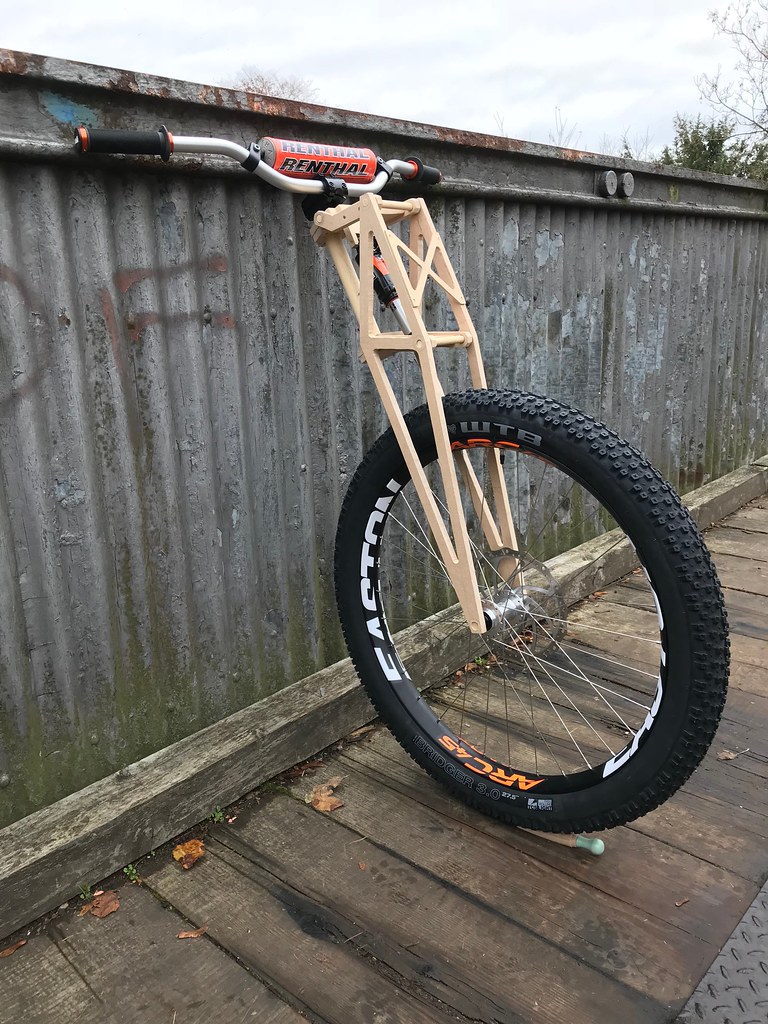 [/img]
Very nice!
Now I want to know how it rides!
Good work.
woody74 - Member
Good work
Wood work
Nice. I always have a soft spot for linkage forks. I designed a pair that looked almost exactly the same back in 1991 at university. But we had just got a carbon fibre winding machine thing so rather than a shock it used a carbon fibre spring. Love a linkage fork 😀
I would like to try a good linkage fork though.
Vorsprung did a Tuesday tune about the telescopic vs linkage forks - always good for a watch
https://m.pinkbike.com/news/tuesday-tune-ep-8-why-were-riding-telescopic-forks-2016.html
I rode (and still have the remains of) some Quasar linkage forks, and Mrs was sponsored to ride the last generation of Girvin forks (Noleen coil shock).
Very supple over bumpy fields but slightly disconcerting over drop offs (Girvin axle path).
Main issue with the Quasars was constantly chasing play in the bushes and grease splurging everywhere.
A common problem was the handlebars having to be very high to avoid clashing with the top link - I guess current trend for short stems will help that issue.
I've toyed with making some using long rubber torsion bushes for the pivots (like car suspension arms) to avoid bearing play but don't know if they could ever be made laterally stiff enough or maintain vertical wheel alignment (Greeves motorbike used them).
I predict Epicyclo will be along shortly to join in 🙂
Kilo still make some rather nice looking linkage forks. Light too.
[img]  [/img]
[img] 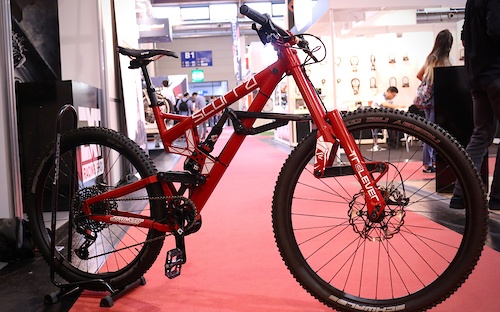 [/img]
2017 linkage genius/madness*
*Delete as applicable.
decking and fence need some work
Nerd Alert
🙂
and no rim brake option i'm oot!
Look Fournales fork
I don't remember those Look forks. I did lust after AMP and Girvin Vector forks, though, they made a lot of sense once you'd spent time riding an early gen set of Manitou elastomer forks.
Love it, mentioned in another thread I'm a bit surprised they aren't as common as they used to be.
This is my fave at the moment [url= https://www.singletrackworld.com/2017/06/wtf-the-funny-fork/amp/ ]https://www.singletrackworld.com/2017/06/wtf-the-funny-fork/amp/[/url]
I had a set of AMPs on an F2? back in the day. They were very nice in a straight line as the axle path ate up the rough stuff. Not so good under braking or in corners as the trail reduced and everything got a bit frantic.
They're a great idea and ought to be able to be built light and stiff with great damping characteristics, only trouble is that telescopic forks are the norm on all forms of 2 wheeled transport and have a lot of development so they really work well these days.
The guy who helped set up Niner, then left, said he'd like to develop some linkage forks but everyone accepts telescopic are the norm so it's not worth the time and money commercially
mick_r - Member
...I predict Epicyclo will be along shortly to join in
Indeed 🙂
Good to see someone experimenting with linkage forks.
I grew up on motorbikes with girder forks, plus others with leading links, and trailing links, and being a young idiot at the time I rode them flat out. I always preferred them to telescopic because of their superior ability to iron out road vibrations - the sort of little irregularities that a telescopic has too much "stiction" to respond to.
An advantage of a properly designed linkage fork is that braking dive can be controlled or eliminated, thus a 3" linkage fork can do the job of a longer travel telescopic because less travel is wasted on brake dive.
Modern telescopic forks though are very good, but to get that performance is expensive.
I have quite a few different linkage forks for bikes in my collection. Unfortunately most do not take advantage of the body of knowledge that existed with motorbikes so they make the basic errors of an axle path that was ok for a short arc but then rapidly changed the offset of the fork to the detriment of the handling in extremis.
The best girder fork made was the Webb as used on Velocettes, and the Vincent Girdraulic (IMO). These would be regarded a very short travel these days. The Vincent is capable of 150mph with the right tuning so needs a good fork.
Incidentally there is a salutary lesson to be learned from the Vincent. Racers looking for more travel when racing against much more modern bikes started extending the travel of the fork by using longer shocks. This then lead to a series of very expensive VIncents stotting off into the scenery at hard braking s-bends. The problem was coming off one corner, then hitting the throttle raised the front end, only to be followed by extremely hard braking initiated when the fork was fully extended. The weight transfer tended to lock the fork up because the links were at an extreme angle. It took quite some time for the cure to be realised because otherwise the fork functioned very well.
That's a longwinded way of saying use long links, and make sure they are always in a position where they can't get locked from braking, ie put travel stops in the design.
If you can get hold of a copy of Phil E Irving's book "Motorcycle Engineering" he's got a chapter on various linkage forks that's well worth reading. It's old (1950s) but the fundamentals haven't changed.
OP, Chris Porter disagrees with all of your points about body position, and he's all about having fun down hill as well.
Hi mick_r - I think that the move to shorter stems is one of the reasons why this type of fork has a better chance of success now than it did back in the 90s. As you say, trying to get the top link to clear something like an 80mm stem is a challenge that becomes much easier to overcome if the stem is only 35mm long.
Hi epicyclo - I agree, I think that the longer you can make the links (within reason!) the better. I went with links that were 120mm long combined with a shock with 50mm of travel giving just over 100mm of wheel travel. The longer links help to minimise the change in fork offset, helping to keep the handling more consistent through the forks travel. It also reduces the angle that the links have to rotate through.
Hi nickc - I've got a lot of time for Chris Porter, but I certainly don't agree with everything he has to say! I find it a bit odd that, as someone who has previously referred to Motocross bikes when talking about bike geometry, he appears to have chosen to take his bikes in the opposite direction. More generally, for me the biggest issue with modern bike design is the lack of differentiation between bike-stability and rider-stability. Longer front-centres and steeper seat angles are resulting in longer, more stable bikes. And if you derive your fun from going as quickly as possible then this move if possibly a good one. But these same changes are actually putting the rider in a less stable position, tipping the rider forwards and requiring their arms to support more of their weight more of the time. I get most of my fun from threading a bike down a challenging piece of singletrack. My speed is (almost) irrelevant - it's the fun of confidently playing with a bikes limits across technical terrain that I get my kicks from. I believe that this is more likely to happen if the rider can adopt a more stable body position, with the rider being able to support almost all of their weight through their legs most of the time. This is actually more like the position that a Motocross bike places the rider in, rather than the stretched out position of something like the Geometron, which Chris Porter had helped to develop. But, as I've said, I think that he is trying to achieve something else with his bikes.
Few bike companies as divisive, I know, but linkage fork fans should all quite like Moulton’s forks. Not the coil sprung leading link types, but the ones with flexitors. The pivots, springing, damping and bearings all done in one. Lovely satisfying bits of kit.
😀
great stuff.
Interesting thread!
🙄
Some of it: quite some engineering madness.
But nice that people still tinkering around with it.
😉
The other good thing about linkage forks is that you don't have to run floppy slack head angles to disguise the forks deficiencies.
See, where I disagree with about stability is this; you suggest that a crouched position is more stable, and it is, when compared to standing fully upright, but more stable even than crouched, is on all fours, with the weight spread something like 70/30 legs and arms. Where I think most riders fail, is that they don't get low enough, because 1. they haven't learned to ride that way, 2. a lot of riders just aren't fit enough to maintain that body position for any length of time.
I agree with you, in that I think a lot of development has gone into making bikes stable on descents mostly it seems because lots of riders can't physically get in that position (I'm not saying that many riders could do with losing a few pounds, but...) or don't seem to want to learn how to ride off road in way that will make them more stable, so if you want to make a bike that is fast/fun but with good rider control, make the bike more stable is probably your best bet.
What's most fun of all (in my opinion of course), is 1. being on a stable a predicable bike, and 2. getting in the right shape on the bike. Having a stable rider [i]and[/i] bike.
You haven't discussed (in your very interesting blog) your thoughts on telescopic seatposts, and they way they've influenced bike design. I'd be interested in your thoughts.
I'd be very keen to have a go on your bike though, it looks super interesting. Will you keep us updated as you build it?
these same changes are actually putting the rider in a less stable position, tipping the rider forwards and requiring their arms to support more of their weight more of the time.
That's not how a Geometron feels at all when you're riding it. In fact it feels the total opposite of that and you have to make sure you weight the front more than on a regular bike.
If you want to go a bit further with your leading link design you might want to have a look at sidecar MX forks as they all go down the same route.
Not criticising BTW as I love the idea of leading link forks. Just not sure it's right for a none motorised bike.
Like this thread very much and like if people do such great work at home.
Compliment!
based on above post from nickc - bloke I checked:
https://www.daveypushbikes.com/full-moto-frame.html
Interesting.
My impression - without adding any deeper know how of mountain bike and suspension design:
From my "feeling" I doubt this position thing.
A rider in one of the world’s largest motorcycle races, the Enduropale du Touquet in France
This position for a motorcycle - isn't that based onto the wish to have as much grip on the rear tyre as possible.
No idea about the horsepower - but this guy tries to transfer 150 hp or so onto the ground?
Mountain biking, going downhill:
I have at least the feeling that - in the case I'am scared to go over the bar and shift my weight too much to the back I'am slow.
Not enough grip on the front tire.
Getting the center of gravity LOW and MORE TO THE FRONT: this makes me fast... In this situation very little pressure on the back tyre. Which is good.
A rider in one of the world’s largest motorcycle races, the Enduropale du Touquet in France
The motorcycle is heavy. Center of gravity "above ground" of the biker not such a big deal.
Mountain biking: center of gravity of the biker has the biggest influence... It has to be low. And in fact - when going fast I have the impression that I move my bike with my body position and less with steering.
I might be wrong. But this came to my mind when reading this thread and when reading> https://www.daveypushbikes.com/full-moto-frame.html
The position thing you describe I doubt.
Additional, linkage forks: beside advantages I would fear a lack of stiffness - or even play - in the yaw / steering direction. Isn't this design in this direction very soft? Problem of instability around this axis?
But I like the whole project very much - and I'am not an expert. Means very possible you are right on your path and above only noise.
Great learning project.
Very, very neat!
Good luck!
😉
Hi nick_c - the position that I believe I should be trying to achieve on a bike is the cycling equivalent of an 'Athletic Stance'. It's primarily an American term, but usefully helps to describe the starting position that a person adopts in many different sports (a tennis player waiting to receive a serve, a boxer preparing to take or deliver a punch or a golfer reading to tee-off, as examples). Obviously, it varies from sport to sport, but it's an incredibly stable position from which a person can react effectively to external influences (I've written about it in more detail throughout my blog, but specifically here www.daveypushbikes.com/blog/balancing-act-part-3).
Bike stability is an interesting one - I'm not sure anyone who rides a mountain bike for fun would actually want a 'really' stable bike. One that could steam-roller its way from the top to the bottom of a hill with minimal input from the rider. However, for those who race, stability takes on a whole new level of importance so long as the bike can still accelerate and turn effectively. I know it's easy to bash the marketing departments of the big bike companies, but I would suggest that its easier to market a fast bike / race bike (using this speed as a proxy for fun) rather than a bike that, from the outset, has been designed to maximise fun.
As for dropper-posts, I believe that these can only have a positive influence on riding (so long as you can find a reliable one!) The position and support that a rider requires when pedalling up hill when compared with attacking a downhill trail (for example) is so different that it must make sense to better optimise the bike (all else being equal) for these situations.
I will be building my new frame in February and I already have all of the other parts for it so will hopefully have it in the woods soon after. I'll be putting updates on my blog, but can also post here on the forum if you're interested?
Hi singlespeedstu - I must state that I have never ridden a Geometron, so I am about to adopt the very dubious position of the armchair critic! With that rather large caveat in place, I would suggest that the need to weight the front wheel more on this bike than one with more traditional geometry is primarily the result of the slacker head angle (64.2 degrees on the G13 in its 'low' setting). Try riding this bike with a 68 degree head angle and I suspect it would start to feel very 'nose-heavy'. However, as I said, this is all just theorising from my sofa whilst watching Spectre, as I have never ridden the standard bike, let alone one with a more conventional trail bike head angle.
Thanks for MX sidecar suggestion. I suppose a big part of the reason for building the mock-up fork was to start exploring whether this set-up really does have merit for contemporary mountain biking.
Hi andreashoen - I'm certainly not disputing that a motorcycle is heavier, faster and has very different power delivery(!) But when I look at the evolution of mountain bike geometry, I believe that we started with something reasonably good (Klunkers, which were actually not that far off Motocross bikes in terms of their standing rider position), but then became overly preoccupied with racing in the 1980s, adopting a lightly tweaked version of road bike geometry. In many ways I think that we've been trying to perfect this overly compromised arrangement ever since. I've written more about my views here www.daveypushbikes.com/blog/assume-the-position. I suppose I'll find out shortly whether or not my theory is correct when I build my new frame!
really looking forward to seeing your bike design OP.
oliverdavey80 - Member
...Bike stability is an interesting one - I'm not sure anyone who rides a mountain bike for fun would actually want a 'really' stable bike. One that could steam-roller its way from the top to the bottom of a hill with ...
I presume you're familiar with the work of Tony Foale on motorbikes?
I've done similar but cruder experiments in the mid 70s and agree with his conclusions.
Hi epicyclo - yes, Tony Foale's work is pretty comprehensive! There's also a book by Gaetano Cocco that has some helpful/relevant things to say about motorcycle geometry and suspension design. I've summarised some of what I understand about this in relation to bottom bracket height and centre of gravity here www.daveypushbikes.com/blog/bottom-bracket-height-the-most-misunderstood-dimension
Like the whole project.
But doubt the theories.
read:
http://www.daveypushbikes.com/blog/bottom-bracket-height-the-most-misunderstood-dimension
Mmmm. We talk about mountain bikes? And going downhill? The rider has to be able in msec time frame to move and push the bike in such a way to avoid crashing.
Part of the mountain bike frame design is being able to push the saddle very much down. Means the biker is able to get very low and is able to push his body "freely" around.
mountain bike for fun would actually want a 'really' stable bike.
No fun, no fast. Same as with sea kayaks (the ones for really good paddlers and really bad weather are UNSTABLE) and same with aerobatic airplanes. These airplanes are unstable as well...
Going on a rough trail downhill is very much like aerobatic flying...?
Great thread. As someone who rode an AMP fork a lot in the mid-90’s, I find the idea of non-telescopic forks very interesting and the work you have put in OP, is excellent.
I don't think there's much to gained from trying to compare the unstable characteristics of aerobatic planes to bikes TBH.
If I might be so bold, OP has some odd dimensions, I can imagine that trying to find the bike he wants that performs well on his specific terrain would be hard to impossible to get via an industry that is set up to shift large numbers of bikes to a formula, building a custom bike seems like a great idea, I imagine it'd be a great way to experiment. Good luck to him, I hope it works.
Interesting blog - I shall read more of it!
Regarding BB height, this is something I’ve experimented with by adjusting the geometry on my current full-sus and hardtail (with movable dropouts, different fork lengths, anglesets and sag). Although it’s just anecdotal evidence based on my messing about I can say with a fair degree of certainty that as soon as a bike slides laterally a lower BB height makes it easier to keep the bike balanced. It almost feels like cheating!
I don't think there's much to gained from trying to compare the unstable characteristics of aerobatic planes to bikes
why?
❓
lets say, small cruising airplane: designed to be stable. Makes hands off flying possible.
I would compare this airplane to: road race bike for example
aerobatic airplane: designed to be not stable. Airplane follows every control input right away.
This is very much what I want from an mountain bike...
💡
How reacts the machine to the control input? That's an important question for the design of a machine. No matter if airplane, seakayak or bike.
Touches this question right away:
I'm not sure anyone who rides a mountain bike for fun would actually want a 'really' stable bike.
My answer (but might be wrong): no. This wouldn't be fun.
Linkage Suspension Fork Mock-Up
No question a great, great project. Love it.
😉
But as mountain biker: don't fully agree with the "stability ideas" presented in the http://www.daveypushbikes.com blog.
lets say, small cruising airplane: designed to be stable. Makes hands off flying possible.
I would compare this airplane to: road race bike for example
aerobatic airplane: designed to be not stable. Airplane follows every control input right away.
This is very much what I want from an mountain bike...
It's what you might want from a trials bike or a BMX, but I can't see it being much use for the majority of mountain biking. I agree there might be a place for less extreme variations, though, but still limited.
Airplane follows every control input right away.
This is very much what I want from an mountain bike...
That only works if you’re very strong and very skilled with excellent balance etc. A mountain bike being ridden on gnarly trails is constantly subjected to near-random destabilising forces, which not only cause the bike to deflect from its path but also unbalance the rider causing them to apply unwanted inputs to the bike.

