
MegaSack DRAW - This year's winner is user - rgwb
We will be in touch
Me, I'll go with -30c.
Although if it drops to -30c and its still cloudy I might, MIGHT risk -32c.
😛
Around 20 deg c.
Or if its muddy.
The mud is the scary bit. It could hide cracks similar to a windscreen shattering. Not worth it.
This is the type of mud transported around in a jar on rides, I take it? The stuff you slap on to make the bike look the part? :O)
Where's TJ? I'm sure he has studied the possibility of this ACTUALLY happening in minute detail from websites (rather than real scientific sources) and can give you a genuinely misinformed answer about this.
More bothered about my xt brake seals leaking in the cold and the resultant crash or fluid over pads and disks
I am more worried about mr Winkie turning into a foo-foo
It's not a consideration tbh, UK doesn't get that cold- cold enough to be not much fun to ride in mind.
At the temps that would have me worrying about the bike, I'd have bigger worries. Like how to deal with the upcoming ice age.
Seaside Winkie Dancake?
Well the temperature commercial aircraft fly at is at best about -30degC and they are made out of aluminium and composites and they don't have any problem.
I'd be more worried about seals and lubricants and my own body.
When I flew to Japan, crossing over Siberia at 2am, the info screen showed -72ºC outside. But aluminium is actually aluminium alloy, and a lot depends on the mix and the heat treatment. The thing that impressed me most was the ability of the engines to work in those temperatures.commercial aircraft fly at is at best about -30degC and they are made out of aluminium
Seaside Winkie Dancake
Quite fancy a shanty. You hum it I'll join in at the chorus.
Sorry, I was taking the mickey. I just read on another thread about folk worrying about riding in the cold with carbon.. not just alloy!
The phenomena is called the Ductile to Brittle Transition and Steel with BCC unit cells is the material that suffers this. Which menas pretty much all steels bikes are made of unless they are FCC stainless (like 306/316 etc).
In fact some aluminium alloys actually get more ductile at low temps. (6061 T6 for example) I can explain that if anyone wants to know about slip planes and arrhenius equations.
Back to steel though - most modern steels have been fiddled with to depress the ductile to brittle transition temperature (DBTT) so in Uk conditions there is not much of a worry. This was mostly as a result of the liberty ship failures.
Although I would not be completely convinced that all manufacturers of bikes/components even know anything about metallurgy and have any awareness of the DBTT and may well have specced a rare steel which still has a relatively high DBTT for some other reason (like cost, or having it foisted uppon them by a salesman/manufacturer).
Relatively high means -5 or even zero..
I went through a phase of worry for my sdg seatpost after hearing of a few cold-related failures but it doesn't bother me so much now.
because I don't use it anymore.
Interesting.
Where can I find out about ductile to brittle transition temeratures and also BCC and FCC steels please?
well pretty much the only fcc steels are stainless.
bcc are all carbon steels apart from some of the mega high strength ones which are BCT, I can't remember if the BCT ones are any good at low temps or not, semi pissed now...
It is hard to find a modern carbon steel that has not had its DBTT depressed significantly.
The best book on steels is [url= http://www.amazon.co.uk/Steels-Metallurgy-Applications-D-T-Llewellyn/dp/0750637579 ]Steels, Metallurgy and Applications by DT Llewellyn[/url].
Or look in the ASTM series, I have lots of stuff on PDF/ereader that might be helpful.
Other than that here is a quick google.
https://www.google.co.uk/search?q=ductile+to+brittle+transition&ie=utf-8&oe=utf-8&aq=t&rls=org.mozilla:en-GB:official&client=firefox-a
http://www.exo.net/~jillj/activities/mechanical.pdf
http://en.wikipedia.org/wiki/Ductility#Ductile.E2.80.93brittle_transition_temperature
http://materialiaindica.ning.com/forum/topics/ductile-brittle-transition
https://www.google.co.uk/search?q=liberty+ships+failures&ie=utf-8&oe=utf-8&aq=t&rls=org.mozilla:en-GB:official&client=firefox-a
http://en.wikipedia.org/wiki/Liberty_ship#Problems
http://en.wikipedia.org/wiki/Ductile-brittle_transition_temperature#Ductile-brittle_transition_temperature
https://www.google.co.uk/search?q=materials+for+cryogenics&ie=utf-8&oe=utf-8&aq=t&rls=org.mozilla:en-GB:official&client=firefox-a
http://www.journalamme.org/papers_amme03/1240.pdf
http://www.google.co.uk/url?sa=t&rct=j&q=&esrc=s&source=web&cd=8&cad=rja&ved=0CHoQFjAH&url=http%3A%2F%2Fwww.springer.com%2Fcda%2Fcontent%2Fdocument%2Fcda_downloaddocument%2F9781441999788-c1.pdf%3FSGWID%3D0-0-45-1326037-p174117366&ei=SPr6UJuKDMil0AXI5YDwDA&usg=AFQjCNGMQIYKUe0dFWRW4PeKa9Be7xbzZw&bvm=bv.41248874,d.d2k
http://www.slac.stanford.edu/cgi-wrap/getdoc/slac-tn-03-023.pdf
http://cryogenics.nist.gov/MPropsMAY/5083%20Aluminum/5083Aluminum_rev.htm
http://cryogenics.nist.gov/Papers/Cryo_Materials.pdf
A good explanation of Unit cells (which is what FCC and BCC refers to) is [url= http://chemed.chem.purdue.edu/genchem/topicreview/bp/materials/unitcell2.html ]here[/url] and on wikipedia [url= http://en.wikipedia.org/wiki/Cubic_crystal_system ]here.[/url]
If your frame is going to crack with the cold then i think your forks may sieze up first.
Or your bars snap, or your bearings/freehub/BB/headset etc etc etc.
Freehubs tend to go first i find.
Coldest I have ridden is about -12, on a mugdock nite ride. Mechs and brakes stop working, then toes and fingers, a long way before frames and other fixed metal bits
FYI this graph is an excellent indicator of the difference in low temperature mechanical behaviour of FCC and BCC metals.
[img] 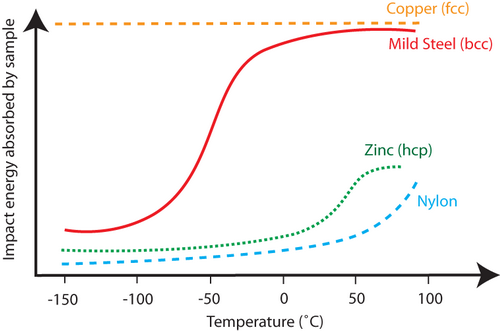 [/img]
The International Space Station gets pretty cold ( less than -100 degs C) and that is made of Aluminium Alloy and Titanium, so I think we're fine. The al alloys that decent bike frames are made from are very similar to that used on aircraft, which again get pretty cold, certainly colder than you'd consider riding in.
wobbliscott - MemberThe International Space Station gets pretty cold ( less than -100 degs C) and that is made of Aluminium Alloy and Titanium, so I think we're fine.
Yeah, but how well would you get on riding it round a lap of laggan black?
Borrowed a workmates spare town bike and biked to the office in Helsinki at -25 saw some other folks riding around on similar bikes ... Totally unremarkable there....
I remember Liberty ships and brittle fracture of welded steel structures from metallurgy lectures.
Wonder what happens with my home made steel frames joined with brass - which is an alloy of copper (from the graph above really good at low temps) and zinc (really bad when cold) ?......
Northwind - Memberwobbliscott - Member
The International Space Station gets pretty cold ( less than -100 degs C) and that is made of Aluminium Alloy and Titanium, so I think we're fine.
Yeah, but how well would you get on riding it round a lap of laggan black?
It'd be out of this world.
igmc
I know a robot who thinks the relative difference in UK seasonal temperatures is nothing compared to glowing orange.
I think brass goes to BCC of the Zinc - it defo does with beta brass which is CuZn (Ie 50/50) . So it will be crap at low temps, but I cannot remember what brazing brass is. Brass varies from FCC to Bcc depending on composition...
Ridden at -17C on my Soul.
No change in the feel of things other than the fork was a lot firmer than normal as the oil had become more viscous.
If my non-riding in the past few months is any thing to go by it appears i don't ride in anything under 10 degrees C, i prefer to ride in temps between 18 - 22 degrees C. Unfortunately this has not happened very much this past year.
I broke a USE seatpost clamp in -10 temperatures. Not saying much though. 😕
I've ridden my On One SS in -25 degs without a problem so I would say if you are based in the UK you have nothing to worry about. 😉
If it gets as low as -273, I'd probably not bother to go mountain biking.
I am more worried about mr Winkie turning into a foo-foo
I tie a bit of string to mine before I go out in the cold.
That way if it does turn inwards I can yank it back out again with the string.
Martin you've always got another 6-7 if one goes pop or just hold it together with a few fishing rods and duck tape.
I'd be more worried about an SDG Ibeam seatpost
Seem to remember a few threads a while back about those breaking in the cold
I have 2 sdg I beams on the mountain bikes and have ridden 2 winters ago in -10c with 13.5stone on them. Both are holding up fine. Worth it for the comfort of those fx saddles. Mmm.
The International Space Station gets pretty cold ( less than -100 degs C) and that is made of Aluminium Alloy and Titanium, so I think we're fine. The al alloys that decent bike frames are made from are very similar to that used on aircraft, which again get pretty cold, certainly colder than you'd consider riding in.
Orbital loading of the ISS is tiny, not even a remotely comparable application! Add to that the fact that alloys massively change properties with heat treatments and are very customisable, that's a generalisation you really can't make, unless you were a mechanical engineer working on a chunk of the ISS?
That said, I've never found myself considering my frame strength in the cold, even when I had a carbon full sus. I know that most decent composite resins will cope happily down to -40 and the fibres themselves will too. I have never considered the DBTT of steel for reasons of assuming most manufacturers would have the brains to avoid steels with high DBTT, plus the coldest I've seen the UK where I've been has been -17, and my primary worry was brake freeze and freehub pawl freeze, and neither was a problem.
toys19 - Member
well pretty much the only fcc steels are stainless.
bcc are all carbon steels apart from some of the mega high strength ones which are BCT, I can't remember if the BCT ones are any good at low temps or not, semi pissed now...
It is hard to find a modern carbon steel that has not had its DBTT depressed significantly.
The best book on steels is Steels, Metallurgy and Applications by DT Llewellyn.
Or look in the ASTM series, I have lots of stuff on PDF/ereader that might be helpful.
Other than that here is a quick google.
https://www.google.co.uk/search?q=ductile+to+brittle+transition&ie=utf-8&oe=utf-8&aq=t&rls=org.mozilla:en-GB:official&client=firefox-ahttp://en.wikipedia.org/wiki/Ductility#Ductile.E2.80.93brittle_transition_temperature
http://materialiaindica.ning.com/forum/topics/ductile-brittle-transition
https://www.google.co.uk/search?q=liberty+ships+failures&ie=utf-8&oe=utf-8&aq=t&rls=org.mozilla:en-GB:official&client=firefox-a
http://en.wikipedia.org/wiki/Liberty_ship#Problems
http://en.wikipedia.org/wiki/Ductile-brittle_transition_temperature#Ductile-brittle_transition_temperature
https://www.google.co.uk/search?q=materials+for+cryogenics&ie=utf-8&oe=utf-8&aq=t&rls=org.mozilla:en-GB:official&client=firefox-a
http://www.journalamme.org/papers_amme03/1240.pdf
http://www.google.co.uk/url?sa=t&rct=j&q=&esrc=s&source=web&cd=8&cad=rja&ved=0CHoQFjAH&url=http%3A%2F%2Fwww.springer.com%2Fcda%2Fcontent%2Fdocument%2Fcda_downloaddocument%2F9781441999788-c1.pdf%3FSGWID%3D0-0-45-1326037-p174117366&ei=SPr6UJuKDMil0AXI5YDwDA&usg=AFQjCNGMQIYKUe0dFWRW4PeKa9Be7xbzZw&bvm=bv.41248874,d.d2k
http://www.slac.stanford.edu/cgi-wrap/getdoc/slac-tn-03-023.pdf
http://cryogenics.nist.gov/MPropsMAY/5083%20Aluminum/5083Aluminum_rev.htm
http://cryogenics.nist.gov/Papers/Cryo_Materials.pdfA good explanation of Unit cells (which is what FCC and BCC refers to) is here and on wikipedia here.
Now that's the kind of post that gets me excited.
I really want to improve my metallurgy so some reading for me there. 🙂
Question for you Toys19
You mentioned:
[In fact some aluminium alloys actually get more ductile at low temps. (6061 T6 for example) I can explain that if anyone wants to know about slip planes and arrhenius equations.]
Maybe you could shed some light on how this works? I would not expect any metals to become more ductile with reduced temperature. This seems very odd, of course I would expect ductility to increase with temperature as they progress towards melting point.But certainly not the other way round. Would be interested to hear why?
Cheers
bu66er, wish I had not said that.
How much do you know about crystal structure?
Do face centred cubic and body centered cubic (FCC and BCC) unit cells mean anything to you?
Brain dump:I'm going to make some simplifications and generalisations now.
Deformation in metals happens in two ways, elastic and plastic.
Elastic: You can think of elastic as just springs stretching/compressing, which is the "bonds" between the atoms stretching, or squishing.
Plastic: is permanent deformation, so (simplified) when the "bonds" get stretched too far, they "break" and the atoms start to move relative to each other.
This movement manifests itself as something called slip, or dislocation movement, think of it like a ruck in a carpet.
Now these dislocations move along planes in the crystal structure, and the number of available planes depends on the crystal structure.
In FCC there are 12 planes (called slip systems)which the slip can occur along easily.
In BCC there are none, well there are 12 but it is not a truely "close packed" system so it needs some heat to help the dislocations "jump" from one plane to the next.
See wikipedia [url= http://en.wikipedia.org/wiki/Slip_%28materials_science%29#bcc ]here[/url]
So that explains why FCC metals stay ductile at low temps, and BCC metals do not.
Next is why the ductility of FCC metals can "increase" at lower temps.
This is a bit harder to explain as it relates to competing processes that are thermally activated.
In all metals at higher temps the ductility increases. Purely due to available thermal energy making the atoms "looser" in their lattice so dislocations can move more easily. But this does not happen until higher temps have been reached (remember competing process).
Another process that happens with temperature is vacancy generation and diffusion in the crystal lattice. What this means is that some atoms jump out of position and leave a hole, this is a vacancy, and it causes a high energy lattice strain (an incongruence) due to the imbalance of the attractive/repulsive forces of the atoms no longer being ordered. The jumped atom squeezes in elsewhere (called an interstitial) and has a similar strain effect. These lattice strains can slow down dislocation movement and hence make the material less ductile.
BTW Spontaneous vacancy generation is modelled by an arrhenius equation which is exponential with temperature. (There is also some interesting stuff in semiconductors that is related to this, but I won't go in to that now) The vacancy generation is limitied by an activation energy which is required to kick start it.
So thermal lattice vibrations increase ductility, but vacancy and interstitial generation can decrease ductility. These processes compete.
As temperatures decrease so do the generation of vacancies/interstitals, which in FCC metals means that disclocations can move about more freely without bumping into holes/vacancies.
But in BCC as temps decrease, there is no thermal energy to activate slip onto other planes, so ductility decreases.
So competing processes: with 6061 (an FCC metal) if you cool from say 200c, then ductility decreases as thermal mobilty decreases, until around 0c then ductility starts to increase (slowly) as the vacancy/interstitial generation tails off. I can't quite remember but I think this is around the temp of the activation energy, below which there is no vacancy generation. (room temp is considered warm/high energy in these terms)
I'll bet you wish you hadn't asked now...
(Caveat: All simplified and generalized, so if you are a metallurgist too, please do not shoot me down, I'm sensitive..)
Nice description! (especially the ruck in the carpet bit)
Back to brazing - Sifbronze no.1 is 60% copper, 39% ish zinc and a few other bits (Si and Sn I think). From a brief google FCC / BCC in brass seems to depend on more than just the zinc / copper ratio. If you find anything I'd be interested to know (not that I think it is a major problem in the UK).
Might have a chat with the metallurgist that sits opposite at work (but brazing isn't commonly used in most industries so probably need to dust off some books).
Tbh I know very litte about brazing metallurgy other than what I have forgotten since uni, and that wasn't much..
Orbital loading of the ISS is tiny, not even a remotely comparable application! Add to that the fact that alloys massively change properties with heat treatments and are very customisable, that's a generalisation you really can't make,
all irrelevant because Al doesnt undergo a DBTT. Not a function of which alloying elements you add to it (which form precipitates, rather than changing the basic structure).
The electron microsopes I used to study Al alloys were themselves made largely of Al alloy, and cooled by liquid nitrogen (so below 77K, ~195C). None of them snapped...
so if you are a metallurgist too, please do not shoot me down, I'm sensitive..)
I'm sure theres a joke there (sensitive, ductile, brittle)... Not been one for a few years now but sounds good to me.
notch sensitivity...
The thing that impressed me most was the ability of the engines to work in those temperatures.
Intake air temperature is raised by 500C just through compression alone - before any fuel is added to the mix. by the the time the air reaches the turbine we are talking about 1500C - well beyond the melting point of even the most expensive Nickel Alloys used in turbine construction. Bleed air from the compressor is used to cool the blades to acceptable levels by way of some incredibly sophisticated plumbing. Despite all this the maximum allowable temperature within the turbine is the major limiting factor of engine performance in terms of both thrust and efficiency - so engines are run as hot as physically possible.
....so you dont have to worry about air temperature the next time you go on holiday - in fact lower temperature is probably better since a greater temperature increase is possible and therefor better performance - but you would probably need to have designed the engine around these conditions to gain any significant advantage.
Do people really consider this when going out for a ride? 😯
No I consider getting salt all over the bike from the minging roads and then not being able to remove it when I get back as the hosepipe is frozen - result = rotting bike
Hi Toys19,
Thanks for taking the time to generate a nice long reply. Now i'm gonna be annoying 🙂 I just really find this interesting.
There me be some difference in the nomenclature regarding ductility that we are both using I will explain what I understand it to be. There is stiffness and also ductility. These are not the same for me. Stiffness can be described as what happens in the elastic region. Ductility on the other hand is what happens when you get into the plastic zone (dislocation movement as you rightly describe).
Back to the original question: You mentioned: "In fact some aluminium alloys actually get more ductile at low temps. (6061 T6 for example) I can explain that if anyone wants to know about slip planes and arrhenius equations"
Being a geek, I questioned this to myself as it does not seem to correspond with the physics that I have studied (a long time ago). Even with your lengthy reply I still cannot see this. So I have to conclude that we may be talking about different things here. I looked through some of the literature you cited and this seems also to be in opposition to what you have mentioned. (S.W. Van Sciver, Helium Cryogenics, International Cryogenics Monograph Series)
6063-t6 is at its stiffest (highest E) at 0 degrees kelvin dropping with temperature increase.
I believe that the original question was related operating temperature. In general for materials as temperature reduces, stiffness increases, and as stiffness is increases flexibility is reduced. This essentially makes them more brittle.
With composites, as temp reduces polymer chain mobility is reduce also making the matrix material more brittle. There was an earlier reference to aircraft and composites which implied that bike composites must also be ok. Well not necessarily, you cant make that assumption. There are many different types of matrix materials each with their own optimum operating temps. Aircraft materials are carefully selected after years of testing (they are also hugely expensive) bikes on the other hand are a different kettle of fish. Designers skills related to these materials (in the cycle industry) are still in their infancy. Many mistakes are still made and many failures still occur. but that's another discussion.
Back to the original discussion. Could it be that you are thinking of heat treatments and cooling of cast materials and the effects that you would see described in a phase diagram? You also mention interstitials and describe them differently to what I understated them to be. Interstitial element sizes are usually smaller than those of the base material, thus they can fit in between the lattice framework. As i understand it these are normally added intentionally to inhibit dislocation movement (Alloying elements).
I believe that the original question was related operating temperature. In general for materials as temperature reduces, stiffness increases, and as stiffness is increases flexibility is reduced. This essentially makes them more brittle.
Ah unfortunately this is just incorrect. Increased stiffness does not neccesarily make things more brittle, I guess I did not explain it very well.
The major contributor to brittle failure is a lack of ductility.
The more I consider this the more dissapointed I am, you have completly misunderstood my explanation, and that can really only be my fault for not making it clear enough. bugger.
Chief900, did you have any luck understanding what I was trying to explain or shall I go a bit deeper/shallower?
4130 should be good down to -100 °C, safe limit would be -70 °C.
may not survive a martian winter.
HTH 😉
experianced two sdg ibeam posts fail in cold weather 1 whilst riding on a canal path (under 1 month old) + witnessed two others fail around the same time there was a defect with the bonded joint IMO as design defect (I like the clamp mechanism / interface) however I would not risk my life with them especially after experiancing SDG's importers arrogant responses (.....never seen one of our posts fail..... blah blah blah.... doesn't happen blah blah blah....
maybe the products improved??? I hope so...I for one do not trust them
I had my free hub go at -13 and had to push my bike the rest of the way to work 🙁
Seriously?
Orbital loading in the ISS is not high, but loading due to the differential pressure between the interior if the capsules and the vacuum of space is very very high, as are the thermal stresses imparted when the craft moves from the sunny side of the Earth to the dark side where the temp goes from minus hundreds of degrees to plus hundreds of degrees, not to mention the temp difference between the structure that faces the sun compared with the parts of the structure that are facing away from the sun.
The stresses on a bike frame are tiny with high factors of safety in comparison whether they be steel, alloy or CF frames. Cracks in frames are more likely to be due to abuse, damage or quality defects rather than overstressing or fatigue.
Yes, you can manipulate the mechanical properties of al alloys, but there are limits.
I'm not getting you wobbliscott, what is it you are agreeing or disagreeing with?
I am more worried about mr Winkie turning into a foo-foo
I tie a bit of string to mine before I go out in the cold.That way if it does turn inwards I can yank it back out again with the string.
Sir, That's a Belter.
[img]  [/img]
[img]  [/img]