Blokes in the staff room talking about castering, gyroscopic effects and such like.
Why is it that even with a tiny (walking pace) forwards movement it becomes so much harder for a bike to fall over?
gyroscopic effects and castoring.
I seem to remember that it is actually the rake rather than gyroscopic effect which keeps the bike up. Otherwise a bike on rollers would stay up by itself (anyone tried that?)
Something to do with the rear wheel being a trailing wheel that self aligns, the higher the speed the stronger the self alignment force. Was on QI last night on Dave.
ROFL at the above answers... stop trying to confuse the magic.
The process happens as a result of magic.
Blimey. Learn something new every day!
Good to have reminders to question accepted knowledge. Think about it for 2 seconds (CM's point) and gyro. forces obviously aren't contributing much.
The old fashioned answer was gyroscopic effects, but someone recently studied it and found that the castor effect dwarfs the gyroscope effect. That is, the contact patch of the front tyre is behind the axis of rotation of the forks, so forward motion tends to drag the front wheel straight.
I seem to remember hearing that someone made a bike with a 90 degree head angle and not only was it almost impossible to ride but it didn't stand up on its own either.
Physics, innit.
Nuff said
;-P
What about a single wheel, then? Not a unicyclist, just a rolling wheel. Would it go further than a "ghosted" bike, or pretty much exactly as far? i'm guessing the latter, which means that the whole trailing wheel thing doesn't make a lot of sense.
hmm, just read the bit about the castor effect, which means that my thought experiment depends on the head angle of the bike being ghosted.
Carry on.
Or stop. Seems like we're pretty much there!
Different situation. The COG of a wheel rolling along is in the middle, equal mass above and below, and that mass is ALL gyroscopic mass. A rolling bike has much more mass above the COG of the wheel AND that mass is in unstable equilibrium.
Ned.
What was them big tires fitted to your 29" inch wheels on that nice bike of yours ?.
[img]  [/img]
Most people have little idea of the magic that keeps them upright. Unfortunately that is of little help when teaching people to ride. The answer is fairly straightforward. It is impossible to ride a bike in a perfect straight line with the centre of gravity over the line. You will fall off at any speed (including stationary). Instead as you move forward you subconciously steer into the fall. This causes the centre of gravity to pass over the line and you will correct in the opposite direction. The reason it gets easier with speed is that the centripetal force increases with speed, so less correction is needed.
Sadly, gyroscopic effects have almost zero contribution, as wsa demonstrated using a bike with counter-rotating extra wheels.
Now I have broken the magician's code, at least you can explain to the three year old how to balance their bike! It also helps to hold their handlebars as you walk alongside, turning into the direction of fall.
PS is you don't believe me, feel free to brace your handlebars and ride off, just don't blame me for the consequences.
[i]centripetal force[/i]
Well done. There are some Physics student in the universe after all.
🙂
[i]"...someone made a bike with a 90 degree head angle and not only was it almost impossible to ride ..."[/i]
I've always wondered what one of these would handle like.
[img] 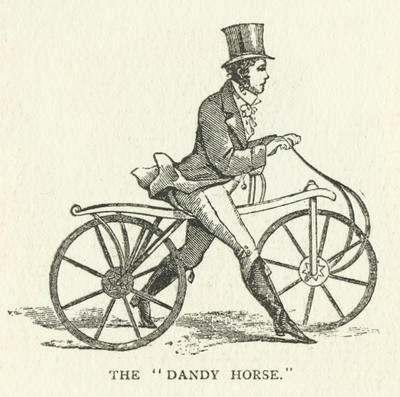 [/img]
Has anybody who's more used to modern bikes ridden one and can give their opinion ?
The reason it gets easier with speed is that the centripetal force increases with speed, so less correction is needed
You wot?
I thought they didn't fall over because my dad said he was still holding me?
Think of a weight on a string held above your head. When stationary it drops vertically downwards under gravity. Now whirl it round your head. At low speeds it will rise because it is moving in a curve it has acceleration, and that gives rise to a force that is balanced by the tension. Whirl it faster and the weight rises until eventually it will be horizontal. This is centripetal force. The angle with the horizontal is akin to the lean needed to correct the falling. Move faster, less lean.
As I said it is physically impossible to ride in a straight line.
Oh and my student and professional Physicist days are over, I just play one now.
cetripetal acceleration I was tought IIRC
MTG i've seen one of those ridden and you almost always have one foot on the floor. Also i think that picture is innacurate. Fairly centre they have a small amount of rake. Not much though so probably tough to ride.
I know what centripetal force is (and I also know that there IS such a thing as centrifugal force despite what smart-arses tell you, depending on your frame of reference) but I don't think it applies to keeping your bike upright.
The only centripetal force acting in the system of a ghosted bike is in the vertical plane.
cetripetal acceleration I was tought IIRC
And what is acceleration proportional to?
You wot?
In laymans terms: at higher speeds you dont need to lean very far to generate G-force (centripetal force measured as a multiple of gravity at the surface of the earth). So the point at which you subconciously turn the bars is much more 'upright'.
The centripetal force is the opposite of centrifugal force, because the centrifugal force doesn't exist physics people wont talk about it. Imagine a swirling conker on a string, you apply a centripetal force to the string, the opposing force dopesnt exist, so the concer accelerates towards the center of the cirlce. If a centrifugal force existed the conker wouldn't move.
Conversely Track standing you turn your bars 90deg, then keeping your bodyweight/COG completely still you pedal forewards and backwards to move the line between your hubs/contact patches one way or the other underneath it, trying to line the two up. Either that or your arms flail wildly from side to side on the bars which achieves the dame thing by moving the contact patch ofthe front tyre, but looks a lot less cool.
I have it on very good authority:
The gravity fairies get scared and run away when you start moving on a bicycle, that's why you won't fall over.
The gravity fairies love drunk people though, and will often completely over-power them.
So don't ride your bicycle when you're drunk.
You lot talking about bikes falling over makes it sound like you actually ride them! ROFLOL etc
because the centrifugal force doesn't exist physics people wont talk about it
Yes it does, and yes they do, Engineer boy 🙂
Read my post - I know what it is, but I don't see how it applies to keeping the bike upright cos it's only in the plane of the bike. Unless you're talking about the small restorative force if the bike leaves the vertical plane, but I think that's dwarfed by gyroscopic forces which are in turn dwarfed by the castor effect.
As I said it is physically impossible to ride in a straight line.
But it will roll downhill by itself for a long way, without anyone to lean it into the fall
A massive bike with super tiny wheels will still behave like a bike, so gyroscopes aren't a factor
There's a nice video on the subject, I'll see I can find it.
Yesiamtom, most [url= http://www.google.co.uk/search?q=dandy+horse&um=1&ie=UTF-8&tbm=isch&source=og&sa=N&hl=en&tab=wi&biw=1152&bih=773 ]pictures of DandyHorses[/url] show them with a vertical steering axis, just like a horse drawn waggon of the time.
Traction engines use a similar system to waggons, where the whole axle turns on a central pivot.
It seems it was only when pedals and internal combustion engines became common and speeds increased that designers introduced rake and trail.
I take it a Dandyhorse would have no self centring and be impossible to ride no-hands then ?
It'll just follow the line of least resistance IMO
Whether that be a straight line or around a bend
[url= http://http://www.mefeedia.com/watch/38915122 ]The physics of the [/url] riderless bike. Nice video although it takes a while to get going
i'm probably being thick, but surely with a positive head angle, a wheel has negative castor (ie the force pulling backwards on it will constantly be pulling the wheel away from straight, not towards it)? a good caster would be like a trolly wheel, where its pulled straight behind the trolly, no??
........ What tyres for castering?
the gyro forces are noticeable, however important they are compared to others.
My bike with the big heavy fat franks on is way more stable, whether in a straight line or in a constant radius turn, than it is with 28c slicks.
Vigorous counter steering seems to be much more worthwhile too. I wonder if this is to get over the extra gyro stability, or because of the extra sideways kick from precession?
Molgrips,
We crossed posts, in what frame of referance would you feel a gyroscopic force?
i'm probably being thick, but surely with a positive head angle, a wheel has negative castor (ie the force pulling backwards on it will constantly be pulling the wheel away from straight, not towards it)? a good caster would be like a trolly wheel, where its pulled straight behind the trolly, no??
In both cases the contact patch of the tyre is behind the steering axis. The vertical axis on the troley means the wheel always follows it. The raked out head angle on a bike means the steering axis is actualy ahead of your frotn hub by a few inches, the slacker the angle, the further this point is and the more stable the bike becomes.
Turn the bars to 90deg and the steering axis and contact patch line up (assuming no fork offset) and the whole thing becomes unstable.
[Edit] dandy-horse stability, would you just not counter steer? I.e. to initiate a turn you actualy turn left to go left, rather than right on a 'normal' bike. As by turning left the line of the contact patches moves right thus tiping you into the corner?
We crossed posts, in what frame of referance would you feel a gyroscopic force?
In a rotating frame of reference, there is a force acting away from the origin. This is centrifugal force (I think you typoed).
Has anyone ever tried a bike on a rolling road?
Have a look at this,
http://tlatet.blogspot.com/2011/04/physics-of-riderless-bike.html
... then lets talk... (-:
That's no good. They don't explain it at all.
Plus the bike he shows does steer itself, but not in a straight line.....
Sory, yea my bad, centrifugal.
Although if anyone can explain the witchcraft that is gysoscopes to me? Never understood those.
I figured it out all on my own - I am good at this physics stuff 🙂 If you hold the bike wheel still and tilt it so the part moves left at the top part moves right. Take a particular chunk of mass at the bottom, it has momentum to the left. If the wheel is rotating, however, that same chunk still has momentum to the left when it's at the top, which means it's now opposing your tilt. So all the force you put into tilting it ends up opposing the tilting force a short time later.
The faster you spin it, the shorter that time lag is so the better it works. This also explains why you can get it to oscillate if you wiggle the wheel side to side at the right frequency. That frequency matches the angular momentum of the wheel. Hence speed wobble on motorbikes, I suspect.
The gross and net result of it is that people who spent most of their natural lives riding iron bicycles over the rocky roadsteads of this parish get their personalities mixed up with the personalities of their bicycle as a result of the interchanging of the atoms of each of them and you would be surprised at the number of people in these parts who are nearly half people and half bicycles...when a man lets things go so far that he is more than half a bicycle, you will not see him so much because he spends a lot of his time leaning with one elbow on walls or standing propped by one foot at kerbstones.
[img]  [/img]
[img]  [/img]
[img]  [/img]
You never see them moving by themselves but you meet them in the least accountable places unexpectedly. Did you never see a bicycle leaning against the dresser of a warm kitchen when it is pouring outside? Near enough the family to hear the conversation? Not a thousand miles from where they keep the eatables?
[img] 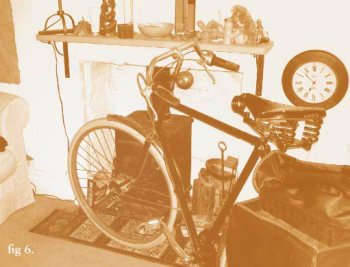 [/img]
[img]  [/img]