Forum menu
@TiRed - curious what causes the down-spike on both lines at week 35/36 - some sort of reporting artefact?
@TiRed – curious what causes the down-spike on both lines at week 35/36 – some sort of reporting artefact?
August bank holiday. They don't trend in phase because this year fell in ISO week 36 (Aug 30), one week later compared to 9/10 of the previous years. The dip on Week 19 was VE day.
But…
Spoiler for You should look away now Dr Who fans
Yay!
Many thanks for posting that Tired, its very interesting. That will lag the infection rate charted by Zoe though, won’t it?
Does the data I listed from Zoe not suggest that those trends will start bending soon for the South of England? What is the last date on the x axis? Can you plot the Zoe data in the same format?
I am not suggesting that interventions don’t work by the way. I am, however, questioning why....
The infection rate appears to have been levelling off in Southern England before lockdown 2.
The infection rate appears to have already been decreasing in Liverpool before they went into tier 3.
Yes I expect and have predicted the curve to turnover this week to next. The last date should be Nov 20 and the dashed lines are significant intervention dates. I'm of the opinion that local data is not as helpful due to stochastic variation. Finding one area that looks good, can be countered by one that looks poor. Hence NHS regions are probably the right level, nation too large and UK unhelpful.
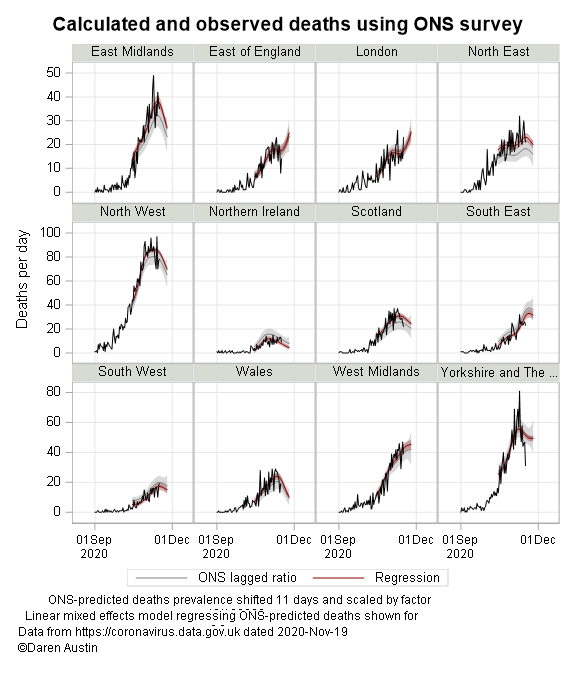
I've done the same forward regression with both ONS and REACT surveys. This makes stronger predictions about the course of admissions and deaths. But forward projection to deaths is less than two weeks from prevalence. ONS death projection below. These surveys are informative, trends do feed through the chain. Why should we be surprised otherwise?
thols2, inside that professor's head must be a really weird and scary place.
I was staggered that the government plan to spend £22billion a year on track and trace! It's an absolute shambles.
Thanks again Tired. So are you in agreement that the infection rate began to slow in the Southern regions before lockdown 2 was introduced?
I guess we will have another reference point when the weekly ONS survey figures are published later this week.
So are you in agreement that the infection rate began to slow in the Southern regions before lockdown 2 was introduced?
More than that, he told us, pages ago, that he expected it to, and told us when we were likely to see the effect in the figures for admissions and deaths.
Where are you going with this? That changes in behaviour before lockdown (both mandated by government and chosen by companies and individuals voluntarily based on scientific advice from amongst others SAGE) can reduce transmission?
began to slow in the Southern regions before lockdown 2
A little - there was not a lot of evidence in the South, beyond rule of 6. Tier 1 does little to limit spread. The South West has higher hospital admissions now than in the Spring. Below is a plot of data-derived doubling time and growth rate for the epidemic by region. Note the consistency and 7-10 day doubling, a small fall, and then a decline since lockdown towards stable or shrinkage.

Kelvin,
There are anomalies (from my perspective at least) in the data that I can’t get my head around and this is why I have started posting. I don’t dispute any of the responses I have received (and do greatly appreciate them) but am not yet personally convinced that infection rates are slowing solely as a result of interventions. I have no data to back this up, apart from what I have already posted. This is why I have been seeking feedback.
Haven’t been on the thread much lately so not really up to speed with what has been posted previously, sorry. When I get more time I will go back through the thread.
I will step away for now as I’m spending too much time melting my brain with it all 🙂
Cheers
squaredog
That’s a telling graph TiRed. When taking out the starting prevalence, the behaviour across all UK English regions looks far more consistent then I was assuming based on graphs of either absolute or per population case/admissions/deaths. Very interesting. I’m very surprised.
am not yet personally convinced that infection rates are slowing solely as a result of intervention
Solely is doing a lot of work there. Can we accept that the slow down is overwhelmingly as a result of intervention?
Solely is doing a lot of work there. Can we accept that the slow down is overwhelmingly as a result of intervention?
You can accept that but I am yet to be convinced.
Bye for now.
I don’t dispute any of the responses I have received (and do greatly appreciate them) but am not yet personally convinced that infection rates are slowing solely as a result of interventions.
So what do you think is slowing the infection rates?
Batman & Robin
Kapoww, Baaaanng, Crrrrash. They're giving Covid-19 a beating.
Mark Drakeford has said today that the gains made in the Welsh firebreak lockdown are already being reversed in some areas. I'm not hugely surprised, but it's disappointing.
Northern Ireland provided some excellent data - closing schools adding lockdown, extending for a week. The same plot at the nation level is impressive.
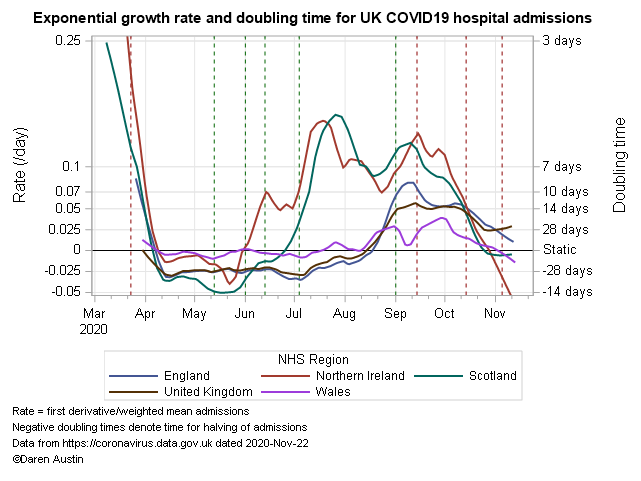
These are public domain data, the derivative is calculated using a smoothed algorithm, so does not butt right up to today. But NI had it right, and so do Scotland.
Note how all the regions basically climbed at the same rate in Aug-Sep, despite London being hit hard and SW not so. No exceptionalism and no reduction for past burden. I've looked at the same at NHS trust (not regional) level, the results are similar.
but am not yet personally convinced that infection rates are slowing solely as a result of interventions.
Interesting....
Rates falling in Scotland, too soon to be the result of tier 4 changes last week, so it's either herd immunity, this fabled 30-50% of us that are immune, or Boris's bugle. 🙂
How many more deaths at the end of January/February then?
Probably no much more than there would have been, I reckon loads of folk would've had the family Xmas anyway.
5 days is excessive mind.
I still don’t understand what the rules will be, does anyone? Because of that, people will just do what they want, won’t they. They’ll hear 5 days, and act as if anything goes during that period. Or just chose to limit household mixing to as little as possible. Zooming/FaceTime with grandparents will happen here now, no matter what the rules. Others will take the messaging to mean that they can have a proper Xmas, and meet up with most of their family and friends, at some point. Has anyone mentioned work parties and New Year revelries yet?
Yeah, good luck with that nuance…
https://twitter.com/bbcnickrobinson/status/1331304650625200138?s=21
Not the whole week either, 23rd to 28th. Back to your tier Monday night.
Others will take the messaging to mean that they can have a proper Xmas, and meet up with most of their family and friends, at some point.
Well, they can even if the government says no, because the rules are unenforceable.
The police don't know which 3 households have been picked for the duration for everyone in the country.
Kelvin nailed it, but thats what would happen if the relaxation wasn't in place as well. Too badly handled for too long. Better get the January lock down supplies in. I also predict a mass explosion of shopping next week so we may see rates shoot up before Christmas. Lockdown should have been earlier, when rsres were lower, all its done is pent up people's need to buy tat for Christmas.
unworkable, unenforceable unrealistic....
Mark Drakeford has said today that the gains made in the Welsh firebreak lockdown are already being reversed in some areas. I’m not hugely surprised, but it’s disappointing.
I'm fully expecting another firebreak in December to try and buy us some space back for the free-for-all that christmas will become.
Not the whole week either, 23rd to 28th. Back to your tier Monday night.
Well that's any plans for my 40th ruined (29th). Good job I haven't planned anything other than a big ride on my own and a chippy supper!
Sounds a perfect birthday RJ!
We're birthday buddies RJ! My 40th was a few years back though. Two days later I was in hospital having my spine mended. Hope yours goes better!
Half the country will be having a free for all over this (ridiculous) relaxing of the rules over the Christmas period.
The other half will be thinking, I don't want to put more pressure on the NHS, give my elderly or vulnerable relatives/friends the virus and listening to the science.
Hubby and I are listening to the scientists, not the government. Although I do understand why they have had to do this, owing to the amount of irresponsible people who would have gone and had a full blown Christmas anyway.
Half the country will be having a free for all over this (ridiculous) relaxing of the rules over the Christmas period.
The other half will be thinking, I don’t want to put more pressure on the NHS, give my elderly or vulnerable relatives/friends the virus and listening to the science.
Yep. And they'll be more Tier 3's or Lockdown 3 in January as a result. Tier 3 does seem to have been rather more successful than predicted tough, and note the new Tier 3 is akin to the current lockdown, so I suspect it'll be pretty effective.
Not sure if it went past me but the new Tiers are up on the .gov website. As predicted, Tier 3 is basically as we are now yet allowing the Rule of Six outdoors.
Nobeerinthefridge
Free MemberRates falling in Scotland, too soon to be the result of tier 4 changes last week, so it’s either herd immunity, this fabled 30-50% of us that are immune, or Boris’s bugle.
Lanarkshire and I think also Greater Glasgow's rates were already falling, and that dominates the stats because they account for so many of the cases. But the rates were too high and the falls were too small.
The new tiers weren't brought in solely because of rises, though naturally that's what gets the headlines- they were also because prevalance/cases in some areas are just far too high so the small changes that were being seen weren't enough. The tier 4 areas need sustained higher rates of fall to get them under control.
(****ing useless Richard Leonard complained that Lanarkshire shouldn't have been put into tier 4 because their rates were falling, the absolute tosser)
Here is an article about the way the Oxford AZ trial was run which seems a bit worrying, or is it? Is it just a bit sloppy or does it put a big damper on dreams of freedom?
https://www.wired.com/story/the-astrazeneca-covid-vaccine-data-isnt-up-to-snuff/
I think the important thing to know is that all of the vaccines so far with results are on interim not full data. So do not comprise the full data set that will be provided to the regulators.
I am commenting on all the vaccine data issued so far for all companies. Not a vaccine specifically. (have to put that in due to work).
We're going to my folks for Christmas and my sister will be there. I am worried it's irresponsible, but it means a lot to them.
I am worried it’s irresponsible, but it means a lot to them.
After arguing the opposite in the Christmas bubble thread yesterday, Mrs K has countered my argument firmly in that we are having the in-laws and 89yo great Nan around for Christmas. My Mil uses London public transport for essential work as a social worker to other people houses, Mr K has immunity complications and both the kids are swanning about in separate schools. It follows the rules but I’m not comfortable, I’ll have to medicate my nerves with booze all day to get through it :/
Anyway, the geographical tiers are announced at 11am and will be reviewed on the 16th, I’d be fairly confident we are all in a harsher tier than we might have thought until then - essentially 2 more weeks of being fairly locked down, and maybe quite rightly after the jump in yesterday’s numbers.
The new tiers weren’t brought in solely because of rises, though naturally that’s what gets the headlines- they were also because prevalance/cases in some areas are just far too high so the small changes that were being seen weren’t enough
Aye, I'm not arguing with that, it had to be done. It's interesting looking at tier definitions, we should be in 2, not 4, indeed nowhere in Scotland should be 4.
However, I'd happily stay in 4 as long as it takes.
Richard Leonard isn't an embarrassment, hes far worse than that.
Yesterdays numbers jumped because the day before was so low. Look on the Gov.uk site and track the cases by specimen date and the 7 day average. Or even hospital admissions and look at the trends.
The zig zagging happens every week... never any point comparing one day with the previous day (although this happens on TV & Radio news all the ________ time)... but compare yesterday do the same day next week... not good.
I'm still hoping that things are flattening off, or even slowly falling, but it's wise not to let hope inform your reading of the data...
Having said that, Hospital admissions look like they've turned, so fingers crossed....
https://coronavirus.data.gov.uk/details/healthcare
7 day averages, is about all I pay attention too, but tbh it's hospital numbers that seem to be the real number worth watching.
Yes... but of course they are driven by who is catching this, not just how many people are. As we may (I hope not) find out early next year, after more generational mixing next month.
Yeah, but they are absolute. positive case is entirely based on how many tests you do, hospital cases aren't so subjective.
Still climbing in the South East which is a bit worrying
https://coronavirus.data.gov.uk/details/healthcare?areaType=nhsregion&areaName=South%20East
hospital cases aren’t so subjective
Agreed. But reading back from hospitalisations to infections is still flawed... as I think the return to school and universities showed... if you were just watching hospital numbers at that time, you completely missed the size and timing of the increased spread that was occurring... (this was pointed out to the government, but hey, when ruling on gut instinct, taking into account multivariance is too much to ask).
Good point Kelvin, thanks.
But I agree with you that case data from elective testing is mostly bobbins, sadly, and admission data and deaths far more informative (along with ONS sampling).
After arguing the opposite in the Christmas bubble thread yesterday, Mrs K has countered my argument firmly in that we are having the in-laws and 89yo great Nan around for Christmas. My Mil uses London public transport for essential work as a social worker to other people houses, Mr K has immunity complications and both the kids are swanning about in separate schools. It follows the rules but I’m not comfortable, I’ll have to medicate my nerves with booze all day to get through it :/
Sounds like a done deal, and quite likely you'll get away with it. But the statistics suggest that quite a few families will be burying relatives in January because of infections they passed on along with the cranberry sauce over the Christmas dinner table.
My mum died a couple of weeks ago. We're going to the funeral next week in a socially-distanced way, have ruled out the grandkids mixing for 'refreshments' afterwards. And my stepdad has decided it's not sensible to travel down to us during the festive period despite the comfort that would bring him.
The government has thrown in the towel on Christmas because any regulations will just be ignored anyway. Doesn't mean their guidance is right, though.
Sorry for your loss, Martin.
Sorry to hear that Martin.
I agree re the throwing in the towel, and I think they're using the impending vaccinations as a crutch too.
I think it's clearly been rising since September, and the changes then.
Education mixing is driving it.
And being managed terribly, without any significant test,trace,isolate that is working.
It's based on a lie that schools are covid secure.
I think they'll use the Christmas deregulation and any rises, to distract from and ignore the main problem - schools.
What do we make of the story in the FT today about questions over AZ's vaccine data - calling out the small (?) sample of the 90% and the sub 55 age group in that data set.
I figured the p value was the p value... so it was fine?
https://www.ft.com/content/4583fbf8-b47c-4e78-8253-22efcfa4903a
Might be behind a paywall:
Disquiet is growing over the way that Oxford university and AstraZeneca have handled the early readout from trials of their coronavirus vaccine, which much of the developing world may rely on to emerge from the pandemic.
The results were hailed a success for showing an average efficacy of 70 per cent — a figure reached by pooling the results from cohorts on two different dosing regimens.
One set of participants received two identical doses a month apart, while the other group received a half-dose, and then a full dose. The efficacy for the first, larger group was 62 per cent. In the second subgroup, it was 90 per cent.
It has emerged that administration of the half-dose started with a mistake. It was then given to a smaller number of participants than those who received two full doses, making the discovery of its greater effectiveness look like a lucky break.
Yet on Tuesday, Moncef Slaoui, the head of Operation Warp Speed, the US government’s funding programme for vaccine development, disclosed that second subgroup was also limited to people aged 55 or below, a demographic with lower risk of developing severe Covid-19.
Oxford and AstraZeneca did not disclose the age breakdown on Monday, when results were released.
“There are a number of variables that we need to understand,” Mr Slaoui said. It is still possible the difference in efficacy was “random”, he added.
Markets have taken notice. London-listed shares in AstraZeneca have lost more than 6 per cent since the announcement. By comparison, since trial results from their vaccine were released earlier this month, showing an effectiveness of 90 per cent, shares in Pfizer and BioNTech have gained 6 per cent and 14 per cent respectively; Moderna is up 11 per cent since its vaccine trial data came out, on top of big gains in the run-up to publication.
One early critic this week, Geoffrey Porges, an analyst at SVB Leerink, said he thought it was unlikely the AstraZeneca jab would get approval in the US after the company “tried to embellish their results” by highlighting higher efficacy in a “relatively small subset of subjects in the study”.
John LaMattina, a former president of Pfizer’s global research and development unit, said in a tweet it was “hard to believe” US regulators would issue an emergency-use authorisation for a “vaccine whose optimal dose has only been given to 2,300 people”.
Much of the confusion stems from Oxford and AstraZeneca not being fully forthcoming on the reason for the two different dosing regimens — which changed unexpectedly as trials progressed.
In a statement late on Wednesday, Oxford acknowledged a difference in manufacturing and measurement processes meant later phases of its clinical studies resulted in half a dose being mistakenly administered instead of a full one.
The Wednesday statement said this was discussed with regulators at the time, who agreed to use two testing regimens. “The methods for measuring the concentration are now established and we can ensure that all batches of vaccine are now equivalent,” it said.
Richard Lawson, a UK trial participant who still does not know whether he was given the vaccine or a placebo because the trial has not yet been unblinded, told the Financial Times he was informed of the mix-up in July, before getting a booster shot.
As a general rule, vaccinologists usually aim for the lowest dose that is still effective, but the efficacy of the lower dose is still not explained. Oxford professor Sarah Gilbert has said it is possible that a smaller initial dose primes the immune system in a way that better mimics natural infection. But there is no precedent for other vaccines to be administered in this way.
“We just don’t have all the information we need to tell whether these results are reliable,” said Natalie Dean, an assistant professor of biostatistics at the University of Florida. “We certainly don’t have enough information in the public domain to decide whether this half dose is really working.”
Prof Dean contrasted the AstraZeneca disclosures with those from other trials. “We had this precedent set by the other vaccines with Moderna and Pfizer/BioNTech and these were single trials, with a protocol released in advance,” she said. “We had a chance to look through it . . . It was fairly straightforward.”
There are also concerns at variations in the trial of the Oxford vaccine in different countries. As well as different dosing regimens, there were also differences between the control groups in different countries: in the UK, participants who did not get the Covid-19 vaccine were administered a meningococcal vaccine; in Brazil they got a saline placebo.
These discrepancies have led to the suggestion that the data is too patchy to combine into a single convincing efficacy result.
An AstraZeneca spokesman defended the trial, saying they were “conducted to the highest standards” and met their primary efficacy endpoint. The company has said more data will continue to accumulate and additional analysis will be conducted, refining the efficacy reading and establishing how long the vaccine protects against the virus.
The results will appear in a peer-reviewed journal, and regulators have set an efficacy threshold of 50 per cent, meaning a jab with a 70 per cent efficacy would still get approved.
Despite the questions over efficacy, the Oxford/AstraZeneca vaccine does offer some undisputed advantages. It is cheaper than the mRNA vaccines from Moderna and Pfizer/BioNTech and can be stored in a refrigerator rather than a freezer.
Oxford university said it “completely” understood the interest in the discovery of the dosing mistake and the switch in dosing tactics, which was approved by UK regulators.
“As this is a complicated scientific area, our scientists would like to wait until the peer-reviewed publication of the interim phase 3 results in The Lancet [medical journal] before discussing this further, which we anticipate will be in the next few weeks,” it said.
So according to the ONS 1 in 85 people in the uk has Covid at the moment 😮
cobblers tier 2, not exactly "post" lockdown :/
Tier 3 here in Manchester as feared. Utterly fed up with it now. Like, it can go **** itself.
So far we have:
Tier 2
Liverpool & London
Tier 3
Manchester, Hull, Newcastle, Birmingham, Wolverhampton and Kent.
My mum died a couple of weeks ago. We’re going to the funeral next week in a socially-distanced way, have ruled out the grandkids mixing for ‘refreshments’ afterwards. And my stepdad has decided it’s not sensible to travel down to us during the festive period despite the comfort that would bring him.
I'm sorry to hear that. I'm struggling to balance that I don't want any negative outcome and the kids then find somehow they might have been to blame in the future - possible overthinking but who knows.
You can only ever make decisions for what you think is the best with the information in front of you.
With regards to the Ox/AZ vaccine results. Any randomised clinical trial is first analysed using an "Intent to treat" analysis. This is the primary analysis. You conduct the analysis based on what subjects were randomised to - NOT what they actually received. In this case that is vaccine or placebo. The efficacy is 70%. It doesn't matter if you received a half-dose first, no dose second, the wrong treatment (placebo not active or vice versa - it happens). The ITT analysis is the truth, everything else is post-hoc.
What the misdosing calls into question is the veracity of the trial. It appears that the contract manufacturer had a suspect assay and hence the doses added to the vials was incorrect. That would be a serious finding in any audit. In any other clinical setting it would probably sink the trial results! If it failed manufacture, what else might have failed?
Clearly the 70% is sufficient for approval, but the subgroup is what we would normally call "hypothesis generating". We would then conduct a confirmatory trial at the lower dose. Also the trial is powered to detect a difference of active from placebo - say 50%. Any smaller differences are less likely to be significant and could be a chance finding.
[t:dr] A chance finding in a poorly executed trial calls into question the veracity of the data as a whole and makes regulatory approval more challenging.
Tier 3.
Which immediately makes me question why we locked down and the effectiveness of the tiers given we've gone up 2 levels.
Surely we should be down a level given the government said the tiers and lockdown were to reduce infections.
Anyone would thinking keeping schools open was a bad idea...
Another planned weeks holiday bites the dust. I'm looking back on my 3 nights in Keswick in October like some kind of round the world trip now.
South Cambs has a lower rate than the Isle of Wight.
But they're in tier 1, and we're in tier 2. What's that all about?
not just rate
maybe your areas growth is high enough
maybe your areas ITU capacity isn't looking good
etc.
Lockdown has worked well for Kent gone from Tier 1 to 3.
Lockdown has worked well for Kent gone from Tier 1 to 3.
Dudley too.
Good job we're not putting all the rules on hold over Christmas too...
maybe your areas ITU capacity isn’t looking good
Good point. ITC occupation is still rising nationwide IIRC, and some regions have very little spare capacity already... never mind if demand keeps rising.
EDIT: third graph here...
https://coronavirus.data.gov.uk/details/healthcareAnd the annual "winter NHS crisis" (always unforeseeable, despite always happening) is coming.... we need this epidemic to be much better under control by then... not just not worse.
One of Swale Boroughs councillors (I think) has stated that their exponential rise is based on the fact that pretty much no one could be arsed to observe the lockdown. Maidstone and Medway border Swale, so...
@kentishman @Kryton57 exactly, Kent is not too bad overall (numbers falling) but the bad districts are REALLY bad (amongst the worst in the country I believe) Dover, Swale, Thanet, Gravesend etc. It's disappointing as I'm in an area of fairly low incidence where people generally ARE observing the lockdown restrictions, but totally expected!
Dover, Swale, Thanet, Gravesend etc
Has Farage been on tour, telling people that (now, he's said the opposite before) lockdown is misguided, and should be resisted?
@Kelvin if I were to suggest that the sterotypically "pleb" areas were trending towards non-compliance and rampant coronavirus infection, whereas the traditionally more affluent areas were behaving themselves and are doing OK I would be jumped on by the STW-woke-massif, so of course I will not be suggesting that 😉 I will just note that absolutely no-one in Kent is surprised in the slightest by this micro-regional variation in infection rates!
What you're seeing in Kent is what's been going on in W Yorks and NW England since the end of July. If you live outside the hotspots/inner city areas, it's irrelevant as you're all lumped in together at a council or county level.
There isn't an easy way to do it though.
[t:dr] A chance finding in a poorly executed trial calls into question the veracity of the data as a whole and makes regulatory approval more challenging.
thanks @TiRed. I saw that for some of the placebos it was actually the meningitis vaccine rather than just (i assume) distilled water). Assume that doesn't matter...
As of 2 weeks ago, East Sussex had the lowest rates in England. Its been sky rocketing since. My local experience shows a lot of uni children coming home from bad areas before lockdown to live with family.
I kinda feel that the above several posts answer the questions as to why the new Tiers/allocation are as they are. They are they to stop current increases, and with an anticipated bump over Christmas protect ITU in Jan/Feb.
I kinda feel that the above several posts answer the questions as to why the new Tiers/allocation are as they are. They are they to stop current increases, and with an anticipated bump over Christmas protect ITU in Jan/Feb.
So shut the schools and non-essential shops as these are a bigger causes of infection than any of the places that have been closed.
It's the lack of logic that annoys people.
With Swale in Kent much of the infections were in the prisons on the island with east Sheppey have a rate of over 1200 per 100K last week.
So shut the schools and non-essential shops as these are a bigger causes of infection than any of the places that have been closed.
It’s the lack of logic that annoys people.
I’m not defending the point despite having two kids of my own in school, but Hancock said earlier and specifically in parliament, that the strategy was a balance of economy, education and to protect the NHS. Of course what he didn’t add to that - not my insensitive words btw - was acceptable loss which is surely in their consideration
Slight detour but @zilog6128 are you based in Kent? I am from Kent original and family all live there still so regularly visit (not this year though).
My sister is in the NHS in Kent and has seen the impact of the increase in hospitalisations and infections directly. My niece is currently self isolating due to a positive case in her school bubble.