Hi,
The builders have got to casting the floor of my extension (they want to get it in before the Christmas break)
My plans show a floor made up with 125mm insulation underneath a total slab thickness of about 175mm of concrete. The insulation sits on blinded hardcore with dpm.
The builders are suggesting that about 100mm of concrete should go below the insulation, with the remaining 75mm on top, because the UFH would have less to heat below it (i.e. a smaller thermal store, I suppose)
I'm guessing there's not much difference in the overall effect, but thought I would ask if one way was any better than the other.
Does anyone have an opinion?
Thanks.
BTW, it'll be an electric mat style heater with ceramic tiles.
Even tho I'm a huge concrete fan as stOner may well mention that is way over specced for domestic use! Personally I'd be putting a bit more stone in, same amount of insulation, (incidentally is that cellotex or expanded polystyrene, 125 of cellotex seems a little ott also if so) and perhaps 100 mm of concrete. This is cheaper for starters, and I also thought the electric mat types went directly under the tiles but I could be wrong?
Currently working on a new domestic build and the floor build up we're specifying is:
150mm concrete (on hardcore)
Radon membrane (or DPM)
200mm celotex
Vapour barrier
75mm screed with underfloor heating
This may be ott if its only an extension and the insulatiion can go below concrete but for new build thats our preferred design.
Creamegg's solution sounds about right I think. Anything you put between the heater and the air will require higher temp. in the heating element to get the heat out into the air. There is probably an installation guide for your underfloor heating that will give you typical figures or allow you to calculate it
In my kitchen I have the heater cables directly on top of the Celotex then a 75mm screed on top. Be aware (you already may be) that the heater cables for this type of application are a lot more heavy duty than the mat type which are designed for direct under tile application and not for under a screed, either way I'd not want the total floor thickness on top of the wires, that's an awful lot of concrete to heat up with your expensive electric!
ah sorry I didt realise it was electric. Suppose it dosent alter things too much as you still want the electric matt on top of the screed and the insulation below the screed so that your heat isnt absorbed into the concrete
Hence the way I suggested the make up. Btw cream egg is that architect spec because again it's way more than required concrete wise? Did you not fancy a block/beam scenario?
150mm for a ground bearing concrete floor slab is minimum we specify.
We also specify block and beam (or insulated block and beam these days) if on a sloping site or if client preferred them or if there was any other reason.
I shall remember this day that wrightyson loses the faith 🙂
This is the cross section I did for the Building Control on the Barn.
The thick blue line is DPM (tag missed of screen dump)
We actually laid 75mm of screed on the insulation in the end.
Even with an elec UFH system you need some thermal mass above the insulation for the UFH to have some thing to sink heat into for the gentle buffering effect that it has.
[img]  [/img]
[img]  [/img]
[img]  [/img]
[img]  [/img]
Money shot for wrightyson:
[img]  [/img]
+1 on the 150mm concrete slab.
Not sure if the OP is laying a slab / and screed or just a slab? "Total"?
My electric UFH is laid over a 6mm tile backerboard to reduce the transfer of heat into the (existing) screed . In this case I was limited with total stack height over the existing floor.
The starting point would be to speak to the supplier of the UFH mats to see what they recommend. It will be along the lines of a tile backer boards
Thanks folks.
The drawing specifies it all in the following order:
Tiles
Heater mat
10mm insulation board
50mm screed
100mm concrete slab
125mm celotex
DPM
Blinded hardcore
There's nothing on the drawing insulating the floor/wall interface either, so it looks like I should spec that quick!
Depends on where the room is, if it has some big south facing windows then insulation under the slab as you will benefit from solar gain (both will work just different response times).
Though that the insulation was required to go under the slab these days but maybe wrong.
Having now spoken in depth to the builders, they are working to a plan very much like Stoners and are ignoring the detail on the plans.
Glad I bothered with an architect now 🙄
😆 stoner!! As I said 100 mm is plenty for a non load bearing slab! Any concrete or tarmac for that matter is only as good as your subbase! I'd get a sheet of 25 cellotex tho because labc do like to see it on the perimeter. Just rip it down to say 20 mm less than your screed and insulation make up then trap it in with the floor insulation!
Just to add to the consensus, when I put underfloor heating in my kitchen I went
Hardcore
Sand (to blind)
DPM
100mm concrete
100mm celotex
75mm screed containing pipes for underfloor heating
Tiles
I also had a 25mm perimeter of celotex around the room (now hidden by the skirting) to insulate the heated screed from the walls.
More insulation wouldn't hurt but I didn't want to dig any more.
Putting the insulation under the slab wouldn't be wrong but gives a greater mass to be heated and therefore a slower response time. I chose just to heat the screed.
150mm of concrete is sureley OTT for the floor of a room, maybe for a garage floor?
Glad I bothered with an architect now
Glad I didnt 😉
Tiles
Heater mat
10mm insulation board
50mm screed
100mm concrete slab
125mm celotex
Why the insulation board between the heater mat and the screed thermal mass? Doesnt make much sense to me....unless you're supposed to be using that elec UFH as a "quick" heater as opposed to a background system.
I also have a big 12' square south facing glazed wall that acts as a solar gain store for 3 seasons when there's some direct sunlight. In summer integrated blinds in the double glazing prevent solar gain. The 75mm screed and 25mm stone+adhesive tiles act as a great internal thermal mass.
[img] 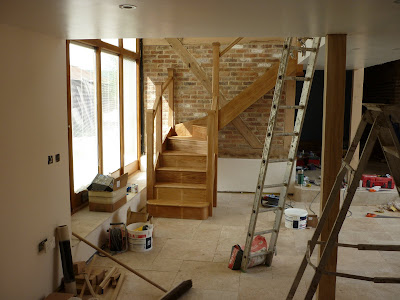 [/img]
[img] 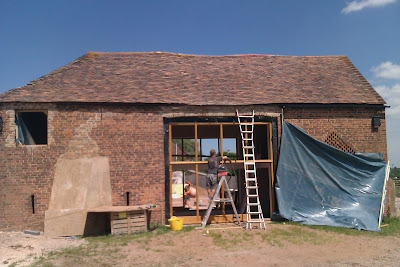 [/img]
Been away for a couple of days!
100mm is the minimum thickness for a concrete ground bearing slab. However with site tolerances this can soon be erroded so that you may end up with 100mm or less.
Even on my own extension I specified an 150mm slab. Additional Cost on a 16m2 plan area was around an £95. Minimal cost in my eyes.
Contractor questioned it. Come day of pour he invites me to pop back and check the DPM. While there I ask for levels.... guess what we have around 30mm of tolerance across the subbase!
Why the insulation board between the heater mat and the screed thermal mass? Doesnt make much sense to me....unless you're supposed to be using that elec UFH as a "quick" heater as opposed to a background system.
The heat can go in either direction. Hence the insulation to limit the heat sent / energy lost in the "wrong direction". Electric UFH does not need to be postioned under screed. Its placed on top of the screed and to reduce the downward heat flow, on top of a suitable insulation product. The 10mm noted above sounds very much like a tile backerboard.
The thermal mass is a result of traditionally having to cover a wet system with screed to support the floor finish and to protect the pipes. There are however systems available where an wet pipe (floating underfloor systems) is supported within a void under the floor thus doing away with the downside of the thermal mass, and as a result providing a more reactive / responsive system.
I'm not an Architect.
Well it's poured now, 100mm (reinforced) in so I don't want anyone telling me it's wrong!
The electrician phoned as the slab was setting to say that the underfloor heating he was including in the quote would only "warm the tiles" rather than heat the room, he said it was a quote for the warmup brand of heater mat, which I've not heard great things about. So now I'm trawling about for a system that will pump out enough heat for the room rather than just the tiles......
.....nothing like being prepared eh?