
MegaSack DRAW - This year's winner is user - rgwb
We will be in touch
I'm looking for a bit of guidance from more experienced trad climbers.
I've been getting into trad more over the year... still barely getting out but thats due to other sports (biking) and work getting in the way. I've probably been outdoors leading trad about 15-20x lets say in the last year.
I've done years of sport climbing (Living in France) on and off (had a big shoulder injury to recover from) but I'm generally comfortable on a rock face.
I guess the reason for the post is I feel like I'm probably "too" comfortable and I feel like I've got into a few climbs this weekend that I'm questioning the sanity of.
I'm leading at MVS and so are my mates so we are all a similar level but the exposure of some of the climbs I feel is maybe just a bit too much to risk..
I broke up with my misses a year ago and I feel a bit "numb" to risk since then.. I'm not sure if I can fully contribute it to that but it feels like its the main reason. Being aware of that is helpful and I can use it to my advantage at times (no Elvis leg in tricky situations and no panic where it wont help fumbling for some much needed gear is going to save me).
I guess what I'm asking is, am I risking too much too soon? Is it normal / safe to feel numb in the face of danger? Do I need to find more protected routes to build my trad experience rather than just climbing any MVS I find?
Picture below from the weekend.. the first bit of gear was just under my feet and was not good due to the rock having nothing deep to get a grip of - I managed to get some good gear where I was stood in the picture so the top felt less exposed but it still wouldn't have ended well for my legs / head if I had slipped at that point.
That was a small climb but later that day I did a harder MVS which meant I had only 1 foot on a small placement and a really crap open handed under cling whilst fumbling for gear about 10 meters up with nasty rocks below... luckily the gear was bomber but it's still a long placement for a low grade and maybe a bit much? Shame though as the climb was really nice.
[img]  ?raw=1[/img]
Just climb lots of different routes on as many crags/ different places as possible. Build up a decent chunk of experience before pushing grades, and remember how hard a grade can feel can vary massively across the country and dependant on your experience/ technique to date.
Feeling numb to danger? You need to focus on the climb, but that's different. Some routes are run-out, but that's part of it. I wouldn't recommend just turning your mind off from the danger if that's what 'numb' means. I would recommend studying the route, assessing the risk, consider the run-out etc and then if ok, then climb it. Different things.
The grade doesn't matter so much as the prang factor which when I was last climbing in the UK was given in the Yorkshire guide as a "P" number. If you're well within your grade don't worry too much as even if the gear isn't great you're unlikely to fall off.
Just look at the climb and judge for yourself.
Some climbers want to tick high grades and go for routes with poor protection to score their first E-whatever. I tended to do the opposite and go for high technical grades with a low E-number as they were generally safer.
Some examples from Stanage of similar difficulty but increasingly dangerous hence the higher grade.
Suzanne - HVS 6a but you can jump off the crux without hurting yourself (Might be E1 now).
Flying buttress Direct HVS/E1. Great gear but not many people get up it first time without falling until they realise where to rock over.
Chameleon E3 5C. One of the frighteners I've done. All the gear fell out when going through the crux with no chance of down climbing and nasty rocks to fall on. I stupidly did it on sight and later found the first ascentionist had topped roped it about 20 times first. I got to the top sat down and started shaking.
I'd treat being numb to danger as a red flag. Pick some well protected routes and get the mileage in and try not to get miles above gear. Focus less on grades for a while. Sounds like you've been unlucky in recent routes, there's plenty of safer options out there and you can usually get a feel for the gear from the ground or the guide.
Looks like a nice spot - where was it op.
As Edukator says it's not the grade itself that's the main problem what you need to look for are climbs that can be well protected. If you've also only really climbed sports climbs then you also need to gain trust in the gear that you place yourself (never understood why people trust bolts placed by strangers but not gear they place themselves but hey ho)
Counter-intuitively steeper climbs are often safer as falls tend to be into thin air.
To gain trust in just how good gear can be you need to test placements in a safe environment. The easiest way to do this is to find a quarry or other steep rock face and put in gear at about shoulder height, clip a sling into it then step in the sling. If the gear pulls then you are going to drop all of a foot or so back to the ground. It won't take long before you realise just how good self-placed gear can be.
P.S. MVS is a very Lakes centric grade which got me trying to identify the climb you are on. Hoad Slabs just outside Ulverston?
ukclimbing.com forums would be the place to ask, not that I'm entirely sure what the question is. You wonder if you might be being overconfident? Unlikely if you're worrying with gear at your feet. [edited as missed last bit of the original post]
mvs is a not very often used grade in the areas I know (yorks - btw the new guide's abandoned P grades, though you can work out risk by comparing adjectival and technical grades, or alternatively by looking at the climb). Why not get on a few more strenuous but better protected vs climbs and see how it goes?
Thanks for the advice guys - exactly the advice I needed to hear.
Numb is maybe slightly the wrong word I guess I am focused on the climb, being considered with moves but I feel for example like there were no run out options of either of the climbs I did - once I was in there it was committed and I didn't read the route well enough from the bottom to see that the gear placement was marginal until I was in that position each time.
I normally think I'm quite good in reading where I'm going and where looks good for gear but up close it was a different story.
I guess my logical brain is just surprised that I'm comfortable(ish) with being in those positions after being so reliant on sport bolts every couple of meters before hand.
I climb 6a/+ inside normally but can stretch to 6b/+ depending on the style of route - does that sound like a MVS is a comfortable trad grade for me with this amount of inexperience?
I'd forget about your sport/indoor grades for now and just climb as many trad routes as you can, working up from a low grade on every new rock/crag so you gain as much experience as possible.
look at the technical grade the climb gets as well as the overall grade. Without wanting to sound condescending it may be that you're missing potential gear placements.
For example a VS with tech grade of 4c is pretty average, nothing too difficult technically and good gear not too spaced out. If a VS has a tech grade of 4b or 4a it's usually a good indication that the climbing is technically easier but the gear may be sparse and the risk in falling is higher. While a VS with 5a tech grade would suggest harder move/s but with great gear or hard move close to ground.
Sometimes you have to be inventive or really look around for gear (even looking off route). Also, small gear in small cracks aren't necessarily poor placements, asking as they seat well.
Nipper99 - that's Ulverston - Hoad Slabs.. however on UKC (didn't look before) it doesn't show it as a MVS.. it's a HVS maybe that was my bad climbing off the route.. I thought I was doing a VS into a MVS (the crux near the top you could go around it or do it).
Looks like it could have been "Hoad Road"
http://www.ukclimbing.com/logbook/crag.php?id=1460#maps
To be fair we only went there as it's on the doorstep and there are a couple of routes up it worth doing whilst we were waiting on a friend finishing work before going to Newby Bridge
[editing because slow. What others have said about grades] I do think that particularly at these low (okay let's call 'em mid) grades where I operate, outdoor climbs can bear little relation to what you'll find in a climbing wall. Watch out for words like "traditional".
Sport 6a/6a+ is roughly equivalent to E1 but that assumes you are confident climbing in both styles. Until you trust your own gear any sort of comparison is pointless.
Just get out and do lots of easy climbs, pick routes that are noted in the guidebooks as being well protected (or at least not picked out as being poorly protected) until you feel comfortable.
Even after 30 years of climbing I find I need to climb 3 or 4 times a week to become fluid in how I move on rock otherwise I look like I'm auditioning for a role in Thunderbirds 😆
If you are in Ulverston then nip down to Birkrigg Quarry and practice putting gear in on the low level traverse there - even better training if you put the gear in *while* doing the traverse!
if you are happy climbing 6a/6b UK rock grade indoors it would make MVS feel easy. However, with 6a/6b French/Spanish (sport) grade ability you might find some trad VS routes hard work and worrying. Don't forget that 6b UK rock is roughly the same as French 7b. It's only bouldering grades that are similar in the UK and France.
Sometimes the gear isn't there, and if it is sometimes rhythm and focus and going a bit further than you should before you get something in can be better than stressing about finding that placement earlier.
MVS sounds like a strange grade to me! I always like a good HS. They're often well protected, they're easy but still feel like proper climbing. I've been on plenty of S climbs that have felt harder/scarier! If climbing VS, pay attention to the English technical grade. The higher the better, as it means it should be well protected.
Also, make sure you have a big rack. An easy S/HS will obviously feel much harder if you don't have the right gear! Lots of nuts and a full set of cams.
Are you still climbing with a single sport rope? Consider buying some half ropes and learn how to use them. They make meandering/long climbs much easier to protect for you and your second.
Reading the comments above ^ that were posted in my time of replying are also greatly received.
I do think I need to work on reading the grades better as to be honest I've delegated that a bit to friends.
I wouldn't be worried about placing small gear it was more how shallow some of the gear was and it's not really cracks there as the rock is quite a solid piece and polished so nuts I was testing were pulling out (actually gave myself a knock on the nose testing a bit of gear!) oops.
After going on UKC I think thats also part of my issue - not reading what other climbers have said about a route... reading it now it gives a much better indication to what the conditions are like than the guide book we were using.
So I think my take aways so far are:
1, test falling onto gear as whitestone said
2, get a better understanding on trad grades so I can find better protected climbs to build up hours
3, read ukc for insights into what the climb may entail rather than just the guide book
4, I think I'll get an instructor to take me out for a day and see if they spot anything noticeable about my style / gear placing that is lacking
@Edukator Sometimes it works the other way round as well. In the mid 1980s a mate and I were doing one of the (then) new rock climbs in the Mt Blanc range. A couple of pitches up and we noticed a French team speeding up towards us. The next pitch was given French 6b. By the time I was ready to start the French lads had caught us. The crack was a perfect hand jamming crack and would have been Severe or VS at most on a gritstone edge. We had done the next three pitches and were abseiling down by the time the French leader had got to the top of the crack pitch!
Pretty well every crack we did was way over-graded for someone who could jam, the slabs on the other hand were desperate.
@mwleeds - MVS is probably only used in the Lakes
Edit: it's not so much testing falling onto gear as understanding the placing of it, hence the hint about low level testing.
get a better understanding on trad grades so I can find better protected climbs to build up hours
There is a hidden language in the guide books you have to learn, any words like 'bold' mean 'no gear at all', regardless of the grade.
So a description like VS 4c "A bold introduction to VS at Stanage", means 'one slip and you're in intensive care'. I recall scaring myself shitless on just one such VS at Stannage years ago, not a single piece of gear and a good selection of spiky boulders to ensure any fall would be fatal (if lucky), wheel chair (if not). After that I figured out how to read the guides better....
My indoor grade was going off what Kendal set on their walls - I'm assuming it's French grade as thats the same as what I was climbing in France... I wouldn't be on 7b in France. So lets just say I'm a solid 6 French grade climber.. Obviously from climbing it I can say it feels easy but I don't think I'd want to go harder if it wasn't protected every couple of meters.
Whitestone - that's a good idea indeed - something to do of the evening too!
I think you're also right about the amount of time climbing, I'm about to build a home bouldering wall in the garage and maybe up the stairs as I can't really justify going to kendal that much to climb over winter so hoping some drills indoors will aid the lead climbing on the wall once a week. (between the cycling).
We normally climb on 2 ropes if the route is more varied but because of the direct nature of that slab I thought it was safer on a single rope as I assume there is less stretch / slack in a single rope system?
I don't actually have a trad rack - my friends do so I borrow theirs... maybe it's time I start buying some gear
Thanks footflaps thats a good insight too! One of my favourite quotes is "You only learn from mistakes, but they don't have to be your mistakes" 🙂
So why does MVS exist? I just assumed it was a normal grade but I did query my mate why it wasn't on the "Trad grade tables" when I saw it at the climbing wall?
Sounds like you'll make a good winter climber if you don't mind climbing thru gear that you know, deep down, is neither use nor ornament.
So why does MVS exist?
In the olden days (pre Extreme grades) there were loads of British Grades. MVS has pretty much been dropped now and it just goes S, HS, VS, HVS, E1. Standards are so much higher now that having 10s grades between Easy and HVS doesn't really make much sense.
The British ability to jam cracks and off-widths eh, Whitestone. I had a go at a Whillans off-width in the Peak. I slithered and struggled but couldn't make head nor tail of it - I wouldn't have wanted to get much higher anyhow, it was wider than my biggest camming thing. Cycling home I suddenly twigged - chockstones! They used to jam stones in cracks for both protection and to make holds, with no stones it was several grades harder and dangerous.
Not many MVS around these days, and I wouldn't use it as a benchmark grade as it can either mean an easy well protected VS or a poorly protected severe. And it's not always easy to tell the difference from the ground or the guidebook.
My advice would be to look for stuff that is obviously (or described as) well protected at 4b - usually Hard Severes, get good at climbing those sorts of moves and placing copious gear when you're knackered, then move up to VS 4c, which tends to be a bit steadier, and generally well-protected.
They used to jam stones in cracks for both protection and to make holds, with no stones it was several grades harder and dangerous
Nah. Brown and Whillans were just bloody good at jamming! Normally while nonchalantly smoking a fag. 🙂
Re: MVS. Originally in the UK rock climbing scheme there were the following grades: Easy, Moderate, Difficult, Very Difficult, Severe. They then added "mild" or "hard" to indicate whether a route was easy or hard for the main grade, a sort of sub-division if you will. This meant you could get Mild Very Difficult! Some of these sub-divisions stuck, others didn't so you get Hard Difficult and Hard Very Difficult but not the mild versions.
As routes got harder then Very Severe was introduced and again mild and hard modifiers were applied. Over time Hard Very Severe became a complete grade in its own right. Mild Very Severe however had a fight on its hands: in a lot of areas grades went - Severe, Hard Severe(HS), Very Severe(VS) but in the Lakes the grades went - Severe, HS, MVS, VS.
What it tends to represent in current Lakes guidebooks is a poorly protected HS though there are exceptions. Back when the grades were introduced all routes were unprotected as the gear just wasn't up to handling the forces generated in a fall, hence "The leader must not fall".
Edit: found it! Here's an article that explains all the above (and more) http://bobwightman.co.uk/climb/article.php?p=uk-grades - it was the standard UKC link about the UK grading system
They used to jam stones in cracks for both protection and to make holds, with no stones it was several grades harder and dangerous.
Wooden blocks for protection. There are still some in various cracks at Milverstone Edge, you can just loop a sling round them.
Thanks for the explanation guys all very helpful indeed, I'm going to link my climbing buddies to this post!
Just what I needed!
In addition to what footflaps says, they also didn't used to have adjective and technical grade.
I spent most of one Winter climbing in the Peak in the 80s and heard a lot of folklore from the locals. Apparently purists had removed some of the natural chockstones that had been in cracks in the 50s as well as the ones added by climbers.
Brown was famous for his chockstone use in artificial climbing:
Unfortunately for René, who thought that the British would let them go ahead, now was the time for Chris to perform his best ever lead on rock. He decided to show the ‘Frogs’ a trick used by ‘The Master’, Joe Brown: taking some pebbles, he jammed two in the crack and with a sling around them trod delicately in the etriers.
Yep, but he normally went back and freed the routes later. I'm afraid you have no excuse. (Apart from the fact it's a horrible offwidth and you don't want to do it...) 😀
🙁
[img] 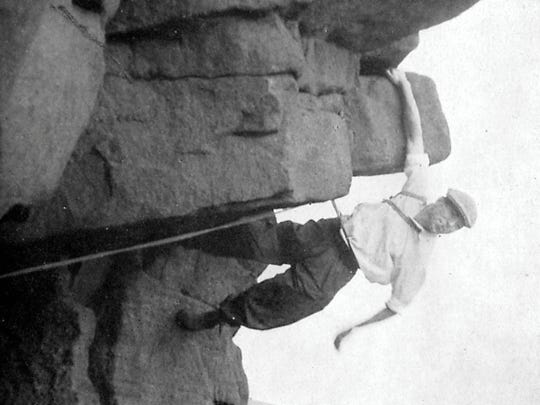 [/img]
Some lakeland crags can be frustratingly compact with holds but little gear - sounds like you might have been on one of them! Don't over-analyse ukc comments - it can put you right off reading about other people's epics. You might also want to apply your 'trip advisor' filter to discard the nutter reviews 🙂
You should be able to navigate a crag from the guide really and like your English teacher always said, 'read the question' - get used to the secret language that can reveal the route character.
At French 6a/6b indoors you shouldn't find anything technical enough to stop you on a VS. Getting up them is another set of skills mind. I've seen indoor 7a climbers fall apart on VS/HVS. Ask away though, we talk a good climb on here 😉
...and there's been just a little discussion of chockstones on UKC, the following sequence of threads on one climb giving a little of the flavour:
"Removing the chockstone from Right Eliminate"
http://www.ukclimbing.com/forums/t.php?t=98319
"Off To Remove The chockstone From Right Eliminate" http://www.ukclimbing.com/forums/t.php?t=567510
"Physics puzzle - right eliminate chockstone disposal"
http://www.ukclimbing.com/forums/t.php?t=106117
"Trial seperation"
http://www.ukclimbing.com/forums/t.php?t=98690
"Right Eliminate - VOTE : Replace Chockstone"
http://www.ukclimbing.com/forums/t.php?t=99149
"Right Eliminate" [putting it back again]
http://www.ukclimbing.com/forums/t.php?t=98925
can't offer any advice on grading as I have very little experience on climbing in the uk.
the numbness thing i can totally relate to. Did some silly solo climbs (alpine)after losing a close friend and girlfriend in an avalanche.
the recklesness wore off after a while though (and has been replaced by being a bit of a wuss since becoming a dad)
what i would notice as a sportclimber going to an alpine (trad) environment is that i would get so focused on the climb that i would forget about placing gear.
i needed to learn to look constantly for placements and not climb a bit and say. mmmm about time i put something in and only then start looking for a placement
MVS is an interesting grade... not quite as interesting as the HXS that I used to encounter on the questionable coastal crags I used to frequent 15 years ago.
VS is a reasonable grade to consolidate at, once you have a selection of them under your belt it can be better to hit E1 rather than HVS as you usually know what to expect with E1. I had a load more E1s done than HVS before I laid off the climbing.
Lakes crags are quite interesting in themselves. Quite often the polish makes them seem more difficult.
Lakes crags are quite interesting in themselves. Quite often the polish makes them seem more difficult.
I found them harder than the equivalent Peak district grade.
Although in some cases finding the route was the hardest part.....
As others have said there is a bit of a knack to reading guide books expecially when combined with English understatement and dry wit. In general as well slabs are going to be more run out than cracks etc due to geology.
Thanks for relating Spot - really sorry to hear about the tragic news, it certainly puts things into perspective. I also think you're very right about climbing then looking for gear placements. It's a bit like biking maybe where most people want to brake on the hard stuff but it's too late and they should have lost their speed on the easier bits and read the track ahead better.
Interesting what you say about E1's Electric.. I don't suppose anyone has any suggestions on what to climb around the South Lakes or within a 2/3 hours drive knowing what's been said?
Thanks
Alex
Most of the lakes climbing I've done was north. Shepherds crag has a few nice classics and a few reasonably interesting middle grades.
Done a few nice easyish routes on Bowderstone crag, again up north.
South I've spent a bit of time in Tilberthwaite quarry, theres a bit to go at in there.
I spent most of my time on Peak Gritstone/Dartmoor Granite/North Devon sea cliffs. Different climbing altogether.
Shepherds Crag was where I did my first trad climb and first lead. That all felt obtainable - I'm sure we should go back though as we probably missed a lot of good routes too.
Thanks for the other recommendations I'll take a peak into them more
This time of year is perfect for grit - Yorkshire and Peak.
I grew up around there so have an idea.
Wallowbarrow Crag in Dunnerdale has lots of easier routes. It's low lying and south facing so can be good at any time of year.
Whitestone Crag near Newby Bridge is also worth a visit or two. (There might be a connection between this and my user name!)
Much of the other South Lakes stuff is getting to be too high up to be worth it at this time of year.
At this time of year nipping over to Yorkshire for the grit is worthwhile, less than two hours Ulverston to Ilkley for example.
I had a go at a Whillans off-width in the Peak
Don's Crack at Ramshaw perchance? I will never forget the attempt by my brother and I to climb this. We got up somehow, but were destroyed physically and mentally. We both served our apprenticeship on Peak District grit so were no strangers to awkward jamming cracks, but this one takes the biscuit. "Only" HVS last time I checked.
This time of year is perfect for grit - Yorkshire and Peak
I beg to differ. The Roaches is distinctly green and damp in places at the moment; especially overhanging places 🙂
If you're feeling like routes at MVS are too risky or unjustifiable then pick routes that have better gear and / or have a good hard think about your protection placing skills and get some help if necessary. There are plenty of routes at that grade which have excellent protection.
edit - just read the rest of the thread and it seems you've got this advice already.
Whitestone was actually where we went in the afternoon, We've been a couple of times I really like it there! I only just clicked!
Thanks again
Eliminate A on Dow Crag was my first Lakeland VS [cough] years ago. An absolute belter to aspire to when you're happy on multi-pitch stuff. Thomas at Wallowbarrow is good and handy.
I've done a few at Wallowbarrow but I'm terrible at remembering names or being bothered keeping a record. I know it was east on the Crag though the last time I climbed there and enjoyable.
The Whitestone MVS I climbed was "Cracked Wall" which UKC has as a HS 4b
Happy enough on multipitch
I ordered a few books this morning so I'll get reading up too
I know you requested helpful advice, and this may not sound too helpful - but it's meant in the nicest way 🙂
It sounds like you're going to hurt yourself!
From what I've read in this thread it sounds like you've limited climbing experience outdoors, thought you were climbing MVS and ended up on a poorly protected HVS.
I think the idea of being able to focus totally on the climb is great (and a lovely feeling when you're in that place on hard routes) - you should focus on maintaining and building that by consolidating your climbing on well protected routes. Don't do anything that'll mean you lose that confidence.
Knowing when you are in a dodgy place (and how to get out of it safely) comes with experience. 20+m up with crap gear under your feet is not place to discover how quickly performance drops off when you discover "the fear" and how quickly (instantly!) you can get pumped. It's a very steep learning curve from up there, and it it'll take a long time to rebuild that confidence if you do deck.
I have sort of skim read this so sorry of I repeat anything anyone else has said
Firstly MVS a Lake things. I think it crosses the HS VS boundary
It may be worth giving a little background. I'm 50 and currently climbing but not at a high standard. This summer I have lead 1 VS loads of HS and S. Indoors upto 6a and a few easy angles 6as Outdoors. I don#t think I'll do any more runouts.I taught my son to lead this summer. How now leads VS outdoors. Back on the day I was climbing a fair bit harder than that
I did do some routes with run outs on routes. Mainly I'm happy that I controlled the risks. But I have a few regrets the risks I took
This is my thoughts about risk. In some ways your in an ideal position. Being scared doesn't help it just makes you do things badly. But you need to keep a constant objective eye on risk.
I use to build a sort of chain in my mind that I was always reviewing. Near the top of the steep route, objectively risk can be low.
Risk of falling, low
Risk of top runner failing, low
Risk of the nest runner failing, low
Risk of the next runner failing, low
Risk of hitting anything even if 3 runners fail, low
Basically that is safe as house
In your opening post things weren't so good
Risk of falling (I don't know)
Risk of runner failure high
Things to hit yes
Our overal assessement all depends on the first pont. If you genuinely felt comfortable on every move and would have no worries down climbing then you were fine. If you were any where near a risk of falling then you were pushing to hard IMHO. Edit as your not that expereinced lets say it was not the right situation as you need expereince to judge when you might fall
What I think you need now (its what my son to have) is an apprenticeship. Just loads of trad mileage, go for quality not grade. I did a few years of upto VS. Just loads of different routes. You'll then be fast and accurate with gear, Happy reading guide books etc.
At that point I think its OK to explode through the grades
In the summer from you I'd be up on the mountain crags doing loads of classics
Your not far from North Yorkshire Limestone. Attemire springs to mind
I beg to differ. The Roaches is distinctly green and damp in places at the moment; especially overhanging places
The Roaches always has distinctly green and damp bits 😉 . Ramshaw ftw right now.
It sounds like you're going to hurt yourself!
Whilst I'd agree with the words of caution, I can't help but think it's a little too cautious. Thinking back to my now sadly defunct climbing career, some of the most valuable lessons I learned were the times when things went wrong. I had everything from going off route, gear falling out, gear failing, and getting hopelessly psyched/pumped on crux moves with no get out option other than to complete the route. The point is if you want to improve you have to push the boundaries. The trick is judging how far.
My best advice to the OP would be to get good at placing gear, and judging when to run it out or not.
Not much to add other than getting out with someone much more experienced at placing gear than you. They can then critique your placements when seconding or even point out missed gear placements. Try and do a few easy multi pitch routes with them too so you can learn how to put a good belay stance together and get used to swapping leads. Corvus in Borrowdale is a classic low grade outing; even when I was climbing way above the grade it was still a superbly enjoyable route.
Maybe invest in a bouldering mat too for the base of the crag; nice to sit on beteeen routes, good to clean your boots on and adds some confidence to leading. Also, probably stating the obvious but the smaller the crag, the more likely you are to deck out especially if you can't get some decent gear in low down.
Finally as others have said, just work your way through the grades reasonably slowly, no need to feel compelled to start ticking E grades quickly (though you'd probably get up low grade E1, E2 now) and pick routes based on guidebook descriptions and what you like the look of at the crag when you get there. Popular routes, whilst more polished, tend to have their gear placements in the bleeding obvious category as they are so well used.
I've been known to run out routes but I generally get a couple of good pieces above the belay and then run it out until i think..."oh sh!t, look how far up i am". This has been multi pitch stuff in winter though and only really on long straight gullies where a fall would mean a long slide until the rope catches...not above rocky outcrops. I also only do this when i'm climbing well within my grade and having a good day.
However, I think you also need to think of your climbing partners too. What would happen in the event of a freak fall? Would you get hurt? what position would that leave your partner in? Having witnessed a couple of falls on single pitch routes where the climber has bounced off the ground, their partners have freaked out a bit and it's not been a nice situation, quite distressing actually for all concerned. So out of respect for your belayer, I think you should make an effort to put a piece in every 5m at least (more gear on shorter routes). Otherwise you may as well just solo.
Are you taking your safety for granted? it's one of the reasons I prefer trad to sport, the risks are greater so the reward tastes sweeter!
From what I've read in this thread it sounds like you've limited climbing experience outdoors, thought you were climbing MVS and ended up on a poorly protected HVS.
Sadly, getting out of your depth and off route can be part of the learning experience! Managed to turn VS into HVS and above a couple of times through my ineptitude, including a memorable one on a sea cliff when an easy HVS turned into a massively run-out E2.
Your not far from North Yorkshire Limestone. Attemire springs to mind
I love that area but I'm not convinced it's a great recommendation for someone to build confidence. Lots of the easier routes on Yorkshire lime are polished, some have the odd loose hold and hard for the grade starts above iffy landings are not uncommon.
their partners have freaked out a bit and it's not been a nice situation
I've been surprised with how calm people can be. One of my first days in the Peak a guy fell off Downhill Racer breaking both ankles. He was helped into a comfortable position to wait for the ambulance and a stretcher while someone went to phone for an ambulance (no mobile phones back then) then everyone else got on with climbing.
The off-width wasn't Don's Crack, it was on Burbage IIRC.
I love that area but I'm not convinced it's a great recommendation for someone to build confidence. Lots of the easier routes on Yorkshire lime are polished, some have the odd loose hold and hard for the grade starts above iffy landings are not uncommon.
I over reached my advice. That's the trouble with being a Southerner
I just remembering doing morning star I think when I was getting back into climbing after a break
There's some classic VS routes at Brimham and Ilkley. I think the easiest VS I lead in my heyday was twin cracks at woodhouse scar.
Having some 'bewareness' of being numb to fear and dropping a couple of grades to consolidate your experience seems like a good way forward. I get the impression that doing 'an apprenticeship' in learning to trad lean, by gaining experience as one works up the grades is pretty much the best way to be safe.
Having got injured by too much climbing as a youth, on the bad side I've dodgy elbows, but on the good side I'm having to drop right down in my grades and just go climbing - as it were, which is probably a plus when it comes to safety. It could be worse.
I just remembering doing morning star
Not finding that in the YL guide?
I had a brilliant 2 days soloing at Twistleton, Attermire and Oxenber in October. Idyllic spots and very quiet.
Not finding that in the YL guide?
...I'm thinking Evening Star at Twistleton 🙂
Or Moonshine at Attermire?
Thanks for the continued advice - all has been read and greatly appreciated, it's all certainly helping and very insightful.
I'm going to take the wise advice and swat up on my knowledge a bit more on the reading side and get some milage in better protected routes.
Any more route suggestions or advice appreciated 🙂
This makes me nostalgic although I was very much a classic rock not a hard rock kind of guy. Especially when leading - this was pre-caming devices mind!
I am spooked by the concept of being numb to risks though. As mountaineers, risk assessment and management is a priority. I talk as someone who used to do a bit of soloing (at rel. low grades in the context of this thread). The buzz there was not any numbness. On the contrary it was the very heightened sense of risk - and the memory of how fast your fall when it goes wrong 😉
Anyway -good luck in the wider context and enjoy your climbing. Great photo BTW!
Any more route suggestions or advice appreciated
Avoid 'microroutes' at this point, get on things that are a proper length. Trying to lead those short sharp 6-8m things you so often encounter on grit, limestone and Northumberland sandstone is a sure fire way to failure and demoralisation!
Go for volume, set yourself a challenge of x many routes / pitches / metres of climbing in a day, the grade doesn't matter for this. If you feel up to it do some soloing well within your grade.
And as others have said, get in tow with someone who can give constructive feedback on your gear placement etc.
Oh, and next spring, set some time aside and go to Reiff. If there was ever a climbng area designed to boost confidence and develop skills in a friendly way it's Reiff. Stunning scenery too.
Avoid 'microroutes' at this point, get on things that are a proper length. Trying to lead those short sharp 6-8m things you so often encounter on grit, limestone and Northumberland sandstone is a sure fire way to failure and demoralisation!
Only if you worry about grades. Just drop a few grades when you start climbing on grit or sandstone, it takes a while to get used climbing with your whole body, smearing and relying on friction.
Just drop a few grades
Sometimes quite a few.
It's a funny thing trad climbing because being relaxed in dangerous situations really is the key to it (and is why so few good climbers at the wall end up fulfilling their potential outdoors). This is different from being a go-for-it-merchant (yes you do get away with it 99% of the time; that 1% will catch up with you eventually).
I was a complete weakling, hopeless at bouldering and indoors. Had a good head and climbed way harder trad routes than I ought to have. I now ride a bike like a big pussy! 😀
An apt name! 😀
For me it was always about time on the rock, and the specifics of each type of rock/crag. I might have climbed E whatever on something, but I'd always drop down a bit for a new crag and build up mileage again.
Somewhere that allows you to completely immerse yourself in that particular type of climbing for a extended period always saw my best climbing. Places like Lundy, where you go for a week or so, are brilliant for this. (as well as being a truely inspiring place to climb).
Sorry
Evening Star
Twisleton
http://www.ukclimbing.com/logbook/c.php?i=39856#photos
Brimham is an odd place to climb. Some very poorly protected routes as well as many that are safe as climbing can be
back to the OP. In case this hasn't come up
phrases that mean poor or distant protection
run out
committing (all this can include how easy it is to escape or reverse)
hard to protect
bold etc.
Actualy exposed is not usually a reference to protection. It refers to a sense of height or being over a large drop
I guess what I'm asking is, am I risking too much too soon? Is it normal / safe to feel numb in the face of danger? Do I need to find more protected routes to build my trad experience rather than just climbing any MVS I find?
Hi. To add to what's been said above, it sounds like you're doing OK - at least you're stepping back and looking at how you're climbing instead of just thoughtlessly going for it until you get badly out of your depth!
Yes, I think you should concentrate on getting mileage in on easier/better protected routes to gain experience in placing gear. The people I've always enjoyed climbing with the most have been the competent and calm, irrespective of grade: the people who know how to place gear, who know when they can trust it enough to jump off onto it, who know when it's just there because there's nothing else and who can place a piece with just a couple of tries of size and orientation. All stuff that comes from experience.
I don't think it's normal to feel numb in the face of danger. You don't sound like you have the experience to judge if you're in a genuinely dodgy situation or not so you should at least be more nervous.. in fact you should be pretty nervous all the time when climbing at about VS, as the picture you posted shows it's a grade where there's usually a fine selection of ledges to hit. Airborne retreat shouldn't really be an option unless it's steep and you know the gear is good (and that there's preferably a lot of it). Of course, as someone else said you only really learn by direct experience, so sooner or later you'll end up hanging from gear and probably being slightly surprised that it held. But I would NOT suggest jumping off to do any kind of deliberate fall testing unless you have a lot of backup, you're with someone who really knows what they are doing and you're wearing a helmet (as any top piece that rips will be following you down the rope..). If you've been leading indoors then you already know how to fall, but you need a lot of different experience to know the difference between bomber gear, OK gear and iffy placements that are just psychological.
Someone else mentioned this, but I agree that it'd be a good idea to start getting your own gear. It's sometimes a bit awkward on multipitch routes where it's easier to combine racks, but if you're just cragging then you can always use your own, and learning what you've got and how it's racked makes finding the right sized nut or friend a bit faster.
I hope all that isn't off-putting. It's worth building the experience. Knocking off some big lead where you climb well, protect it well and then look back up the route that's empty of metalwork is a fantastic feeling and a real achievement and something to aspire to.
All good added advice, thanks guys it's nice getting a collectives thoughts, it feels much more balanced getting considered feedback like this of all your advice / experiences.. and dare I say it much nicer than UKC!
I'm not sure about this numbness..it's bugging me a bit to be honest if its a thing or not.
Basically I can remember at one point being very scared of doing big drops on my mountain bike (chalet road gap style) and then one day it felt like nothing, I still got a buzz off landing though but the feeling of doing it was more methodical. Now on bikes if there is something big that I haven't done and think I'm in a more methodical than apprehensive mindset.. but normally I'd follow a mate into something and I'd have full trust in their ability.. it's rare that I'll go and tackle a large new feature for the first time on my own.
I hope im on the calm and not reckless end of the spectrum but I'm not sure I'll know fully without more experience or like you have mentioned a mentor.
Climbing is so strange as everything is done at a much slower pace.. you can walk yourself into danger rather than not have time to process it like on a bike at 15/20mph... that's a huge reason for loving it too as it really engages the brain and feels pure!
I'm sure I'd crap myself just before falling if I did calculate it wrong as I still do indoors. (I climbed an overhang the other week climbed past 2 bolts, finished it and then couldn't clip and hung for 5 seconds knowing I was going to fall and went a bit white!).
So I don't think my emotions are broken, I'm just surprised at my approach to climbing trad... I remember before I did my first trad climb thinking "I'm going to clip gear every 1-2meters as this is dangerous" and before I knew it I was at the top with bigger distances in the gear than I had hoped. Granted it was an easy route but I had specifically set off with the mindset to over place gear.
I had to type all the above to try and come to some conclusions, writing it down makes me think maybe it's just more the case of over climbing and missing the basics of being more strict to place gear.
I'm going to take all the advice on board and get on some well protected routes and go from there.
I'm back in France in June so sadly most of the Summer will be sport climbs but I would like to get some more epic days in higher up if possible with a mix of sport / trad.
[b]My first trad lead - a bit high to the first bit of gear, or just what was available?![/b]
[img]  ?raw=1[/img]
[b]My first 6a sport lead - moving through the crux was great but I do remember cacking myself in a horrid smear position[/b]
[img]  ?raw=1[/img]
[b]Dodgy UK Sport lead - wasn't massively happy with the distances of the bolts, think I'm on the crux as I remember thinking the rock I was stood on would hurt a bit to swing into[/b]
[img]  ?raw=1[/img]
My first trad lead - a bit high to the first bit of gear, or just what was available?!
I wouldn't say so. It looks like mostly a scramble/easy climb to the ledge below the first piece so I'd say that was the logical place to for the first piece of protection. Same with the second, after that you don't really need any more (this is assuming they were good placements). I was always a proponent of the idea that you should only place gear when it makes sense (if you can). One of the first lessons I learned was not to mess around wasting energy on unnecessary protection as it just tires you out and increases the likelihood that you will fall, especially if towards the top of a route.
Interesting - for that 3rd piece though if it was missing and I did fall - it's going to be a bit of a bang onto that first scamble rock isn't it? I thought the idea was to avoid coming in contact with anything below ideally?
Ideally. But that's not always possible. Even on sport climbs, as your picture shows, there can be a risk of hitting something, especially if it's easy-angled.
It's about using your judgement as to the likelihood of you falling vs the objective danger of falling.
The general "rule" is to put in just enough to stop you injuring yourself should you fall. So rather than think about a piece of gear every X metres look for gear that prevents you hitting anything. When you are on easy ground (for the grade) then it's usual to put in less gear as there's less chance of you falling off.
Putting gear in very low down is only usually of use for bouldering type starts since as soon as you get off the ground then rope stretch and belayer reaction times render them useless. Unless the ground below is particularly nasty I wouldn't bother until my feet were at head height then a second piece once my feet were level with that. After that it's a case of reading the route and figuring out which placements to use.