VW were the first of the major manufacturers to go full EV. They didn’t really have a choice after Dieselgate. No one was going to buy a VW, diesel or otherwise, so they went full EV earlier than most. Only BMW really dipped their toes before this.
Toyota seem to be feet dragging. I know someone that had a petrol Yaris and a hybrid one as a replacement, and the hybrid didn't do much better mpg at all. Our old 99 plate Mk1 would do over 60 mpg on the motorway, and that was the 4 cylinder petrol. SIL's Prius is 'worse' on fuel than their old 2.0 diesel Avensis.
Piddle poor from Toyota. Yaris GR it is then !
SIL has just ordered a Yaris Hybrid. Bloody pointless IMHO - she has the Prius as well. My Mrs was asking what 'would' I buy, and I said hybrids just aren't giving the fuel efficiency over an ICE car, and leccy cars are way too expensive for our use.
SIL’s Prius is ‘worse’ on fuel than their old 2.0 diesel Avensis.
Yeah they are very sensitive to driving style. We would get similar economy to the Passat in our MK2 Prius, around 57-60mpg on motorways but that involved sticking the cruise on 70 and leaving it there. It was however far better in town than the Passat, worst trips were 50mpg vs about 35. And of course no NOx problems and no diesel smoke.
That was an old one though, newer ones should be better. My colleague gets low 70s from his MK4. But you have to know how to drive it well.
But yes, they are slow on the EV rollout.
That’s because Toyota seem to be of the belief the Hydrogen and fuel cells are a better solution than batteries.
I can understand their point, and it works for aircraft, but for cars, where mass is less of an issue and where you’re left having to create more and harder infrastructure for H2…I’m not sure it stacks up. They must know quite a lot that I don’t.
Are you counting the big amounts of energy used in cracking crude to produce gas/diesel in the emissions calculation of your putative ICE vehicle?
Well given the context of my point it would be silly not to.
VW were the first of the major manufacturers to go full EV.
If you ignore Mitsubishi, Renault Nissan, BMW, PSA (Stallantis), Kia, Hyundai... . VW were very late to the party with the E-up which wasn't even a specific platform like those before it.
Toyota seem to be of the belief the Hydrogen and fuel cells are a better solution than batteries.
They need to cut the energy losses in hydrolysis and fuel cells by half to equal the efficiency of battery EVs. Planes yes, cars no on current levels of efficiency.
Currently Hydrogen seems to be a good choice for applications where refuelling is needed rather than recharging - things like trucks, building and mining equipment etc which have to work all day and can’t economically be switched off to recharge plus would need a ridiculous battery pack to keep them going.
Hydrogen production is also in its infancy - a lot made from oil right now which rather defeats the point but that’s just an enabler to get the distribution and end user side of things up and running while the electrolysis and energy source (renewables) is ramping up.
Hydrogen can also be burned in an IC engine or used in a fuel cell. Engines are a short term option, fuel cells the medium.
No one, including the big industry players knows which tech will win out in the long term - for example battery technology might develop sufficiently that it dominates. For the short-medium term though both are being developed.
Batteries seem to be dominant for cars, as they’re already “good enough” and will only get better - 300 mile ish range is enough for the vast majority of people and journeys, and a 30 min ish recharge stop after driving for 5 hrs (300 miles at 60mph) is well under what what would be needed for normal human comfort & safety reasons anyway.
See here for some of the stuff that we are doing at work (I work for Cummins and we’re actively working in both areas plus others)
Toyota seem to be feet dragging. I know someone that had a petrol Yaris and a hybrid one as a replacement, and the hybrid didn’t do much better mpg at all.
They got badly burned (!) when Europe chose which version of a lower emission ICE was going to be favoured. They went with standard engines with a Cat, Toyota had put a lot of work into lean-burn tech with good results and were behind the curve at a stroke when the regs were changed. They are not keen to suffer a similar fate when we shift to non-dinosaur fuelled vehicles.
If you ignore Mitsubishi, Renault Nissan, BMW, PSA (Stallantis), Kia, Hyundai… . VW were very late to the party with the E-up which wasn’t even a specific platform like those before it.
I meant full EV - Not just one (additional) car in the lineup, but replacing mainstream models. VW group now has ID3/4 and their Audi, Skoda and Seat equivalents, Porsche Taycan and it's equivalents and a host more. VW announced in 2017 that by 2030 they would be full EV, this has been pushed back to 2035 for VW group due to commercial vehicles. They also stated in 2021 that there would be no more ICE developments - at all.
The Zoe, the Leaf, the I3, the earlier Ioniq's, etc were all additional. The ID3, ID4 and Buzz were to intended to supplant the Golf, Transporter, etc.
VW were the first of the major brands to do this. Mercedes, Ford, GM, etc have followed suit on the coat tails of Tesla and VW with plans to fully electrify.
Suspect green hydrogen might be needed for inter-seasonal storage of energy (the harvesting in summer will be higher than the use in summer and vice versa in winter) rather than vehicles of any kind.
I note JCB are already producing electric diggers - the high torque characteristic of electric motors makes sense.
In terms of range, my first Ford Escort used to manage about 300 miles on a tank back in the 90s. Diesels that do 600-700 miles are a more recent option.
Speaking to folk who know, we already have quiet a lot of public EV charging points relative to the number we’ll need. I forget the comparison between petrol nozzles and public EV chargers - but I think there are more chargers (might be petrol stations and chargers).
I reckon I can get the EV charging load onto the distribution system even once all cars are EV (and that’ll be a while).
We just had a couple of EV chargers fitted to the outside of our garage, and 7kW of solar arrives within the month.
So why are we driving two diesels?
We ordered our EV in November and we’re still waiting for a delivery date.
PS - at the moment split hybrid makes sense. One EV that you use as much as possible, one diesel for long motorway journeys / cruising to the Alps with bikes and boards. Uses each vehicle in its sweet spot and avoids flying. Hybrid vehicles make little sense unless you have a very short every day use.
I considered a plug in hybrid as a “next car” - doesn’t make any sense for my use which is mainly weekly 100 mile is round trips and few short journeys so I’d spend most of my time using the IC engine and would be a step back in efficiency from my current diesel. Those with lots of short trips - sure that makes sense.
An EV would suit my use A usually charged at home or work, and for the occasional (4-5 times a year) long trips would need a charge at public charger to top up - I’d be making a food / coffee / toilet stop on those trips anyway, so as long as there isn’t a queue for a charger that would be a nonissue.
Now the question of actually affording one is different - I can’t do it’s purely hypothetical right now sadly.
One EV that you use as much as possible, one diesel for long motorway journeys / cruising to the Alps with bikes and boards.
That is our current (haha) model. My wife is trying to get a new job that does not require a car but that is proving tricky. So we might be looking for another car when the EV goes back in May. Hoping supply eases up.
“Present model” please molgrips 😉
Those with lots of short trips – sure that makes sense.
Not necessarily, old team leader has a Pug 508 or something, bought it for exactly that reason. It stops running on electric after a while and needs a few long runs before it will play again. Tbh full electric would have made far more sense for him but he wanted the long range flexibility for weekends away.
@squirrelking - I mean plug in hybrid, as the whole point of that is to use electric on short trips. If they behave as your old team leaders one does that completely defeats the point !
I think I mentioned a few weeks ago on this thread that I was planning a 1000+ mile round trip in my M3P, the longest since I got it over 2 years ago.
The first thing to note is I relied completely on the car to plan the route and pull me in when it deemed fit to charge. I started looking at routes and supercharger locations but in the end decided I would just plug the postcode in for where we were going in Cornwall (from Newcastle) and let the car do the rest.
It was about 450 miles to Newquay airport where I was picking up my wife and daughter. After fully charging the night before the car pulled me in twice on the way down (Woodall and Bristol) for ~20 mins a piece. By the time I’d been to the gents and grabbed a coffee/sarnie the car was saying it was ready to continue the journey.
The Tesla infrastructure is very very impressive, the whole thing was a doddle. The car was preconditioning batteries for up to 40 minutes in some cases ready for fast charging. The chargers at Bristol were 250kW and I was clocking over 1000 miles per hour when I first plugged in. Getting on for ICE levels of refuelling that.
None of the supercharger locations were on the recent non Tesla rollout. They ranged from me being the only car on a bank of 8 to one on the way home which was fully utilised when I returned to the car (another bank of 8).
I was very early arriving at Newquay airport after having a great run down. 8 hours door to door including two stops so plugged into a 50kW GeniePoint charger at the airport. And this is where I realised how far ahead Tesla is, it’s light years. It took me 15 mins to get the thing even charging despite having already registered all my details with them and there was no pre conditioning. By the time I got it going at a much slower rate I would have nearly been ready to set off again at a supercharger.
I wouldn’t hesitate to do a journey like that again in an EV but it would absolutely have to be a Tesla. Once you’re off their infrastructure it’s a shit show, broken chargers, slow, occupied, etc. I stopped at Cornwall services and out of 4 bays there was only 1 rapid CCS connection that was functional and there was an MG on it and an iPace waiting. So that would be at least an hour before I could even plug in.
The non Tesla infrastructure has a long way to go and the rate EVs are selling I’m worried about how it will keep up. I’m positive though because once the whole lot is as good as Tesla is now it’s completely viable even for these edge cases where people tow a boat to the south of France once a decade.. 🙂
I wouldn’t hesitate to do a journey like that again in an EV but it would absolutely have to be a Tesla. Once you’re off their infrastructure it’s a shit show,
And that's why Tesla can't make enough cars to meet demand no matter how much they increase their prices. However I wouldn't call the non-Tesla charging networks a complete shit show. I try to stick to reliable easy to use networks like Instavolt, Osprey, MFG and maybe Gridserve and whilst it takes a bit more journey planning than putting a post code into a Tesla nav system and I've had to use my plan B or C a couple of times I can't say my public rapid charger experience has been a shit show.
Aye you’re right, I was perhaps being a bit harsh there calling it a shit show. I think I’ve been spoiled with 150kw minimum chargers for over two years that are always available and working so when I leave that I get a shock.
I think what my journey did demonstrate was the value in the connected systems that Tesla operate. I.e. they know which cars are where, state of charge, which superchargers are on the route etc etc so can manage occupancy at chargers and ensure batteries are ready for charging. The rest of the infrastructure needs to be joined up like that too eventually.
I was clocking over 1000 miles per hour when I first plugged in. Getting on for ICE levels of refuelling that.
Don't think so, I csn put 600 miles in my ICE car in about 5 mins.
Fair enough but I said getting on for not equal to.. 20 mins to near enough brim the battery compared to 5 mins to brim a tank of dino juice is not exactly worlds apart is it?
9 months into EV ownership and the public charging network still disappoints me. As mentioned above, even new ‘good’ chargers are over complicated to operate. Trying to get an ionity charger to start took nearly 10 minutes as it decided to eventually talk to the internet and then the web page on my phone. Why can’t they just work with a contactless card like InstaVolt?
This was after not being able to use another location because the elderly gentleman in his new car still had ‘50 mins to charge’. Yes, that’s because you are already at 86% so it’s now charging slowly- can I use it as I am part way through my journey home and have another 150miles to go and no charge? He was very nice but didn’t ‘get it’. He did helpfully suggest the free Tesco charger across the road.
There need to be guides to etiquette posted on chargers to help with stuff like this.
I am now much more confident getting near home when the tortoise appears on the dash 😆
@whatgoesup it is a PHEV! Like you I assumed that would be perfect usage conditions but it seems not. Unless it's that famous PSA reliability at play.
they know which cars are where, state of charge, which superchargers are on the route etc etc so can manage occupancy at chargers
The non-Tesla networks very much need this at least until there are many more chargers. A simple overstay fee like Tesla use would help enormously to reduce the number of vehicles left parked on rapids with a complete charge or drivers determined to charge to 100% even if it would be faster for them to move on. Instavolt are considering implimenting overstay fees which would be marvellous.
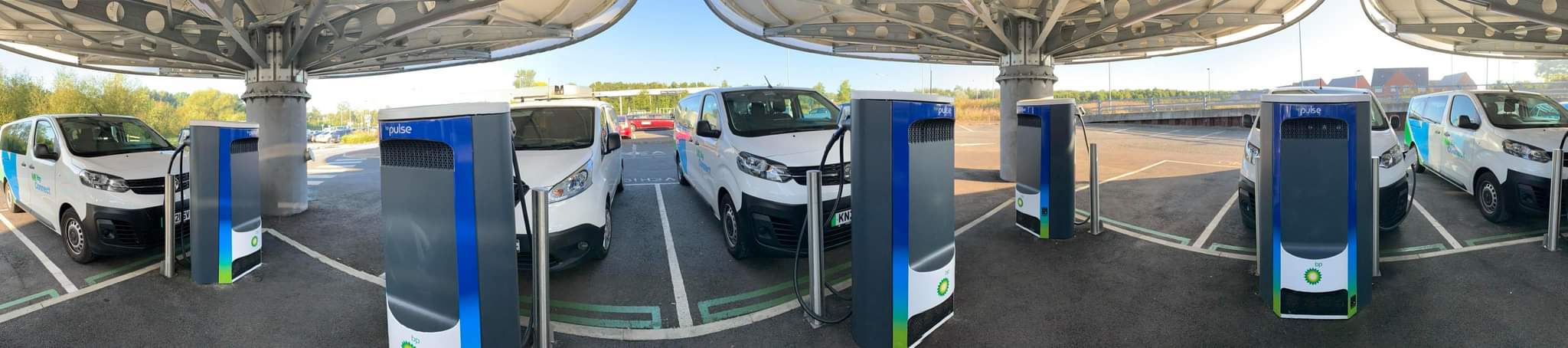
The BP Pulse hub at Milton Keynes is infamous for fully charged MK Connect Vans being abandoned for for hours on end blocking all the chargers
Q4 Quattro Etron ordered through Tusker today, delivery date June..23 ..
It can be cancelled right up to a month before delivery, once date firmed up, so we’ll see 🙄
The German cars in my company Tusker scheme were outrageously expensive, and the range wasn’t great. I ordered an Ioniq5 fully loaded for almost half the price and an extra 50 miles of range. It’s just docked at Tilbury…..
I wouldn’t hesitate to do a journey like that again in an EV but it would absolutely have to be a Tesla. Once you’re off their infrastructure it’s a shit show
Yep was off piste last weekend and used a none Tesla charger,
lots of hassle and I wouldn’t like to have to rely on them on a trip.
Q4 Quattro Etron ordered through Tusker today, delivery date June..23 ..
I ordered a Volvo XC40 Recharge as a replacement company car at the start of April. Delivery date stated as 12-Jan-23, but i'll be amazed if it turns up on time.
Can't come soon enough considering the current diesel prices!
From June 30th all home chargers are required to be "smart" chargers and have a data connection.
On the face of it, provides good benefits especially on cars that dont have on board charge timers to allow you to take advantage of cheaper off peak power.
But a tin foil hatted part of me wonders if this is just paving the way for taxing EV charging - as a way to recoup fuel duty in the future.
Are all cars capable of "granny charging" off a standard wall plug? Will this get around the issue? Most cars will do 7-9 mph charge speed like this, so you could get 60-80 miles of range added overnight which will do for most people, most of the time.
Yes, they'll all granny charge off a regular socket - plus there were thousands of non-smart domestic charge points installed even before smart ones were required for the grant.
The "smart" stuff mandated now is around defaulting to off-peak charging, adding a random delay to the start of a charge (both overrideable if you want), and supporting some new demand regulation standards (which you can choose to sign up to).
As homes get more electrified (car charging, heat pumps, induction hobs, etc) there's a need for more smartness to manage demand - both within your house, and on the wider grid.
The future will be road pricing, not trying to tax EV "fuel" separately to domestic energy.
But a tin foil hatted part of me wonders if this is just paving the way for taxing EV charging – as a way to recoup fuel duty in the future.
Well something's got to replace lost fuel duty hasn't it?
it'll be road charging, way too easy to bypass the smart charger is you wanted to
I used the Belford (Northumberland) Tesla supercharger for my eTron a couple of weeks ago. Was simpler to use even than the Ionity ones, but it has hi-lighted the stupid position of the charging sockets on the car. I had to get the bumper almost touching the charger to get the plug to reach. On the return at 2 am I just drove along side blocking another bay in the hope that there wouldn't be much business at that time of the morning.
In recent trips down south I've been impressed with the aptly titled Fastned facility at Hamilton, the new Grid Serve chargers at Burton-in-Kendal and MFG Chargers at Crow Orchard (J27 of the M6).
Length DOES matter!
[url= https://i.ibb.co/KWvBdWX/IMG-7169.jp g" target="_blank">https://i.ibb.co/KWvBdWX/IMG-7169.jp g"/> [/img][/url]
Fast Neds just outside Glasgow
[url= https://i.ibb.co/KLtQdCv/IMG-7166.jp g" target="_blank">https://i.ibb.co/KLtQdCv/IMG-7166.jp g"/> [/img][/url]
I’ve got a question. For RWD EVs… how does regenerative braking work when driving “enthusiastically”? For example, a BMW i4 40. It could be a bit like pulling on the handbrake mid corner if done wrong which would end badly so I’m sure the on board computer wouldn’t allow. So what happens? No regen while cornering? Front brakes are employed to balance things out?
My employer is about to offer a salary sacrifice scheme for EVs with a company called LeasePlan.
Have they made a good choice or should we avoid at all costs?
I’ve got a question. For RWD EVs… how does regenerative braking work when driving “enthusiastically”? For example, a BMW i4 40. It could be a bit like pulling on the handbrake mid corner if done wrong which would end badly so I’m sure the on board computer wouldn’t allow. So what happens? No regen while cornering? Front brakes are employed to balance things out?
Skoda Enyaq; Can’t notice anything odd; you’d not know it was just the rear wheels applying braking force (in fact I’m I too you mentioned it, it hadn’t even occurred to me). I don’t think even full regen is actually very much braking at all in the grand scheme of things, and you’d really need to be driving ‘full twunt’ and be extremely close to the limits of adhesion for it to make any difference. You certainly don’t get that weird arse end settling feeling that you get when you use the handbrake to slow down instead of the footbrake (to see if you can put the right number of clicks on to gently stop at the line, obviously, I can’t be the only one who doe this on quiet roads every now and again?).
I'd expect the ESP to know exactly what's going on with all the wheels, so yeah if there were a hint of slippage it'd reduce regen, which it can do instantly. But as above, regen isn't that much so you'd have to be right on the edge and remember these cars aren't sports cars, if you get that close to the limit don't expect them to behave like one.
My employer is about to offer a salary sacrifice scheme for EVs with a company called LeasePlan.
Aren't they the ones who take advantage of the fact your payment is pre-tax and simply stick 40% on top of the normal prices?
If anything like Teslas then the moment wheel lock-up is detected, regen is rapidly reduced until the wheel rotates again and then subsequently much less than usual.
<blockquoteAren’t they the ones who take advantage of the fact your payment is pre-tax and simply stick 40% on top of the normal prices?
That seems to be standard practice for Sal Sac providers. Certainly at least half the tax saving goes to them.
I’ve got a question. For RWD EVs… how does regenerative braking work when driving “enthusiastically”? For example, a BMW i4 40. It could be a bit like pulling on the handbrake mid corner if done wrong which would end badly so I’m sure the on board computer wouldn’t allow. So what happens? No regen while cornering? Front brakes are employed to balance things out?
In most modern systems all regen requests are processed in the same way as a brake request, i.e. negative torque, the motors just act as extra actuators.
And traction/stability/steering controls are a factor in how that torque request is handled. So you'll have a request for xNm braking sent to the rear motor and it'll do just that, when x gets too large it'll be split between front and rear axles (so you'll activate front friction brakes) when it gets larger again (and hits the threshold for the motor) you'll have motor and friction braking the rear axle, and just friction on the front.
Steering works the same way, as you increase yaw rate the clever bits will add braking to the correct front wheel to ensure that the car stays level and doesn't start sliding all over the place.
The original i3 got this hugely wrong and had a large number of complaints and a rushed fix, which wasn't very good either.
I don’t think even full regen is actually very much braking at all in the grand scheme of things
Most of the current and maybe ~50% of the previous gen can hit ~2.5 m/s2 deceleration just with one pedal drive. Even the i3, which is effectively two generations old, can do that.
In a straight line the limitation is the energy going back into the battery, but it's still possible to hit over 5m/s2 momentarily, completely on the electric motors (in AWD). A full on emergency stop will be around 8m/s2. And use friction brakes.
Oh I say. The Ioniq 6:

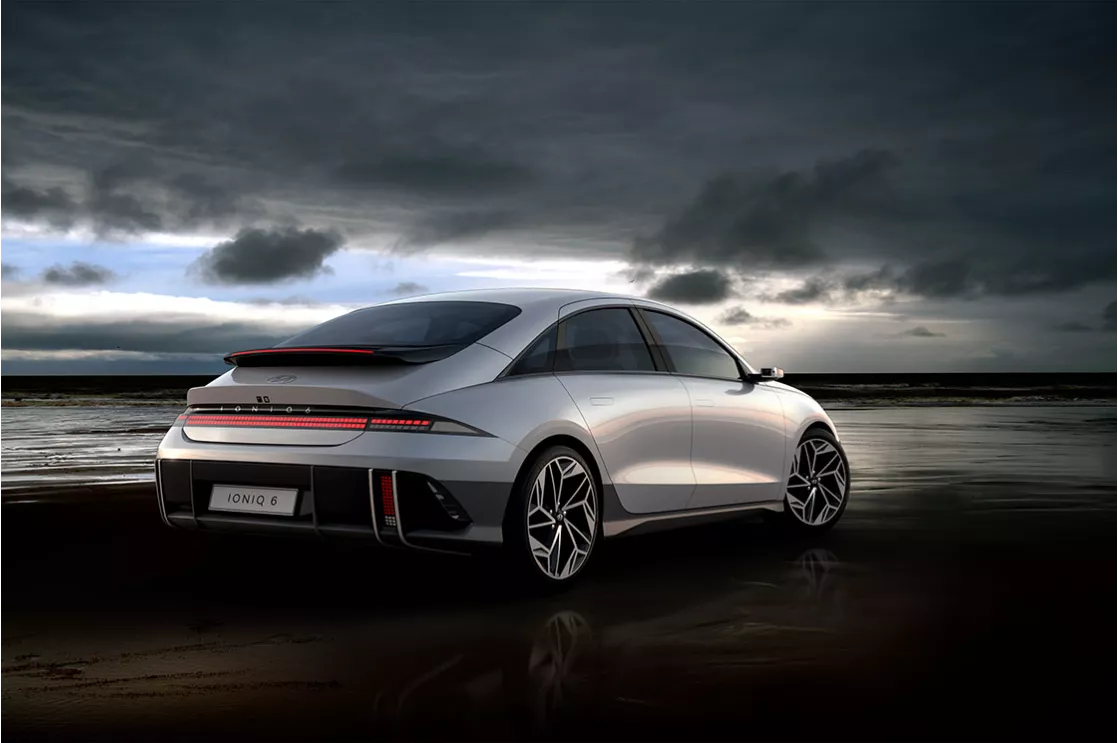
I knew it was wise to wait… 😀
BMW have launch the new 1X too, bizarrly with only 275 miles wltp. Perhaps they know mrs K only drives short distances…
Oh I say. The Ioniq 6:
But will it tow a caravan?
Dunno. The Ioniq 5 is one of the best towers so maybe.
Also saw an EQE at the Merc dealer today. Phwoargh.
bizarrly with only 275 miles wltp. Perhaps they know mrs K only drives short distances…
Since when us 275 miles a short distance? It's plenty, I've got no issues with a 185 mile range.
BMW have launch the new 1X too, bizarrly with only 275 miles wltp. Perhaps they know mrs K only drives short distances…
Not sure what's bizarre about it, knowing what the huge majority of your customers *actually* do, and making the car more efficient (lighter) seems to be a win win.
Something like 95% of customers could do a weeks driving on a 400km range battery and only do two or three journeys a year that need a mid journey top up there and back.
I'm guessing we're going to see a lot more prestige cars with prestige prices and smaller ranges (and better efficiency) until there is a step change in battery cost and/or achievable energy density.