What, er, is it exactly?
Fluffy things in the sky? I know little.
Or outsourced computing? I know little, but think of hotmail or flickr - these are cloud services.
I've just started using [url= https://www.dropbox.com/ ]Dropbox[/url], let me know if you want an invite. 😉
Basically it's storage in the sky that you can access from any device that's connected to the internet.
You have an account.
You sign in.
You access what you want.
My understanding is that your files anre split and stored at different locations making it difficult for hackers to access all your info, but I still wouldn't store sensitive stuff.
Main benefit is file size that can be stored.
I can, for example, upload my product catalogue and give access to all my clients to read and I guess download. something that would require 100 emails...
Or upload the files on a PC and show the catalogue to customers using my phone or a tablet.
First impressions are good.
Its a sales term. Basically its for outsourcing a 'service' rather than computing however all the models seem to be wrong, as they just seem to end up as hosting companies.
All part of the cycle, of centralisation/decentralisation.
Don't worry give it a year, and the next big thing will be along. Although the cloud idea has been about for around 10 years, look at Utility Data Centers, so its just a spin on a very very old idea.
Rather than have to worry about buying servers, installing the software you want on it, maintaining it, upgrading it, replacing it when your service contract expires etc etc...
You buy cloud services where someone else does all that crap for you and it just works.
Much like utilities. You buy electricity from a cloud. You don't have to build your own power station and run a cable to your house.
[img] 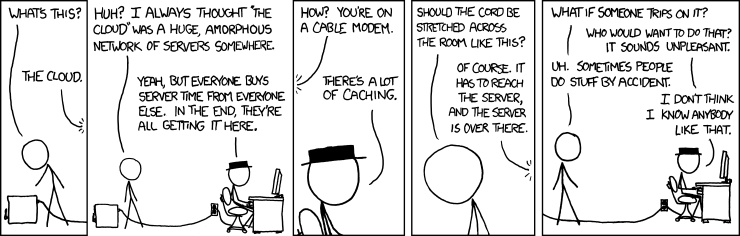 [/img]
Cloud - lots of computers providing a service on the internet for you.
GMail, Hotmail, Yahoo Mail are examples of 'email' in the cloud.
We (as a company) are migrating from email in-house (MS Exchange) to Google Mail. I don't have to worry about licensing, hardware costs or downtime (relatively speaking) 🙂
Another example of the cloud - YouTube video encoding. At home, you have ONE computer, encoding a HD video.... it might take 5hrs to finish?
Upload it to YouTube, and it will use multiple computers together.... and finish in about 1 minute.
Loads and loads of different examples, depending on how technical you are for understanding them.
Cloud.
Plus points: Distributed, so easy to carry on if something bad happens in a single location.
Minus points: Where does your data go if the cloud provider goes bust? e.g. what happens to my Flickr photos if they go titsup?
or downtime
Read the gmail cloud service agreements - SLAs aren't brilliant. This is a potential failing of current cloud offerings: the one size fits all approach doens't always translate to the level of service you might expect from a dedicated outsourcer.
We (as a company) are migrating from email in-house (MS Exchange) to Google Mail
Just done this as well - I can't actually see any downside at the moment....
e.g. what happens to my Flickr photos if they go titsup?
You have them backed up, right?
I think the cloud is an easy way to access info from anywhere in the world providing you have an internet connection and not a substitute for storage space.
Rather than have to worry about buying servers, installing the software you want on it, maintaining it, upgrading it, replacing it when your service contract expires etc etc...
That's what it *should* be however when you come to actually deploying servers, that's not what you get, especially if you want CPU intensive jobs which run for 1 month then nothing for 3 months, as you end up having to buy enough servers for the 1 month job for your entire contract.
I looked into this for work and basically they offer a network link, air con and power and you have to do the rest, and you can only change your requirements up, not down. So you might as well buy the kit yourself if you have enough aircon and power spare in your computer room.
We (as a company) are migrating from email in-house (MS Exchange) to Google MailJust done this as well - I can't actually see any downside at the moment....
Works well until it pops and you have to wait for google to fix it, and if you aren't worried about IP.
I know about the SLA's and have taken these into account.
Currently Google Mail have an average of 7 minutes per month... that's only 2 reboots of our mail server..... and the average is taken from a second here, a second there, not 7 minutes continuous.
We're also looking at the cloud for SQL 2008 number crunching. One task currently takes 8hrs (every night) on our current hardware. Same task took 10mins in the cloud! That could be run on demand when a client clicks the button..... food for thought.
TBH - even if gmail are a shower of sh!te, it will still be a glowing beacon of reliability compared to our existing 'IT support'! 😉
I looked into this for work and basically they offer a network link, air con and power and you have to do the rest
Well, no you didn't.
What you did was look at the building blocks that cloud companies use to provide cloud services.
If you'd wanted cloud services you'd have talked to a cloud service provider and would have been discussing applications not hardware.
richc - it appears you don't understand what the cloud is!
Give Rackspace a call - they've got some cloud experts in house, and have found them *very* helpful.
"The Cloud" is the latest IT buzzword, beloved of Chief Execs and FD's everywhere, as it is code for outsourcing, hence the laying off of internal IT staff.
So, the "Cloud" is just - outsourced stuff you can do using the internet, then...
Richc - surely that is NOT cloud computing, just locating?
The cloud means virtual servers or services accessible from anywhere, to me. I've got a load of work documents in 'the cloud' (actually Live Mesh) and I can access them from anywhere. I could use apps in 'the cloud' too if I was using google apps for editing docs etc.
Different clouds though, which is a tad annoying.
I thought we were going to start referring to The Cloud by it's real name: Hard drives in India.
"The Cloud" is the latest IT buzzword, beloved of Chief Execs and FD's everywhere, as it is code for outsourcing, hence the laying off of internal IT staff.
It's more than that. Part of it is economies of scale. A cloud company can offer services that IT teams simply can not.
Minus points: Where does your data go if the cloud provider goes bust? e.g. what happens to my Flickr photos if they go titsup?
They'll end up with my Fotopic ones.
(yes - I did have copies)
I thought we were going to start referring to The Cloud by it's real name: Hard drives in India.
Unless you're using one for massive computational power instead of storage 😉
We (as a company) are migrating from email in-house (MS Exchange) to Google Mail.
Does that mean you have @gmail.com mail addresses? If it does I think the downside may be in customer perception.
I looked into this for work and basically they offer a network link, air con and power and you have to do the rest
Er, you looked at co-location in a data centre, not cloud services..!
Blimey - I'm a lawyer and I seem to understand more about IT services that an IT man. Worrying..! 😯
Blimey - I'm a lawyer and I seem to understand more about IT services that an IT man. Worrying..!
I wouldn't worry, most IT bods and care givers probably know more about the law than you. 😉
Mr Woppit - MemberSo, the "Cloud" is just - outsourced stuff you can do using the internet, then...
Pretty much, the main reason for it's rise seems to be purely that simpletons get to use a new bullshit bingo buzz word since the concept has been in heavy use for a few years.
It was Rackspace (and BT and Amazon) we spoke to, and once you get down to the nitty gritty (not the marketing, but rather what access, performance and availability speeds can you guarantee) unless you are talking about generic services, all you just get network, power air con and a network link.
I also spoke to HP (and Dell) technical marketing and sales, and they had to admit unless you are talking about simple mail or data storage you won't fit into the cloud.
Might be different in the future, but if you want to deploy now, that's the reality.
You're not talking about cloud services. The cloud is an application layer, not a hardware layer.
What 5e said.
I feel that this is relevant
[url= http://www.zdnet.com/blog/microsoft/is-apple-really-using-windows-azure-to-power-icloud/9687 ]http://www.zdnet.com/blog/microsoft/is-apple-really-using-windows-azure-to-power-icloud/9687[/url]
That's my point, all the cloud applications out there at the moment are data storage and mail based, if you want somewhere to put pictures/documents and read email the 'cloud' can do this, However I could access my mail (and data) from anywhere 10 years ago and I am fairly sure that wasn't a cloud service, rather just a firewall port forward to a pop/imap server authenticating against LDAP.
If you want to use the cloud for processing data (like render farms for for FEA) you drop out the the cloud model, and they offer you hosting rather than services.
If you think the cloud can do this you ought to let Rackspace know.
A cloud company can offer services that IT teams simply can not.
Can you name some?
For some companies externally hosted services are appropriate for others not. There is a loss of flexibility and if your company tends to add and remove services/servers as mine does then offsite contracts can be restrictive.
They are efficient due to the concept of "virtualisation" however if you have sufficient internal resources its straightforward to use this technology internally and that gives a huge amount of flexibility and actually is far more cost effective.
Having internal skills and the requirement to make fast changes would largely determine if this is usefull for you.
Although the cloud idea has been about for around 10 years, look at Utility Data Centers, so its just a spin on a very very old idea
Goes back a lot further than that, basic concepts are the same as the computer bureaux of the 1960s and 1970s.
The cloud is an application layer, not a hardware layer
Depends what "cloud" service you're talking about. It can be application but equally OS or even basic iron - SaaS, IaaS etc to throw in a few more buzzwords (buzz-acronyms?) designed to impress your CEO.
That's my point, all the cloud applications out there at the moment are data storage and mail based, if you want somewhere to put pictures/documents and read email the 'cloud' can do this, However I could access my mail (and data) from anywhere 10 years ago and I am fairly sure that wasn't a cloud service, rather just a firewall port forward to a pop/imap server authenticating against LDAP.If you want to use the cloud for processing data (like render farms for for FEA) you drop out the the cloud model, and they offer you hosting rather than services.
If you think the cloud can do this you ought to let Rackspace know.
They're anything and everything. Epos, accountancy, labour management... the list is endless.
You need to talk to cloud application providers who provide the service(s) you want.
If you want bespoke services then you can pay a cloud company to write them.
You seem to be talking about providing cloud services for yourself which is contradictory.
Cloud computing seems to have a different term depending on who you speak to. RichC your description is not what i would describe as cloud computing. Basically the cloud is a generic term for offering applications, processing power and/or storage and be billed per usage. e.g. Imagine the 'traditional' scenario of providing a database server for a certain task with a intense month end routine. You would identify the specification, purchase the hardware, install it, maintain it, patch it, (finance) depreciate it and have the capacity to do x number of tasks in y time. Cloud computing would mean you identify the role of the machine, i.e. database server (with usage estimates as well), and then run your tasks on it. If your usage spikes (month end processing) then you have the option of adding additional resources (memory, processor, bandwidth, more servers) to decrease processing time or expand capacity for a period of time. Your cloud provider should be constantly monitoring and providing stats on the services you've taken. This can apply to any services. Gmail, youtube, flickr are all good example of cloud computing for dedicated tasks, however the new wave of cloud computing for business is the scenario described above. The cloud computing for consumer is focussed on music and storage i.e. iCloud from Apple and whatever the Google and Amazon services are called. HTH
Bill by usage is how we define - it also usually allows for a greater variation in SLA to suit budgets. It can be by CPU time, IOPs, storage used what ever metric you care to use and can be accurately measured and reported.
Much of what I do day to day is sold internally as 'private cloud' as it seems to keep middle managers happy .. we have connectors to utilise external resource but for a number of reasons, mainly non technical, we just use in house compute power at the moment.
5e our spec was, we need to run computation jobs (using industry standard software) which will use about 2TB of storage 3 times as year. Our current jobs take 28 days to complete so they must take this amount of time or less. After which we need access to the 2TB of data(via network or tape) and will not require the service for another 2 months.
Sound like a service suitable for a cloud? Did to me, didn't to any of the cloud services companies.
The cloud is a buzzword, that at best doesn't mean anything, or at worst means completely differently things to different companies, hence the confusion.
I have to admit I am biased towards finding out exactly how they are hosting the cloud services as I've worked in Datacenters for 13 years (and on 'cloud' service for at least 6 of those) as I know how to spot the difference between what marketing say, and what actually happens.
richc Amazon disagree with you
[url= http://aws.amazon.com/ec2/ ]Amazon Cloud Compute Platform[/url]
You seem to be talking about providing cloud services for yourself which is contradictory.
Not if you're a big enough company - often service units like IT are distinct from the business, and are required to compete with external providers - in this area a 'private cloud' can offer an alternative to the business with comparable pricing models.
I wish we were closer intwined wit the business though. I'd have a really nice car by now 🙂
edit double post
I wouldn't worry, most IT bods and care givers probably know more about the law than you.
Excellent. Got an issue at the moment on the difference between "profit" and "anticpated profit" when trying to determine what is in or out of a direct loss category for limitation of liability.
Anyone?
Not if you're a big enough company - often service units like IT are distinct from the business, and are required to compete with external providers - in this area a 'private cloud' can offer an alternative to the business with comparable pricing models.
Yeah, granted.
richc Amazon disagree with you
Not when you try and actually buy the service from them.
Marketing, does not equal reality.
5e our spec was, we need to run computation jobs (using industry standard software) which will use about 2TB of storage 3 times as year. Our current jobs take 28 days to complete so they must take this amount of time or less. After which we need access to the 2TB of data(via network or tape) and will not require the service for another 2 months.
Why does your "job" take 28 days? does it actually take that long from start to finish?
Do you have any other requirements for "IT" during that period and after the processing has completed? other Db's, ERP systems for the company etc and how do you "view" intepret the output later? I assume you require/have some way of storing the output for analysis and distribution?
Depending on expertise and cost you may be able to make use of virtualisation internally.
Sound like a service suitable for a cloud? Did to me, didn't to any of the cloud services companies.
Me too, but I think you are approaching this with a far too highly tuned bullshit detector 🙂
It also sounds like you'd be able to fairly accurately price keeping this in house - storage and archiving are relatively cheap these days (look at midline SATA - close to SAS performance, close to SATA price .. or just SATA if IOPs/high mtbf aren't an issue) - I can see the processing may be an issue if it isn't needed all the time but maybe you could short term lease the iron and archive your workloads when not required?
Got an issue at the moment on the difference between "profit" and "anticpated profit" when trying to determine what is in or out of a direct loss category for limitation of liability.
🙄 ok ok which bit are you stuck on?
Excellent. Got an issue at the moment on the difference between "profit" and "anticpated profit" when trying to determine what is in or out of a direct loss category for limitation of liability.Anyone?
Have you tried switching it off and back on? 😀
I can see the processing may be an issue if it isn't needed all the time but maybe you could short term lease the iron and archive your workloads when not required?
Or accept that during parts of the year you will have spare resource. If this is within a virtualised environment it may been you are underutilising a bit of your hardware as oppose to having pieces of hardware lying dormant.
It's marketing, essentially.
Originally, IT used the term "cloud" to refer to a network that operated like a black box, where the actual interconnects are unimportant.
Eg, if you're a network provider linking up sites in Edinburgh and London, you don't need to micromanage the exact route; you wouldn't sit there going, "well, from Edinburgh there we'd connect you to Carlisle, Carlisle goes down to Manchester and then Birmingham..." - it's both unimportant and impossible to define as it's all automated routing. Simpler to say that the connection goes 'into the cloud' at Edinburgh and comes out at London, the middle bit is irrelevant.
What this means is that you're no longer looking at traditional point-to-point communications. The cloud model is any-to any. In the above example, you open a new office in Birmingham, you just bolt that into the cloud as well.
Now we're looking at service providers giving more than just connectivity. Storage, computing power, applications are all being offered in 'the cloud'. It sounds flashy and impressive but it's basically the same principle as the networking model above; it's an any-to-any solution where the actual bit in the middle doesn't really matter.
To those who are still with me and thinking "wait a minute, you've just described a web server," you get five Cougar Points; now look at the first sentence of this post again.
Yeah, I should have qualified that surfer - maybe lease any additonal hosts over and above normal anticipated workloads. You'd still have to chew on the vlayer licensing, unless you can do it on Xen or Hyper V (I only do VMWare...)
But you are largely describing a meshed WAN cloud. We have one of those however our data centre is in one physical location. The routes to that location are chageable based on certain criteria internal to the technology (MPLS in this case)
Cloud computing also refers to the physical location of services and data which may be distributed.
However I could access my mail (and data) from anywhere 10 years ago and I am fairly sure that wasn't a cloud service
It could've been, depending on how it was done.
I think Rackspace are just a hosting company using the buzzword 'cloud' to attract customers. Cloud computing is a concept, Rackspace may or may not be implementing it in all aspects 🙂
@brassneck
There are very competitive deals using vsphere for a limited number of hosts. Over that number costs escalta significantly.
It really depends on the size of the organisation and whether those resources can be utilised at aother times.
it makes sense if you have equal upload and download speeds, but the typical 10:1 ratios you get in this country don't really make it worth while.
for example:
[url= http://labs.autodesk.com/technologies/photofly/ ]project photofly[/url]
uploading 45 2meg jpgs is prohibitively slow even with 50meg cable setup (approximates to a 5meg upload here).
The job takes 28 days (would be nice to be less) because it's software for the development, analysis and testing of microchips.
At approx 2 Million (and 6 weeks) a dry run, to make them you don't want to get it wrong to many times.
surfer has it. Cougar's model doesn't sound like the cloud to me.
To those who are still with me and thinking "wait a minute, you've just described a web server,"
No you didn't, you just described a 1970s Unix mainframe at a university...
Exactly, it just all part of the centralisation/decentralisation cycle, but with a fancy buzzword and using the WAN rather than LAN.
I do see the point for organisations without decent IT departments, but it you have a group of people who know what they are doing and a reasonable budget, I haven't seen any cloud offering that cannot be done in house.
When they offer 24by7 support and 4 hour SLA for resolutions (not just picking up the phone) and restores that aren't just for DRM that might be a different matter however.
I haven't seen any cloud offering that cannot be done in house
?
You can install 100 servers for a couple of days and then magic them away again?
richc - you might be able to use the cloud for your requirements.
Does your application use a distributed processing system? Or does it require one massive server?
Look into virtual server hosting... http://www.rackspace.com/cloud/cloud_hosting_products/servers/
Spawn multiple 'servers' and harness their power for your distributed processing.
Cougar - you're talking about a networking mesh (WANs), not cloud computing.
@brassneck
There are very competitive deals using vsphere for a limited number of hosts. Over that number costs escalta significantly.
It really depends on the size of the organisation and whether those resources can be utilised at aother times
That's the problem - I think Foundation gives you 3 hosts and a vCenter, limited to 4 vCPUs and no storage vmotion. It gets good at Enterprise Plus but for smaller purchasers thats prohibitively expensive to only use some of the time.
Luckily we have a global direct deal, so just put E+ everywhere B-) - works out cheaper for us over 3 years including maintenance.
You can install 100 servers for a couple of days and then magic them away again?
Yes, and in fact we do.
You can install 100 servers for a couple of days and then magic them away again?
VM's yes, its not rocket science.
Physical boxes, yes but its harder (OS on local disk, shared disks on SAN and vice versa)
I have done both in environments, where a cluster is 500-800 servers, and needed rebuilding/imaging every 60 to 90 days, with the latest updates.
As long as you can script, and understand how to build live CD's (and can remotely mount them, if not someones got a shitty job in a very cold room) its a pretty easy thing to do.
If they all need to be different then that's harder, but using RDP and puppet its still not difficult.
Installing/deploying boxes is the easy part, monitoring, performance tuning, backing them up and securing them is the difficult bit.
VM's yes, its not rocket science
Where do the VMs run?
Are you seriously suggesting purchasing and instlaling a load of servers, once a year, for some task, and then selling them again a few days later?
And there you have it, Wopster, as simple as that. Either not the simple answer you were looking for or a spectular troll. 😉
Are you seriously suggesting purchasing and instlaling a load of servers, once a year, for some task, and then selling them again a few days later?
They are virtual not physical. Its difficult to know without knowing more about the apps/data/business etc but its not uncommon to have dozens of VM's running on a single physical host.
No, I would like to get someone else to do it. However nobody wants to play. So we are stuck with a small 4 CPU Quad core cluster of 4 physical boxes, which can host upto 124-160 hosts each, with reasonable performance.
Big compute jobs, require physical boxes as ESX/VMware hosts really don't work that well with that kinda of load (Xen is much better though), so we have a few really big boxes, with lots of quad core CPU's and hundreds of Gigs of RAM.
Where I used to deploy hundreds of boxes all the time, I was working for a company developing cloud services software. Hence the constant rebuilds of physical machines, as they were dicking with the hyper-visor code.
They are virtual not physical. Its difficult to know without knowing more about the apps/data/business etc but its not uncommon to have dozens of VM's running on a single physical host.
That'd be pointless for number crunching tho, that doesnt' give you any extra actual CPU power. Which is what 'cloud' services can offer.
No, I would like to get someone else to do it. However nobody wants to play
Right.. is it because you are a small business perhaps? I mean, the Amazon thingy above sounded ok, but I expect they are looking for big fish.
You know, I have a mate who's into this stuff, I'll drop him a line.
Nice thread.
I had to explain to somebody at work recently that "the internet" isn't stored in a big warehouse somewhere in the USA and guarded by the CIA from Al-Qaida attacks.
It was like explaining a rainbow to a blind person.
Ironically though hels, it was invented by Americans* to be resistant to attacks and not need guarding.. 🙂
* kind of
I thought it was an Egghead at MIT that invented t'internet ? (or thought up the required address protocols and all that)
No you didn't, you just described a 1970s Unix mainframe at a university...
You know, I thought that as well... (-:
I thought it was an Egghead at MIT that invented t'internet ? (or thought up the required address protocols and all that)
http://en.wikipedia.org/wiki/History_of_the_Internet
The internet is a giant TCP/IP network, which was invented (or at least developed) as arpanet, a network to connect US military bases together that could still work with lots of bits of it taken out.
I think you guys have gotten too quickly excited over a fairly average computing system and lost sight of the OP.. for the OPs sake and the sake of sanity.. let me introduce..
[url= http://www.liveleak.com/view?i=be9_1308038755&p=1 ]THE cloud[/url]
Thing is when normal people talk about the internet, they are actually talking about the WWW which was invented by CERN, not the D/ARPA net.
As whilst, the internet was a good invention, developing tools to actually make it useful was a better one.
Yes and there have been numerous tools since it was invented, the WWW being just one, as I am sure you know.
That'd be pointless for number crunching tho, that doesnt' give you any extra actual CPU power. Which is what 'cloud' services can offer.
As I said without knowing more about the application its difficult to say. You are assuming it maximises CPU during the whole process. Most systems use a mix of resources and CPU is only one of them. Within a virtual environment thats why it can be efficient to over commit resources.