brooess - MemberWhat the anecdotes in this thread, the death and injury stats and general experience on the roads tell you is that the driving test is too easy, penalties for inadequate driving are not high enough, and drivers need re-testing more frequently
Yup, if you keep getting caught and/or keep hitting things then you're not really cut out for this driving lark.....
As above, suspend everyone involved in a shunt pending retest, retest every 5 years and 3 strikes your out, you incompetent ****
and if you got caught by one of those big yellow boxes on a pole then I'm assuming you've fallen asleep 😀
No, it is. WHATEVER you do, it's more dangerous to do it faster. Because you (and everyone else) has less time to react, and if there is an accident the consequences will be worse. It makes everything you do more dangerous.
Driving at 65mph on a fast stretch of motorway when everyone else is doing 80+? Sometimes going quicker is safer, although I understand your point.
Driving slower is a bit of a skill, it takes time to learn, but it's nice when you get it. So much more chilled. I also agree with Hora about none of us being "good" drivers, we can all improve. Don't get complacent.
Cougar - ModeratorIt'd be more interesting if everyone spilled the beans about past accidents
I'm not sure as that's a good metric either. I've had four collisions in the last two years. Five in fact, if you count my previous car. In each case, I was stationary.
5) Back in the Mondeo, very bad weather conditions. Traffic up ahead stopped suddenly, I stopped because I'd left sufficient braking distance, guy behind wasn't so lucky. That smarted a bit.
2) Very tight single-track country road, met oncoming traffic. I drove as far over into the ditch / hedgerow as I could and waited for them to pass; first vehicle squeezed past, second dragged itself down the side of my car in the process and then sped off.
3) Waiting to pull out of a side road, young lad turned off from the major road far too fast, didn't see the parked car in front of him and clipped me in swerving to try and avoid it.
4) Approaching a hump-backed bridge, boy racer came over the bridge the other way with his head on fire. I stopped before the bridge where it was still wide enough for two-way traffic, he bounced across the road trying to wrestle control, ricocheted off a dry stone wall into the side of me.
5) Queuing to enter a mini roundabout, been there half a minute or so, someone kindly slammed into the back of me. Understandable as my car was no doubt difficult to see, being a bright red family saloon with its brake lights on.
How unlucky are you?! 😀
We'll look at writing in some sort of exemption and name it after you 🙂
Driving at 65mph on a fast stretch of motorway when everyone else is doing 80+? Sometimes going quicker is safer
I do that all day every day, in a vehicle that's speed limited.
It's no more "dangerous" than speeding to keep up with the 80+ crowd.
In fact, I'm fairly sure it's safer, but that's just my own observations from doing shed loads of miles at less than 65 on motorways.
The UK has some of the safest roads and lowest accident rates in the world...
I'd be quite interested to know how true that is.
[url= http://en.wikipedia.org/wiki/List_of_countries_by_traffic-related_death_rate ]Most road accident stats I see[/url] are only for injuries or deaths.
If you go by those then yes we do have comparatively "safe" roads.
But a lot of that can be attributed to factors other than [i]good driving[/i].
e.g. we're high income country so there are many more modern cars on the roads - which means more modern safety features to avoid accidents (ABS, Traction Control etc) and more features to lessen or avoid injury (seatbelts, airbags, impact bars, crumple zones etc).
We also build features into our roads to lessen accidents as standard (crash barriers, collapsible posts etc) that some other countries don't.
And of course we have roads where the traffic is pretty homogenous - mostly motor vehicles doing the same speed, an occasional cyclist, but very little in the way of horses, cattle, elephant etc!
How unlucky are you?!
I'm thinking of taking the car in to have it demagnetised.
But a lot of that can be attributed to factors other than good driving.
And yet for all those modern advances, the speed limits haven't changed since the 60's. How come it's safe to drive this 1966 car at 70mph:
[img]  [/img]
... yet dangerous to drive this 2014 model at (say) 80mph?
[img]  [/img]
Is that the new model Mondeo? 😯
[i]googles furiously[/i]
It is, that's very nice
Isn't it.
One of the reasons I didn't replace my Mondeo with another Mondeo is I knew the MkV was imminent and would've been gutted that it wasn't available when I was swapping cars.
I think these courses might me more effective if the instructor wore boxing gloves, asked a series of safety related questions and administered a thump in the face for each wrong answer.
And yet for all those modern advances, the speed limits haven't changed since the 60's.
Neither have reaction times or physics.
[quote=jam bo ]Those three points will be valid for three years and you'll have to inform about them for five.
<shrugs> 5 years will be up in September, my next renewal's after that. I seem to have got away with it.
[quote=Harry_the_Spider ]A point it worth about £50 on your insurance*.
So, 3 points x 5 years x £50 = £750.
Do the course.
*Source - My last speed awareness course.
Well if they're as accurate about everything else then I'm even more glad I didn't do the course!
[quote=Cougar ]I'm not sure as that's a good metric either. I've had four collisions in the last two years. Five in fact, if you count my previous car. In each case, I was stationary.
You must be doing something wrong to be [s]"attacked"[/s] hit by 5 different [s]dogs[/s] cars. The statistical odds of that happening would appear to be very low.
Proximate cause.
😉
And yet for all those modern advances, the speed limits haven't changed since the 60's. How come it's safe to drive this 1966 car at 70mph:
You know the reason why the speed limits haven't gone up.
In the 60s there was far less traffic, but we were generally far less safety conscious in all areas of life. We've improved safety at work and on the roads particularly. They have stayed where they are because it's equivalent to lowering them relative to the capabilities of the cars. Would you like to raise the speed limits until accidents are the same as they were in the 60s?
But the main reason is that 70mph is FAST ENOUGH. The ONLY reason people object is because they enjoy going faster and get frustrated when forced to stick to the speed limit. Well, tough shit, deal with it. I'd enjoy being able to walk around John Lewis and help myself to the tech goods too, but I'm not going to whinge about not being allowed to.
[quote=molgrips ]You know the reason why the speed limits haven't gone up.
Please sir? Is it because it's easier to do nothing?
Actually, speed limits have come down in many places. When I was a kid I'd never seen a 50mph speed limit, now there are extended sections of them all over the place. There never used to be a 30mpg limit in the village I went to school, which seems insane now looking at it.
And yet for all those modern advances, the speed limits haven't changed since the 60's.
The other answer is that things seem to have been going pretty well since the 60's in terms of road safety:
[img]  [/img]
Why would you look at that graph and think [i]"You know what, if we increased the speed limits we'd probably only go back to the 1980s level of fatalities. That's fine."[/i]?
the main reason is that 70mph is FAST ENOUGH.
By what definition? Why not have a little man with a red flag, 4mph is fast enough?
Neither have reaction times or physics.
They trotted that out in the course.
Braking distance is calculated as stopping time plus thinking time. The latter hasn't changed, but the former absolutely has. You reckon I can't out-brake a 1966 Toyota Corolla?
Proximate cause.
Ah, maybe my car is frightened of other cars and it attracts them?!
By what definition?
Because you can travel around the country and drive places and it's fine. What possible reason would there be for driving faster other than impatience?
[img] 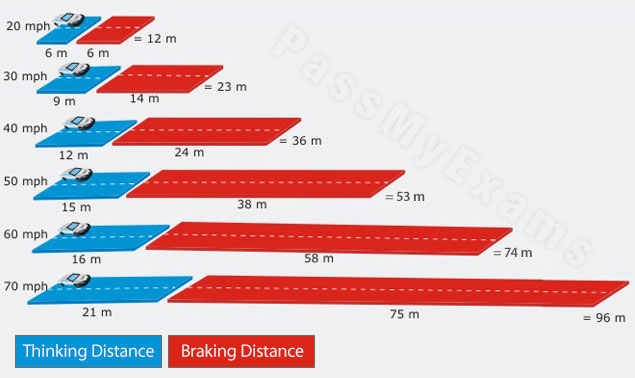 [/img]
At 70mph, reaction times account for a quarter of the overall stopping distance. Three quarters of it is down to the car.
Because you can travel around the country and drive places and it's fine. What possible reason would there be for driving faster other than impatience?
Why not set the motorway limits to 30mph then? We'd be [i]really [/i]safe then.
Braking distance is calculated as stopping time plus thinking time. The latter hasn't changed, but the former absolutely has. You reckon I can't out-brake a 1966 Toyota Corolla?
Probably not. ABS doesn't stop you any faster.
Ooh.. you rotter.
Yes it does, in practice.
Never mind that the Corolla probably has small thin wheels and drum brakes...
I was told on the course I did that the reason the speed limit on motorways hasn't gone up is partly because the crash barriers are all designed to work for vehicles going at 70 with a certain safety margin built in. Obviously if the limit went up, they'd have to refit the barriers for the whole network. Not sure how true it was, but that's what AA drivetech bloke reckoned.
Plus we'd all be using more fuel if we went faster, and there's only a limited amount of that so we should probably look after it.
Plus we'd all be using more fuel if we went faster
But, but, modern cars are far more aerodynamic and engines are much more fuel-efficient.
Neither have reaction times or physics.
Tyre compounds have come on massively in the last 30 years, the coeff of friction when braking is much higher now, esp in the wet.
engines are much more fuel-efficient.
not so sure mpgs are higher. 50mpg was quite easy in a 70s car (lighter, longer stroke engine, less congestion etc).
Mine must be better, it has "Eco" in its name.
And "Blue", for reasons I don't fully understand. It's red.
(According to the book, "Red Awesome." I think it was painted by Dulux.)
I was told on the course I did that the reason the speed limit on motorways hasn't gone up is partly because the crash barriers are all designed to work for vehicles going at 70 with a certain safety margin built in.
Not just the barriers. Slip roads, bend radius, cambers and signage will all be designed round an expected top speed (plus a margin). In theory many of them would have to be redesigned too if there was a significant increase in the speed limit.
But the main point for me is that graph. Fatalities have been falling for decades.
What people are effectively saying is that the fatality rate is now low enough that we can afford to increase it a bit by increasing the speed limits.
Risk Compensation 101
If the speed limit went up they'd probably have to do more engineering on the cars to cope with higher speed collisions.
I went on one of the old speed awareness courses and it was pretty pants...my sin was doing 45 mph in a 40 zone .... After Coming off a 50 mph zone..
Funny thing it twas in my smart and not the evo iv had then:-)
I didn't whine about it though but I'd rather people looked where theyre going rather than staring at the speedo worried about the limits tbh.
Mine was the longest 4 hrs of my life. An instructor who clearly didn't have a clue spouting so many half truths propaganda that was clearly nonsense. According to instructor I had the speed your travelling at when you hit the brakes is more important than the accident impact speed! Better than the points but once you've said that you've set it all.
The 70mph limit may seem archaic, but I think it's set about right. It's policed in a way where 85 is acceptable but over 90 is strictly not on. People simply don't have the skills to deal with anything higher and raising the limit would see actual speeds tread over the ton. Yes, modern cars can outbrake vehicles from the past (anyone tried a car with brake assist?) but the person behind the wheel is still potentially a muppet with no actual experience of motorway driving.
hot_fiat - Member
The 70mph limit may seem archaic, but I think it's set about right. It's policed in a way where 85 is acceptable but over 90 is strictly not on. People simply don't have the skills to deal with anything higher and raising the limit would see actual speeds tread over the ton. Yes, modern cars can outbrake vehicles from the past (anyone tried a car with brake assist?) but the person behind the wheel is still potentially a muppet with no actual experience of motorway driving
Which is why it makes no sense to issue a licence and then not periodically check peoples abilities.
Who has bothered with further driver/rider training? Assessments or practising skills such as e stops etc?
According to instructor I had the speed your travelling at when you hit the brakes is more important than the accident impact speed!
I'd agree with that 100%. Because the speed your driving at when you hit the brakes is the one you have control over. If you have enough control over your speed and enough observation you wont have an impact speed, because you will not crash.
TLDR 😉 I went and wrote this: http://pickled-hedgehog.com/?p=3154
And a month later, I'm still practising what was so unrelentingly preached. But in an ambitious break from STW tradition, I don't think I'm a great driver. I also know that switching off - especially in urban areas - is stupid and for that I'm glad I did the course.
That's a properly entertaining write-up. Nicely.
Though the pedant in me needs to say, "peddle."
hot_fiat - MemberThe 70mph limit may seem archaic, but I think it's set about right. It's policed in a way where 85 is acceptable but over 90 is strictly not on.
While I get where you're coming from, that sounds like an argument for an 85mph limit. The question really is whether people go at the limit + 10, or whether they go at the speed they feel is appropriate. (I don't know)
I like the idea that a speed limit that most people believe is correct is more self-enforcing, and also has the effect of making people respect the limits more in general (ie, if you're used to going 10mph over the limit, you're more likely to go 10mph over through roadworks, or past a school, or whatever- you're used to speeding). But humans are complicated.
Google "85th percentile"
Exactly that idea- though, pretty much 100% of drivers do more than 40 up my commute right through the blind offcamber corner, constant accidents there...
[quote=Northwind ]I like the idea that a speed limit that most people believe is correct is more self-enforcing, and also has the effect of making people respect the limits more in general (ie, if you're used to going 10mph over the limit, you're more likely to go 10mph over through roadworks, or past a school, or whatever- you're used to speeding). But humans are complicated.
Which is exactly the reason why I think the de jure motorway limit should be raised, given hot_fiat's suggestion of a de facto 85 limit at present. The current situation discredits speed limits in general and results in people ignoring speed limits which matter a lot more. What on earth would be wrong with an 80mph limit which is enforced?
GrahamS's argument is fallacious, given that motorways are the safest roads and raising the limit would likely make little or no difference to the total injury rate (the majority of motorway deaths occur in conditions where 70 is too fast). Given that a higher motorway speed limit might result in lower speeds elsewhere on more dangerous roads there's actually a chance of it lowering the overall death rate.
GrahamS's argument is fallacious, given that motorways are the safest roads
You're making exactly the same statement: motorways are the safest roads, so we can afford to make them less safe.
Risk Compensation.
Given that a higher motorway speed limit might result in lower speeds elsewhere on more dangerous roads there's actually a chance of it lowering the overall death rate.
There is that chance. Conversely there is a chance that people might get more accustomed to driving at higher speeds on motorways and find a 20 or 30 limit interminably slow by comparison.
[quote=GrahamS ]
GrahamS's argument is fallacious, given that motorways are the safest roads
You're making exactly the same statement: motorways are the safest roads, so we can afford to make them less safe.
Nice snippage. The next bit was actually "raising the limit would likely make little or no difference to the total injury rate (the majority of motorway deaths occur in conditions where 70 is too fast)." We've already done the argument about making something which isn't dangerous a bit more dangerous doesn't make it dangerous - the difference between 70 and 80 in good conditions is that.
The other question of course is why not 60 in that case, or 50, or a bloke with a red flag? You could make exactly the same argument regarding raising the speed limit from any of those points - it's a fallacious argument. What's so magical about 70?
Conversely there is a chance that people might get more accustomed to driving at higher speeds on motorways and find a 20 or 30 limit interminably slow by comparison.
People are already used to driving a lot faster than 30 on motorways. Do you really think 80 is likely to make 20 feel any more pedestrian than 70 does? This is about respect for speed limits.
Of course you're also ignoring the point that people already do 80 on motorways and I'm not actually suggesting increasing the speed people travel at, simply making it legal to do 80 and enforcing the limit harder above that point.
Tyre compounds have come on massively in the last 30 years, the coeff of friction when braking is much higher now, esp in the wet.
This is all very true, the unfortunate thing is the amount of cars that have tyres that are either on the legal limit or illegal is shocking, I must see at least one a week that has cords exposed. The amount of cheap budget tyres fitted is amazing as well, when you think that is all that is keeping you in contact with the road, the budget tyre in the main has far less grip than it's more expensive counterpart when it's wet/cold.
Nice snippage. The next bit was actually "raising the limit would likely make little or no difference to the total injury rate (the majority of motorway deaths occur in conditions where 70 is too fast)."
I didn't snip the next bit to alter what you were saying. I just disagree with it. The injury rate [i]would[/i] be altered.
You say the majority of incidents happen where 70 was too fast (Source?) - but if those people currently drive at the 70 limit with no regard for conditions then they'll do exactly the same for an 80 or 90 limit - meaning higher impact speeds and more injury/death. (Which is what I mean by the physics not changing).
We've already done the argument about making something which isn't dangerous a bit more dangerous doesn't make it dangerous - the difference between 70 and 80 in good conditions is that.
It doesn't make it "dangerous". Agreed. It does make it "a bit less safe" though.
The other question of course is why not 60 in that case, or 50, or a bloke with a red flag? You could make exactly the same argument regarding raising the speed limit from any of those points - it's a fallacious argument. What's so magical about 70?
We do already drop the speed limit of some particularly dangerous sections (not that many people pay attention to it).
There's nothing magical about 70 of course, it's just the status quo. Any shift from a limit which is currently working well for us should be considered properly in terms of financial and safety costs and benefits, not simply based on "cars have got better, so lets make it faster".
I'm not actually suggesting increasing the speed people travel at, simply making it legal to do 80 and enforcing the limit harder above that point.
Yeah I'd be in favour of that. Make it an 80 limit, but strictly enforce it with average speed cameras on all entry/exit slip roads. I suspect that would be an overall reduction in speed on many motorways and would also be incredibly unpopular.
The trouble with an 80 limit is that there are a lot of people who rather thoughtlessly drive to the limit rather than the conditions and instead of being at 66-72mph (taking some speedo error into account) they're gong to be going 10-12mph faster.
This will magnify the speed differential to the groups of vehicles which are speed limited below that and because of the generally poor standard of driving and pure traffic density* the UK now suffers from, it could cause a significant increase in accidents just from that development.
I used to think that 80-85 would be much better but now I'm pretty sure that the current situation works just fine as it saves fuel, stress levels and gives the sanctimonious something to froth over.
* I've never been so scared driving as I was coming back from Morzine a couple of years ago. Having had a fairly blissful drive through Northern France's dual track motorways I was confronted by the M20-M25 just after rush hour. Really struck home how overcrowded our roads are and how aggressive and discourteous everyone is.
G
The French seem to do OK with a 80mph speed limit.
In terms of casualties, UK roads are safer than France
[url= http://en.wikipedia.org/wiki/List_of_countries_by_traffic-related_death_rate ](4.3 deaths per billion-km versus 6.3 in France)[/url]
[quote=GrahamS ]You say the majority of incidents happen where 70 was too fast (Source?) - but if those people currently drive at the 70 limit with no regard for conditions then they'll do exactly the same for an 80 or 90 limit - meaning higher impact speeds and more injury/death. (Which is what I mean by the physics not changing).
I never suggested that those deaths were happening because people were doing 70 when that was too fast - the most obvious large scale incidents I can think of the speeds were a lot lower than that. A higher speed limit would make no difference at all to them.
A quick google found http://www.bbc.co.uk/news/uk-15608217 - of their list of major incidents all of them involve either speed limited vehicles or poor weather conditions.
There's nothing magical about 70 of course, it's just the status quo. Any shift from a limit which is currently working well for us should be considered properly in terms of financial and safety costs and benefits, not simply based on "cars have got better, so lets make it faster".
We can afford not to make them safer then?
[quote=GrahamS ]In terms of casualties, UK roads are safer than France
(4.3 deaths per billion-km versus 6.3 in France)
Which is completely irrelevant. How many of those deaths were on 80 limit roads?
Brilliant, I love topics like this, it's like TJ is still with us. So far off topic as to be a series of opposing rants. The OP wondered if a speed awareness course is worth it and the answer always has to be yes. At best you'll learn something about moderating your speed or not getting caught, at worst you'll not want to put yourself through that amount of tedium again. I myself, am an appalling driver, who usually got caught speeding every four years just as the points were due to come off from the last time. Since the course, incident free, however I've found the best way to moderate your speed is to tow a caravan, that works a treat but you do get a lot of people going past you really fast!
I've never been so scared driving as I was coming back from Morzine a couple of years ago. Having had a fairly blissful drive through Northern France's dual track motorways I was confronted by the M20-M25 just after rush hour.
Hah.. so innocent...