UPDATE: Reviews section refreshed, redesigned, searchable: Go take a look
^that's the way it should be.
Round here everyone us bitching because the sheep that have grazed the hills for "hundreds of years" are being moved for forestry. Couldn't make it up. ****ing idiots.
The lynx project folk are numpties
Which is a shame, as I’d love to see Lynx in Scotland
The estates would likely poison them back into extinction mind you
Also, that video of a Bear up there has the text Bear Chases.
If that’s the speed of a Bear chasing someone, I’ll completely reassess the level of risk of travelling in Bear country. As it seems walking very slowly is enough to outpace them.
Frankly we should put the effort into our existing wildcat.
Ive not looked so this is a question rather than a statement. But isn’t the Wildcat basically about done? Simply not enough genetic stock left to survive?
That’s a zoo not rewilding and who pays for the sheep that get eaten?
Tax payer surely?
There is a lot of effort being put into wildcats and recently a previously unknown pure wildcat female has been found and added to the breeding programme. The population of wildcats is very precarious and inbreeding with feral domestics cats is a huge issue but they might just survive.
Piemonster -indeed but the lynx project claimed enough money would be made from tourism to pay for eaten sheep - and also denied that lynx would eat sheep anyway.
Local "buy in" to rewilding projects is essential - look at the success of sea eagles on Mull to see this. Ecotourism to Mull is worth millions of pounds.
The lynx - truly Schrodingers cat.
Will create lots of income via eco-tourism as folk come to the area in the hope of seeing one.
So secretive that they'll shy away from any contact with humans.
I live the idea of trying to re-balance the environment and the flaura and fauna it contains but I can't see any point in introducing lynx until we've sorted out the habitat problem and that will require intervention and legislation on a scale we've not seen since the Clearances.
The Cairngorms Connect project probably gives us our only real chance at sorting some of this out but the area identified is ring-fenced by stripped grouse moor and a deer population way in excess of what the land can comfortably support.
The not-entirely-unbiased Beaver Trust weigh in:
https://twitter.com/beavertrust/status/1266326925045268480?s=21
On boars, I thought the ones gone feral in Gloucestershire were causing devastation?
The lynx project folk are numpties
How so?
uhuh

If I'm being pedantic, that's not the Tay, it's the Dochart... 😉
(I watched some friends paddle it at that level. One got a good kicking in the wave just below the bridge...)
I've been in Matts (old) house and felt it trembling when the water was quite a bit lower than that.
[strong]CraigW[/strong] wrote:
Who pays for the environmental destruction caused by sheep farming?
Point of contention here. Sheep are not causing environmental destruction as you call it. They are maintaining a managed landscape that has been created by us (humans), for our benefit (food creation) over the past millennia.
If you want to talk about environmental destruction look no further than the out of town shopping complexes (I am sure you have used them) and the new sprawling housing developments (maybe you live in one), or the airports built so you can go on holiday to places where prime coastal areas are now covered in hotels. Or maybe the rainforest being burnt to grow soya for a vegan to have his "milk". That is environmental destruction.
If you want a return to a more natural landscape than that that grazing with sheep produces then fine. Let us have that dialogue. But to come at it from the starting point that sheep on the hills are destroying the environment is not going to make you many friends amongst those who you most need to have on board if change is indeed what the bulk of society wants.
I don't really know much about the issue, but I live in an area where beavers now inhabit. This photo was taken by me in April. When I moved here five years ago this was thickly wooded up to the waters edge, as you can see, all the trees have been felled by the beavers. Five years ago the trees were full of birds nesting, now there is no birdsong to be heard. I think it would be hard to convince me that this is good environmentally.
[img]  [/img]
The education officer at the Highland Wildlife Park was adamant that there was no chance of Lynx all whilst wildcats still existed as the competition for territory would mean the immediate extinction of the wildcats.
If you want to talk about environmental destruction look no further than the out of town shopping complexes (I am sure you have used them) and the new sprawling housing developments (maybe you live in one), or the airports built so you can go on holiday to places where prime coastal areas are now covered in hotels. Or maybe the rainforest being burnt to grow soya for a vegan to have his “milk”. That is environmental destruction.
Totally agree. When I think about environmental destruction, the Scottish highlands are not the first place that comes to mind.
When I think about environmental destruction, the Scottish highlands are not the first place that comes to mind.
Yes, but aren’t large parts of the highlands an overgrazed wasteland (either by sheep or excessive deer populations), or forestry monoculture?
Roseanna Cunningham is the Perthshire MSP, and environment minister
she also has a terrible track record regarding the fish farming industry, but unfortunately snp can do no wrong so gets away with it
The lynx project folk are numpties
How so?
The "information" they were putting out was laughable. They were being pressed by some sheep farmers and what they were saying was ridiculous including that the sheep farmers would have to get guard llamas and that the money from eco tourism would be enough to pay for compensation but had no idea of what the mechanism would be.
Also see the point on wildcats
There was also a proposal to fence off big chunks of the highlands to "reintroduce" all sorts of animals completely against scots law and the ethics of mountains as access would be restricted.
Again - I have no issue with reintroduction but it can only be done with complete transparency and community buy in.
boriselbrus
Thats damaged the woodland yes - but opening it up like that allows a more varied flora and fauna to colonise the area - so less dense woodland at the waters edge but more habitat for other species. Overall they improve biodiversity
Some of that looks to be saw cut as well but might just be the pic
ratherbeintobago
Subscriberyes, but aren’t large parts of the highlands an overgrazed wasteland (either by sheep or excessive deer populations), or forestry monoculture?
Correct. The Glen Feshie estate has shown what reduction of grazing pressure can do.
I first visited Glen Feshie with my dad in the early 1970s. It was hoaching with deer. There were virtually no young trees outside fenced plantations though. It was a bit of a grass and heather desert with a dying scattered Scots Pine forest. Now you can walk through the Feshie and see young trees and other new growth everywhere.
TJAgain:
All the trees have been felled by Beavers - they all have the "sharpened pencil" ends.
This Loch had been fenced off to stop deer from killing new trees, apparently the aim was to increase biodiversity in an area which has very few trees to encourage more variation including hopefully Ospreys. The surrounding area (thousands of hectares) has many lochans and very few trees especially round the water. All the beavers have done is turned the habitat around this lochan into the same as the rest of the area. They have reduced biodiversity not increased it.
As I say, I don't know much about it and the Beatrix Potter in me likes the idea of having more furry mammals around but I think we do have to be very careful. Th simplistic thoughts of "too many deer, let's introduce wolves or lynx!" does worry me, much as I'd love to see these animals in the wild.
Point of contention here. Sheep are not causing environmental destruction as you call it. They are maintaining a managed landscape that has been created by us (humans), for our benefit (food creation) over the past millennia.
The usual argument from farmers, blaming it all on the townies. Plenty of people living and working in the countryside can see the problems caused by sheep.
Yes, destroying the rainforest is bad (most of it is for animal feed). Just as destroying the forests in the UK is bad. Even though much of it happened a few hundred years ago, why would you want to 'maintain' this landscape?
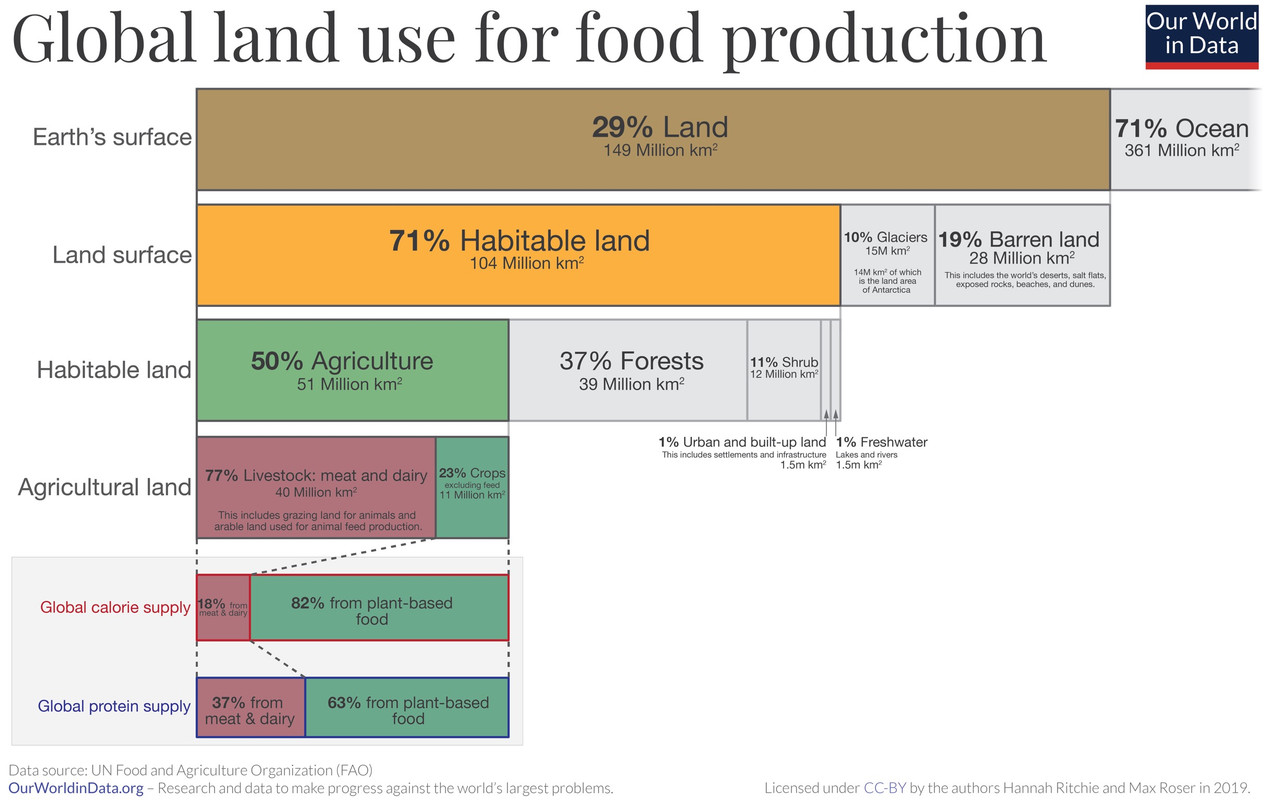
Sheep farming is a remarkably inefficient way of producing food, which hardly anyone wants to eat. Sheep is about 1% of the diet, yet uses 75% of the land in Wales.
Please list these problems caused by sheep on 75% of the area of Wales and I will try and address them for you if I can.
If you want to see open grassland then sheep farming will maintain that. If you want to see woodland regeneration then the sheep have to go.
It's about what you want to have happen
Sheep farming is a remarkably inefficient way of producing food, which hardly anyone wants to eat. Sheep is about 1% of the diet, yet uses 75% of the land in Wales.
I don't know about Wales, but here in Highland Perthshire the land used for sheep can't be used for pretty much any other type of food production. It's steep and rocky, you can't plough it and climate means not much grows but grass, gorse and Heather. It's not like you could grow wheat or cabbages there.
Yes, destroying the rainforest is bad (most of it is for animal feed).
Do you have evidence for that?
I don’t know about Wales, but here in Highland Perthshire the land used for sheep can’t be used for pretty much any other type of food production. It’s steep and rocky, you can’t plough it and climate means not much grows but grass, gorse and Heather. It’s not like you could grow wheat or cabbages there.
Or you could grow trees. The natural tree line in most of Scotland is over 1000m. If you reduce grazing pressure, woodland will grow just about everywhere.
80% of Amazon soya goes to animal feed. And plenty more for oil and other processed foods. You can't blame the vegans for everything. https://globalforestatlas.yale.edu/amazon/land-use/soy
1. We were talking about food production. I can eat sheep, I can't eat trees.
2. Soya, fine. What about palm oil which I believe is the biggest cause of deforestation at the moment?
3. Why bring vegans into it?
Look, I'm an environmentalist, we are pretty much on the same side, but when I look at the country the Scottish and Welsh uplands are not the issue. The pollution, excess consumption, dependance on oil fueled transportation, waste and increasing population are far, far bigger issues. I'd rather flatten London and plant trees there. It would be far more beneficial 🌿😁
3. Why bring vegans into it?
Who knows? Seems to be the usual distraction from the farmers.
Palm kernel meal is used for animal feed. Seems to get ignored as a 'by-product', but it is still contributing to deforestation. https://www.theguardian.com/environment/2011/may/09/pet-food-asian-rainforest
There's plenty of food for everyone, if it was produced and distributed in a more efficient way. Why does every piece of land have to be exploited for food production? Why not leave some space for nature. Forest cover in Scotland is still less than half of the European average.
Without wanting to rake over other threads, food production is one thing, shooting estates another.
But you made the assertion that sheep were destroying the environment. I hold that they are maintaining an environment that mankind destroyed several hundred (if not thousand) years ago in the the UK when deforestation occurred for firewood, ship building, pit props, charcoal, etc etc. Sheep were one of the first domesticated animals and were able to utilise those deforested areas not suitable for cultivation and have done so ever since, providing meat, and until comparatively recently a huge proportion of the textiles we have used. The wealth of large parts of the UK and commonwealth was built on the wool trade. That same wool is now almost a waste product while the world carpet their homes and clothe themselves with petrochemical based products. Why people have such a focus on sheep I really don't know. As I said. If the majority of society wish to see the countryside re-afforested, then fine, let us have that conversation and work out the best long term way to achieve that that balances all the needs of society. But to simply scream, "get rid of the sheep, they are destroying the environment" is blatantly wrong, and will be completely counterproductive to achieving any sort of consensus or compromise going forward.
How so?
The Lynx Project, at least the one which gets the headlines, has a rather dubious history.
Paul O’Donoghue who is charge also has his Wildcat haven and, most recently, announced he had a project to release eagles this year in Wales. Which undermined a proper project to do so which has been going on for a couple of years planning out and involving local people.
Has been covered several times in Private Eye and similar.
He recently lost a case against Andy Wightman around his business practices.
I think Lynx Uk trust does more harm than good. If they are going to be reintroduced then will be by someone else. My suspicion is there may be a mysterious reintroduction in the same way the beavers were and then some evidence produced several years later showing no one has really noticed them.
And I would agree, the principle of hunting estates is an abomination, though there can be little argument that the landscapes they have produced, such as heather moorlands and open woodland Chases such as Cannock, are quite unique and it would be a sad day if all those areas were allowed to return to a dense homogeneous climax woodland.
@dissonance Is there a difference between the Lynx Project and Lynx UK?
Mind you, if lynx were reintroduced on the sly, how would anyone know given how secretive they’re meant to be?
All the beavers have done is turned the habitat around this lochan into the same as the rest of the area. They have reduced biodiversity not increased it.
plus one to this
Look at a Canada, no ****ing trees at all.........
But you made the assertion that sheep were destroying the environment. I hold that they are maintaining an environment that mankind destroyed several hundred (if not thousand) years ago in the the UK when deforestation occurred for firewood, ship building, pit props, charcoal, etc etc.
Livestock, in general, on a rocky hillside or not, is an inefficient way to produce food, at least in terms of delivering calories to cake holes.
If in 20 years time we’d managed a large scale shift to vertical farming and lab grown meet I genuinely believe all our lives would be better. It won’t happen, all a bit icky eating a petri dish burger. Even if we did, we’d probably turn the unused over to some other monoculture purpose or just tarmac the lot.
Welshfarmer - I agree with much of what you say but not on the shooting estates. They have produced degraded green deserts in scotland with poor biodivesity
https://goo.gl/maps/ETjfs2B3ryJZFhCMA
Or maybe the rainforest being burnt to grow soya for a vegan to have his “milk”
It's almost certainly being used so that the non-vegan can have their milk/meat. Seems 85% of the worlds soybean crop is processed into soybean meal, of which 97% ends up as livestock feed.
https://en.wikipedia.org/wiki/Soybean#Uses_2
Anyway, that's a bit OT.
To my mind, farming and conservation are just modes of land management. In each case, someone is fiddling with the ecosystem to promote the species that they want to live on that land. Sometimes it's so that people can eat it, sometimes not. A pal of mine who used to work on the Abernethy Estate in the cairngorms once described himself to me as a 'Capercaillie farmer'.
Is there a difference between the Lynx Project and Lynx UK?
The one being referred to is the Lynx UK Trust. I am not aware of any formally named "Lynx Project" in the UK.
Mind you, if lynx were reintroduced on the sly
Which is what I suspect will happen in the same way people got frustrated about the roadblocks put in the way of reintroducing beavers. Since despite TJAgain claims the risk to sheep is minimal since they are woodland animals and sheep, at least in this county, dont tend to be. If the sheep are kept away from woodland the numbers lost are low. The only country which reports high losses is Norway which is unusual since the sheep do move into the woodland. Of course there is also a good financial reason to claim predation.
Mind you, if lynx were reintroduced on the sly, how would anyone know given how secretive they’re meant to be?
The forests would begin to smell like a school disco.
@stevious 😀 I’m fairly sure lynxes don’t smell of Lynx Africa though…
TJAgain claims the risk to sheep is minimal since they are woodland animals and sheep, at least in this county,
Any risk needs to be mitigated and the sheep farmers I know have many of their fields adjacent to woodland and breed rare breeds small scale. Losing one ewe would be very damaging to them.
I find it hard to believe that Lynx would go after roe deer in preference to sheep
@tjagain I thought they’d be more likely to go after lambs than a full-grown sheep?
I find it hard to believe that Lynx would go after roe deer in preference to sheep
That's what all the research from Norway shows. In areas with high numbers of roe deer, hardly any sheep are predated.
There are way more roe deer throughout Scotland than in Norway.
https://journals.plos.org/plosone/article?id=10.1371/journal.pone.0079261
They were trying cattle in a section of Abernethy Forest last year. That's the sort of environment they would have fed in before we got into high-density meat production. I don't know how that went. I must contact them.
@scotroutes I read a suggestions somewhere (possibly in the Knepp book) that cattle and horses were less damaging than sheep, not sure why that should be though? As I understand it the usual livestock in the Highlands were small black cows pre-clearances.

