Forum menu
Having recently retired I've bought myself a Nikon DSLR with a 18-105 lens. I'm going to shoot mainly landscape and sports. I'm not really into portraiture. I've got this idea that my 'kit' would be a bit more complete with either a 50mm or 35mm prime lens. Your thoughts please.
Probably, yes. It does depend on use though.
For my full frame dslr I sold all my primes except for the 50mm f1.4 which was the only one that got used.
For my apsc mirrorless I have a range of primes because they're small.
So... I guess, if I was you I'd go for a fast 35.
You will have so much fun with a 50mm 1.4 or 1.7, super lenses!
If you're planning on shooting sports and landscapes, might be better investing in a wide angle or telephoto lens?
Main advantage of those primes is going to be a wider aperture for a focal length you already have covered, so depends if this its something you desire?
I've got a 50mm prime on my Nikon DSLR and as much as I love it I can't help but think a 35mm prime would be more suited to the way I use my camera.
That said I bought my 50mm lens for £100 so it was worth it!
I'd quite like an 85mm for sports. I can get close enough for sports portraiture, but need the speed to catch the action. 18-105 is a very capable nikon lens. 50mm is also worth having and changes your attitude to photo taking quite a bit IMO. A good course is worth it as well, i didn't "learn" much on the one i did, but I learnt a lot about things that I otherwise wouldn't have tried, like fashion portraits and studio lighting. As a result my snaps of friends etc are much better, and my landscapes were getting rather dull. Need a wide angle next though,.,.,
if you only have one lens, you've wasted your money buying an slr.
Get some*, remember your zoom will be most comprimised at the extremes, so 18 and 105 mm might be the most usefull (more 18 than 105, telephoto primes are much less usefull) and the zoom will work perfectly well 28-90mm. But you may as well get the 50mm as well as its a great one for portraits even if you rarely use it.
*plural
I use mine often, good in low light, small and lightweight. Great for walking about.
Another 18-105mm Nikon user here, I bought a Nikkor 50mm f1.4D and find it stays on most of the time, it's great for being selective using the narrow depth of field to unclutter the backgrounds to photographs.
keefus - Member
I'm going to shoot mainly landscape and sports
I am not sure how this usage equates to buying a 50mm or 35mm prime. On a DX body (assuming that's what you've got) they will probably be too long for a lot of landscape stuff and too short for sports.
I've got the 50mm 1.8 for my Nikon and it is a great lens, so I'm not knocking getting one. But just make sure that you get a lens that suits your requirements, rather than a lens that everyone seems to get.
You might be better off saving for a wide angle lens (Sigma 10-20mm?) or a longer zoom for sports (70-300)?
I can't believe anyone with a DSLR isn't going to do at least a bit of 'social photography' - pics of family members, parties, cats etc 🙂
In which case a fast prime is a great idea - allows you depth of field control too.
On a crop sensor I'd go for a 35mm prime too - I have a 50mm 1.4 on my full frame Canon and it's a great general purpose lens. If I had to only ever use one lens again that would be it.
I am not sure how this usage equates to buying a 50mm or 35mm prime.
I read this bit...
I've got this idea that my 'kit' would be a bit more complete with either a 50mm or 35mm prime lens.
...as to be more related to general, non-landscape use.
You can shoot landscape at any focal lenght. 500mm + for mountains with a big moon for example, so adding one prime, regardless of focal length is unlikely to be that useful.
I have a number of lenses, but the one that I always go back to is my 17-55 f2.8. It's not cheap though.
I've used it for portraits, but mainly for landscapes. It's a really useful go-to lens for me.
Saying that, a friends and I are going out on Saturday morning with our 50mm lenses to see what we can capture.
The Nikon 50mm f1.8 is very highly regarded.
The Nikon 50mm f1.8 is very highly regarded.
It's price/performance thing. The AF lens is one of the poorer iterations of the 50mm f/1.8 line. The Ai is the best, then the Ai-S.
The old AF 35mm f/2 is optically superior, and arguably a better focal length for DX, but costs twice as much.
I'm going to shoot mainly landscape and sports. I'm not really into portraiture.
I have the Nikon f1.4 50mm, but I use the Nikon f2.8 70-200 for Sports and the Nikon f2.8 14-24 for Landscapes.
OP did you say if your Nikon was full frame or not? Traditionally landscape photography lends itself best to a wide angle, so I say yes to a wide angle prime somewhere in the range of 20-28mm. You won't need a particularly fast lens as 1- you'll be shooting outdoors and 2- you will probably be shooting f5.6 to f11. What I'm saying is don't spend more money than you need to on a super fast lens, that aside the faster lenses were often the better built.
I bought a 50mm prime for my Canon as it was cheap and another thing to play with on my camera.
For its cost (~75GBP), it's the best value camera kit I've bought.
One of the great things about prime lenses it is forces you to walk and move to get the best picture. Something that a lot of beginners* forget.
Although I usually use it for portraits, f1.8 for that money is impossible if you want a zoom or anything else. The fast speed is great in lower light.
*I am one
Depending on what camera you have, I'd recommend the Nikkor 50mm f1.8 AF-D, as it's a superb lens. Some reviews certainly have it as superior to the AFS-G version, although the af on the latter may be a bit faster. If your camera lacks the mechanical af conncetion, then you'll be limited to the AF S-G version. For portraiture, you might prefer the f1.4 version, as it's 9-bladed aperture gives a smoother [url= http://en.wikipedia.org/wiki/Bokeh ]bokeh[/url]. Expensive though.
The advantage of primes over zooms, is that primes will be sharper across the entire image, at larger apertures. I have an old 28-70mm f2.8 zoom, and my 50mm is noticeably sharper wide open at the extremes of the frame. The zoom needs stopping down to at least f5.6 to get anywhere near as sharp.
Large aperture primes are easier to manual focus in dimly lit situations, although with af this probably won't be an issue. Easier to see what's in front of you though due to the brighter viewfinder image. Many 'kit' zooms are quite murky at the long end.
A 50mm lens would be excellent for using with extension tubes for macro work, although that might not be what you have in mind.
If your camera can take the AF-D lens, s/h versions are relatively very cheap, maybe £50-60 on ebay etc. The 50mm is a small, light, very capable lens, and it's quality will pee over any 'consumer' zoom. Get one.
If you can do without auto focus check Ebay for a Series E 50mm or 35mm - 1.8/4 from the 80's these lenses have exactly the same extraordinary optics as today's 50/1.8 AF-D.
excellent build quality too with full metal body.
Got mine for about £25
more info here:
http://www.kenrockwell.com/nikon/cheapskate-lenses.htm
and
http://www.kenrockwell.com/nikon/nikortek.htm#e
50mm prime on an APS C sensored camera makes a fantastic mini portrait lens, 35mm makes a fantastic walkabout street lens.
Images will be sharper than the equivalent focal length of a zoom lens and you will get several stops wider aperture also.
What camera for? The cheap prime 50mm for each Canon, Nikon and Sony are all around the £80 and represent smashing value
I'm a big fan of my 35 mm F1.8 on DX camera. I reckon I could happily use it 80% of the time and some of my favourite pictures (landscapes) have been taken with it.
Hopefully get a 50 mm F1.4 for Christmas.
I recommend it.
Thank you all....each one of you brought something to the table for me to peruse and digest. Again thank you for your input, greatly appreciated.
50mm f1.8 it is then.
50mm f1.8 it is then.
if you're using it for landscape on a DX body, download Hugin as you'll be doing a lot of stitching to get any decent width.....
35 mm on dx equivalent to 50mm on old film cameras I use mine on my nikon 80 percent of the time quality far out performs the 18-105 love it
Generally they are in the range that makes them good for portraits. I have a 25mm pancake which is really small and easy to carry about. I had it with me when I cycled through London to take snaps of my surroundngs and it was deeply unsatisfying. Not wide enough to take in the streetscape but too wide to get building close ups without getting off the bike and standing in the middle of the road.
Oly do a nice 12mm prime on m43 (24mm equivalent) which could be useful.
To answer the original question, yes..
I think you get a noticeable improvement in image quality and speed and they're very portable on the bike.
35mm f1.8 here on my D7100. Brilliant lens. I went for the 35 over the 50 as it's 50mm equivalent on that crop body.
Just succumbed to a Tamron 90mm f2.8 macro too. Absolute cracker of a lens.
IQ on mine is better but you really have to look for it. Shallow DoF is nice though.
The OP should get one, and then start taking pictures of people.
I used a 50mm 1.4 exclusively on a 5D II for a couple of years. It's amazing what you can accomplish with one lens.
As has been said, your Nikon has an APS-c sensor so a 35mm lens will give the same angle of view as the classic 50mm. The 35mm would be a bit more versatile as an all round lens. A 50mm would be lovely for portraits though.
The nikon 35mm 1.8 DX is a stonking lens. It's small, light and fast. I tried it out on a friend's D90 and was very impressed. [url= http://www.mpbphotographic.co.uk/used-equipment/used-lenses/used-nikon-fit-lenses/nikon-af-s-35mm-f/1.8g/ ] Here's a cracking one for £119 including a hood from MPB Photographic.[/url] I've used them a few times and they're a great seller.
It's amazing what you can't accomplish too, with only one focal length.
But that doesn't mean you shouldn't use one at all 🙂
My f1.7 50mm is my lens of choice to keep stuck on my camera, I love it - obviously if I know the focal length is going to be limiting, then it gets swapped.
If you only have a prime and need to zoom, just walk closer to the subject
That's one of the daftest statements I've heard, yet it keeps getting trotted out.
I'll just move in a little closer to that flying bird, mountain range, sun setting over the sea, bridge architecture, motorsport action, wild animal etc etc then shall I? 😉
I love primes, but accept their limitations. Some situations will allow you to achieve the correct focal length, but by no means all.
That's one of the daftest statements I've heard, yet it keeps getting trotted out.
I quite agree. The only thing that's dafter than that statement is taking it for real, the posting your indignation about it.
I'd go 35mm wider the angle the better especially on a cropped digital camera.
It's amazing what you can accomplish with one lens.
Henri Cartier-Bresson used a 50mm lens for the vast majority of his photographs.
I take a short zoom (28-70) out with me if I'm unsure of what I might photograph, and I don't want to take a bulky load with me, but I prefer the quality of primes over the convenience of most zooms. Some high end zooms, such as the Nikkor 80-200 f2.8, offer fantastic quality to rival any prime lens, which is why many Nikon users use them rather than a collection of primes within that range. But a lot of lower end 'kit' zooms really are too compromised in design (squeezing a huge range like 18-200mm into one lens without it being enormous is always going to involve compromise) to be fully effective across the zoom and aperture range. Plus most people tend to use mainly the extreme ends of the zoom, which is often where optical quality is most compromised.
Having one 'do-it-all' lens on the camera can be a real bonus in some situations, like travelling or situations where having loads of kit/changing lenses a lot isn't practical. But you can have a relatively lightweight outfit with say a 24/28mm, 50mm and a short telephoto like 105/135mm. But everyone has their own preferences and style, so different strokes and all that.
I'll just move in a little closer to that flying bird, mountain range, sun setting over the sea, bridge architecture, motorsport action, wild animal etc etc then shall I?
More importantly you change the perspective. Zooming with your feet just means take a completely different photo.
Given stitching is so easy, if you only have one lens better to go for a longer focal length as you can always stitch to get a wider aperture. Whereas cropping for zoom is lossy in terms of resolution.....
Henri Cartier-Bresson used a 50mm lens for the vast majority of his photographs.
You miss the point. You can take fabulous photos with only one focal length, of course. But you can only take one kind of fabulous photo 🙂
Zooming with your feet just means take a completely different photo.
+1
My widest prime is 25mm* - they do a 17.5mm on m43 that I wish I could use, that would be a lot more useful I reckon.
* well I guess the 8mm fisheye is a prime technically 🙂
I quite agree. The only thing that's dafter than that statement is taking it for real, the posting your indignation about it.
Ah, my mistake - I missed the irony in your delivery, it blurred the lines between sarcasm and a real comment 😕
If you only have a prime and need to zoom, just walk closer to the subject...
Isn't that one of the infamous Ken Rockwell gems, along with not needing fast lenses because excellent high ISO performance and VR make them redundant? 🙄
along with not needing fast lenses because excellent high ISO performance and VR make them redundant?
Well, unless you want the narrow DoF, he's quite correct. I get significantly more 'keepers' on my 24-105 f/4 L IS lens than my 50 mm f/1.8 when taking street shots at night without a tripod.
The 35 mm f/2 IS I'm about to pick up should give me the best of both worlds, however...
Well, unless you want the narrow DoF, he's quite correct.
Um, so he isn't correct then?
Well, unless you want the narrow DoF, he's quite correct.
Not necessarily. No matter how high your ISO goes you can always use more light. Plus the argument about image stabilisation only applies if no-one's moving in your shot. I can take pictures down to 1/8 on my camera but not of my kids playing!
Have a 50mm Nikkor f1.8 prime. For £50 (or whatever they are now) you really can't go wrong. Great little lens.
Having one 'do-it-all' lens on the camera can be a real bonus in some situations, like travelling or situations where having loads of kit/changing lenses a lot isn't practical. But you can have a relatively lightweight outfit with say a 24/28mm, 50mm and a short telephoto like 105/135mm. But everyone has their own preferences and style, so different strokes and all that.
+1
I use a bag like this
[img] 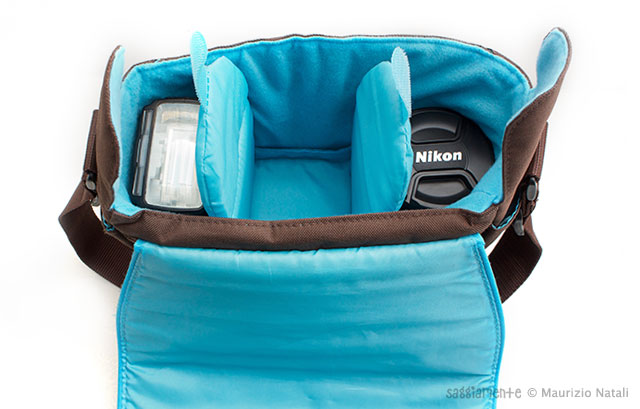 [/img]
Which means I choose three lenses to go out with. Last time it was the 50mm f1.4, the 14-42mm and the 9-18mm.
You can take fabulous photos with only one focal length, of course. But you can only take one kind of fabulous photo
H C-B took all kinds of fabulous photos. He just didn't need loads of different lenses to take them with.
He took fabulous photos with only one field of view though.
There's nothing wrong with only having a prime, but you don't get the option to create different effects with different fields of view. I don't see that as inferior.
Ditto on the 50mm. They don't cost much secondhand, if you don't like it stick on ebay!
Not necessarily. No matter how high your ISO goes you can always use more light.
Yes, it's nice, but ISO4000 on my 5DII has less noise than ISO200 on my 450D. So, I have 'more light', or at least, more opportunity to take noise free shots due to the sensor's superior noise handing with an f/4 zoom lens than I would even if I were using a wide open prime on the 450D. Obviously, a prime on the 5dII would be better still if what you needed was fast shutter, but I'm already streets ahead the best an older, cheaper camera could manage with a fast lens, by having decent high ISO ability.
Plus the argument about image stabilisation only applies if no-one's moving in your shot. I can take pictures down to 1/8 on my camera but not of my kids playing!
But, if you have a higher ISO, you can have a faster shutter speed. For the same reason as you'd be able to with a wider aperture.
Taken together, his point still stands. Unless you need the narrow depth of field, high ISO usability solves the 'need more light' for higher shutter speed issue, and in my experience in very dark scenes where the only shutter speed concern is to avoid camera shake, IS on my L-series lenses buys me more stops than equivalent non-IS prime would. I have some excellent night-time shots of a fair taken at ISO4000 hand held. No prime in the world could take them were it not for high ISO speeds. Likewise I have some very high quality sunset / dusk landscapes taken hand-held where a few years ago the only way you'd have achieved them was with a tripod. High ISO and IS made these situations so. A wider aperture would not have captured the images I was going for.
Edit: I'll go further actually. I was at the Twelve Apostles a few weeks ago at sunset, and it was blowing an absolute hooley. I could brace myself against a fence or wall and high ISO and IS did the rest. The people with tripods weren't having much luck at all by comparison. And again, a wide aperture is exactly what you don't want when you want a good DoF for a landscape.
Much to the disgust of many I now find it necessary to extol [some of] the virtues of another brand that seems invisible to people at times, yet one that was an incredibly big player at one point
With a Pentax DSLR one can fit any K mount lens with no adapter (so that's going back to about 1975) and it will be stabilised (in body stabilisation)...
Obviously, a prime on the 5dII would be better still if what you needed was fast shutter, but I'm already streets ahead the best an older, cheaper camera could manage with a fast lens, by having decent high ISO ability.
Depends on what you call cheap. Less than 200 quid would buy a 2nd hand Pentax K-x (2009 tech) and a 50mm 1.7 M lens or similar (just look on Ebay UK). It would be about a 1/5 of the cost of the 1000 pound second hand 5d MKII body and give it a real fright..
Yes thats FF vs crop sensor.. perhaps that makes it even more interesting 🙂
Have a look on http://www.dxomark.com/ for the sensor performance...
It would be about a 1/5 of the cost of the 1000 pound second hand 5d MKII body and give it a real fright..
I have the advantage of not needing to spend that, having already got a 5DII, which, is 2008 technology 😉
..and you can use lenses at the field of view they were designed for rather than the weirdness you end up with using ff lenses on apsc.
..and you can use lenses at the field of view they were designed for rather than the weirdness you end up with using ff lenses on apsc.
what weirdness? you will be left with the centre which should be incredibly sharp - you just have to take into account the crop factor
hardly a big deal
I'm already streets ahead the best an older, cheaper camera could manage with a fast lens, by having decent high ISO ability
I'm not arguing for wide aperture INSTEAD of high ISO. I'm saying that BOTH are useful, of course. And that the idea that high ISO removes the need for wide apertures is silly. They both do different things.
Much to the disgust of many I now find it necessary to extol [some of] the virtues of another brand that seems invisible to people at times
Hehe.. I'd never do that.. 🙂
And that the idea that high ISO removes the need for wide apertures is silly. They both do different things.
They do, which is what my first post on the topic said, which you probably missed whilst trying to a be contrarian as usual. However, the high ISO ability of a modern dSLR buys you many more stops of 'light' than even the widest prime would in normal ISO ranges. So, [u]unless[/u] you want the narrow depth of field (a point I made quite clear), for shooting in low light you'd be better off with high ISO than a prime. A prime would help further, but in recent years, the steps forward with ISO buy you many more stops of light than the difference between f/4 and f/1.4.
Throw in IS, which is usually only found on slower zooms, and you will get much better low light results than if you didn't have high ISO ability, or IS, but did have a prime.
a good DoF for a landscape
That's not quantifiable, just because it's a 'landscape' doesn't mean it has to be sharp from 2ft-?
No such as *good* DoF just as there is no such thing as *narrow* DoF (as per Molgrips).
DoF is either shallow or deep. Field of View is Narrow or Wide.
A good DoF is subjective and depends on what the intent of the photographer is trying to achieve. Yes a deep DoF is *generally* used for landscapes and shallow *generally* used for portraits for example but that does not mean either is *good*.
And to be totally pendantic (and in reference to Molgrips statement), yes if you want a deeper DoF then good high ISO handling is more useful than a wider aperture but if Focal Length is the same (and consequently Field of View) then you are best with a prime at high ISO than a zoom at high ISO.
For like for like shooting a prime is very nearly always the better option but you lose the convenience.
And yes 9/10th's of the photo comes from the photographer regardless of the equipment being used.
Zokes I'm just airing my opinion as you are yours.. hopefully you won't interpret it as some sort of war/crusade
If one is just starting out, they'd probably be better spending the money on the glass. Having an expensive body but average lenses seems a bit pointless. Not saying you have this.
Forgetting low light for a minute. The OP's question was open ended. [i]Should I buy a prime?[/i]
A prime will almost certainly beat the zoom at the same focal length which I think is some of what Molgrips might be getting at as well as other things. Its madness to think someone would be always shooting at the widest aperture all the time. Not many lenses are sharpest at their largest aperture.
The cleaness of ISO is a property of a given camera. These cameras are like computers. Generally speaking a better one will be out in the next year or two with some ISO gain. You might still have the same glass. So the benefit of the new body might not be fully realised because the glass was never invested in.
Throw in IS, which is usually only found on slower zooms, and you will get much better low light results than if you didn't have high ISO ability, or IS, but did have a prime.
Again life exists beyond the realms of Canon and Nikon. Stabilisation can be found in the body and therefore applicable to any lens that fits the given mount. So this stabilisation premium per lens is not always a problem - it depends on what system you run. These other brands include Pentax/Sony/Olympus to name a few which all have in-body stabilisation systems...
The OP has Nikon so yeah he will have to consider that. Other people might not though.
------------------------
For the record I did have a Canon Powershot compact many moons ago and I've also owned Olympus and Panasonic cameras in the past.
And now I fly off on another rant (I'm sure in another life I was destined to work for Pentax marketing - which I believe are criminally underrated and have been badly marketed) 😆
Many will think I'm mad (probably some truth in that). I changed to Pentax for tank like build quality, in body stabilisation, range of great primes (new and legacy - four of six lenses I own are primes) and also various weather resistant lenses that allow shooting in adverse conditions as this US marine demonstrates in Afghanistan (his blog is very interesting regardless of what camera brand you shoot with):
Many people on this forum would not limit themselves to two brands shopping for considering a bike or bike components...
------------------------
What was the question again, OP - Yeah go get yourself a prime!
and forget about everything and enjoy whilst the rest of us squabble
I've just got myself another old manual focus lens, a Porst 55mm f1.2. I'm using it on an aps-c Nex-7 but with a focal length reducer so it behaves like a full frame lens.
The light is crap so I can't do much with it at the moment but I thought this one was funny (for complete lack of depth of field)...
[img]  [/img]
That's not quantifiable
Which is why I didn't.
Though, I think it would be safe to say a 'good' DoF for landscapes would very rarely be using an aperture wider than f/2.8?
Lets get this sorted once and for all. This is what I meant when I said that Ken Rockwell's statement about high ISO and IS reducing the need for fast prime lenses:
Low light, fast shutter required: High ISO and / or prime lens. But a modern SLR will get you a higher clean ISO than the equivalent stops bought by a fast prime lens over a slowish zoom
Low light, shutter just fast enough to avoid camera shake: High ISO and IS. In my experience, the IS on my 24-105L f/4 IS returns fewer blurred shots than my non-stabilised 50 f/1.8
Narrow DoF: Hooray! A prime is the only lens that can do this (which is why I own several)
Low light, shutter just fast enough to avoid camera shake: High ISO and IS. In my experience, the IS on my 24-105L f/4 IS returns fewer blurred shots than my non-stabilised 50 f/1.8
Which is why I have a stabilised FF body and a 50mm f1.4 😉
You're not limited to just stabilised zooms anymore, for aps-c I have a stabilised 50mm 1.8.
my 24-105L f/4 IS returns fewer blurred shots than my non-stabilised 50 f/1.8
it's resolving power is poor and doesn't have a flat field though. which isn't ideal for some landscapes, for some people, on some cameras in some shooting scenarios and is possibly detrimental to producing technically good*images.
*as judged by some people but not a given de-facto set of parameters that are universally acknowledged.
Not sure if there is a Nikon equivalent, but the Canon 24mm f/1.4 L ii is really excellent for landscapes especially when the light isn't great.
Can't be bothered to check all the above so sorry if it's been said but on a non-ful frame camera a 50mm works as 80mm - ideal portrait lens but good for other too obvs. If you're into landscapes get something wider as well as maybe a 100mm with a macro which would allow for more creativity.
Which is why I have a stabilised FF body and a 50mm f1.4
Now we're talking... The 35mm f/2 I would have bought yesterday if the staff in the shop had any interest in making money (I'll buy it online as I'm less likely to spend 30 minutes being ignored there) has IS.
Jeez, this thread reminds me why I avoid photography forums.
Ahem, In somewhat related news, there's a couple of really nice lenses in the classifieds right now... 😀