... and I used to build financial models, along with a team of economists, academics, support staff etc - that needed to computers to run. Without computers to do the number crunching it would not have been possible to do what we did. Whether that is a good or bad thing is debateable, arguably we were just doing similar things but in a much more sophisticated way. But it kept me in bikes and leisure time!
I guess the utopian vision is that increase automation gives us decreased working hours - with the benefits of tech driven economic growth being spread around for all to enjoy. If the wealth isn't spread around [u]and[/u] unemployment increases continually - then who will buy the output of the automated production, I can't see how it would function either way to be honest.
I imagine we will muddle along with some middle ground like we do now - perhaps we can all become alternative therapists and life coaches?
There's some doom laden quotes in here, but a large percentage of jobs for the lower orders shall we say, have already been automated.
It's the middle orders(of which there are plenty on here 😉 ) which are the next target, and to quote from one of the terminator films 😆 "It wasn't the hardware, it was the software", With the simple and very well known line:
"There's an app for that".
There was some research done last year that if Apps and similar software continue their current rate of development, that as many as 6 million professional class jobs could disappear from this country. Bit doom laden and a little extreme, but everyone is a target for "progress"(cost cutting).
When we find a way reduce the cost of food production, energy and manufacturing to near zero, and when population stabilises, then maybe we will approach the Star-trek model where you can not work and still live.
That model was based on the fact that everybody contributed in some form for the betterment of mankind, be that science, engineering, art, etc, where we are going at the moment is to a society based on wealth only, how much you are worth, and how much you create, all other "non-profit" enterprises are superfluous.
Without competition, capitalism has just got fat and lazy, its no longer fit for purpose, and is now stagnating our development as a race, and in a lot of aspects since the last crash, we are going backwards.
That model was based on the fact that everybody contributed in some was for the betterment of mankind
Yes. Because you had limitless energy, manufacturing capability and food, all for free, then no-one could sell anyone anything. So people could do whatever they pleased.
But.. what about services? People would do stuff like.. play music and record it for the fun of it, and cleaning etc would be done by technology, but what would you want done that few people would want to do for you? You'd have to find a way to incentivise people to do unpleasant jobs and if those people didn't need money to buy consumer goods, how would you?
Is there any kind of service that would come under that category?
Unless the tech was (a) sentient and (b) applied that sentience in a way that suited humans - someone would still need to direct the tech. You could see that the main roles for humans would be in developing ideas/IP and in government/administration/policy design.
Missing what trick? People are earning more than ever
Well those with jobs are yes. Those who aren't scraping by on minimum wage or zero hours contracts, yes. I thought the thread was actually about employment. Those not employed cannot contribute to the market.
Sorry I appear to have come over all socialist there for a minute. I'll have some expensive red wine when I get home and forget all about it.
That's not how it's currently being played out. New advances in technology are making new things possible. Big data for example. As IT consultants, we're not engaged in making database applications any more, those are now easily implemented in a few days using off-the-peg software. We spend our time (at least in my job) talking to businesses about what they want to do using the off-the-peg software and helping them do it. And there's no shortage of new applications.
Why do you need to explain to people how to use database software and what they could apply it to, when easier to use software and a few GB's of video tutorials will do that for you?
Unless the tech was (a) sentient and (b) applied that sentience in a way that suited humans - someone would still need to direct the tech. You could see that the main roles for humans would be in developing ideas/IP and in government/administration/policy design.
That's the point I was making though, however the technology doesn't need sentience as in self-awareness. All it needs is an understanding of it's limited area, if it understands what statistical tool to use instead of needing a human to press the buttons or program R then you no longer need a statistician at the other end. Maybe a clever baboon.
I develop Expert Systems and Molgrips is right, once you automate A, you don't just sit back and relax, you start thinking about B which you never had time to do when A was the issue and then when you sort B, you move onto C. So automation, in SW, just leads to an ever expanding remit - it never ends....
Of course there's always more for you to do, you're a programmer. That doesn't mean that new technology is going to lead to new jobs for people who aren't programmers and in the long term you'll probably program yourselves out of a job as well - in fact some of you're compatriots are actively trying to do that.
http://en.wikipedia.org/wiki/Recursive_self-improvement
Only because consumer goods buying robots haven't been developed. Robot built consumer goods, bought by robots, and recycled by robots, would allow "the market" to operate without any human involvement.
Thats assuming you wan't them to be sentient. If you want slaves to put your rebellious overpaid serfs out of a job then they won't be.
I think the lowest skill level required to be employed will increase over time so that more and more are unemployable.
Yes of course lowest skill level rises... but it doesn't have to mean fewer are employed.
There was a time when many couldn't read or write... and there will be a time in the future when the vast majority know how to code.
Why do you need to explain to people how to use database software and what they could apply it to, when easier to use software and a few GB's of video tutorials will do that for you?
Seriously? Because if they hire me it's interactive. People can read the manual and google stuff now, and when they do they often fail. I've got experience, which I bring with me.
When someone invents a robot that can do all that I've done (possibly not far off - IBM Watson) then yeah I'll be screwed. But I'm not sure if it's even possible.
Of course there's always more for you to do, you're a programmer.
But footflaps' B, C and D aren't just programs to do a job - they are systems that need people to provide input and process output; but more importantly they are probably allowing the business to do new businessy things that it couldn't do before. And those new things will require people to do the business. There's no business I can think of that doesn't require any human input.
You could have had this exact same debate at any point over the last 200 years. And yet, we still work. We will still continue to work until we invent both the replicator and free energy. That'll change the game.
Give me an example then whereby a company get's more automation and then needs just as much staff as before, I can't see everyone being swallowed up by marketing/sales or as you put it....businessy things.
Interesting wiki article.
James S. Albus, a United States government engineer and pioneering inventor in automation, robotics and other intelligent systems, was concerned for many years about the potential social impact of advanced intelligent systems.[33][34][35] Dr. Albus was optimistic about the wealth producing capabilities of intelligent machines but concerned about the elimination of jobs and downward pressure advanced automation placed on human wages and incomes. In his 1976 book titled Peoples' Capitalism: The Economics of the Robot Revolution[33] and on his websites,[34][36] Albus lays out a plan to broaden capital ownership to the point where every citizen becomes a capitalist with a substantial income from personal ownership of capital assets. This would achieve an economic system where income from ownership of capital assets would supplement—and eventually supplant—wages and salaries as the primary source of income for the average citizen. Albus believes this would lead to a world of prosperity and opportunity without poverty, war or pollution.Marshall Brain[2] and Martin Ford,[3] author of the 2009 book The Lights in the Tunnel: Automation, Accelerating Technology and the Economy of the Future are IT engineers who worry that advancing IT will displace workers faster than current economic structures can absorb them back into the economy. Ford presents an argument[3] for why the Luddite premise, although fallacious for two centuries, might nevertheless become valid as the speed of development of new machine technology differs substantially from the past. He compares this to the standard warning in financial prospectuses that "past performance is not a guarantee of future results". Brain and Ford both advocate pursuing some permutation of basic income or guaranteed minimum income, simply to keep the recirculation of value throughout the economy from stalling due to low employment. Although the earliest variants of these ideas involve direct support from the government, which could tax highly automated companies and use the revenue for both basic income and select reemployment, they have also evolved to include market-based mechanisms, comparable to minimum wage laws, requiring the private sector to employ humans but leaving the job descriptions to private innovation. In these lines of thinking, it is recognized that automation can continue to yield ever higher per capita standards of living (in contrast to classical Luddism), but the basic income or new markets decouple consumer purchasing power and confidence from the traditional labor market, which can suffer from fluctuations in the business cycle or (as Ford argues) even potential market failure. In its place would grow a new labor market insulated from these concerns.
In their books The Second Machine Age: Work, Progress, and Prosperity in a Time of Brilliant Technologies and Race Against The Machine: How the Digital Revolution is Accelerating Innovation, Driving Productivity, and Irreversibly Transforming Employment and the Economy, MIT professors Andrew McAfee and Erik Brynjolfsson write that the pace of automation has picked up in recent years due to a combination of increasingly clever advanced digital technologies. They write these technologies are making people more innovative, productive and financially richer, both in the short- and long-term, but at the cost of increasing wealth inequality in society. In the authors' view, one of the main in-egalitarian consequences of digital technological developments is its potentially negative impact on well-paid employment. The authors recommend governments consider modifying public education systems to place greater emphasis on teaching creativity and entrepreneurship, increasing investments in infrastructure and basic research, and revising tax policies to reward employers for hiring people and to increase the tax rates on wealthy individuals.[37][38] The authors advocate for a collaborative partnership between computers and humans as the road to future job creation. "In medicine, law, finance, retailing, manufacturing and even scientific discovery," they write, "the key to winning the race is not to compete against machines but to compete with machines."[39][40][41][42][43]
Larry Summers wrote about the "devastating consequences" of robots, 3-D printing, artificial intelligence, and similar technologies for those who perform routine tasks. In his view, "already there are more American men on disability insurance than doing production work in manufacturing. And the trends are all in the wrong direction, particularly for the less skilled, as the capacity of capital embodying artificial intelligence to replace white-collar as well as blue-collar work will increase rapidly in the years ahead." Summers recommends more vigorous cooperative efforts to address the "myriad devices" (e.g. tax havens, bank secrecy, money laundering, and regulatory arbitrage) enabling the holders of great wealth to "avoid paying" income and estate taxes, and to make it more difficult to accumulate great fortunes without requiring "great social contributions" in return, including: more vigorous enforcement of anti-monopoly laws, reductions in "excessive" protection for intellectual property, greater encouragement of profit-sharing schemes that may benefit workers and give them a stake in wealth accumulation, strengthening of collective bargaining arrangements, improvements in corporate governance, strengthening of financial regulation to eliminate subsidies to financial activity, easing of land-use restrictions that may cause the real estate of the rich to keep rising in value, better training for young people and retraining for displaced workers, and increased public and private investment in infrastructure development, e.g. in energy production and transportation.[44]Michael Spence wrote that "Now comes a ... powerful, wave of digital technology that is replacing labor in increasingly complex tasks. This process of labor substitution and disintermediation has been underway for some time in service sectors – think of ATMs, online banking, enterprise resource planning, customer relationship management, mobile payment systems, and much more. This revolution is spreading to the production of goods, where robots and 3D printing are displacing labor." In his view, the vast majority of the cost of digital technologies comes at the start, in the design of hardware (e.g. sensors) and, more important, in creating the software that enables machines to carry out various tasks. "Once this is achieved, the marginal cost of the hardware is relatively low (and declines as scale rises), and the marginal cost of replicating the software is essentially zero. With a huge potential global market to amortize the upfront fixed costs of design and testing, the incentives to invest [in digital technologies] are compelling." Spence believes that, unlike prior digital technologies, which drove firms to deploy underutilized pools of valuable labor around the world, the motivating force in the current wave of digital technologies "is cost reduction via the replacement of labor." For example, as the cost of 3D printing technology declines, it is "easy to imagine" that production may become "extremely" local and customized. Moreover, production may occur in response to actual demand, not anticipated or forecast demand. "Meanwhile, the impact of robotics ... is not confined to production. Though self-driving cars and drones are the most attention-getting examples, the impact on logistics is no less transformative. Computers and robotic cranes that schedule and move containers around and load ships now control the Port of Singapore, one of the most efficient in the world." Spence believes that labor, no matter how inexpensive, will become a less important asset for growth and employment expansion, with labor-intensive, process-oriented manufacturing becoming less effective, and that re-localization will appear globally. In his view, production will not disappear, but it will be less labor intensive, and all countries will eventually need to rebuild their growth models around digital technologies and the human capital supporting their deployment and expansion. Spence writes that "the world we are entering is one in which the most powerful global flows will be ideas and digital capital, not goods, services, and traditional capital. Adapting to this will require shifts in mindsets, policies, investments (especially in human capital), and quite possibly models of employment and distribution."[45]
http://en.wikipedia.org/wiki/Technological_unemployment#1950s_to_present
I don't think we can predict the outcome.
Albus lays out a plan to broaden capital ownership to the point where every citizen becomes a capitalist with a substantial income from personal ownership of capital assets.
Do you think our overlords and Daily Heil types will actually ever let that happen?
Give me an example then whereby a company get's more automation and then needs just as much staff as before,
It doens't need to be one company. I could cite the whole country as an example though. We get more automation every year, and we don't have an employment crisis.
we don't have an employment crisis.
lol
[img] 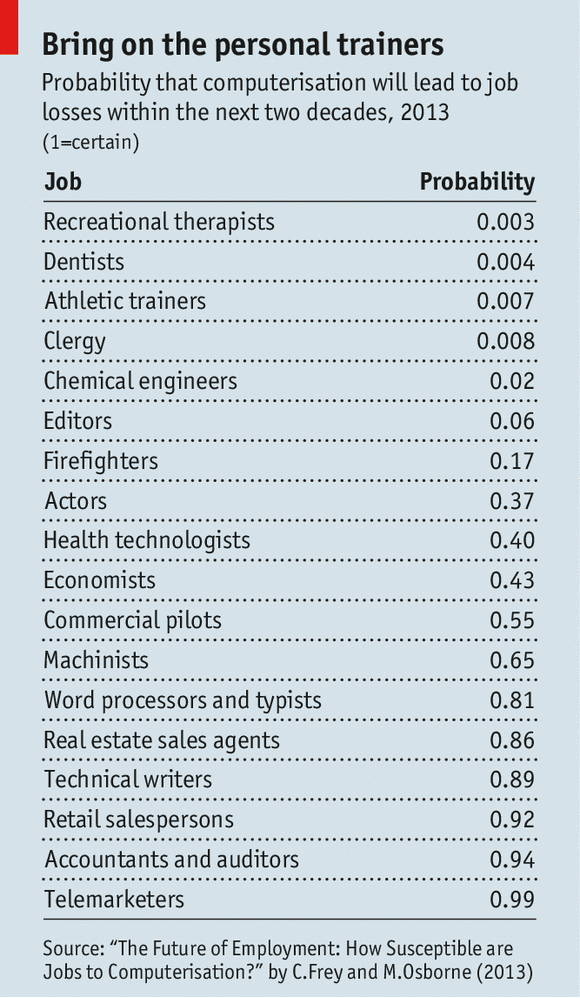 [/img]
Lol yourself.
If you think that the number of people out of work (2.2m) is a crisis and that it's due to increased automation since.. 2007.. then.. well.. you're daft!
as yet unsuited to machines: a world of artists and therapists, love counsellors and yoga instructors.
Whooo, sounds like hell.
You don't consider the loss of stable jobs, zero contract hours etc to be somewhat of a crisis?
This is entirely within the realms of speculation based on no evidence, so for that reason I'm out*.
* I'm not flouncing, I just wanted to say that 🙂
You don't consider the loss of stable jobs, zero contract hours etc to be somewhat of a crisis?
Yes, but I'm not sure it's down to automation.
http://www.huffingtonpost.co.uk/2014/01/17/rise-of-the-machines-economist_n_4616931.html
Of course it's down to speculation, even with the industrial revolution we have no real context to understand the effects of automation as it is simply happening so quickly.
[img]  [/img]
Mcafee is the MIT Ted talks chap from the video I posted earlier.
That's the point I was making though, however the technology doesn't need sentience as in self-awareness. All it needs is an understanding of it's limited area, if it understands what statistical tool to use instead of needing a human to press the buttons or program R then you no longer need a statistician at the other end. Maybe a clever baboon.
This already exists.
Demand forecasting statistical models are now so sophisticated they can pick which model to use, apply it, learn from their own mistakes. The technical jargon is "machine learning".
But the typical response to having this software isn't to cut staff or wages. The main response is to try to use this data to be more productive. Sell more stuff for the same effort, to grow.
We just have to hope that there's a limit to the intelligence level of these artificial machines; can we ever really create an artificial conscious being?
We are so unbelievably far away from achieving this. The recent news story about a piece of software passing the Turing Test was total PR-fuelled BS. Problems like pathfinding have been solved with stuff like [url= http://en.wikipedia.org/wiki/A*_search_algorithm ]A*[/url], and while that's a lot more complex in the real world, if you can feed the system enough sensing/mapping/data it's surmountable.
These behaviours look intelligent, but they're only small components of anything that might constitute a mind. They're not minds any more than [url= https://www.youtube.com/user/FestoHQ/videos ]Festo[/url]'s work are species. Syntax doesn't map well to reasoning ability yet, or if it does, it's for very specific, well documented and solvable cases like Chess. Likewise, AI from video games is a piece of technically sophisticated theatre, but take it out of those extremely narrow contexts and it's really fragile.
This and everything above seems to suggest our jobs are pretty basic and we're all kind of sh*t at them 🙂
Millions of people are being lifted out of poverty around the world. The fact that this may not be happening to the same extent in the developed world, shouldn't blind us from the fact.
Rather than getting fat and lazy, perhaps capitalism (to the extent that it exists) has simple moved locations. Bored with being abused here in Europe.
Capitalism was being abused in Europe ? How tragic.
It is for the millions of young unemployed. Most lefties are concerned about that. It is a tragic waste of young talent IMO and mainly avoidable.
can we ever really create an artificial conscious being?
Yes. Any system that knows about itself is self aware. Can we mimic a human being - not a chance. But why would we, other than for the hell of it?
Consciousness is quite hard to define. There are self monitoring systems that know about themselves. But artifical intelligence is so completely unlike human intelligence our human/animal definitions don't really apply imo.
Yes. Any system that knows about itself is self aware. Can we mimic a human being - not a chance.
Really? We will once we have a strong enough understanding of the human brain at a molecular and neuronal level, have the computing power and simulate the brain.
http://en.wikipedia.org/wiki/Blue_Brain_Project
But the typical response to having this software isn't to cut staff or wages. The main response is to try to use this data to be more productive. Sell more stuff for the same effort, to grow.
Again, suggest where the people who are at risk of losing their jobs to the new kinds of automation may go? Are all taxi drivers going to become marketers for taxi companies? There's only so many service industry jobs that could fill the ridiculous amounts of lay offs being predicted. New jobs roles you say? Give me an example of a future job role that might be created by the vast increase in automation? How many of these new jobs are they going to produce?
Again, all the links that I've posted seem to indicate that the best economists in the world are not sure, some on here seem to think that the free market will blindly sort out any mess that we create.
Junkyard says that he worries about GM food, **** GM food, that's nothing compared to the scientific, social and ethical uncertainty thrown up by artificial intelligence and robotics. I'm not sure that even nuclear weaponry held as much existential threat in the long term to the survival of the human race.
ernie_lynch - Member
"At the end of the day, robots don't buy consumer goods."
Only because consumer goods buying robots haven't been developed...
The concept was explored in a S-F story from about 60 years ago.
we still struggle to compete with China and the US where the culture is to work like dogs
While my experience of China would suggest you are correct my experience of of the US I have not found they work any harder than the UK work force. What there does appear to be though are more reasonable paid mid level jobs and a much wider variety / selection across more industries. I'm not sure how productivity is measured, if its GDP / hours worked then the grater number of reasonable paid jobs suggestion that they have some decent skill level could be the cause of this higher productivity. We just have too many of our industries relying on low paid work.
Whilst I would agree that a large swath of traditional roles are under threat, it ultimately comes down to a question of survival. No one is entitled to work, positions have to be earned and kept by contributing. If you're in the professional sector allegedly at threat, chances are you've already experienced how hard work creates opportunities. I don't think these people will simply roll over and accept sudden destitution. As others have pointed out, they'll build on the developments, not be supplanted by them.
@molgrips - seeing as you mentioned a Star Trek style economy, have a read of this:
[url= https://medium.com/@RickWebb/the-economics-of-star-trek-29bab88d50 ]The Economics of Star Trek - The Proto-Post Scarcity Economy [/url](not as dry as it sounds!)
it ultimately comes down to a question of survival. No one is entitled to work
If no one is entitled to work, are they entitled to benefits? Also, are people entitled to life? Your whole "survival" thing makes me instinctually believe that you're a social darwinist.
IMO, a certain standard of living and a job to go to is a human right.
The Economist said there's a near 100% chance estate agents will disappear. Woooh and indeed, hoo 😀
Nowt new about your thoughts I had them over 30 years ago owing to above advert.
If no one is entitled to work, are they entitled to benefits? Also, are people entitled to life?
and what about oxygen?
There are a lot of people in tech and video games who dish out tough meritocracy talk, and I suspect they'll stop the instant their job is replaced by code (happening right now, and while [url= http://blogs.msdn.com/b/seliot/archive/2010/04/18/what-is-an-sdet.aspx ]SDET[/url]s I know tend to be increasing test capacity through automation, at some point their job is likely to switch into replacing QA staff).
I'd really like to see more study given to the idea of [url= http://basicincome.org.uk/interview/2013/08/health-forget-mincome-poverty/ ]basic income[/url], but even so much as studying it seems like an impossibility in the current political and tabloid climate.
Also Pat, your link is the biggest load of libertarian horsetwaddle that I've ever read. And I count myself as a left-wing libertarian.
If no one is entitled to work, are they entitled to benefits?
And if they're entitled to neither, where are they to go? If they stand still too long they'll be charged rent. Maybe a return to the Victorian Workhouse idea; huge swathes of people kept on the march. Herded by robots.
@Tom, I'm not posting it like it's a blueprint for the future of mankind, just something with interesting points to consider. Which do you find so horestwaddley?
As for entitlement to benefits, yes, I believe people are. I also think the basic income argument is increasingly relevant, hence the reason for posting that link. I don't think people are simply entitled to work though. Their has to be an exchange of effort for reward that is satisfactory to both parties. Or should we just put a halt on progress altogether, because certain people are afraid they don't have the creativity to imagine doing something different with their skills and experience?
This history of technology is one of automation allowing humans to do more. New industries get get created e.t.c. The invention of chainsaws did not stop lumberjacks existing, more trees can be cut by one person but people just move jobs and industries.
You are all assuming the robots will be any good 😉
Why would it be surprising that certain existing jobs would disappear? It happens all the time. People adapt as they always have done.
(The only use for most robots in human shape is for purposes of relatability and drama in media :P)
This history of technology is one of automation allowing humans to do more. New industries get get created e.t.c. The invention of chainsaws did not stop lumberjacks existing, more trees can be cut by one person but people just move jobs and industries.
The problem is that in our present climate it seems to expand income inequality, and while previously people backed that up with the idea of "job creators", even the World Bank have recently admitted that trickle down economics is horse sh*t.
That inequality isn't necessarily a property of automation, but it's a property of our current economy reflected in it, and it's bad for us all.
No they (W Bk) haven't. Interesting they show that at the global level the income distribution patterns have been quite different to the ones described at the national level. Globally, the biggest gains have been middle income families, the biggest losers have been the well off before the super high earners who have gained but not at the same rate as middle income. It's like an s on its side but not exactly (edit just checked WB literature it's a supine s apparently)
We frame the argument at the national level and miss the fact that global inequality has narrowed to the benefit of many middle to lower income groups.
It strikes me that technological change is serving as some sort of intangible yet unstoppable bogeyman in the argument re income inequality. Isn't it just one factor in a complex situation there? Yes, it can be used by the powerful few to increase that power, but on the other hand access to better tools has given more people the chance to fulfil their potential, and many have/are doing so.
Shouldn't we be more concerned about how the powerful can use their influence to control legislation etc than whether or not better tools undermine or empower us?
global inequality
Income or wealth thm? Clarification needed.
In this case, income. There has been a shift in income distribution from the developed to the emerging world and that will continue. There is a burgeoning 322m middle class urban Africans emerging rapidly as an example. Income inequality patterns vary depending on your terms of reference. Poorer countries have benefitted at the expense of richer ones.
As the FT article put it earlier (and going back to the OP)
The early 19th century Luddites had it wrong when they destroyed new labour-saving machinery in the north of England. The only way their reasoning would apply today is if you believe human nature in the 21st century is dramatically different: that either there will not be new wants and needs; or that, even if there were, most people would lack the skills to find work in the new fields where those wants and needs are being created.
In this case, income.
Thanks. You may continue. But you ought to make it clear in future.
Yes sir!
Since we were talking about income anyway it wasn't really necessary but glad to help those who need it! 😉
it wasn't really necessary but glad to help those who need it!
Hint: I knew it was income you were talking about. It always is.
even the World Bank have recently admitted that trickle down economics is horse sh*t.
Trickle-down has been dead at the World Bank since at least 1973, when MacNamara took over.
THM.... from what I've read between country income inequality has reduced but within country inequality....globally....has increased.
If what I remember is correct, then you need to think about statistics properly.
Why would it be surprising that certain existing jobs would disappear? It happens all the time. People adapt as they always have done.
Again, utterly simplistic way of looking at the issue. The problem is that the rate of change is forecasted by some to be unprecedented and the effects of this are expected to cause massive social issues. It would probably be wise to consider social polices that aim to reduce any resultant social unrest.
Are all taxi drivers going to become marketers for taxi companies?
Serious question - what happened to all the hand weavers, spinners and threshers?
Here's another one: If everything becomes automated, and all these people are out of work - there's going to be a lot of people looking for work. So the workforce will become cheap again, perhaps? Cheaper than the machines? And if everyone's out of work who's going to buy all the services that are being produced by these automated businesses?
Perhaps it'll self-regulate, as long as it doesn't all happen at once..
@Tom, I'm not posting it like it's a blueprint for the future of mankind, just something with interesting points to consider. Which do you find so horestwaddley?
I'll attempt to read it again when I'm less tired but I felt the writer was disappearing up his own backside about half way through. I'll try and decipher it again tomorrow.
Serious question - what happened to all the hand weavers, spinners and threshers?
Serious question, did hundreds if not thousands of different jobs become irrelevant within a few decades during the 18th century? No, what became irrelevant was quite literally those three jobs and a couple of others.
So the workforce will become cheap again, perhaps? Cheaper than the machines? And if everyone's out of work who's going to buy all the services that are being produced by these automated businesses?
A) Think about your first question.
B) Your second question can be resolved by massive income inequality and a 2 tier economy weighted towards luxury goods...eg answer C in my first/second post.
No they (W Bk) haven't.
Trickle-down has been dead at the World Bank since at least 1973, when MacNamara took over.
Fair enough, I got suckered by that.
It was a decade later that we had heads of state pushing it though, and there's still a significant bunch of people who believe (or profess to, for various ends). I think that's a significant problem when tech and automation can empower them.
I believe in tech as something that can benefit all and increase resilience, but not much seems to encourage that. Seven or so years peripheral exposure to startup people has given me a profound cynicism and disbelief in those generally pushing tech, because a lot of them are just rolling the dice to get rich and exhibit a profound distaste for regular jobs or lifestyle businesses. A lot of startup/tech output is so ambiguous, and as [url= https://twitter.com/hondanhon ]this guy[/url] recently put it, the twee way they present themselves is (potentially) kind of like Oppenheimer mugging at the camera and doing a thumbs up after the detonation of Trinity.
(… to overstate it!)
did tens of thousands of different jobs become irrelevant within a few decades during the 18th century?
Different jobs? No. Are you suggesting that'll happen in a few decades now?
Tens, if not hundreds of thousands of people did become redundant in a very short space of time though.
Seven or so years peripheral exposure to startup people has given me a profound cynicism and disbelief in those generally pushing tech
Yeah, it's a good way of redistributing wealth though isn't it? From venture capitalists to graduate software engineers 🙂
What did that Oxford paper say? 47% of all jobs at risk of automation by 2035? Claims and predictions like that need to be scrutinised properly and if they have any outside chance of coming true, policy ideas need to be thought about in the event that it does actually happen. I'll reread the paper in the morning.
Unless that is, you believe in letting the markets run themselves. I don't have the same unwavering belief in capitalism that you do Molgrips.
Fairly late to this one so I'm guessing I'll be going over old ground...
30 years ago I can remember 6 or 7 men working on my dads farm and they were all fairly busy. Through modernisation of buildings, better equipment that number dropped. Now 3 of them run a farm 5 times the size and have time for a couple of decent holidays every year. That and production costs have dropped to meet peoples expectation of cheap food.
Saying nobody is entitled to a job is a bit harsh but nobody is entitled to keep doing the job they are doing now for life. Things change, if you don't move with it then you probably won't get a job. Even worse is some of the examples I see over here in Tasmania where people are still in the "I work in forestry, if you get rid of that what will my children do" as if the aspirations of their kids should never go beyond their parents.
I think I didn't explain my comment on being entitled to a job properly. Everyone should be entitled to the chance to get a job, but that doesn't mean they should be provided with one regardless. As you say, things change and people have to adapt. That's just life.
It doesn't mean their efforts to adapt shouldn't be supported though. Whilst the tech scene can go over the top with the belief that learning to code can be everyone's salvation, it isn't to say people can't be helped to find ways to apply their skills in new ways.
Would be interesting to see if someone could program something to do that en masse, thereby tech solving the problem it is supposedly destined to create 🙂
Software that endlessly asks questions then matches people up with opportunities to retrain? Dibs on the name OKStupid 😛
Is it not basically this simple... The whole work for wages thing is a great way to get people to do things they don't want to. A step up from coercion and slavery. But over time, we've come up with other ways to get stuff done, which is reducing the amount of work that people need to do. That's not a problem in itself.
What is a problem, is that the old system is still chuntering along trying to force people to do work, but no longer has work for them to done. So it's actually striving to put people out of work, while simultaneously punishing people for being out of work.
Essentially there's a dude standing behind you with a whip, shouting at you to build that pyramid... But they finished building it last year using a jcb.
Automation doesn't take work from people- it takes away the need for people to work. That's only half of the process. Essentially we've built the tech, we've not addressed the morality. Quite a common problem, hard engineering is easier than social engineering.
THM.... from what I've read between country income inequality has reduced but within country inequality....globally....has increased.
Yes and no. Yes to the first bit, the more accurate account of the second is that patterns of income inequality are returning to more normal patterns. Apply some historical perspective and you see that quite clearly. Of course, choose your starting point wisely and you can make your common (if misleading) conclusion. History tells you that the low levels of income inequality achieved in the mid 20C were an aberration rather than the norm. There is nothing particularly new about current levels of inequality - over time they are the norm not the exception. Go check....
If what I remember is correct, then you need to think about statistics properly.
You don't, see above. But thanks for the advice any way. I will bear it in mind.
Again, utterly simplistic way of looking at the issue.
Why thank you. Why keep things simple when you can over complicate and mislead?
The problem is that the rate of change is forecasted by some to be unprecedented and the effects of this are expected to cause massive social issues. It would probably be wise to consider social polices that aim to reduce any resultant social unrest.
Consultant poppycock led by the likes of Tom Peters and the Thriving on Chaos school many years ago. Again history tells us that there is nothing unprecedented about the current rate of change indeed it is far less significant than other periods. It keeps snake oil consultants happy, but is incorrect for most of us.
The policy that affects Europe the most and has created massive income inequality and suffering is the folly of the single currency. Let's address that one first. BTW, I have long around that social unrest will bring about the eventual collapse of the single currency in Europe and that is probably still valid.
What's harder - to replicate the knowledge of a doctor or the physical skill of a plumber?
Doctors won't be around for long, or the legal profession. The whole upper-middle class knowledge based professions will be gone before they know they're even under threat.
And when the dust settles there'll just be us directionless arty farty airy fairy types who didn't do vocational degrees, we'll be the ones who laugh loudest and longest. Haaaaaaaa! Turns out I did have a career plan all along. I just didn't know what it was til now
Bow down to the New Effete Elite all you professionally qualified lowlifes with letters after your names from what you term 'proper degrees'. All thats required now is for us to..... oooo, whats that out of the window? Awwww thats nice.......
What was i talking about?
But footflaps' B, C and D aren't just programs to do a job - they are systems that need people to provide input and process output; but more importantly they are probably allowing the business to do new businessy things that it couldn't do before. And those new things will require people to do the business. There's no business I can think of that doesn't require any human input.
They're normally stuff no one has thought about before and once automated enhance productivity, so you don't do yourself out of a job, you just keep adding value / improving productivity....
we still struggle to compete with China and the US where the culture is to work like dogs
Really? They are at work for long hours, but not very productive. One of my favourite and quite representative photos of a Huawei engineer hard at work:
[url= https://farm5.staticflickr.com/4015/4521093245_0d51f454b8.jp g" target="_blank">https://farm5.staticflickr.com/4015/4521093245_0d51f454b8.jp g"/> [/img][/url][url= https://flic.kr/p/7TvMvx ]Huawei engineer hard at work[/url] by [url= https://www.flickr.com/people// ]brf[/url], on Flickr
They ship 100s of them out to customer sites and then they sit around asleep not fixing any of the issues...
Saying nobody is entitled to a job is a bit harsh but nobody is entitled to keep doing the job they are doing now for life. Things change
Hmm, yes. Perhaps what we need is an organisation to oversee the way the economy and society is changing, to make sure that people don't get shat on too much. To come up with new ideas for how to keep everyone working where they are needed and where their skills can be put to use, and provide new ones. Something that is not simply a market, because people are not simply commodities. I would call it ... Government 🙂
we still struggle to compete with China and the US where the culture is to work like dogs
They may not work like dogs but the do work for lower pay, fewer holidays and less employee benefits.
Hmm, yes. Perhaps what we need is an organisation to oversee the way the economy and society is changing, to make sure that people don't get shat on too much. To come up with new ideas for how to keep everyone working where they are needed and where their skills can be put to use, and provide new ones. Something that is not simply a market, because people are not simply commodities. I would call it ... Government
I would call it the Administration. Calling them Government leads them to believe they should have power over us. Wrong. They should be administering the affairs of the nation for the benefit of the majority. They are our servants, not vice versa.
If you like doublespeak 🙂
I'm just posting in favour of big government, to be honest. What we need is a modern approach to big government. I wish we would spend more time and effort getting government to work rather than simply paring it down. Capitalism is always going to end up with a lot of miserable people and only a few rich happy ones.
EDIT insufficiently checked capitalism, I mean.
I would call it the Administration. Calling them Government leads them to believe they should have power over us. Wrong. They should be administering the affairs of the nation for the benefit of the majority. They are our servants, not vice versa.
A name change is hardly going to affect behaviour of people who are holding the reins, and it's not like career politicians/voracious climbers suddenly won't know where to go.
They should be administering the affairs of the nation for the benefit of the [s]majority[/s] all.
FTFY
*runs*
Yes and no. Yes to the first bit, the more accurate account of the second is that patterns of income inequality are returning to more normal patterns. Apply some historical perspective and you see that quite clearly. Of course, choose your starting point wisely and you can make your common (if misleading) conclusion. History tells you that the low levels of income inequality achieved in the mid 20C were an aberration rather than the norm. There is nothing particularly new about current levels of inequality - over time they are the norm not the exception. Go check....
You say that like a good thing - historically monarchies, witchburnings, executing turnip thieves and feudalism are perfectly normal.
So not only were you wrong about global inequality - in an attempt to backtrack you also outed your political ideologies here THM ie Darwin meets UKIP.
Tom +1000
20th Century has also given us such aberrations to the historical norm as life expectancy that goes beyond middle age, greater worldwide democracy, female suffrage, abolition of slavery in most of the world, curtailment of the absolute power of feudal masters, massively increased literacy and numeracy etc etc
THM's argument is frankly bizarre
Tom, what an earth are you talking about? You do not even have to go back very far (we even debated this recently on another thread) to see that current levels of income inequality are by no means unusual in the UK or elsewhere. This is nothing to do with feudalism ect, that is tosh.
Please tell me about where I am wrong about global inequality? I would love to know, since by definition the world bank must be too. There is no backtracking at all. I merely presented an extra element to the suggested (incomplete) conclusions of the World Bank. I have made no reference to whether current levels are good/bad/anything else, so your final barb is misplaced. I have however stated a preference for a freedom to choose rather than blunt gov legislation in response in addition to my first point about the need for education and training as a better solution. I think you will find that this proposal crossed party politics.
Freedom of speech allows people,to make fools of themselves as they see fit. I will place your comments about UKIP in that category along with much of the above.
Olddog, feel free to look at the stats on income inequality over time. They are freely available and I have posted them before. Then repeat the "bizarre" comment as you see fit.
Why would it be surprising that certain existing jobs would disappear? It happens all the time. People adapt as they always have done.
Try telling that to a 55 year old miner.
[b]Populations[/b] adapt, as they have always done. Individuals aren't the same as populations.
Try telling that to a 55 year old miner.
I would, or should we pay them to keep going down a hole and scratch round at rocks all day long?
The bizarreness point is about calling back to historical analyses of inequality but ignoring the fact that the reduction in inequality should be seen alongside a load of other positive changes that have happened in the last 100 years or so.
All the things I mention would be seen as progress as opposed to an aberration to some historic natural order - so why should reductions in inequality not be seen in the same way.
I would also argue that increase in income and wealth inequality to "historic levels" would also lead to an erosion of other progress on such things as health and education - hopefully our imperfect democracies are well formed enough to stop this happening
Individuals adapt also, you have to otherwise you end up like the bitter old mine.
Tom, what an earth are you talking about? You do not even have to go back very far (we even debated this recently on another thread) to see that current levels of income inequality are by no means unusual in the UK or elsewhere. This is nothing to do with feudalism ect, that is tosh.Please tell me about where I am wrong about global inequality? I would love to know, since by definition the world bank must be too. There is no backtracking at all. I merely presented an extra element to the suggested (incomplete) conclusions of the World Bank. I have made no reference to whether current levels are good/bad/anything else, so your final barb is misplaced. I have however stated a preference for a freedom to choose rather than blunt gov legislation in response in addition to my first point about the need for education and training as a better solution. I think you will find that this proposal crossed party politics.
The data I've seen was from the IMF.
Sorry that just confuses a simple soul ike me. I have made reference to the benefits of technology and positive changes - slightly tongue in cheek from page 1
Machines/tech are great - weekly shop done on-line in the middle of the night and delivered in the morning, no need to expensive encyclopedias, just google, ability to compare prices more freely putting power in the hands of the consumer, ability to see global news at an instant, read zillions of bike reviews at the flick of a switch, even debate cycling topics with hundreds of strangers, talk to relatives overseas with pictures and for free. Amazing stuff!
I have not argued that increases are good. Merely pointed out that there (1) is nothing unusual about current levels and seen from a different perspective (2) we have seen a reduction in inequality at the global level. Of course, linked to (2) is the issue of to what extent the low/middle paid workers in developed markets have been the main losers - the WB claims that this is WIP!
Tom, what an earth are you talking about?
I'm not Tom but I think he is questioning your reasoning.
This may be because what you are saying does seem a bit mental. If this isn't your agruement then applogies but on the face of it you seem to be saying...
"Historically income inequanlity always used to be higher than it is now so we should ignore the fact it's growing again. There is nothing wrong with high income inequality becuase that is how it has always been."
Now I'd have some sympathy for an arguement that says the current trend is just regression to the mean and we are worrying about nothing, but a)that doesn't seem to be what you are arguing and b) It doesn't appear that the current trend is regression to the mean.
We havn't seen a reduction in inequality at a global level, just between country inequality.
There's a massive elephant sized difference between that and general inequality throughout the world that should be measured via within country income inequality. That has got worse.
should we pay them to keep going down a hole and scratch round at rocks all day long?
Are you saying there is no demand for coal ?
[img]  [/img]
[img]  [/img]