UPDATE: Reviews section refreshed, redesigned, searchable: Go take a look
Cheers Scottie - some very interesting stuff there.
Fond memories of a lovely wee lassie from Milngavie!!
Here was me thinking that Leuchars meant - a place with a railway station and (ssshh dont tell) some nukes hidden away in Tentsmuir!!!
fisha - Member
Really interesting topic. As for identity, I'd agree with the cohesive feel of Scotland. I've always lived in Ayrshire, so a lowlander really, but my family harks from Loch Awe area.
There is a cohesive Scottish identity, but it's not a single identity, as I think this thread shows(in an albeit narrow way). We live in a multicultural world, so the identities will be very wide ranging. I personally think that's a good thing.
There's also a very large Scottish/British (majority) identity in the modern day sense, as the indy ref confirmed. And a large EU identity too(one that I personally subscribe to, so much so, that I think I was get an Irish passport in the future just to keep it, even if I don't use it.)
duckman - Member
SS7
Problem there, is Scotland does't recognise it's Irish history, so how can they seriously begin to address the question of Gaelic, when they don't even recognise the largest group of peoples history that have the closest connection to Gaelic?
Been a mandatory part of the History courses on Migration and Empire since 2009. If you don't teach the bits with warts, your pupils will fail.
Good to hear!
somewhere in this sort of discussion is the subtle distinction between "the scots people" and "the people of scotland" I am not one of the former having no familial roots in Scotland but I am one of the latter having made scotland my home.
Its a subtle point often missed in the independence debate
Shhh thm.. state secrets...
[img]  [/img]
😆
([url= http://www.secretbunker.co.uk/ ]really interesting place to visit by the way[/url])
I drove past it recently Graham but didn't stop as the lure of Kingsbarns golf was greater!!
It didn't look much from the road. What's there? A button!!!
tjagain - Member
somewhere in this sort of discussion is the subtle distinction between "the scots people" and "the people of scotland" I am not one of the former having no familial roots in Scotland but I am one of the latter having made scotland my home.Its a subtle point often missed in the independence debate
I personally thought that throughout the Scottish ref, with the way the voting was allowed to happen, ie anyone resident in Scotland had a vote. Meant that it was acknowledged that you have a recognized stake in Scotland and was a good thing.
I think that came across well(Even if it isn't always true on the ground at a personal level). But I guess that's not really for me to confirm.
its often the political commentators that miss this distinction IMO - hence the unfounded accusations of racism against the SNP. Note EU immigrants were allowed to vote in the scots referendum but not the EU one
It didn't look much from the road. What's there? A button!!!
Nah a big ass underground nuclear shelter hidden 100ft under a field with a little farmhouse on top.
Including dorms, war room, and a studio where they would broadcast to (whatever was left of) the nation. There are also displays of the old battlefield hazmat suits and weapons etc and exhibits about the nuclear Observer Corps etc.
Remember going there a couple of decades ago with my gf (now wife) out of tourist season and it was deserted and quite eerie.
(I also remember that there was clearly more to it than we were seeing. I peered through silvered glass window on one locked door and saw an SA80 sitting on a desk, which was an oddly contemporary weapon for a museum. Decided at that point I should probably be less nosey... 😯 )
My other abiding memory is that it we forgot it was a Sunday and there were no buses. So we had to hitchhike back to St Andrews. We ended up getting a lift from an interesting woman whose dashboard was covered in bird skulls she collected from the beach, while I was crammed in the back with her bear sized dog.
She was local and maintained that everyone in the area knew fine well the bunker was there as they'd watch the trucks disappearing into it while it was being built.
Just like the one at Barnton then.She was local and maintained that everyone in the area knew fine well the bunker was there as they'd watch the trucks disappearing info it while it was being built.
This is quite interesting too http://www.secretscotland.org.uk/index.php/Secrets/SecretShipsOfCalMac
A few folk wondered by the doors were so over-engineered
I peered through silvered glass window on one locked door and saw an SA80 sitting on a desk, which was an oddly contemporary weapon for a museum. Decided at that point I should probably be less nosey
At least it wasn't a ZX81.
That would have been scarier.
It always amused me that you would be moved on withing a few minutes of stopping anywhere near Leuchars but people were allowed to camp outside Greenham Common. Go figure, as they say!!!
i
[url= https://en.wikipedia.org/wiki/Welsh_exonyms ]The wiki page on Welsh Exonyms[/url] is interesting with regards the etymology debate. It says that some Welsh names pre-date the English ones, some are English names adapted to Welsh, and some are literal translations of English names.
So Milgavie could be any of those, if Gaelic was introduced at any point after the original geneisis of the place. I still don't know how to pronounce it mind.
What do you mean by "ethnically British"?
I assume he means not Anglo-Saxon, but also not Irish...
I still don't know how to pronounce it mind.
Mill-Guy.
(or Mull-Guy depending on your accent! 🙂 )
Cheers Scotroutes done many crossings on Columba and Clansman, always wondered why the Clansman was so slow
Mill-Guy.(or Mull-Guy depending on your accent! )
I've been calling it Mor-guy all my life. Not that I live there, of course, I live in Maryhill which definitely isn't Gaelic. It's named after Mary Hill.
When IGM says "ethnically British" I think it's in the sense of people who spoke a Brythonic language related to modern Welsh rather than a goidelic language like Gaelic.
On the other hand, it could be because of the high level of facilities and grants automatic out of catchment places to James Gillespies High. Which this year caused a shortage of spaces for catchment kids and much gnashing of teeth in some quarters. Not sure how it was resolved but there is pressure to review policy now.As an aside; the Gaelic school in Embra is massively oversubscribed. Must be migration from the Highlands eh?
Of course, if you are from Glasgow, then the correct phonetic conversation goes like this:
[i]"Whaur'd ye comfy?"
"Mill Guy"
"Oooooohh... Mill-in-Gav-eee.."[/i]
[img]  [/img]
When IGM says "ethnically British" I think it's in the sense of people who spoke a Brythonic language related to modern Welsh rather than a goidelic language like Gaelic.
Didn't the Celts come from mainland Europe, though?
Celtic [i]culture[/i] came from Europe yes. Last thing I heard it was simply a cultural migration not one of actual people. I'd also read that most Brits are in fact descended from the original post ice age inhabitants anyway, so even when people invaded they didn't bring that many actual people with them. But the spread of Celtic culture wasn't an invasion like the Saxons anyway - just cultural sharing.
One of the ward's older patients got quite incensed that money was being spent on Gaelic in the area, as Doric was Aberdeenshire's historic tongue.
While this is undoubtedly true of lowland (most of) Aberdeenshire, don't forget Highland Aberdeenshire, Banffshire and Moray. The last native speaker of Gaelic in Aberdeenshire (Jean Bain of Braemar) died as recently as 1984. In the 1891 census, 60% of the population of Braemar habitually spoke Gaelic.
All the signs at Cairngorm ski centre are bilingual now. When was the last time Gaelic was widely spoken in that area
When I moved to Grantown as a child in the late 60's my father's secretary spoke some Gaelic and remembered it being commonly spoken when she was a child prior to the First World War. And this was in Moray. In Badenoch Gaelic still survived as a community language until the Second World War.
[url= http://www.linguae-celticae.org/dateien/Gaidhlig_Local_Studies_Vol_21_Baideanach_Narann_Ed_II.pdf ]source[/url]
Celtic culture came from Europe yes. Last thing I heard it was simply a cultural migration not one of actual people.
My understanding was that it was actual people: it was pre-existing inhabitants responsible (for example) for the construction of stone circles.
But I'm no expert.
In Aberdeenshire, where they have lived for years, some of the old locals still speak Doric as noted above - is that a dialect of Scots, are both dialects of English, or are they all languages?
I'm from Aberdeen/shire, and as with Donald above (who seems to know his stuff!) can confirm Doric is a Scots dialect- although it has such a strong identity that it could argualby be its own language. Track down some writing by broadcaster Robbie Sheppard, he has written columns in local press in Doric. Even better, try finding some traditional Doric language on YouTube. I know very little of it from a historical and linguistic POV but it makes me swell up with pride with my roots being in the bleak farming land surrounding Aberdeen via Sutherland and..er Montrose... I'm actually in a kilt writing this right now.
FWIW, my mum is a Highlander and English was her second language when she moved to Aberdeen from Melness as a 15 year old in the early 60's. She had to adapt pretty quickly, even then, to get a job etc.
As an aside for the OP's benefit, its hacks me off when searching iPlayer for programs that I cant filter out BBC Alba programming from the results... if someone knows a way to do that id be grateful haha!
When IGM says "ethnically British" I think it's in the sense of people who spoke a Brythonic language related to modern Welsh rather than a goidelic language like Gaelic.
Didn't the Celts come from mainland Europe, though?
There were people here before the Celtic take over. But I think we are talking over a long period of time, thousands of years. So in that sense, it rings true to me that it was both cultural movement and physical movement between tribes that held a lose common culture. Saying that, I'd probably doubt British Celts knew much of Celtic culture in the far south and east of Europe or of Spanish Celtic culture, would probably, know more of German and French.
I think we also need to take into account that there were less people then too, so more space to move into.
They probably followed the natural resources as they saw them, more than anything I'd imagine though, particularly if there were events of large scale migration at particular times.
And you've also got to take into account that they warred among them themselves as well, so that would have caused movement too.
Put it this way, the people on these islands came from somewhere(even the pre-celts), migration, imo has been a (variable 😆 ) constant over the last 8000 years.
Again difficult to ascertain for certain, as Celtic written tradition didn't start in Scotland till about 4/500Ad as far as I know. So, alot of this is speculation.
I live in Maryhill which definitely isn't Gaelic. It's named after Mary Hill.
I apparenlty don't say that correctly either. Being from the midlands I can't help but say meryhill, like the shopping centre.. that or mary. hill.
:-/
I don't even bother with the Tak Me Doon road...just sounds silly with an english accent.
Wouldn't worry about it. I grew up with people mispronouncing Milngavie.
Seen plenty of tourists asking about Glass-cow or Ed-en-burg.
And done the same thing myself when I first went to Kirkcudbright. 🙂
[quote=scotroutes ]tjagain » craigw
Leuchars / Luacharas (a place with reeds or rushes)
That makes sense as it's on the Eden estuary. I grew up the next village over
Be glad you have a sense of identity, i like that folks that come from Wales, Scotland, Ireland, Yorkshire etc, seem to be proud to be from there, i grew up in Hampshire, you never really hear people talk of being passionate and proud of being from the Home Counties!
Always enjoyed political geography, my own family has constantly moved about, mostly for work.
On my mothers side, her mother was of Glaswegian stock, but she was born in Sunderland with father in dockyard, then raised in Sheffield as he then went to work in steel industry, she married my grandad and moved to Wiltshire, then Hampshire.
My grandad was born in Italy, then came over in the late 30's, and worked on farms in Wilshire, East Sussex and then Hampshire.
On my dad's side, they came from Larne in Northen Ireland, to Birmingham and Solihull.
I was raised in Portsmouth, then lived for years in North Yorkshire, before marrying a Norfolk girl and settling here, i've never felt settled in one place and i believe my heritage is a large part of that.
Yeah, the etymology of place names is useful for challenging the view that Gaelic was confined to the Highlands and Islands.
I'm generally in favour of some investment in retaining the language. Without it we'd lose access to some of the wonderful songs and stories. My own knowledge is mostly restricted to "hillwalkers" Gaelic. Being able to decipher the names of land features is a handy skill to have. I did start to learn it but ended up in arguments with my wife over the pronunciation of some words. Turns out that the curriculum teaches Skye Gaelic whereas she speaks Lewis Gaelic 🙂
Be glad you have a sense of identity, i like that folks that come from Wales, Scotland, Ireland, Yorkshire etc, seem to be proud to be from there, i grew up in Hampshire, you never really hear people talk of being passionate and proud of being from the Home Counties!Always enjoyed political geography, my own family has constantly moved about, mostly for work.
On my mothers side, her mother was of Glaswegian stock, but she was born in Sunderland with father in dockyard, then raised in Sheffield as he then went to work in steel industry, she married my grandad and moved to Wiltshire, then Hampshire.
My grandad was born in Italy, then came over in the late 30's, and worked on farms in Wilshire, East Sussex and then Hampshire.On my dad's side, they came from Larne in Northen Ireland, to Birmingham and Solihull.
I was raised in Portsmouth, then lived for years in North Yorkshire, before marrying a Norfolk girl and settling here, i've never felt settled in one place and i believe my heritage is a large part of that.
*Littlest Hobo theme tune
I also have a smattering of Lallans (from my Mum's side) and we used Cant words when we were younger without knowing from where they'd originated.
Words and language.
My favourite is kirk, which is a rough phonetic spelling of the Norse (and possibly Dutch) pronunciation of church.
For those who don't know what that means I'll let you guess.
On the "ethnically British" question I think someone (molgrips?) pointed out the two Celtic groupings, which are related but diffferent. In modern terms British/Welsh in one side and Scots/Irish on the other.
For the interested, the Scots were an Irish tribe originally and you can go and see their original hill fort from their arrival in what is now Scotland at Dunadd - place your foot in the footprint.
Oh, and can I just add, I've never yet met a Sheltie that didn't consider themselves Scottish.
My own knowledge is mostly restricted to "hillwalkers" Gaelic.
I started off like that in Basque/Euskara. Remember being out of water on a hot MTB ride, descending hopefully to a village that turned out to be just [url= https://goo.gl/maps/Fro2jxAkA4z ]a chapel and a farmhouse[/url], no sign of anyone. Eventually found the most delicious water pouring out of the hillside round the back of the church so made a waypoint on the map for future emergencies. The 'village' name is Iturriotz, literally 'cold spring' so a little knowledge of placenames can go a long way!
it makes me swell up with pride with my roots being in the bleak farming land surrounding Aberdeen
And yet others on the thread say local languages are a waste of time....
I'd probably doubt British Celts knew much of Celtic culture in the far south and east of Europe or of Spanish Celtic culture
Don't bet on it. The archaeological record shows that aronze age Britain was part of a huge trading network all over Europe. Britian supplied minerals - there was a huge mineral processing plant on the Great Orme in North Wales, and stuff from there has been found all over the place.
My favourite is kirk, which is a rough phonetic spelling of the Norse
Same word basically all over Germanic Europe today. Norwegians go to Kirke on Sundays, Swedes go to kyrka, Finns go to kirkko, Germans to kirche...
Don't bet on it. The archaeological record shows that aronze age Britain was part of a huge trading network all over Europe. Britian supplied minerals - there was a huge mineral processing plant on the Great Orme in North Wales, and stuff from there has been found all over the place.
There was a good BBC programme last year i believe, with the lovely Dr Alice Roberts (why didn't my history teach look like that!)
http://www.bbc.co.uk/programmes/b06h7x5f
"hiv ye seen Hamish?"
"Aye he's awa nickin' floors fae the Kirk again"
"och nooooo"
There was a good BBC programme last year i believe, with the lovely Dr Alice Roberts (why didn't my history teach look like that!)
Aye, but it also had Neil Oliver, which made it basically unwatchable.
Fair enough! 🙂molgrips - Member
Don't bet on it. The archaeological record shows that aronze age Britain was part of a huge trading network all over Europe. Britian supplied minerals - there was a huge mineral processing plant on the Great Orme in North Wales, and stuff from there has been found all over the place.
Spin - Member
Dingwall in the Highlands is viking in origin meaning meeting place of the assembly or some such. Gaelic though is Inbhir Pheofharain. Never heard anyone actually call it that.
I have.
bencooper
Aye, but it also had Neil Oliver, which made it basically unwatchable.
[img] 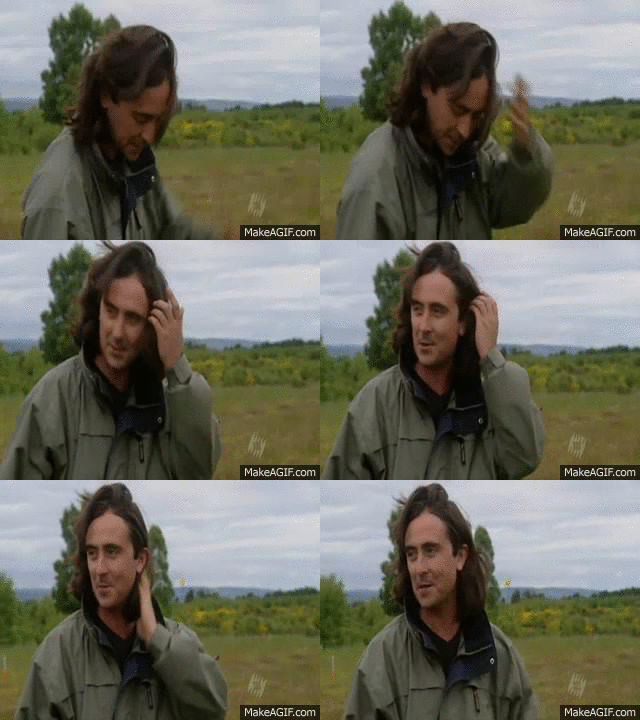 [/img]
molgripsAnd yet others on the thread say local languages are a waste of time....
I know you're not advocating that Molgrips, but just imagine how dull and homogenised life would seem if everyone everywhere spoke the same language with the same accent.
I tried the Dunadd thing ma fit didnae fit

