OK so the theory goes that a long slow ride is best for burning off fat so a ride in zones 1-2 will burn off arround 60% of the calories as fat.
Presuming I don't have time for lots of long slow rides what burns off more fat;
a) 2 hours at a fast pace, burning off more calories, but a smaller proportion of it fat.
b) 2 hours of bimbling allong in the 'fat loss zone' according to my HRM.
Doing more work is going to use more energy.
2 hours ard is more work than 2 hours slow and so result in more fat being used.
BUT 3 hours bimbling along in the fat loss zone, may result in greater fat loss than a 2 hour full on blast.
a)
its all about calories in and calories out. a) will burn more calories
Depends what you eat when you get home....
You are a deluded and credulous fool. I have watched "Alien Autopsy" to a very high level in my impassioned search for enlightenment and I can't be bothered arguing with you.
First, it does not matter where the fuel comes from while you are exercising; in the end (ie later in the day) your body will replenish and rebalance your energy stores. So a calorie surplus will always end up increasing your body fat; and a calorie deficit will always end up reducing your body fat. The source of fuel while you are exercising is irrelevant.
Second, what matters is the total amount of calories you burn; not the proportion that come fat. If you exercise at lower intensity, a higher proportion may come from body fat, but this may be a smaller absolute number of calories.
Right, well assuming this is not a troll, and according to what I understand is generally accepted:
They will both burn off a similar amount of ACTUAL fat, although a) will result in more calories being burned. a) will take more out of you so you won't be able to do it as often. a) [b]may [/b]also make you insanely hungry so you [b]might [/b]not be able to resist filling your face when you get home which [b]may [/b]result in the ingestion of more fat.
You can burn fat up to a certain level of intensity, and then above that you start to burn carbs in addition.
b) is better in theory for burning up fat, but you have to go for much longer than you would a), but it's also easier on your body which enables you to do it for longer (assuming you have time). I can ride b) for 15 hours a week, but couldn't hammer for 15 hours a week.
It's also worth noting that b) actually trains your fat burning metabolic pathways which allows you to burn more fat - which is why cyclists do it in the winter time.
But if you only have 2 hours a week then definitely a).
LHS - it's more complex than you say.
First, it does not matter where the fuel comes from while you are exercising; in the end (ie later in the day) your body will replenish and rebalance your energy stores. So a calorie surplus will always end up increasing your body fat; and a calorie deficit will always end up reducing your body fat. The source of fuel while you are exercising is irrelevant.Second, what matters is the total amount of calories you burn; not the proportion that come fat. If you exercise at lower intensity, a higher proportion may come from body fat, but this may be a smaller absolute number of calories.
Is correct.
[i]Presuming I don't have time for lots of long slow rides what [s]burns off[/s] gets rid of more fat;[/i]
Just stop eating as much, then instead of having to actively do something to get rid of something, you just do less of something to get rid of something.
Put the cake down, step away from the chocolates...
TINAS - you just wanted to start this argument again didn't you? Eh? admit it!
LHS - it's more complex than you say.
In relation to the other thread about forum aggressiveness, I accept your point of view from being different from mine and shall leave it there. 😉
going soft LHS?
I can't believe I am wading into this, but...
If you use up your carb stores, you'll feel really hungry, prompting you to eat more. If you don't, you'll feel crap.
If you use your fat stores, it has no effect (mostly) and you'll eat normally.
The above is not derived from reading marketing guff!
going soft LHS?
Hang on a minute TJ, you agree with me so can't pick a fight!! Or can you? 😉
I must admit in the new forum style of constructive disagreement, that I am somewhat at odds with the idea of a preferential fat burning style of exercise....
Professional athletes who have very low body fat percentages would presumably be unable to exercise at low intensity if what you fat burning fellas say is true....
However, I respect your position, and I fully appreciate your right to be wrong.
I'd go a). It's less boring too...I'd focus on fun as that's as good a motivator Shirley?
TINAS - you just wanted to start this argument again didn't you? Eh? admit it!
Nope genuine question, was on the cross trainer at the gym (I can't run on a treadmill so its as good alternative for warming up on, that and the rowers, but they dont have programs) and was wondering what the point of the fat burning progam was when there was also a calorie burning program. Preumably its for proper fatties who's heart can't cope with the next step up because most people would die of bpredom well before coronary heart disease on those things.
The answer is about what I expected, you burn off the same rate of fat/hour once you get going and thats supplemented by jelly babies.
there is no such thing as "fat burning" its all about the intensity or effort you put into exercise. the harder you work the more you benefit you get. its as simple as that. A 30 minute steady ride will use less calories than a 30 min hard ride. therefore the harder the exercise is the more calories you will use up.if you put less calories in your body and you expend more than you put in you will lose "weight" your basal metabolic rate also comes into the equasion aswell which is how many calories you need to just "get through the day"but i wont go too much into that just yet....
there is no such thing as "fat burning"
Isn't there? So we don't use fat as source of fuel when exercising... in any circumstance?
So how do these athletes drop to below 10 or 8% body fat composition?
If you want a great book on the subject of physical performance and how we fuel the body then read mike stroud's book :
[img] 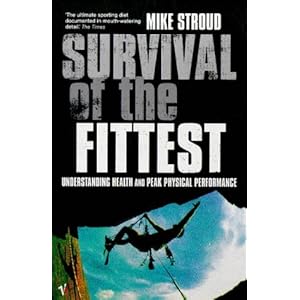 [/img][
He trekked across antartic with ranlph fiennes
[i] if you don't, you'll feel crap.[/i]
depends on the individual surely? I can do quite long miles / hours on the bike come home and not stuff my face. In fact on Sunday after 4 hrs in thx heat in the chilterns the missus had to remind me to eat.
indeed nickc. Well fuelled with long acting carbs before and during I often don't need to eat much after a ride - even after a long high intensity ride.
So why do sprinter have lower body fat than marathon runners? At Olympic level it's about 6-10% for the former and 8-12% for the latter.
Sprinters never train in the fat burning zone.
Agreed also. I rode round Whites and Wall in 3h 45mins on Saturday, didn't eat for two hours after getting back. Was too busy lying in the sun.
Kev
mines 14%... I'm neither a sprinter or a marathon runner, and at 41yrs old I'm miles away from Olympic level.
Kev
So why do sprinter have lower body fat than marathon runners?
Probably because marathon runners don't do lots of weight training like sprinters do. Sprinters train for strength and power
the harder you work the more you benefit you get. its as simple as that.
Not really. If you work hard you're training different metabolic pathways than if you go easy. That's why cyclists do base training (long slow) in the winter and speed training (short fast) in the summer.
Well fuelled with long acting carbs before and during I often don't need to eat much after a ride - even after a long high intensity ride.
Maybe for you, with your idea of 'high intensity'. But we're all physiologically different. I should've said 'you may feel like crap' etc etc. I know I do, but I have a sprinter's physiology.
My theory is that the people who are carrying a few extra lbs are the ones who tend towards sprinting, power efforts, fast twitch muscle, and muscle gaining and so on.
Professional athletes who have very low body fat percentages would presumably be unable to exercise at low intensity if what you fat burning fellas say is true....
I think that they have to eat a lot of fat in their diets to ensure they don't go below dangerous fat %ages.
The whole fat burning zone thing has been slightly misapplied. TJ and others have got it right.
If you take it relatively easy when exercising then your body uses mostly fat to provide its fuel, when you need to go hard it asks for more fat AND adds in the instant power of locally stored carb fuels (glycogen) to up the power. So a) is better for weight loss because it will use more fat (as well as your glycogen stores). Your body does not ever use fat only or glycogen only, unless you have run out of one of them..
How much fat you can burn though is limited by how much oxygen you can supply. So over a certain point you can't burn any more fat and rely on carbs. This is your lactate threshold and is currently about 200W for me 🙂
molgrips - MemberHow much fat you can burn though is limited by how much oxygen you can supply. So over a certain point you can't burn any more fat and rely on carbs. This is your lactate threshold and is currently about 200W for me
You cannot burn any more than you are [b]currently[/b] burning, the mistake is thinking that high intensity exercise does not burn fat, or burns less fat, this is just not true.
[i]How much fat you can burn though is limited by how much oxygen you can supply. So over a certain point you can't burn any more fat and rely on carbs. This is your lactate threshold and is currently about 200W for me[/i]
Molgrips, you're not quite getting this...
You don't 'burn' fat.
Fat is one way that an energy substrate is stored in your body.
In order to use up that particular energy substrate, it gets converted into glucose then used up.
In order to use up that energy you need to use oxygen.
Your 'lactate threshold' is nothing to do with fat metabolism; it represents the point at which aerobic exercise becomes anaerobic.
Go and have a read about basic human physiology/metabolism...
In order to use up that particular energy substrate, it gets converted into glucose then used up.
Yes, I used the word 'burn' as shorthand.
Your 'lactate threshold' is nothing to do with fat metabolism; it represents the point at which aerobic exercise becomes anaerobic
No, that's the anaerobic threshold. People use these terms differently, but I am using the term lactate threshold for the onset of lacate production, not the point where accumulation outstrips removal.
Go and have a read about basic human physiology/metabolism...
I have been.
lactate threshold is bullshit
crikey, do you think at the threshold you could exercise without oxygen then? think about what you claimed....
given that a threshold in performance capacity, which some people erroneously think is a lactate threshold, occurs at 60-90% approx of max oxygen capacity, that would suggest that you don't become anaerobic at the threshold.
crikey. I had to give up. Please try to put him right tho. Should we club together and buy him a textbook?
crikey, do you think at the threshold you could exercise without oxygen then? think about what you claimed....
No. Wtf?
lactate threshold is bullshit
So set me straight then. When I did a blood lactate test, lactate levels stayed constant to 225W and then started to rise. Is this not lactate threshold?
molgrips, lactate is produced at rest
maybe you mean lactate accumulation?
maybe you don't know what you mean?
the crikey was at [i]member[/i] crikey, not aimed at you molgrips, though maybe....
See above edit - set me straight..?
Oh.. lol re the crikey confusion 🙂
what do you think the rise in lactate levels mean?
what relevance do they have?
lactate is a pretty important fuel in endurance exercise...
makes you wonder?
Lactate as a fuel? I was taught it is a byproduct of anerobic metabolism.
this is my understanding
This is more about metabolic disorders than exercise but the basic pathways are the same.
Most cells in the body normally burn glucose to form water and carbon dioxide. This is a two-step process. First, glucose is broken down to pyruvate through glycolysis. Then, mitochondria oxidize the pyruvate into water and carbon dioxide by means of the Krebs cycle and Oxidative phosphorylation. This second step requires oxygen. The net result is ATP, the energy carrier used by the cell to drive useful work such as muscle contraction. When the energy in ATP is utilized during cell work (ATP hydrolysis), protons are produced. The mitochondria normally incorporate these protons back into ATP, thus preventing buildup of protons and maintaining neutral pH.If oxygen supply is inadequate (hypoxia), the mitochondria are unable to continue ATP synthesis at a rate sufficient to supply the cell with the required ATP. In this situation, glycolysis is increased to provide additional ATP, and the excess pyruvate produced is converted into lactate and released from the cell into the bloodstream, where it accumulates over time. While increased glycolysis helps compensate for less ATP from oxidative phosphorylation, it cannot bind the protons resulting from ATP hydrolysis. Therefore, proton concentration rises and causes acidosis.[3]
http://en.wikipedia.org/wiki/Lactic_acidosis
I thought that the lactate threshold was the point at which you started to accumulate lactic acid? Which is about the same as the anerobi/aerobic threshold is?
I'm only at arround 175W according to the power measurements on the gym bikes (no blood tests but that was sustained for half an hour before my thighs started to burn which I took to be the very slow accumulation of lactic acid so arround the threshold).
I pedal at a high cadence though so I probably flush a lot of it out and int other muscles rather than lettign it build up in my legs doing slow but stronger pedal strokes.
Hmm.. interesting.. it seems that the point at which the blood lactate levels rise in the lactate test is termed onset of blood lactate accumulation.
But a steady state must be reached even with elevated levels since I could exercise for a good few hours at just above OBLA and not feel the same as if I'd sprinted for 30 seconds.
TJ, when were you 'taught'? maybe in the mid 80's. maybe basic physiology that hadn't been updated - like the medical profession tend to get fed....
Muscle cells use carbohydrates without oxygen for energy, producing lactate as a byproduct, but then burn the lactate with oxygen to create far more energy. The heart in particular has a good appetite for lactate as fuel
I'm only at arround 175W according to the power measurements on the gym bikes
As I understand it, your anaerobic threshold is usually measured as your power level for a 10 mile time trial or 30 minute effort. But those gym bikes are way out, since 175W woudl really be a pretty gentle pace even for a weekend biker.
Muscle cells use carbohydrates without oxygen for energy, producing lactate as a byproduct, but then burn the lactate with oxygen to create far more energy.
Right, that explains a lot.. missing piece in my jigsaw. Explains why levels can be elevated but steady.
Molgrips, OBLA has been a known concept since the mid-80's
I'm only at arround 175W according to the power measurements on the gym bikes (no blood tests but that was sustained for half an hour before my thighs started to burn which I took to be the very slow accumulation of lactic acid so arround the threshold).
Well that sounds like a really scientific test - must remember to try it sometime.
As I [b]miss[/b]understand it, your [s]anaerobic[/s] threshold is [s]usually[/s] [b]sometimes[/b] measured by [b]some people[/b] as your power level for a 10 mile time trial or 30 minute effort.
is it 10 miles or 30 minutes? there can be quite a difference.....
InterestingiDave. A quick google agrees with you. Every day is a school day on STW.
30 minutes. That better?
EDIT: so you'll google to agree with iDave, but I have to do my own googling which you then ignore?
Too many crikeys, I really need to change my user name...
Yes, iDave I was using 'lactate threshold' because that other boy said it, and I am aware that lactate is used as a fuel.
What I was getting at was that the idea that 'fat burning' as a discrete process is not connected with the onset of accumulation of lactate and/or aerobic or anaerobic metabolism.
Fat is storage of energy, like wardrobes are storage for clothes, when you need more clothes, you can take them out of your wardrobe, but the way you wear those clothes doesn't affect the clothes still in the wardrobe. And if you keep buying clothes and putting them in your wardrobe, your wardrobe will stay full of clothes.
Best to wear more clothes and not buy as many.
(the above may well be a very poor metaphor, or absolute genius...)
why is it thirty mins?
so can you sustain that 30 min level of effort (power output) for 90 mins?
if so, could you have gone faster for the 30 mins?
or is there more than one threshold?
and we haven't even touched on the pysch' aspects......
Fat is storage of energy, but it can only be released at a certain rate. As I understand it...
.....or build a bigger wardrobe
Molgrips - because what you say is often simply wrong. I don't ignore what you say.
You may just be explaining yourself poorly but often you appear to have basic concepts confused.
It seems to me (from my own experience) that if I go over the power level I can sustain for 30 mins then my time to exhaustion falls off a cliff.
When I was on form I could do 330W for 30 minutes, but 350W for only 3 minutes.
Perhaps that's why coaches use the 30 minute test.
I'm very curious tho.. I'm listening if you want to give me more information or suggest reading. The idea of more thresholds seems sensible - from what I've read and heard, some coaches split the common zones 1-5 into sub-zones so perhaps this is why.
but often you appear to have basic concepts confused.
As do you. I've lost count of the number of times a 'quick google' has proved you wrong and me right. But you don't seem to follow up.
and some coaches don't use 'zones' at all
Damn - suckered back in
Molgrips. How many folk on these thread have agreed with you? How many have pointed out basic errors you have made?
Dave clearly has good knowledge. His approach is from a different direction to mine and I don't agree with some of his conclusions but his grasp of the basic science is clearly good.
Hmm TJ/Molgrips pack it in. It appears Molgrips has accepted his errors and is now graciously moving on, I don't think he needs any further beatings.
I looked at HRM 'zones' in some detail, along with weight loss, when I was racing, but came to the conclusion that, for me, they didn't really offer a great deal.
I appreciate I'll probably wind up iDave by saying this, but I feel that so many of the modern training aids tend to focus on the watts or the calories or the power to weight ratios and overlook the basic hard work and, most importantly, the actual results achieved in races.
I tried training as scientifically as I could (ie not very well at all says iDave..) but ultimately I got better results from learning how to race rather than learning how to train well.
What I'm trying to say is that training has become an end in itself, rather than being seen as a way to get good results.
Sorry toys *doffs cap*
and some coaches don't use 'zones' at all
That'd be interesting. How'd you separate base training from speed training? Or would you not?
ultimately I got better results from learning how to race rather than learning how to train well.
Tis a good point, you definitely need both. A good coach recognises this of course.. first few XC races I entered when I gave up on the enduro stuff I found terribly mentally difficult. The pressure of having someone on my wheel for an hour waiting to pounce on any let-off or corner run wide freaked me out a bit 🙂
How many have pointed out basic errors you have made?
You certainly didn't.. all you said was 'molgrips you're an idiot' without ever offering any detailed information of your own.
Btw my questions are not arsey I'm-right-you-must-be-wrong questions - they are honest questions and I appreciate the answers.
iDave - Member
and some coaches don't use 'zones' at all
Dave - are you talking specifically about HR zones?
I'd agree (if this is what you're saying)that HR zones are fairly arbitrary, but I'd still have thought any coach would need some basis on which to differentiate intensity.
Even without slavishly following HR numbers (or watts) I'd still think of "easy", "quite hard" and "all out effort" as zones.
So why do sprinter have lower body fat than marathon runners? At Olympic level it's about 6-10% for the former and 8-12% for the latter.
[url= http://en.wikipedia.org/wiki/Clenbuterol ]Clenbuterol, usually.[/url]
Molgrips. How many folk on these thread have agreed with you? How many have pointed out basic errors you have made?
Sorry TJ I have to stick up for molgrips there. As an observer who has found these threads highly amusing it has to be said a lot of what molgrips says is true even if not explained well.
And i think its due to the sometimes jumbled explanations that you fail to understand when he is correct. This is not always his fault, often yours for having no patience.
Well thanks phil 🙂